6
Feb
Peter Reveen: Legendary Stage Hypnotist Unveiled
The Enigmatic Career of Peter Reveen: A Master of Stage Hypnosis
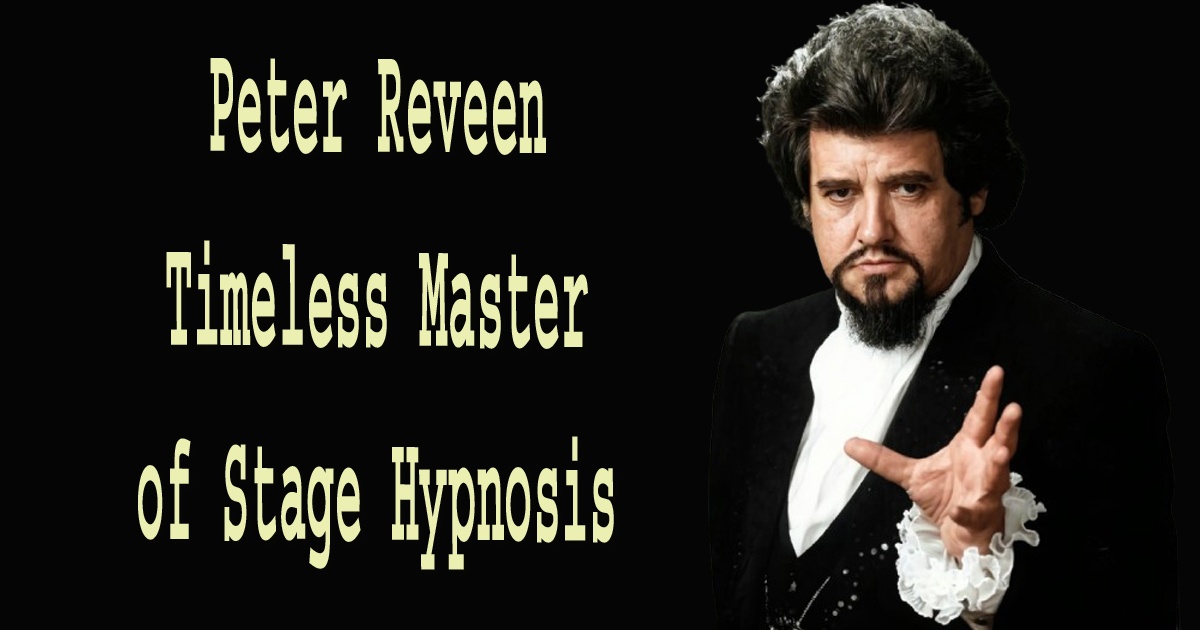
Peter Reveen, the master stage hypnotist known for his charismatic presence
In the world of performance arts where the boundaries of the mind are tested and teased, Peter Reveen emerged as a figure of considerable intrigue during the latter half of the 20th century. As a stage hypnotist who combined illusion with audience interaction, Peter Reveen created shows that left spectators pondering the limits of suggestion and consciousness. His performances, often framed as explorations of the “superconscious” state, captured a blend of entertainment and subtle education, reflecting an era when hypnosis was shedding its vaudeville roots for a more polished theatrical presence. Reveen’s path provides insight into the craft of stage hypnosis, where charisma and technique converge to produce moments reported as both amusing and profound.
Born Peter Justin Reveen on October 8, 1935, in Adelaide, South Australia, he entered a life marked by early challenges and self-determination. Historical accounts note that at age five, Peter Reveen faced abandonment by his mother amid family strains tied to his father’s wartime service. This backdrop, while sparse in details, seems to have fostered a resilience that propelled him into entertainment. Initially drawn to magic as a youth, Peter Reveen performed at children’s parties and local events, developing sleight-of-hand skills that would later complement his hypnosis routines. By his late teens, he delved into hypnosis literature, traditionally understood as a means to access deeper mental states, shifting his focus from tricks to the power of suggestion. This transition marked Peter Reveen as a stage hypnotist who prioritized ethical engagement, assuring participants of safety and respect in his acts.
Peter Reveen began his professional life as a teenage magician performing at children’s parties in Adelaide, Australia, before transitioning fully to hypnosis in his late teens after intensive self-study.
Early Ventures and the Rise of a Hypnotic Persona
Reveen’s initial steps in professional performance took him beyond Australia in 1961, when he ventured to North America on a six-month visitor’s visa. Landing first in Hawaii and then California, he honed his act in small venues, blending hypnosis with illusion to create what he dubbed “The Impossibilist” show. Reports from the time describe Peter Reveen as a poised figure on stage, often in a tuxedo, explaining hypnosis in accessible terms as a natural relaxation process rather than anything supernatural. His routines involved volunteers experiencing altered awareness, performing lighthearted tasks that highlighted the mind’s suggestibility without crossing into discomfort.
By the mid-1960s, Peter Reveen had established a base in Vancouver, Canada, where he began extensive touring. His shows gained traction in theaters and community halls across British Columbia, emphasizing family-friendly content that appealed to diverse audiences. Newspaper promotions from the era touted his ability to unlock “the superconscious,” a concept Peter Reveen promoted as an enhanced state of focus and creativity. This approach set him apart in stage hypnosis, where he avoided sensationalism in favor of observational demonstrations. Reveen’s early success in Canada, particularly in the West, laid the groundwork for broader recognition, as word-of-mouth and repeat bookings built his reputation as a reliable entertainer.
Read Ormond McGill Hypnosis: Proven Techniques & Legacy Exclusive Article
Notable Performances and Las Vegas Highlights
As Reveen’s career gained momentum, his tours expanded to include the United States, where he made a significant mark in Las Vegas during the 1970s. Featured in the renowned “Folies Bergère” revue at the Tropicana Hotel, Peter Reveen brought his hypnosis act to the Strip, captivating crowds with interactive segments amid the show’s glamour. Later, he performed at Caesars Palace’s Circus Maximus showroom, venues that underscored his status among top entertainers. These engagements, reported as high-energy blends of comedy and mind demonstrations, showcased Reveen’s skill in adapting hypnosis for larger, more sophisticated audiences.
Beyond Las Vegas, Reveen’s performances in Atlantic Canada became legendary. In provinces like Nova Scotia, New Brunswick, and Newfoundland, he sold out theaters repeatedly, drawing families and curiosity-seekers to shows that mixed illusion with group hypnosis. Attendees often described the experience as a shared adventure, where volunteers reported heightened senses or humorous behaviors under suggestion. One notable aspect of these routines was Reveen’s use of post-hypnotic cues, allowing effects to linger briefly for added amusement. His ethical stance ensuring no lasting embarrassment helped sustain his popularity in these regions, where stage hypnosis filled a niche for wholesome yet intriguing entertainment.
In the 1970s, Peter Reveen released a series of vinyl LP records featuring guided hypnosis sessions, which fans purchased to practice self-relaxation techniques at home.
Expansion into the 1970s and 1980s Tours
The 1970s and 1980s represented the peak of Reveen’s touring life, with over 6,000 live shows across Canada, the United States, Australia, and the United Kingdom. Based primarily in Canada, he traversed the country from coast to coast, performing in major cities like Montreal and Vancouver, as well as smaller communities that rarely hosted such acts. Reveen’s wife, Coral, and their four children often accompanied him, turning the road into a family affair that balanced professional demands with personal bonds. His routines evolved to include memory feats and mentalism, complementing the core hypnosis elements and broadening appeal.
In addition to stage work, Peter Reveen explored media, appearing on television programs such as “The Merv Griffin Show” to demonstrate hypnosis techniques. He also released LP records capturing his smooth, guiding voice, which fans used for self-improvement or relaxation. These ventures positioned Peter Reveen as more than a stage hypnotist; he authored books like “The Superconscious World,” framing hypnosis as a tool for personal growth. Throughout this period, his shows remained clean and engaging, aligning with contemporary views of hypnosis as a psychological phenomenon rather than mysticism. Reveen’s ability to connect with audiences on this level contributed to entertaining over six million people, a testament to his enduring draw.
Read Dr. Michael Dean: Stability in Hypnosis History
Later Years, Management Role, and Reflections
By the 1990s, Peter Reveen shifted gears, stepping into management while continuing select performances. He became the longtime manager for Las Vegas magician Lance Burton, a role he held for about 20 years. Peter Reveen negotiated key deals, including Burton’s extended residency at the Monte Carlo Resort starting in 1995, applying his show business acumen to support another’s career. This phase reflected Reveen’s deep understanding of the industry, gained from decades on stage, and allowed him to reside in Las Vegas, where he settled with his family.
Reveen’s final touring years culminated in a 2008 Canadian farewell, marking the end of an active performing life. Health challenges, including diabetes and dementia, led to his passing on April 8, 2013, at age 77 in Las Vegas. His son Tyrone, who had begun assisting in shows, inherited the mantle, continuing as “Reveen: The Legend Continues” with a similar blend of hypnosis and illusion. This succession highlighted the family-oriented aspect of Reveen’s work, where legacy extended beyond individual acts.
After retiring from the stage, Peter Reveen served as the personal manager for illusionist Lance Burton, helping secure one of the longest-running headliner contracts in Las Vegas history.
Legacy in the World of Hypnosis
Reveen’s influence persists in how stage hypnosis is perceived today as an art form that entertains while respecting the participant’s experience. In an age before widespread therapeutic recognition, figures like him popularized hypnosis through accessible demonstrations, fostering public interest without overstatement. His career, free of major controversies, serves as a model for ethical practice in the field. Modern enthusiasts often reference Reveen’s tours as examples of hypnosis’s communal appeal, where shared laughter and wonder bridged performer and audience.
Reflecting on Reveen’s journey, one sees a self-made entertainer who navigated global stages with grace. His emphasis on the “superconscious” invited viewers to consider the mind’s potential in everyday terms, demystifying hypnosis while preserving its allure. For those exploring the history of stage hypnosis, Peter Reveen remains a key example of measured showmanship, his work a quiet reminder of the human capacity for suggestion and spectacle.
Editor’s Reflection
Looking back, the path Peter Reveen traveled seems less a straight line of triumph and more a long, steady accumulation of nights on unfamiliar stages, each one built on the quiet agreement between performer and audience. He carried hypnosis into rooms where people came expecting entertainment but left wondering what their own minds were capable of when given a gentle nudge. What lingers is the impression of someone who treated the act with a certain seriousness, never letting spectacle overtake the simple human exchange at its heart.
What stays with you after reading about such a career? Does the memory of those old theater tours still feel different from today’s polished productions? How much of what happened on stage was really about the suggestion itself, and how much came from the trust people placed in Peter Reveen? And when you picture him now, do you see the showman most clearly, or the ordinary curiosity that kept drawing crowds back year after year?

Known as The Man Who Notices, Mike Lamp is a theatrical hypnotist and psychic performer with more than twenty years of live stage experience. His work emphasizes observation, psychological influence, and measured presentation rather than spectacle or provocation. Performances are tailored for adult audiences, private events, and professional settings where control, clarity, and atmosphere matter.



Leave a Reply
You must be logged in to post a comment.