12
Mar
The Moon Tarot Card Meaning: Clear Guide to Powerful Symbolism
The Moon Tarot Card Meaning: Clear Guide to Powerful Symbolism

The Moon Tarot Card Meaning depicted through classic Major Arcana symbolism under a luminous night sky.
What The Moon Card Represents
The Moon Tarot Card Meaning sits at the center of one of the most layered cards in the entire Major Arcana. Numbered XVIII, it arrives late in the sequence of the Fool’s journey, coming after The Star‘s restoration of hope and before The Sun’s full illumination, occupying the last stretch of darkness before dawn in the symbolic arc of the Major Arcana. Its position is deliberate. By this point in the tarot’s symbolic narrative, the traveler has moved through outer trials and is now navigating something less visible, the interior terrain of doubt, illusion, and unresolved feeling.
The Moon Tarot Card Meaning draws from a visual language that is consistently strange and somewhat unsettling. A full moon hangs in the sky, flanked by two towers that mark the threshold between the known and the unknown. A crayfish emerges from a pool of water below, beginning its slow crawl toward the path, representing the earliest stirring of unconscious material making its way toward awareness. On either side of that path, a wolf and a domesticated dog both howl upward. The imagery is not accidental. Each element speaks to something operating beneath the surface of ordinary awareness.
The water from which the crayfish emerges represents the unconscious, the reservoir of instinct, memory, and fear that rarely reaches daylight in any clear form. The path between the towers is narrow and continues into an unclear horizon. The two animals represent the dual nature of the human psyche, the wolf embodying raw, untamed instinct and the dog representing the domesticated self shaped by civilization, yet both howling at the same moon, both subject to the same irrational pull.
The Moon card’s numbering as XVIII places it in direct correspondence with the Hebrew letter Qoph in certain nineteenth century esoteric tarot traditions, a letter associated with the back of the head and with unconscious or automatic mental processes.
Symbolism in the Major Arcana
Within Major Arcana symbolism, The Moon holds a specific function. It is not a card of danger in any literal sense, but one of obscured perception. Where The High Priestess guards mystery with composure and authority, seated between her pillars with the scroll of hidden knowledge in her hands, The Moon offers no such composed gatekeeping. It simply pulls the traveler into the mystery without orientation, without reassurance, and without any promise of safe return. The difference is significant. The High Priestess knows. The Moon does not promise that knowing is coming.
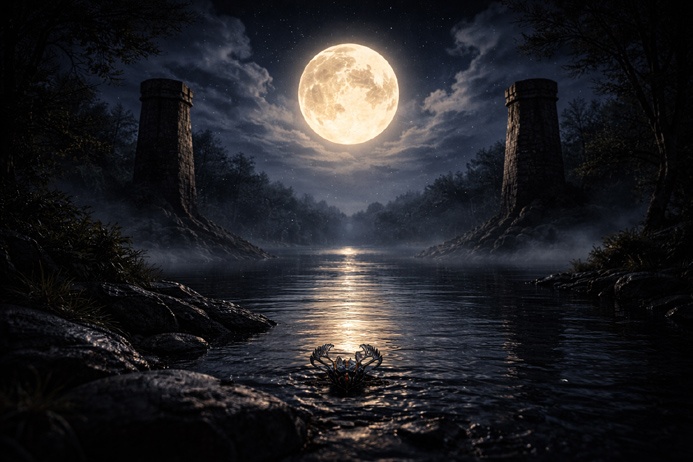
The Moon Tarot Card Meaning finds one of its most enduring visual anchors in the twin towers that mark the boundary between familiar ground and uncharted interior terrain.
Tarot card archetypes assigned to this card often cluster around themes of the subconscious, nocturnal awareness, cycles, and the experience of moving through confusion without a reliable map. The Moon is the archetype of the in-between state, the liminal experience that resists easy interpretation. It reflects a moment when the familiar rules of clarity and logic are temporarily suspended, and what rises to fill that space is older, stranger, and not easily reasoned with. This is the territory some practitioners describe as the realm where imagination runs free of conscious control.
The moon as a symbol carries associations with cycles, the unconscious, and feminine mystery, and in the Rider-Waite deck specifically, the fifteen yods falling from the moon’s face add a dimension of divine emanation that connects the card to Kabbalah’s Tree of Life. In tarot, those associations anchor the card’s meaning in the idea of shifting perception. What appears to be true in one moment may look entirely different in the next. The Moon Tarot Card Meaning accounts for this quality directly. It is a card that asks, in structural terms, whether current perception is accurate or filtered through something not yet examined.
The Moon Upright Meaning
The Moon upright meaning centers on confusion, hidden influences, and the experience of proceeding without full information. When this card appears in an upright position, it typically signals that something in the situation is not yet visible or fully understood. That obscured element may be external, a circumstance not yet disclosed, or it may be internal, an emotional undercurrent or unacknowledged fear shaping choices and responses.
The Moon in the upright position does not necessarily indicate deception by another person, though that interpretation is possible. More often it points to self-deception, or to a state in which anxiety and unresolved feeling are distorting perception. The card suggests that fears, unresolved memories, or wishful thinking may be layering over a situation, creating a distorted picture that feels entirely real but is not grounded in what is actually present.
The upright Moon also carries a connection to intuition that is worth noting carefully. The card acknowledges the presence of deep instinctive knowledge while also recognizing that intuition filtered through anxiety, old wound, or unexamined belief can mislead as powerfully as it can guide. The Moon does not discredit intuition. It asks what condition the reader is in. The signal is real but the reception may be poor. Acting solely on anxious intuition, without pausing to examine what is actually known versus what is feared, is one of the core cautions embedded in this card.
In practical terms, the upright Moon often appears at transitions, when a person is moving out of one phase of life and into another that is not yet defined. The passage feels dark because the destination is not illuminated and because the light available, the cold reflected light of the moon rather than the direct warmth of the sun, shows shapes without fully revealing them, which is often more disorienting than total darkness. That darkness is the card’s central condition, not a permanent state, but a real one that requires patience and careful attention rather than forced resolution.
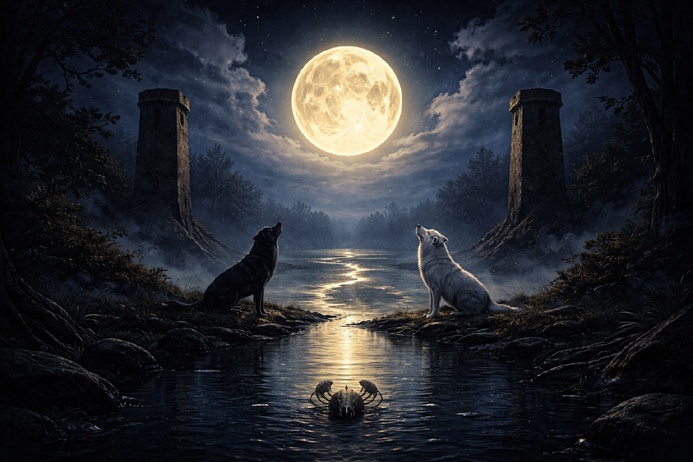
Symbolic night landscape representing The Moon Tarot Card Meaning in the Major Arcana, showing the path of intuition and illusion under moonlight.
The Moon Reversed Meaning
The Moon reversed meaning shifts the emphasis without entirely reversing it. The core themes of illusion and obscured perception remain, but in the reversed position the indication is often that those conditions are beginning to lift. Clarity is returning, slowly and imperfectly, but returning. What had been hidden is starting to become visible. Fears that had seemed overwhelming are revealing their actual shape, which is frequently smaller and more manageable than they appeared in the dark.
The Moon Tarot Card Meaning in reversal can also indicate that confusion has become so entrenched it is now causing paralysis. In this reading, the reversed card suggests a need to stop waiting for perfect clarity and begin acting on what is known, even if that knowledge remains partial. The darkness of The Moon is a phase, not a destination, but a person who has lived inside confusion long enough can begin to mistake that condition for reality, and the reversed card sometimes marks exactly that turning point.
There is also a reading of the reversed Moon that addresses repression specifically. Material that has been pushed beneath the surface for a long time may be forcing its way upward. This is not framed within the card’s symbolism as crisis but as movement, the crayfish finally completing its emergence from the water. What was submerged is becoming available for examination, a process that can feel destabilizing even when it is ultimately clarifying.
Arthur Edward Waite made a deliberate choice in the Rider-Waite deck to depict the crayfish as only partially emerged from the water, a compositional decision that distinguished his version from earlier Marseille decks where the creature’s identity and position varied considerably across printings.
Spiritual Journey in Tarot
The spiritual journey in tarot follows the Major Arcana from the Fool’s first step to the completion represented by The World. The Moon appears at number eighteen, placing it in the final third of that journey, and the numerological significance of eighteen, reducing to nine, connects it to The Hermit, suggesting that this outer darkness carries an echo of the earlier inner withdrawal, but without the Hermit’s lamp to light the way. In that structural context, The Moon Tarot Card Meaning functions as one of the last and most demanding tests of the inner work the Fool has undertaken.
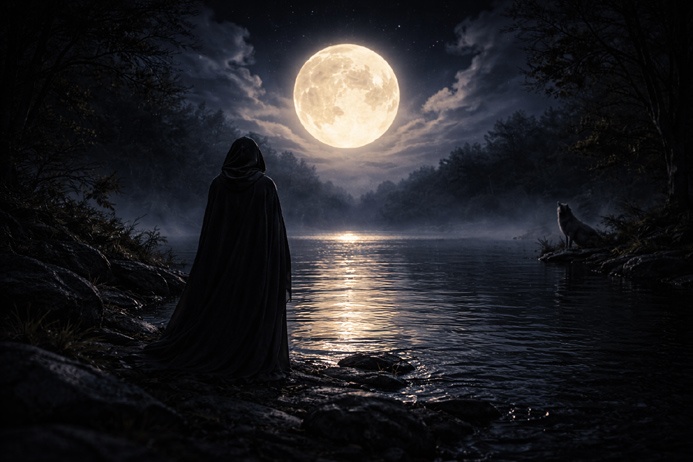
The Moon Tarot Card Meaning reaches its deepest expression in the image of a solitary traveler facing an unlit horizon, the defining condition of the Fool’s final interior passage.
By the time a reader encounters The Moon in the sequence, the Fool has already faced death in the symbolic sense through card XIII, has moved through temperance and the shadow of The Devil, has survived the sudden collapse represented by The Tower. The Moon comes after all of that. It represents not external crisis but the quieter, more persistent difficulty of continuing to move forward when internal perception cannot be fully trusted.
The Moon Tarot Card Meaning in this context is about the willingness to keep moving through uncertainty. The path in the card’s imagery does not end at the towers. It continues. The traveler is required to proceed without the comfort of full visibility, trusting the process of the journey itself rather than waiting for conditions to become easier before taking the next step.
Tarot card archetypes throughout the Major Arcana tend to pair in meaningful ways, and The Moon finds its natural counterpart in The Sun, card XIX, which follows immediately. The Moon Tarot Card Meaning is inseparable from that relationship. The Sun brings the clarity, warmth, and visibility that The Moon withholds. Together they form a complete cycle, one of obscuration and one of illumination, each necessary for understanding the other. The darkness of The Moon is not a failure of the journey. It is among the most necessary passages in the entire sequence, the place where the seeker must finally stop relying on external structure and meet what has been moving beneath the surface all along.
In early Italian tarot manuscripts predating the standardized Major Arcana sequence, the card now recognized as The Moon sometimes depicted two astronomers or astrologers observing the sky rather than animals, reflecting a more scholarly than instinctual interpretation of lunar symbolism.
Working with The Moon
Understanding The Moon Tarot Card Meaning in practice requires a willingness to sit with ambiguity rather than reach immediately for resolution. This card does not reward forced interpretation. Its meaning tends to open more fully when approached with patience, when a reader allows the discomfort of not-knowing to exist long enough for actual information to surface.
The Moon Tarot Card Meaning ultimately points toward honesty about what is not yet clear. That honesty is its own form of navigation. The card does not promise that the path ahead will become visible, but it does indicate that careful, patient attention to what is actually present, rather than what fear suggests might be present, is the most reliable way to move through the terrain it describes.
Editor’s Reflection
What stays with most people who spend time with this card is not the strangeness of its imagery but the recognition it produces. The Moon Tarot Card Meaning is, at its core, about the experience of proceeding through something unresolved, carrying partial information, and finding that patience is more useful than certainty. That is not an unusual place to be. Most people recognize it.
For anyone who has sat with The Moon Tarot Card Meaning during a difficult or unclear period, the questions it raises tend to linger. What does it feel like to trust a process when the outcome is genuinely not visible? Is the fear present in a situation pointing toward something real, or is it shaping perception in ways that deserve closer examination? And what changes, in practice, when a person decides to keep moving rather than wait for the path to become fully lit?

Known as The Man Who Notices, Mike Lamp is a theatrical hypnotist and psychic performer with more than twenty years of live stage experience. His work emphasizes observation, psychological influence, and measured presentation rather than spectacle or provocation. Performances are tailored for adult audiences, private events, and professional settings where control, clarity, and atmosphere matter.

Leave a Reply
You must be logged in to post a comment.