19
Apr
Jeane Dixon Prediction: The Shocking Claim That Built a Legend
Jeane Dixon Prediction: That Made a Legend

Jeane Dixon Prediction One prediction. An entire legend born.
The Woman Behind the Headlines
Jeane Dixon was not simply a fortune teller who found a wide audience. She was a carefully cultivated public figure, a Washington fixture, a syndicated columnist, and a media personality who shaped how millions of Americans thought about prophecy, fate, and the limits of human foresight. Her name carried weight in social circles where skepticism was the norm, and she managed to sustain a remarkable public career across several decades. Understanding any single Jeane Dixon prediction requires understanding the full context of who she was and how she positioned herself in American life.
Read about David Hoy Psychic: The Legendary Super Psychic Revealed in our Exclusive Article
Early Life and Unlikely Beginnings
Born Jeane Pinckert in 1918 in Medford, Wisconsin, she grew up in a family that later settled in California. From an early age, she displayed a striking confidence in her perceptions of people and events. According to accounts she shared later in life, a Romani fortuneteller read her palm when she was still a young child and told her mother directly that the girl possessed the gift of prophecy. The woman reportedly gave young Jeane a crystal ball, which became a significant object in how Dixon later described her own development.
That encounter stayed with her throughout her life and shaped how she framed her abilities to others. She became interested in astrology as a young woman, studying the discipline with enough seriousness to develop a working vocabulary in it. These early years were not marked by public performance but by private cultivation, building the internal framework that she would later present to the world as a coherent gift.
From Private Readings to National Fame
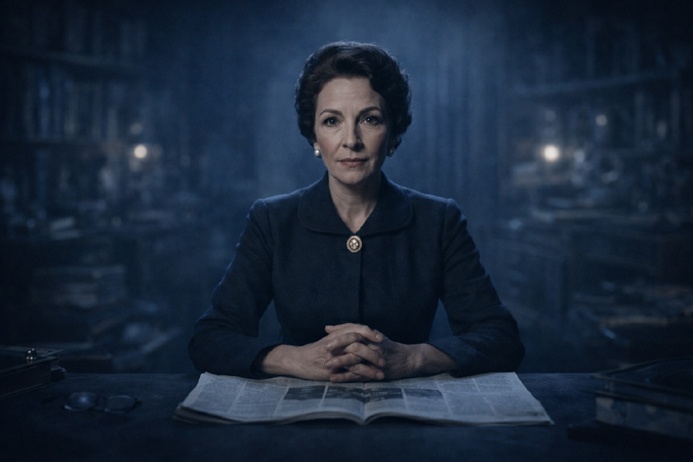
Jeane Dixon Prediction Headlines followed her wherever she went.
Dixon’s path from private consultations to national recognition followed a familiar pattern for that era: word of mouth among well-connected clients, followed by press coverage, followed by a growing institutional presence. She gave readings in Washington, D.C., during the 1940s, and her social access meant that her client base was far from ordinary. Newspaper coverage began to take notice, and by the 1950s she was appearing in print regularly enough to become a recognizable name.
Her syndicated astrology column eventually reached tens of millions of readers, and television appearances brought her into living rooms across the country. Each Jeane Dixon prediction published in print carried the implicit endorsement of the editorial machinery behind it, which added a layer of credibility that purely word-of-mouth reputations rarely achieved.
Washington Circles and Powerful Clients
Few things amplify perceived authority quite like proximity to power. Dixon understood this intuitively, and her presence in Washington social and political circles was a significant part of her brand. She was known to have given readings to figures in government and high society, and stories of her consultations with prominent individuals circulated through the capital’s social networks. Among the most frequently cited was her meeting with President Franklin D. Roosevelt, who reportedly summoned her to the White House in 1944. According to accounts from that period, he asked how much time he had left, and she indicated it would be a matter of months. Roosevelt died in April 1945.
That story, circulating among Washington insiders for years, gave her reputation a gravity that preceded the Kennedy association by nearly two decades. Whether those consultations were taken seriously by participants or treated as entertainment varied from person to person, but the association itself mattered. A Jeane Dixon prediction delivered in the presence of senators or cabinet members occupied a different cultural register than one printed in a newspaper supplement, and she was adept at moving between those registers without losing standing in either.
The Kennedy Prediction That Changed Everything
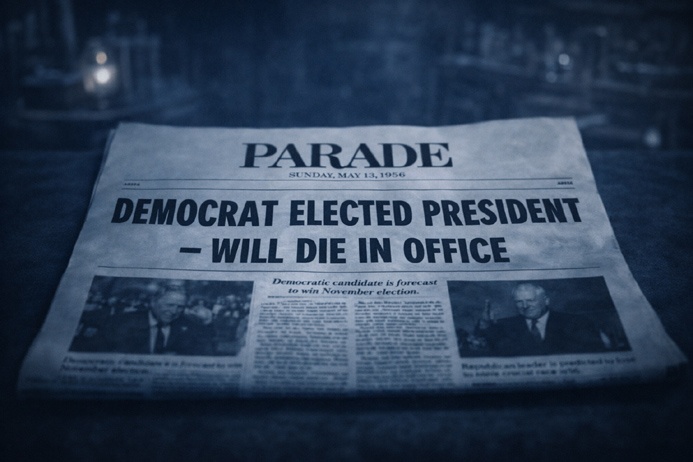
Jeane Dixon Prediction The headline the world remembered longest.
The single most discussed Jeane Dixon prediction in her entire career involved John F. Kennedy. In 1956, Parade magazine published a piece in which she reportedly predicted that the 1960 presidential election would be won by a Democrat who would be assassinated or die in office. What the article frequently leaves out, and what critics have since raised consistently, is that Dixon later predicted in 1960 that Richard Nixon would win that same election, contradicting her earlier forecast entirely. Both predictions existed in print, and the successful one was naturally the one carried forward in public memory.
When Kennedy was killed in November 1963, that prediction was immediately and widely recalled. The specificity of the claim, the years that had passed between statement and event, and the sheer magnitude of the tragedy combined to create a moment that permanently altered how the public perceived her. Whatever her record looked like before or after, that single Jeane Dixon prediction became the foundation of her legend.
The Parade magazine piece that published her most famous forecast was one of the most widely circulated Sunday newspaper supplements in the United States at the time, reaching an estimated 20 million households per issue.
The Rise of a National Sensation
After 1963, demand for Dixon’s insights accelerated sharply. Publishers sought her out rather than waiting for her approach. Her 1965 biography, written by Ruth Montgomery, became a bestseller and introduced the narrative of her gift to a popular audience that had not previously followed her closely.
Speaking engagements multiplied. Interview requests arrived constantly. The cultural appetite for her perspective on coming events was, for a period, nearly insatiable. Each new Jeane Dixon prediction published or broadcast in those years carried the halo of the Kennedy moment, and audiences interpreted her subsequent forecasts through that lens.
The Misses People Forgot
A complete accounting of Dixon’s record looks substantially different from the highlights version. She predicted that World War III would begin in 1958. She expected a comet to strike the Earth with catastrophic consequences. She stated confidently that the Soviet Union would beat the United States to the moon. She anticipated events in the Middle East, in domestic politics, and in international affairs that simply did not materialize.
Any single Jeane Dixon prediction that failed attracted far less sustained attention than those that appeared to succeed. The asymmetry was not unique to her, but it was especially pronounced in her case because the Kennedy association had raised the stakes so dramatically.
Dixon reportedly kept a crystal ball on prominent display in her home office in Washington, D.C., and referred to it during interviews as a focusing tool rather than a source of visions.
The “Dixon Effect” Explained
The pattern of remembering confirming evidence and discarding disconfirming evidence is well documented in psychological research. In popular writing on the subject, it is sometimes called the “Jeane Dixon effect,” a term that honors how thoroughly her career illustrated the phenomenon. A Jeane Dixon prediction that came close to an actual event was remembered, discussed, and cited.
One that proved entirely wrong was forgotten or quietly set aside. This was not a conspiracy or a coordinated effort. It was simply how memory and storytelling work, particularly around figures who have already achieved iconic status. Once a person is established as credible in a given domain, audiences unconsciously filter subsequent information to preserve that credibility.
Faith, Astrology, and Contradiction
One of the more genuinely interesting aspects of Dixon’s public persona was the tension between her Catholic faith and her practice of astrology and psychic reading. The Catholic Church has historically discouraged divination, and yet Dixon maintained a devout Catholic identity throughout her life, attending Mass regularly and framing her abilities as gifts from God rather than products of occult practice.
Audiences who shared her faith were often reassured by this framing rather than troubled by it. A Jeane Dixon prediction delivered within a spiritual framework felt less like fortune telling and more like inspired guidance, which made it more acceptable to a broad American public that was simultaneously curious about the mystical and cautious about departing from mainstream religious norms.
Building a Psychic Empire
Dixon was a genuinely successful businesswoman by any reasonable measure. Beyond her biography, she wrote additional books, including volumes of astrological forecasts that sold steadily year after year. Her syndicated column ran in newspapers across the country for decades. She marketed a horoscope kit and maintained a public schedule that would have exhausted many people half her age. She also founded Children to Children, a nonprofit organization dedicated to feeding and supporting impoverished children, which she considered among her most meaningful contributions.
For Dixon, the commercial and the charitable existed alongside each other without apparent contradiction, and she gave generously of both her time and her earnings to that cause. Each Jeane Dixon prediction that appeared in print was, in a practical sense, also a product, part of a publishing and media operation that required constant output to sustain itself. The business logic of her career rewarded prolific forecasting, and she maintained that pace consistently.
Dixon’s star sign, Pisces, was a detail she frequently cited in explaining her own sensitivity to intuitive impressions, a detail she wove into interviews and public appearances throughout her career.
Media, Myth, and Public Fascination
Television was particularly well suited to Dixon’s manner. She was composed, confident without being arrogant, and capable of speaking about extraordinary subjects in a measured tone that made them feel plausible. Print media had built her reputation, but television extended it to audiences who had never read her column.
The visual medium also allowed her persona, the well-dressed Washington insider with an air of quiet certainty, to reinforce the credibility that her words were claiming. Each televised Jeane Dixon prediction benefited from her presentation, which was always professional and never theatrical in the manner of carnival performers.
Later Years and Lasting Reputation
Dixon continued working well into her later decades, maintaining her column and making public appearances through the 1980s and into the 1990s. Public attitudes toward psychic phenomena shifted considerably during that period, with greater mainstream skepticism emerging alongside continued popular fascination. Her standing among true believers remained solid, while her standing among skeptics remained a subject of pointed critique.
She died in 1997, having spent more than half a century as a recognizable figure in American public life. The organization she founded to support children in need continued operating after her death, representing a practical legacy that existed alongside the more complicated one attached to her forecasting career.
Legacy: The Legend vs. The Reality

Jeane Dixon Prediction Every legend leaves a written record.
Jeane Dixon’s cultural footprint is larger than her verified predictive record would justify, and that gap is itself instructive. The Kennedy association gave her a foundation that no subsequent failure could fully erode, and the media infrastructure of her era was well suited to amplifying successes and absorbing misses without obvious disruption. Her career demonstrated, more clearly than most, how a single dramatic Jeane Dixon prediction could reshape an entire reputation and how audiences construct lasting beliefs around limited but emotionally powerful evidence. The legend she accumulated was real in its social effects, even where the underlying claims remained genuinely contested. That is, perhaps, the most honest summary of what she left behind.

Known as The Man Who Notices, Mike Lamp is a theatrical hypnotist and psychic performer with more than twenty years of live stage experience. His work emphasizes observation, psychological influence, and measured presentation rather than spectacle or provocation. Performances are tailored for adult audiences, private events, and professional settings where control, clarity, and atmosphere matter.


Leave a Reply
You must be logged in to post a comment.