14
Apr
Clairvoyant Visions Exposing Shocking Misleading Claims
Clairvoyant Visions Exposing Shocking Misleading Claims
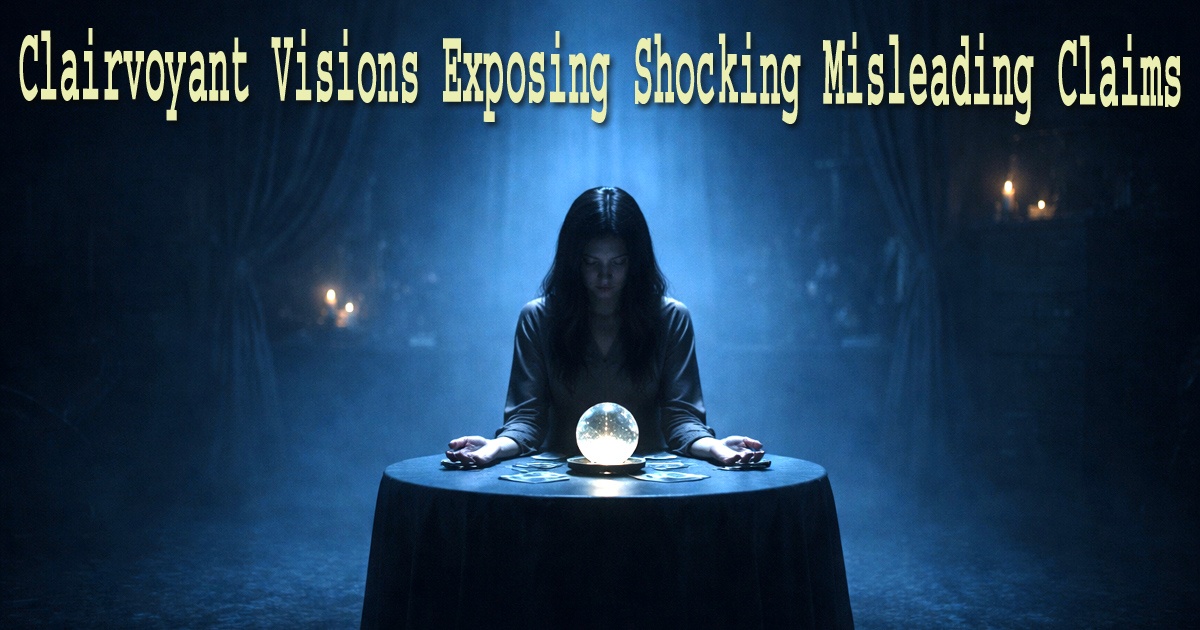
Clairvoyant visions start here
Clairvoyant visions have occupied a peculiar corner of human experience for centuries. From ancient oracles to contemporary television personalities, the claim of seeing beyond ordinary perception draws consistent public attention. What makes this field worth examining carefully is not merely the spectacle, but the consequences. When visions are presented as fact, and when people organize meaningful decisions around those visions, the stakes become real. A measured look at how these claims function, where they fail, and what sustains them offers more practical value than either wholesale belief or reflexive dismissal.
Palm reading as a structured divination system was documented in texts from ancient India dating to the Vedic period, predating formal Western astrology by several centuries.
The Allure of Clairvoyant Visions
Few things capture human attention quite like the promise of hidden knowledge. Clairvoyant visions tap directly into a fundamental curiosity about what lies beyond ordinary sight, whether that means the future, the interior lives of others, or events unfolding at a distance. This appeal cuts across education levels and cultural backgrounds. Surveys conducted across Europe and North America consistently show that substantial minorities of adults hold some openness to psychic phenomena, even among those who would describe themselves as skeptical in other areas of life.
The media landscape has amplified this interest considerably. Psychic hotlines flourished in the 1990s, generating hundreds of millions of dollars annually at their peak. Cable television developed entire programming blocks around clairvoyant practitioners. Streaming platforms have continued the tradition. The format is compelling because it combines personal revelation with theatrical uncertainty, a combination that holds attention.
Read about Self-Fulfilling Predictions: Powerful Psychic Insight Explained in our Exclusive Article
Common Techniques Behind the Visions
Understanding what actually produces many apparent clairvoyant visions requires looking at the methods practitioners use, often without conscious awareness that they are doing so. Cold reading is among the most well documented techniques. It involves making broad, statistically likely statements and then refining them based on the subject’s verbal and nonverbal responses. Equally important is what psychologists call the Barnum Effect, the tendency of individuals to accept vague, generally applicable personality descriptions as uniquely personal. Bertram Forer demonstrated this in a controlled classroom setting in 1948, and the results have been replicated ever since. A practitioner might open with an observation about a connection to an older female relative, a statement that applies to a large portion of any audience.
Vague language compounds the effect. Statements constructed with sufficient generality allow almost any subsequent event to count as confirmation. When a clairvoyant vision includes phrases like “a significant change is coming” or “there is unresolved conflict nearby,” the subject’s mind does the interpretive work. Memory then tends to retain the apparent hits while discarding the misses, a pattern researchers have documented across numerous controlled studies.
Notable Failed Predictions
The historical record of high-profile clairvoyant predictions is not favorable to the field. During the late twentieth century, several prominent practitioners issued detailed forecasts about specific political outcomes, natural disasters, and the fates of well-known public figures. These predictions circulated widely, were documented in print, and then failed to materialize on the timelines and in the forms described.

Clairvoyant Visions: Predictions rarely survive the record
One pattern that emerges from examining failed predictions is the tendency to retreat into reinterpretation afterward. No major clairvoyant has ever submitted predictions to a neutral third party before the events in question, which is a basic step that would allow genuine scoring. Without prior documentation held independently, reinterpretation is always available as an exit. A prediction about a major coastal flooding event that did not occur might be revised to suggest it referred to a smaller, localized incident. The original specificity dissolves into post-hoc flexibility. This process of revision is rarely scrutinized publicly with the same intensity that greeted the original claim.
In the United States, fortune telling was classified as a criminal offense in a number of states through much of the twentieth century, with several municipal codes still carrying unenforced statutes against it.
Psychological Explanations for Apparent Visions
Cognitive science offers a clear account of why clairvoyant visions can feel real to both the person experiencing them and the people receiving them. The brain is a pattern recognition system of great sensitivity. It finds signal in noise, constructs narrative from fragments, and experiences this process as perception rather than construction.
Confirmation bias plays a significant supporting role. Once a person has invested belief in a particular clairvoyant source, incoming information gets filtered accordingly. Events that align with previous visions are noted and remembered. Events that contradict or simply fail to match are processed differently, often categorized as exceptions or timing errors. The result is a subjective record that appears to validate what an objective record would not. Pareidolia, the tendency to perceive meaningful patterns in random stimuli, extends beyond visual phenomena.
People report hearing meaningful phrases in ambient sound, detecting personal relevance in generalized statements, and finding confirmation of visions in unrelated events. These are not signs of gullibility. They are characteristics of normal human cognition operating in conditions of uncertainty and emotional investment.
The Human Cost of Misleading Claims
The consequences of false clairvoyant visions extend beyond disappointment. Documented cases include individuals who made major financial decisions based on psychic guidance, selling properties, withdrawing retirement savings, or declining medical treatment because a vision suggested an alternative course. Grief is a particularly vulnerable context. People who have lost family members and seek contact through a clairvoyant practitioner may find themselves in a prolonged state of managed hope that delays genuine mourning.
Consumer protection agencies in several countries have pursued cases involving practitioners who charged significant fees for ongoing sessions, each building on the last and creating what investigators described as emotional dependency sustained by manufactured urgency. Families have reported that relatives became increasingly isolated as their involvement with a particular clairvoyant deepened, redirecting social energy and financial resources toward the practitioner relationship.
The term cold reading was not widely documented in its current analytical meaning until the 1970s, when American mentalist Ray Hyman began publishing formal breakdowns of the technique for skeptical and academic audiences.
Cultural Influence and Public Reception
The persistence of clairvoyant visions in public culture reflects something genuine about human psychology. Uncertainty is uncomfortable, and the desire for clarity about outcomes, relationships, and futures is not irrational. What varies is the mechanism people choose to address that discomfort. In periods of social instability or personal crisis, interest in psychic phenomena tends to rise, a pattern observable across different historical periods and geographic regions.
Popular culture has reflected and reinforced this interest. The figure of the gifted seer appears across literary traditions spanning thousands of years. Contemporary film and television have updated the archetype without fundamentally questioning it. Even productions that frame their psychic characters with some ambiguity tend to resolve the narrative in ways that affirm the underlying premise. This sustained cultural presence makes critical evaluation harder, because the framework of belief comes pre-installed through decades of storytelling.
Skeptical Investigations and Exposures
Clairvoyant Visions The evidence fills every wall
Systematic investigation of clairvoyant claims has produced a consistent body of findings over the past century. Organizations dedicated to scientific examination of psychic phenomena have tested hundreds of self-identified clairvoyants under controlled conditions designed specifically to remove the cues that cold reading depends on. The results have not supported claims of genuine psychic perception at rates exceeding chance. The James Randi Educational Foundation maintained an open prize of one million dollars for any individual who could demonstrate psychic ability under agreed-upon controlled conditions. The challenge ran for decades, drew more than a thousand applicants, and was formally terminated in 2015 No one ever claimed the prize.
Former practitioners have contributed some of the most detailed accounts of how the illusion is maintained. Hot reading, which involves researching a subject in advance using publicly available information, obituaries, social media profiles, community records, and in some documented cases, information gathered from audience members before a show by assistants posing as staff, has been described in first-person accounts. These accounts describe a gradual normalization of the practice, where the initial discomfort of deception fades into professional routine.
Ethical Considerations in Psychic Practices
The ethical landscape of clairvoyant visions is complex. At one end of the spectrum, practitioners who openly present their work as entertainment, framing readings as reflective or metaphorical tools rather than literal supernatural perception, occupy a different moral position than those who claim documented accuracy and charge accordingly. The problem is that the public often cannot reliably distinguish between these categories from the outside.
When a clairvoyant vision influences a medical decision, a custody arrangement, a financial commitment, or a decision to sever a relationship, the practitioner’s framing as entertainment provides thin protection for the person who took the guidance seriously. Professional bodies in some jurisdictions have developed codes of conduct that require explicit disclosure of the entertainment nature of psychic services, but enforcement is inconsistent and awareness among consumers remains limited. In practice, the label of entertainment has historically served practitioners more than consumers, providing legal cover while doing little to change how sessions are conducted or received.
Moving Forward with Critical Awareness

Clairvoyant Visions What the sphere never shows
Developing a more discerning relationship with clairvoyant visions does not require abandoning curiosity about consciousness, perception, or the edges of human experience. What it does require is a working familiarity with the mechanisms that produce false impressions of accuracy and a willingness to apply the same standards of evidence to psychic claims that one would apply elsewhere.
Useful questions are simple ones. Was the prediction documented before the event it describes? Were the specific details as precise as they seemed in retrospect, or did they require interpretation to fit? Would the same statement have applied to a wide range of possible outcomes? These questions do not resolve every case, but they slow the process by which a plausible-sounding claim becomes a settled conviction. That slower process tends to produce more reliable conclusions and leaves room for genuine wonder without requiring the suspension of ordinary judgment.
Editor’s Reflection
What runs through this subject, taken as a whole, is a tension that has not resolved itself across generations of debate. People want to see clearly into uncertain situations, and that desire is legitimate. The tools offered by clairvoyant visions, however, have not, under any controlled condition across more than a century of testing, matched the weight people have placed on them. That gap, between what is promised and what can be demonstrated, is where most of the difficulty lives.
The questions that remain are not purely technical ones. When someone finds genuine comfort in a clairvoyant vision, even one that cannot be verified, what does that comfort mean and where does it come from? Is the problem the vision itself, or the conditions that made it feel necessary? And if skepticism is the honest position, what does it owe to the very human experiences it is asked to explain away?

Known as The Man Who Notices, Mike Lamp is a theatrical hypnotist and psychic performer with more than twenty years of live stage experience. His work emphasizes observation, psychological influence, and measured presentation rather than spectacle or provocation. Performances are tailored for adult audiences, private events, and professional settings where control, clarity, and atmosphere matter.


Leave a Reply
You must be logged in to post a comment.