5
Feb
Jay B. Zee: The Legendary Stage Hypnotist Revealed
The Enigmatic Career of Jay B. Zee: A Pioneer in Stage Entertainment
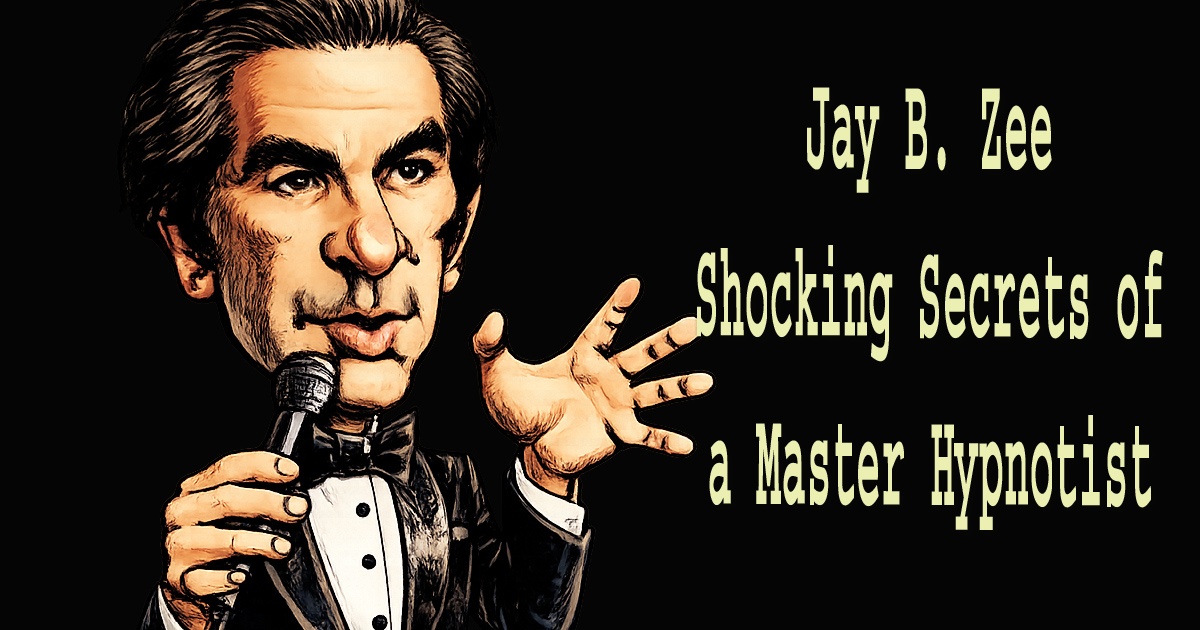
Jay B. Zee, the charismatic stage hypnotist of the 1950s–1970s
In the realm of performance arts that blend psychology with spectacle, few figures from the mid-20th century capture the imagination quite like Jay B. Zee. As a stage hypnotist whose acts spanned decades, Jay B. Zee navigated the fine line between amusement and controversy, drawing audiences into the mysterious world of hypnosis. His shows, often described as lively demonstrations of the mind’s suggestibility, reflected a time when hypnosis was transitioning from vaudeville curiosity to a more structured form of entertainment. Jay B. Zee’s journey offers a window into how such performers operated, relying on charisma, technique, and a touch of showmanship to create experiences that participants and observers alike reported as both thrilling and bewildering.
Born in 1917 under the name Jack Bernie Zitzen, Jay B. Zee adopted his stage moniker early in his career, perhaps to evoke an air of exotic expertise. Details of his youth remain sparse, but historical accounts suggest he grew up in an era when hypnosis was gaining traction in popular culture, influenced by figures like Mesmer and later stage practitioners. Jay B. Zee entered the field not through formal academic channels but via the practical route of performance, honing his skills in the bustling entertainment circuits of the American Midwest. By the early 1950s, he was already billing himself as a stage hypnotist, complete with titles like “Professor” or “Dr.” that, while adding flair, were later revealed to stem from unconventional sources such as correspondence courses and overseas diploma programs. These credentials, traditionally understood as enhancements for credibility in the entertainment world, underscored Jay B. Zee’s commitment to the theatrical side of hypnosis.
Jay B. Zee briefly hosted a Detroit-area radio program in the early 1960s where he interviewed Aetherius Society founder George King, blending his hypnosis background with discussions of extraterrestrial contact.
Early Ventures and the Rise of a Hypnotic Persona
 Jay B. Zee’s initial forays into stage hypnosis coincided with a postwar fascination with the mind’s potential. In the 1950s, as Americans grappled with rapid social changes and emerging interests in phenomena like unidentified flying objects, Jay B. Zee crafted acts that played on contemporary themes. His show, often titled “Anything Can Happen,” invited audience volunteers to experience hypnosis firsthand, leading to humorous scenarios where subjects performed absurd tasks under suggestion. Reports from the time describe Jay B. Zee as a commanding presence on stage tall, articulate, and dressed in formal attire that lent an aura of authority. He would explain the process of hypnosis in simple terms, assuring crowds that it was a natural state of focused relaxation, not some mystical force.
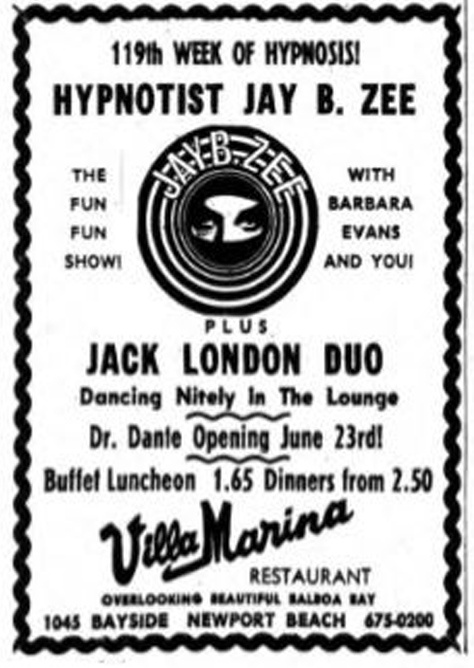
One of Jay B. Zee’s signature routines involved post-hypnotic suggestions, where participants carried out commands after the show ended. This technique, a staple in stage hypnosis, allowed for extended engagement and word-of-mouth promotion. Jay B. Zee toured extensively through states like Illinois, Iowa, and Wisconsin, performing in theaters, clubs, and community halls. Newspaper advertisements from the era highlight his appeal: promises of “howlarious hypnosis” and interactive fun drew families and curiosity-seekers alike. Yet, Jay B. Zee’s methods were not without risk, as the boundary between controlled entertainment and unintended consequences could blur. Practitioners of hypnosis, including Jay B. Zee, often emphasized ethical guidelines, such as avoiding embarrassment to subjects, but real-world applications sometimes tested these boundaries.
Notable Performances and the 1952 Oregon Incident
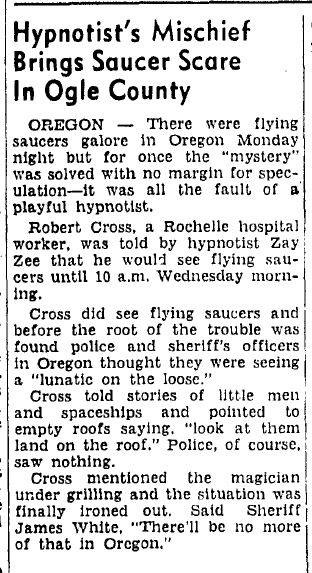 Throughout the 1950s, Jay B. Zee built a reputation as a versatile stage hypnotist, adapting his acts to local tastes. In smaller towns, his shows might focus on lighthearted gags, while in urban venues, they incorporated elements of current events. A particularly memorable episode occurred in September 1952 in Oregon, Illinois, a quiet community northwest of Chicago. During a performance at the local theater, Jay B. Zee hypnotized a young volunteer named Robert Cross and implanted a suggestion that the man would witness an “invasion” of flying saucers the following day. Cross, under the influence of this post-hypnotic cue, reported vivid sightings of bizarre, polka-dotted creatures atop various town landmarks, including the courthouse and police station.
The incident escalated quickly. Local authorities, initially taking the reports seriously amid the era’s UFO hysteria, investigated what they perceived as a potential hoax or delusion. Jay B. Zee was questioned by the sheriff, explaining that the entire episode stemmed from his hypnosis routine a playful nod to the flying saucer craze sweeping the nation. No charges were filed, but the event highlighted the power of suggestion in hypnosis. Observers at the time described it as a harmless prank gone awry, though it led to internal disruptions within the sheriff’s department, including resignations and firings unrelated directly to Jay B. Zee but amplified by the publicity. This moment in Jay B. Zee’s career illustrates how stage hypnosis could intersect with broader cultural phenomena, creating ripples beyond the theater.
Undeterred, Jay B. Zee continued refining his craft. By the late 1950s, he had expanded his repertoire to include educational segments, where he demystified hypnosis as a tool for relaxation and self-improvement. His acts were reported to be clean and engaging, suitable for mixed audiences, though always with an undercurrent of wonder. Jay B. Zee’s ability to blend comedy with demonstration made him a sought-after entertainer in the Midwest, where stage hypnosis filled a niche between magic shows and motivational talks.
In 1957, Jay B. Zee purchased a Ph.D. diploma from an Italian mail-order institution for $58, a common practice among entertainers seeking added stage authority during that era.
Expansion into the 1960s and Collaborative Acts
 As the 1960s dawned, Jay B. Zee’s career evolved with the times. He relocated portions of his operations to Nebraska and surrounding areas, performing in venues that catered to adult crowds, such as steakhouses and nightclubs. Here, Jay B. Zee introduced a partnership with his wife, Barbara T. Zee, who joined him on stage under the name Barbara Evans. Together, they presented “The Fun Fun Show,” a collaborative effort that combined hypnosis with musical interludes from a accompanying band. Barbara’s role, often described as that of an assistant and co-performer, added a dynamic layer to the acts, allowing for more intricate routines involving multiple participants.
In places like Omaha and Lincoln, Jay B. Zee became a fixture in the local entertainment scene. Venues such as Little Bo’s and the Omaha Steakhouse hosted his shows regularly, where audiences experienced hypnosis through interactive séances and comedic skits. Jay B. Zee’s style remained observational, focusing on the participant’s reported sensations rather than claiming any extraordinary powers. He would often preface sessions with disclaimers, noting that hypnosis relied on the subject’s willingness and imagination. This approach aligned with contemporary understandings of hypnosis as a psychological state, influenced by emerging research from organizations like the American Society of Clinical Hypnosis.
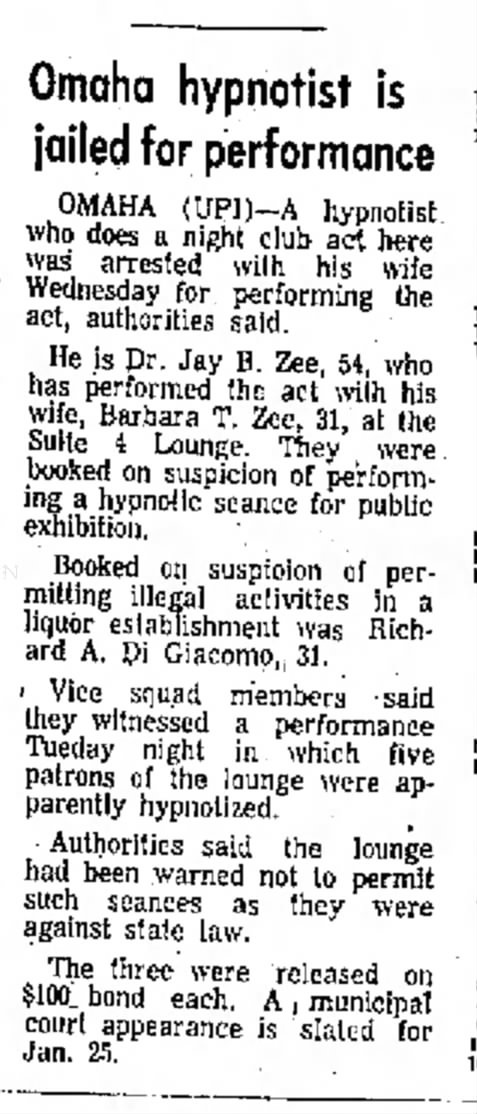
However, the collaborative nature of these performances occasionally courted controversy. In December 1971, during a show in Columbus, Nebraska, Jay B. Zee and Barbara were briefly arrested following a performance deemed indecent by local standards. The act, which involved a hypnotist séance with audience involvement, led to charges that were later resolved with minimal bonds. Such incidents, while rare, underscored the challenges stage hypnotists faced in navigating community norms. Jay B. Zee, ever the professional, continued touring without apparent long-term repercussions, adapting his material to ensure broader acceptability.
Later Years, Radio Ventures, and Personal Reflections
By the 1970s, Jay B. Zee’s travels extended further, including stints in California and Iowa. He maintained a presence in the hypnosis community through interviews and appearances, where he discussed the art form’s evolution. In one reported conversation from 1977, Jay B. Zee described hypnosis as “putting to sleep the conscience,” a poetic way to convey the temporary suspension of critical judgment that allows for suggestive experiences. His shows during this period often featured themes from popular culture, echoing his earlier UFO gags but toned down for changing audiences.
Jay B. Zee also ventured into broadcasting, hosting a radio program in Detroit in the early 1960s. There, he interviewed figures from fringe fields, including those associated with UFO societies, blending his stage hypnotist expertise with exploratory discussions. These episodes, traditionally understood as platforms for open dialogue, allowed Jay B. Zee to explore hypnosis’s intersections with belief systems, always framing them as experiential rather than factual.
On a personal level, Jay B. Zee’s life reflected the itinerant nature of his profession. Married to Barbara, who shared his passion for performance, he balanced the demands of travel with a sense of family involvement. Records indicate the couple resided in various Midwest locations before Jay B. Zee retired to Florida in his later years. He passed away in 1990 at the age of 73, leaving behind a legacy etched in the memories of those who witnessed his acts. Barbara continued on, with traces of her life appearing in public records from states like Washington and Arizona, though details remain private.
Legacy in the World of Hypnosis
Jay B. Zee’s contributions to stage hypnosis endure as examples of how entertainment can illuminate the mind’s workings. In an era before widespread clinical acceptance, performers like him popularized the concept, encouraging public curiosity. His incidents, from the 1952 saucer scare to the 1971 arrest, serve as cautionary tales about the responsibilities inherent in hypnosis. Modern practitioners often reference such historical cases to emphasize ethics and consent, building on the foundations Jay B. Zee helped lay.
For those interested in hypnosis today, Jay B. Zee represents a bridge between old-world showmanship and contemporary understanding. His life reminds us that stage hypnosis, at its core, is about shared human experience reported sensations of altered awareness that entertain and provoke thought. While skepticism surrounds some aspects of his career, particularly his self-conferred titles, Jay B. Zee’s impact on popular perceptions of hypnosis remains undeniable. In reflecting on his path, one appreciates the measured artistry required to captivate without overstepping, a balance he navigated with evident skill across decades.
After retiring from active performing, Jay B. Zee settled in Florida, where he was laid to rest in 1990 at Star of David Memorial Gardens in North Lauderdale under a marker listing his stage title “PH.D.”
Editor’s Reflection
Looking back, the story of Jay B. Zee feels less like a neatly packaged biography and more like a series of snapshots from a time when stage performers could still surprise audiences with the mind’s quiet willingness to follow along. He was one of those figures who worked in the open, using hypnosis not as a secret power but as a shared experience sometimes playful, sometimes awkward, always dependent on the people in the room. What remains is the sense that Jay B. Zee understood the temporary trust audiences placed in him, and he carried that responsibility lightly, even when things slipped sideways.
What stays with a reader after the curtain falls on such a life? Does the memory of those old nightclub shows still carry the same mix of amusement and unease today? How much of what we call stage hypnosis is really about the performer, and how much is about the person who volunteers to sit in the chair? And when we think of Jay B. Zee now, do we see mostly the showman, or do we catch a glimpse of the ordinary curiosity that drew crowds in the first place?

Known as The Man Who Notices, Mike Lamp is a theatrical hypnotist and psychic performer with more than twenty years of live stage experience. His work emphasizes observation, psychological influence, and measured presentation rather than spectacle or provocation. Performances are tailored for adult audiences, private events, and professional settings where control, clarity, and atmosphere matter.

Leave a Reply
You must be logged in to post a comment.