7
Apr
Aquarius Symbolism Meaning: Bold Air Sign Insights
Aquarius Symbolism Meaning: Bold Air Sign Insights
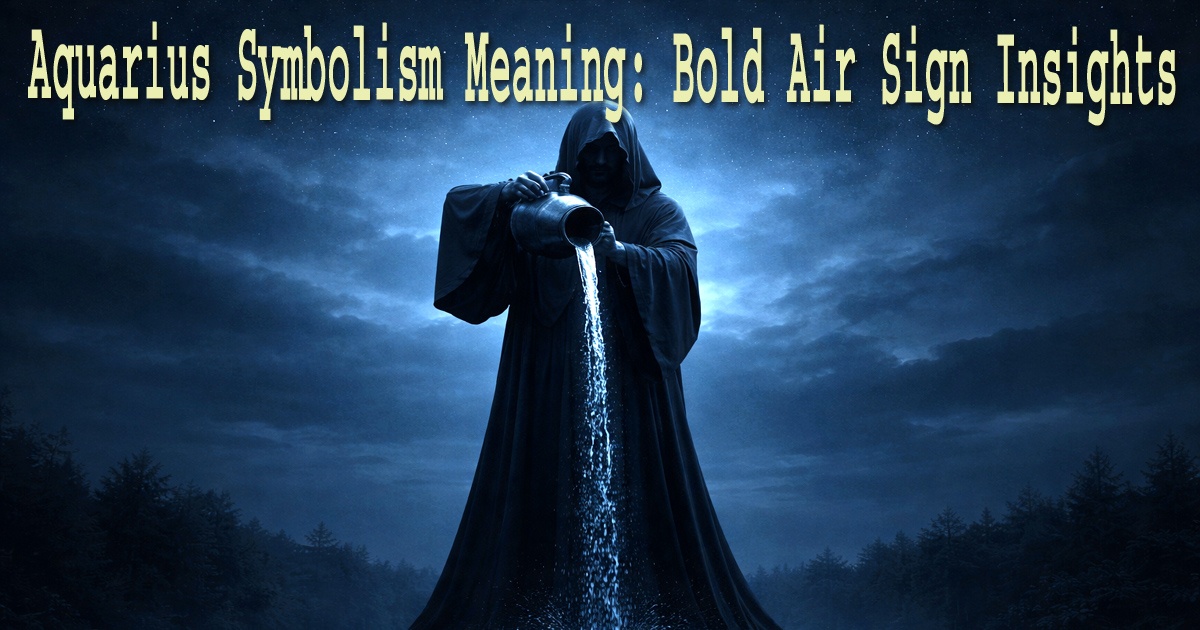
Aquarius Symbolism Ancient waters, modern meaning
The Water Bearer
Aquarius symbolism begins with an image that has puzzled casual observers for centuries: a figure pouring water from a vessel. The sign is classified as an air sign, yet its ancient glyph depicts flowing water. That apparent contradiction is actually central to understanding what Aquarius represents. The water being poured is not ordinary water. In classical astrological tradition it carries multiple meanings depending on the source consulted. Babylonian records associated the figure with the god Ea, a deity of wisdom and the deep waters of the abyss.
Later Hellenistic tradition connected the outpouring with the annual flooding of the Nile, a life-giving event tied to agricultural fertility and communal survival. The streaming of knowledge and collective awareness is a valid layer of meaning, but it developed over time and sits alongside these older, more concrete associations rather than replacing them. The bearer does not drink from the vessel. The water flows outward, away, toward the world at large. That posture, giving rather than receiving, describes the fundamental orientation of this sign.
Read about Zodiac Meaning Explained: Clear Guide to Symbolism in our Exclusive Article
The Aquarian Glyph
The glyph assigned to Aquarius consists of two parallel wavy lines, one stacked above the other. These lines represent waves, whether of water, electricity, or signal transmission depends somewhat on which tradition is consulted. In older interpretive texts the waves stood for the cosmic waters mentioned above.

Aquarius Symbolism Two lines, many meanings
In later astrological writing, particularly after the discovery of Uranus and its adoption as a modern co-ruler of the sign, the wavy lines were reread as electrical current or the oscillating frequency of transmission. Both readings sit comfortably inside Aquarius symbolism because both describe the movement of something invisible that carries information or energy from one point to another. The glyph is one of the more versatile in the zodiac in that respect.
Saturn and Uranus as Rulers
Aquarius is traditionally ruled by Saturn, a planet associated with structure, discipline, time, and institutional authority. That rulership held without dispute through the entirety of classical and medieval astrological practice. Uranus was not discovered until 1781 and was not widely adopted as a co-ruler of Aquarius until the nineteenth and twentieth centuries. Working astrologers who follow traditional methods continue to use Saturn as the sole ruler and find it sufficient for interpretation. The modern co-rulership of Uranus is accepted broadly in contemporary practice but it is a relatively recent addition, not an ancient pairing.
The combination is unusual regardless of when it was formalized. Saturn wants form and Uranus wants to break it. The combination inside a single sign produces the particular tension that runs through Aquarius symbolism at every level: the reformer who still believes in systems, the revolutionary who writes constitutions, the iconoclast who builds institutions. Understanding this dual rulership is probably the most useful key available to anyone trying to read this sign with any depth or precision.
The constellation now called Aquarius was recorded by the Babylonians under the name GU.LA, associated with the god of wisdom and fresh water, and appears in star catalogues dating to at least the second millennium BCE.
The Eleventh House
Aquarius naturally corresponds to the eleventh house in the whole sign house system and in the thematic ordering of signs around the wheel. It is worth noting that this correspondence is sign-based, not dependent on any individual chart. In a given nativity the eleventh house may or may not be occupied by Aquarius, depending on the Ascendant. The association is between the sign and the house as parallel categories of meaning, not as fixed positional equivalents.
The eleventh house governs groups, associations, networks, friendships distinguished from family ties, and the concept of collective aspiration. It also governs hopes and goals conceived in relation to others rather than in isolation. When Aquarius symbolism is examined through the lens of the eleventh house, the emphasis falls on participation in something larger than the individual.
The water bearer pours outward, toward a gathering, not toward a single recipient. The image implies a community, a gathering, a group of people toward whom that outpouring moves. The eleventh house gives Aquarius its social dimension, though it is social in a particular way, more concerned with shared purpose than with personal warmth.
The Fixed Air Quality
Each sign in the zodiac carries both an element and a mode. Aquarius is fixed air. Fixed signs are associated with persistence, concentration, and the capacity to sustain an idea or effort over time. Air as an element governs intellect, language, exchange, and the movement of thought. Fixed air is therefore thought that holds its shape, a position maintained through logic and conviction rather than through sentiment or habit. This quality shows up consistently inside Aquarius symbolism as a kind of ideological stability.
Aquarian energy tends to arrive at a point of view through reasoning and then defend it steadily, sometimes to the point of stubbornness. The fixed quality also contributes to the sign’s reputation for unpredictability, because a fixed air sign can be simultaneously rigid in principle and genuinely open to unconventional ideas, provided those ideas pass a certain internal test of coherence.
Ptolemy listed Aquarius among the original 48 constellations in his second-century astronomical text the Almagest, placing it in the region of sky the ancients called the Sea, a zone containing several other water-related constellations despite being an area of relatively few bright stars.
Humanitarian Orientation
Aquarius is often described in astrological tradition as the humanitarian sign. That label is accurate but requires some qualification. The humanitarian tendency in Aquarius symbolism operates at a conceptual level. The concern is for humanity as a category, for justice as a principle, for freedom as a structural condition. This is distinct from the more personal, emotionally driven compassion associated with signs like Cancer or Pisces.
Aquarian concern tends to be principled and sometimes cool in its emotional register. A person with strong Aquarian placements may advocate passionately for a cause while remaining personally detached from the individuals directly affected. That is not indifference. It is the particular form that care takes when filtered through fixed air and a house ruled by collective rather than personal association.
Uranian Influence and Originality
The Uranian dimension of the sign contributes what might be called the electrifying quality in Aquarius symbolism. Uranus rules sudden shifts, lateral thinking, the arrival of ideas that seem to come from outside ordinary sequence. In the context of Aquarius, this influence expresses itself as intellectual originality, a tendency to arrive at positions through an unconventional route, and a genuine comfort with ideas that have not yet been accepted by the larger culture.
Aquarius placements in a chart often correlate with early adoption of ideas that later become mainstream, or with consistent interest in systems and structures that sit outside conventional frameworks. The Uranian thread in this sign is what gives Aquarius its association with the future, not because the sign is prophetic in any mystical sense, but because Uranian energy moves ahead of consensus.
Aquarius in Relation to Leo

Aquarius Symbolism Same axis, opposite pull
Every sign has a polarity, and the axis Aquarius occupies sits opposite Leo. Leo is a fixed fire sign associated with individual self-expression, creative authority, and the singular will. Aquarius is fixed air associated with collective identity, group purpose, and the distribution of attention rather than its concentration. The Leo-Aquarius axis in a chart describes the tension between the individual and the collective, between the leader and the community, between the performer and the audience.
When Aquarius symbolism is considered alongside its Leo opposition, the sign’s meaning becomes clearer by contrast. Aquarius does not lack ego. Fixed signs rarely do. But the Aquarian orientation tends to direct energy outward toward the group and toward principles that exist beyond the self.
Aquarius and the Concept of Detachment
Astrological literature frequently mentions detachment in connection with Aquarius, and the observation is grounded in actual symbolic logic rather than character stereotype. Saturn brings the capacity for measured restraint, long-range thinking, and a certain sobriety in emotional expression. The emotional distance sometimes attributed to Saturn is better understood as the discipline of not allowing feeling to override judgment, a distinction worth preserving because it keeps Saturn’s influence from reading as coldness when it is more accurately described as composure under pressure.
Uranus brings the tendency to observe systems from outside them rather than from within. Fixed air resists being moved by current sentiment. All of these factors combine to produce a sign that is genuinely capable of standing outside a situation and analyzing it without being drawn into its emotional field. In Aquarius symbolism this detachment is not a flaw or a defense. It is a functional mode, the stance of the observer who can see patterns across time and across groups because the view is not obscured by immediate feeling.
In ancient Egyptian astronomical tradition, Aquarius was associated with the god Hapi, the deity of the annual Nile inundation, and the rising of Aquarius in the night sky was observed in connection with the flooding season that determined agricultural cycles.
Saturn’s Structural Role
While Uranus provides the disruptive and visionary qualities commonly associated with the sign, Saturn’s presence as traditional ruler keeps Aquarius symbolism anchored in something more durable. Saturn rules institutions, laws, calendars, and the architecture of civilization. In Aquarius, this energy does not disappear simply because Uranus is also present.
It means the Aquarian impulse toward reform tends to express itself through the building of new structures rather than through pure demolition. The sign is associated with constitutions, charters, scientific societies, and civic organizations. The radical idea gets organized into a framework. The vision gets written down. That Saturnian persistence is what allows Aquarian energy to produce lasting change rather than momentary disruption.
Got questions? Talk to Mike directly Here.
The Waters of Collective Knowledge
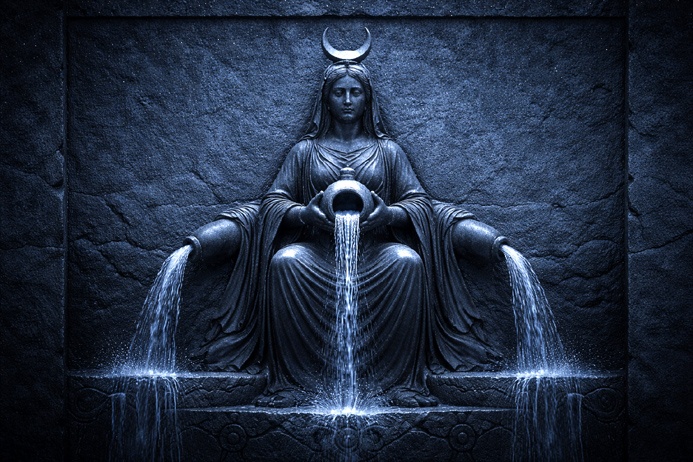
Aquarius Symbolism Wisdom poured before history recorded it
Returning to the image of the water bearer is useful because it contains more than it first appears to. The figure in classical depictions stands above the flow, holding the vessel deliberately, directing the pour with intention. This is not a passive image. It describes a conscious act of transmission. The knowledge or awareness being distributed does not arise spontaneously from the crowd. In Babylonian tradition the figure associated with this constellation was Ea or Enki, a god who brought wisdom from the primordial waters to humanity.
That mythological background gives the mediating role genuine ancient weight. The bearer stands between a source of knowledge and the people who need it, a posture that is priestly as much as it is intellectual, and one that the classical world understood in those terms before later traditions recast it in more secular language.
That mediating role sits inside Aquarius symbolism in a way that is often underemphasized. The sign is not simply communal. It carries a thread of the teacher, the transmitter, the one who has received something and chooses to give it outward rather than keep it contained.
Editor’s Reflection
What makes Aquarius symbolism genuinely interesting is not any single image or keyword but the way the pieces fit together without quite resolving. Saturn and Uranus pulling in different directions. Water poured by an air sign. A humanitarian instinct expressed through detachment rather than warmth. These are not contradictions to smooth over. They are the sign itself, built around productive tension, around the idea that holding opposites in balance is not a failure of consistency but a form of integrity.
The questions Aquarius raises are worth sitting with. Does the detachment that allows clear thinking about collective problems also limit genuine connection with the people those problems affect? Is the reformer who works within systems more or less effective than the one who refuses them entirely? And when considering Aquarius symbolism in a chart or in a historical figure, how much of what looks like eccentricity is actually just someone operating ahead of the available consensus? These are not simple questions, and anyone who has spent time with this sign knows they do not resolve easily. That is probably the point.

Known as The Man Who Notices, Mike Lamp is a theatrical hypnotist and psychic performer with more than twenty years of live stage experience. His work emphasizes observation, psychological influence, and measured presentation rather than spectacle or provocation. Performances are tailored for adult audiences, private events, and professional settings where control, clarity, and atmosphere matter.


Leave a Reply
You must be logged in to post a comment.