7
Aug
Paschal Beverly Randolph: The Powerful Clairvoyant America Forgot
Paschal Beverly Randolph: The Forgotten Father of American Clairvoyance
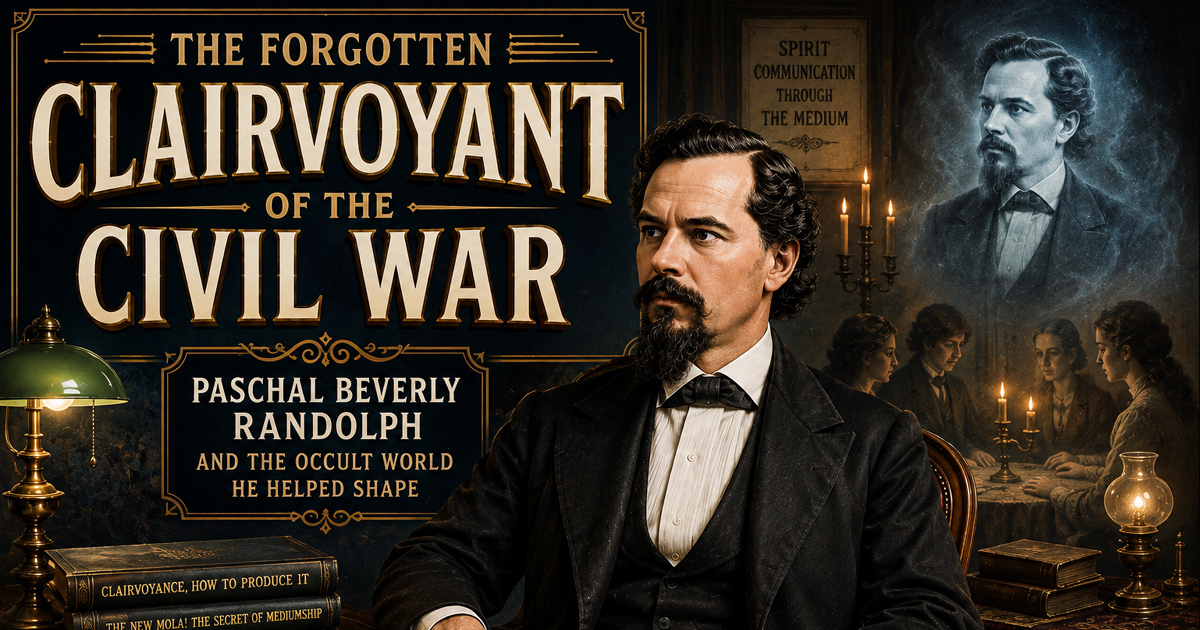
Paschal Beverly Randolph became one of 19th-century America’s most unusual figures, combining clairvoyance, trance mediumship, writing, and occult study.
Who Was Paschal Beverly Randolph?
There is a particular kind of historical figure who shapes an era so completely that the era forgets to credit him. Paschal Beverly Randolph was that figure for American clairvoyance, psychic culture, and occult thought in the nineteenth century. He was a trance medium who performed in halls across the United States and Europe before audiences who left shaken by what they had witnessed. He was a self-educated man who rose from the Five Points slum of New York City to lecture before European aristocracy, befriend a sitting American president, and write more than fifty books and pamphlets that influenced nearly every serious occult organization of the century that followed. He was a physician, an abolitionist, a founder of what is recognized as the earliest Rosicrucian order in the United States, and a man whose personal motto, a single word sewn onto everything he produced, was Try.
He was also a Black man in nineteenth-century America, which meant that every achievement arrived at additional cost and that every door he opened required him to push harder than his white contemporaries. His light skin occasionally allowed him to move through white spaces, and he exploited that ambiguity with the same creative intelligence he brought to everything else. When the movement he helped build no longer served him, he left it and built something more enduring. When the world tried to fit him into a category, he invented new ones.
Paschal Beverly Randolph was born in New York City on October 8, 1825, the son of a white father from the prominent Virginia Randolph family and Flora Beverly, a Black woman who died in the Bellevue almshouse when her son was still young. Left largely to raise himself on the streets of Five Points, one of the most notorious slum districts in American history, Randolph taught himself to read and write, worked as a bootblack, a barber, a dyer, and eventually a ship’s cabin boy and sailor. It was at sea, traveling through Europe, the Middle East, and parts of Asia, that he began to encounter the esoteric and spiritual traditions that would define the rest of his life. He returned to America in stages, increasingly convinced that the invisible world was not a superstition but a territory that could be mapped, navigated, and taught.
Becoming a Trance Medium
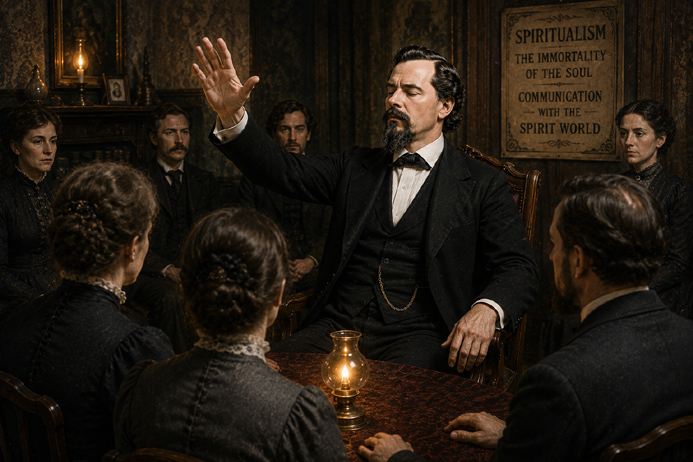
Paschal Beverly Randolph gained attention as a trance medium during an era when Spiritualism was spreading rapidly across America.
By the early 1850s, Randolph had entered the world of American Spiritualism with the timing and force of someone who had been waiting for exactly this moment. The Spiritualist movement was barely five years old when Randolph began presenting himself as a trance medium, dating from the famous rappings of the Fox sisters in Hydesville, New York, in 1848. The country was hungry for exactly what he offered: a gifted performer with genuine conviction, wide travel, and an air of authority that went well beyond the parlor-table séance circuit.
From 1852 onward, Randolph toured as a trance medium, contributing articles to Spiritualist periodicals including the Boston Leader, the New York Messenger of Light, the Journal of Progress, and the Spiritual Telegraph. He became a recognized figure in the lecture halls where Spiritualism intersected with abolitionism, with women’s rights, and with the broader reformist culture of mid-century America. As a trance speaker, he would enter what he described as an altered state and deliver extended addresses on subjects ranging from the nature of the spirit world to the evils of slavery, subjects he linked together with a moral conviction that impressed even skeptical observers.
His abilities as a clairvoyant were the centerpiece of his public reputation. He claimed the capacity to see into the interior lives of strangers, to receive impressions from objects, to perceive events occurring at a distance, and to access information through channels that bypassed ordinary sensory experience. He was not modest about these claims. In 1861, after a series of remarkable trance visions that he described as the most decisive spiritual events of his life, Randolph said he was attended by visible and invisible shapes, representatives of what he called the Order of Light and the Order of the Shadow, contesting for his allegiance and saving him from dangers worse than death itself. Whatever the ultimate nature of these experiences, they were clearly real to him in the deepest possible sense, and his certainty communicated itself to audiences in a way that mere performance could not have managed.
Clairvoyance in 19th-Century America
To understand what Randolph was doing and why it mattered, it helps to understand the America he was doing it in. The mid-nineteenth century was a society in genuine upheaval, not only over slavery and the approaching war, but over the fundamental questions of what the human being was, what happened after death, and whether the materialist science beginning to reshape the intellectual world had anything useful to say about the parts of experience that resisted measurement.
The Spiritualist movement that exploded after 1848 was not, as it is sometimes portrayed, a simple exercise in credulity. It was a serious cultural response to several converging pressures at once. The trauma of mass death from disease and the anticipation of more death from the approaching conflict drove families to seek reassurance that their dead were not simply gone. The reform culture of the era, with its commitments to abolition, women’s suffrage, and temperance, found in Spiritualism a framework that honored direct personal experience over institutional authority. And the emerging prestige of science, rather than discrediting psychic phenomena, initially encouraged a class of educated observers to investigate them with genuine rigor.
Clairvoyance, specifically, occupied a fascinating position in this landscape. It was understood in at least three different ways simultaneously. Some practitioners described it as a natural faculty of the human soul, a kind of extended perception available to anyone sufficiently developed. Others understood it through the framework of mesmerism and animal magnetism, as a physiological state that could be induced through specific techniques and that temporarily expanded the subject’s perceptual range. A third interpretation, increasingly dominant as Spiritualism matured, understood clairvoyance as a mediated contact with the spirit world, in which the clairvoyant served as a channel for information from beings no longer in the body.
Randolph moved through all three frameworks at different points in his career, but he arrived finally at something more radical and more interesting than any of them: the conviction that clairvoyance was a birthright of the entire human race, a natural faculty that had been suppressed by civilization and could be recovered through deliberate practice by any person willing to do the work.
J. W. Dunne Dream Experiments: A Remarkable True Story About Time
What Randolph Taught About Clairvoyance
This is where Randolph’s contribution becomes genuinely original and genuinely useful. His 1867 work, published under the title Guide to Clairvoyance and growing from an earlier 1860 pamphlet called Clairvoyance: How to Produce It, was one of the first systematic attempts in American occult literature to treat clairvoyance not as a mysterious gift bestowed on special individuals but as a discipline with learnable components, specific methods, and a teachable developmental path. What he wrote in Seership: The Magnetic Mirror, published in 1868 and expanding on the same foundations, remains one of the most substantive documents of nineteenth-century psychic theory available to us.
Randolph’s first and most important principle was the one he stated bluntly in his own writing: clairvoyance is not a rare wonder mixed up with mesmerism, fraud, circles, and so on. It is the birthright of every human being. He believed that every person possessed the capacity for expanded psychic perception, that children would eventually be born with it as a natural faculty, and that even in the coarser spiritual conditions of his own era, a great percentage of people could develop it to a most surprising extent. This was not a comforting platitude. It was a working hypothesis that drove everything else he taught.
The developmental path Randolph described began with the body. He was insistent, in ways that ran against the grain of much Spiritualist teaching, that physical health was a prerequisite for reliable psychic development. A nervous system compromised by poor diet, alcohol, tobacco, or sexual excess, in his view, produced unreliable and distorted psychic impressions. He was an early advocate of what we might now call lifestyle disciplines as a foundation for spiritual practice: adequate sleep, clean food, physical exercise, and the regulation of sensory input. His attention to the body was not incidental to his teaching on clairvoyance. It was its foundation.
From this physical basis, Randolph built a psychology of attention that anticipates much of what serious meditation teachers have said in the century since. The development of clairvoyant perception required, in his system, the cultivation of what he called a receptive stillness, a learned capacity to quiet the ordinary mental noise that normally occupies consciousness and to hold a particular kind of open, non-grasping awareness without filling it in with expectation or interpretation. He was notably skeptical of the tendency among Spiritualist practitioners to immediately interpret whatever arose in psychic states as messages from the dead. This interpretation, he argued, was premature and often simply wrong. The raw material of clairvoyant experience needed to be observed with the same dispassionate attention a scientist would bring to a laboratory phenomenon, before any conclusion about its source was drawn.
The magic mirror, which Randolph worked with throughout his career and wrote about extensively, was his preferred tool for developing and stabilizing these capacities. He had encountered mirror-based scrying practices during his travels in France, Egypt, and the Turkish Empire, and he brought them back to America in a systematized form that went well beyond the folk traditions from which they derived. The mirror in Randolph’s system was not a supernatural object. It was a focusing device, a way of occupying the analytical mind with something visual and relatively neutral while allowing the deeper perceptual faculties to come forward without interference. He provided specific instructions for constructing mirrors of different types, glass and metallic, for different purposes, and he described the characteristic visual phenomena that typically preceded reliable psychic impressions: shifts in apparent depth, cloudiness giving way to clarity, the appearance of colored light, and eventually the formation of images that conveyed specific information.
He taught three broad categories of what he called seership. The first was retrospective clairvoyance, the capacity to perceive events that had already occurred but were unknown to the practitioner. The second was present-tense clairvoyance, the perception of events occurring at a distance in real time. The third, which he called prophetic vision, was the most controversial and the one he wrote about with the most caution: the apparent perception of future events before they occurred. He was clear that prophetic vision was the most difficult to develop, the most easily distorted by the practitioner’s own desires and fears, and the most requiring of verification before any weight was placed on it.
What distinguished Randolph’s teaching from virtually everything else available in American psychic culture of his era was this combination of elements: a democratic premise that made clairvoyance available in principle to anyone, a physiological foundation that grounded psychic development in bodily reality, a rigorous phenomenology that distinguished between raw experience and premature interpretation, and a set of practical techniques drawn from multiple cultural traditions that had been integrated into a coherent developmental system. He was not describing what happened to special people. He was describing what any serious student could learn to do.
Randolph and the World of Spiritualism
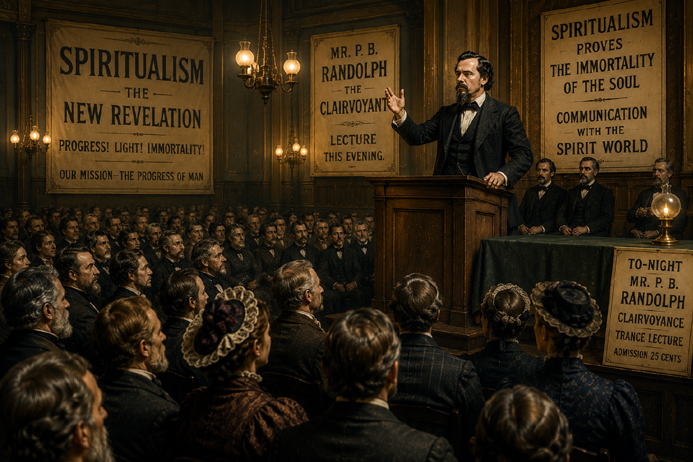
Paschal Beverly Randolph lectured during the remarkable growth of Spiritualism and public interest in communication with the spirit world.
Randolph’s relationship with the Spiritualist movement was productive, turbulent, and ultimately irreconcilable. He contributed to its publications, performed in its venues, and for nearly a decade was recognized as one of its most compelling public voices. He was also, from very early on, a dissenting voice within it, and the dissent grew louder as his own thinking matured.
His primary objection to mainstream Spiritualism was one that his later development would make explicit: the movement, in his view, had reduced the practitioner to a passive instrument. The standard Spiritualist model was one of reception. The medium entered a trance, stepped aside, and allowed the spirits of the dead to use the medium’s body and voice as a communication channel. The medium’s own will, judgment, and development were, in this model, either irrelevant or actively obstructive. What the movement valorized was passivity, the cleaner the better.
Randolph found this model philosophically inadequate and practically dangerous. A person who cultivated passivity as a spiritual discipline was, in his view, cultivating an openness to influence without cultivating the discernment to evaluate what was influencing them. The same openness that might allow a genuine spirit communication to come through would allow any other content to come through with equal facility. Without a developed will and a trained judgment, the trance medium could not distinguish signal from noise, genuine transmission from self-generated fantasy, or benevolent influence from malevolent. His 1861 trance visions, in which he described contending orders of light and shadow competing for his allegiance, were not metaphors. They were his account of what serious psychic practice actually felt like from the inside, and the lesson he drew from them was not that mediumship should be abandoned but that it needed to be transformed from a passive reception into an active, disciplined engagement.
He also clashed with Spiritualist culture on racial terms that the movement was unwilling to fully reckon with. The Spiritualist community’s progressive self-image, its commitment to abolition and women’s rights, did not always translate into the willingness to fully accept a Black man as an equal colleague rather than a curiosity. Randolph himself noted with bitter clarity that had he been white, his ideas would have been received differently and more widely. He was right.
Ted Serios Psychic Photographer: The Remarkable True Story Science Could Not Explain
From Clairvoyance to the Occult
Randolph’s formal break with Spiritualism was announced publicly at least twice, and at least once reversed, which gives some sense of how complicated his relationship with the movement actually was. By the early 1860s, however, the direction of his thinking had become clear. He was moving from the passive model of Spiritualist mediumship toward something that later generations would recognize as active occultism: the deliberate cultivation of inner power, the systematic development of will and vision, and the pursuit of personal spiritual realization rather than simply the reception of spirit communications.
The pivot point was Rosicrucianism, which Randolph had encountered during his European travels and which provided him with a framework that suited his temperament far better than Spiritualism’s passive model. Using the pseudonym The Rosicrucian for his occult writings throughout the 1850s and 1860s, he gradually built a body of teaching that drew on the Rosicrucian tradition of inner transformation, the European magical tradition he had encountered through figures like the French occultist Eliphas Levi, whom he knew personally, and the Eastern esoteric practices he had observed during his travels in Egypt and the Turkish Empire.
In 1858, Randolph was formally admitted to a meeting of the Fraternitas Rosae Crucis in Frankfurt, the organization he would eventually bring to America and establish as the oldest Rosicrucian body in the United States, a distinction confirmed by occult scholar A.E. Waite. The American Fraternitas Rosae Crucis that Randolph built was eventually headquartered in Quakertown, Pennsylvania, and continues to exist today, though its current form carefully avoids the more controversial aspects of its founder’s teachings.
The element of Randolph’s occult system that proved most influential, and most scandalous, was his development of what he called sexual magic, the use of the concentrated will and heightened consciousness of sexual experience as a vehicle for magical and spiritual work. He was the first figure to bring these teachings explicitly into the Western occult tradition, and their influence on subsequent organizations including the Hermetic Brotherhood of Luxor, the Golden Dawn, and ultimately Aleister Crowley’s Ordo Templi Orientis is documented by serious historians of Western esotericism. Madame Helena Blavatsky, the founder of Theosophy, was also significantly influenced by Randolph’s work, though the acknowledgment was not always forthcoming.
The Lincoln Connection
Among the stories that have accumulated around Paschal Beverly Randolph over the decades, the Lincoln connection is both the most compelling and the most difficult to assess cleanly. The broad outline of an acquaintance between the two men is supported by multiple independent sources. What the acquaintance actually involved is considerably more contested.
The most reliably documented element is this: Randolph met Abraham Lincoln in 1851 through the Reform party networks that both men were involved in during that period. Several biographical sources, drawing on contemporary accounts, describe their relationship as a genuine friendship that continued until Lincoln’s death. The most vivid and verifiable anecdote associated with this connection is the one surrounding Lincoln’s funeral. When Lincoln was assassinated in April 1865, Randolph was reportedly among those who accompanied the funeral procession on the train to Springfield, Illinois, a journey that spoke to a genuine closeness between the two men. He was, however, asked to leave the train when other passengers objected to the presence of a Black man. Whether that request was complied with or resisted, the accounts differ, and the episode itself stands as a compressed portrait of the contradictions Randolph navigated throughout his life.
The more elaborate claims surrounding the Lincoln connection require more caution. Some sources within the Rosicrucian tradition, and in subsequent occult historiography, assert that Randolph, Lincoln, and General Ethan Allen Hitchcock together formed a Rosicrucian Council of Three during the Civil War period, making Lincoln a formal initiate of Randolph’s esoteric order and Randolph an active spiritual adviser to the president. The most extravagant version of these claims, circulating primarily in later occult publications, goes so far as to assert that Randolph wrote the Gettysburg Address.
The evidence for the Council of Three claim rests primarily on sources internal to the Fraternitas Rosae Crucis, produced decades after the events they describe, and has not been independently verified through primary historical documentation. Lincoln’s well-documented interest in spiritualism and his wife Mary Todd Lincoln’s active attendance at séances in the White House are historical facts that provide a plausible cultural context for some kind of connection with the psychic and occult world of the period. Whether that connection extended to formal Rosicrucian affiliation with Randolph specifically remains an open question. What is not open to serious dispute is that General Ethan Allen Hitchcock was a genuine figure in Randolph’s life who introduced him to Lincoln, that a friendship of some duration between Randolph and Lincoln appears to be real, and that the Gettysburg Address story belongs to the category of legend rather than history.
A Strange and Controversial Death
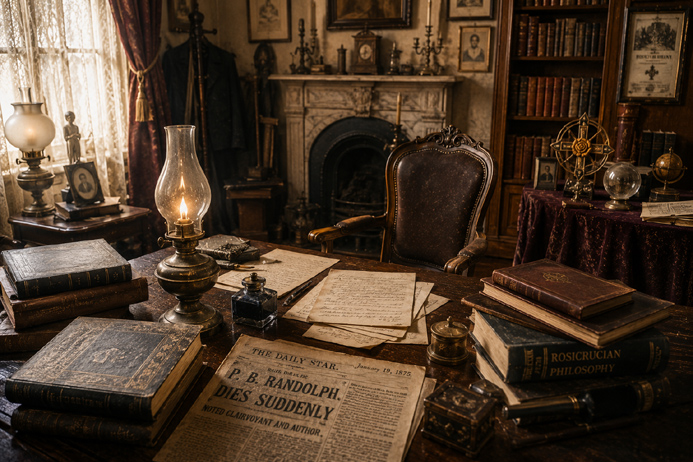
Paschal Beverly Randolph left behind books, teachings, and controversy after his sudden death in 1875.
On July 29, 1875, Paschal Beverly Randolph died in Toledo, Ohio, at the age of forty-nine. The Toledo Daily Blade ran the story under the headline By His Own Hand, reporting that he had died from a self-inflicted gunshot wound to the head in the presence of a neighbor outside his home. The coroner’s verdict was suicide. The Lucas County Probate Court records list the death as accidental. Neither verdict has been accepted without reservation by those who knew him or those who have studied his life.
The circumstances of his death have never been fully resolved, and at least three different accounts of what happened have circulated since 1875. The suicide verdict was the contemporaneous newspaper report, the one that has been carried forward in most standard biographical treatments. But it faces a significant objection that was raised almost immediately: Randolph’s own published writings express a consistent and unambiguous aversion to suicide on spiritual grounds. A man who had written publicly and repeatedly that self-destruction was a profound spiritual error was not an obvious candidate for self-inflicted death by revolver.
The second account, provided by R. Swinburne Clymer, who became Supreme Master of the Fraternitas Rosae Crucis years after Randolph’s death, claims that a former friend of Randolph made a deathbed confession in which he admitted that he had killed Randolph in a state of jealousy and temporary insanity. This account, arriving decades after the event and from a figure with an institutional interest in a more sympathetic narrative around the order’s founder, cannot be verified but also cannot be entirely dismissed.
The third account, preferred by some researchers on circumstantial grounds, is that Randolph was murdered, possibly by a racist neighbor or by someone with political or religious objections to his work, and that the gun was placed near his body to suggest suicide. He was living in a white neighborhood of Toledo with his Irish American wife Kate Corson and their infant son, Osiris Buddha Randolph, born in 1874. The racial tensions of post-Reconstruction America were not a theoretical backdrop to his life. They were a constant practical reality, and Toledo was not immune to them.
What is not disputed is that the last years of his life were genuinely difficult. He was described in some contemporary accounts as struggling with alcohol, experiencing financial hardship, and dealing with personal tensions within his marriage, reportedly having discovered that Kate Corson was involved with another man. He was forty-nine years old, had spent nearly thirty years fighting on multiple fronts simultaneously, and had built an extraordinary body of work that the world was not yet prepared to acknowledge. Whether he died by his own hand, by a neighbor’s, or by forces that the documentary record cannot recover, the circumstances of the end were as complicated and contested as everything else about him.
Arthur Ford Séance: The Shocking Truth Behind the Night Houdini Came Back
The Clairvoyant America Forgot
How does a man who was famous enough in his lifetime to fill lecture halls across the United States and Europe, who published more than fifty books and pamphlets, who founded what is recognized as the oldest Rosicrucian order in the United States, and whose ideas directly influenced Helena Blavatsky, the Hermetic Brotherhood of Luxor, the Golden Dawn, and every serious Western occult organization of the following century, how does a man like that disappear from popular memory?
Part of the answer is structural. Randolph wrote and published in a period before the institutions of academic history took psychic and occult subjects seriously enough to preserve and curate their literature carefully. The organizations that carried his ideas forward often did so without full attribution, absorbed his innovations into their own systems and claimed them as original discoveries, or actively sanitized his legacy to remove the elements, particularly his teachings on sexual magic, that made them uncomfortable. The Fraternitas Rosae Crucis that exists today avoids his more controversial teachings almost entirely.
Part of this answer is racial. In a field already marginalized by mainstream culture, a Black practitioner faced a double marginalization that required extraordinary effort simply to be heard in his own time, and left his legacy doubly vulnerable to neglect and erasure after his death. He was aware of this. He wrote about it directly. He believed that the same ideas labeled Rosicrucian received a hearing that the same ideas spoken by a Black man in his own voice would not have gotten. He was not wrong, and the pattern did not stop with his death.
Part of the answer is that he was genuinely ahead of where his culture was ready to go. His insistence that clairvoyance was a universal human capacity that could be systematically developed, that the body was a foundation rather than an obstacle for psychic work, that the practitioner’s will and discernment were as important as receptivity, and that psychic experience needed to be observed with the same careful attention one brought to any other empirical phenomenon: these ideas found their time eventually, but not until long after his name had faded from the conversation.
The historian Joscelyn Godwin noted in 1994 that Randolph had been largely neglected by historians of esotericism. John Patrick Deveney’s landmark biography, published in 1996, represented the first serious scholarly attempt to recover the full dimensions of his life and work, and even now he remains far less known than figures whose influence on Western psychic and occult culture was arguably smaller than his own.
What remains, for any serious student of clairvoyance, is a body of teaching that deserves to be read on its own terms. The man who wrote that clairvoyance is the birthright of every human being, who developed specific methods for cultivating it and specific cautions against distorting it, and who pursued this work across thirty years of personal difficulty and public hostility, was not simply a colorful nineteenth-century figure. He was one of the most serious and systematic thinkers the American psychic tradition has ever produced. He simply had the misfortune to be born a century before the culture was ready to say so out loud.
Paschal Beverly Randolph: A Nineteenth-Century Black American Spiritualist, Rosicrucian, and Sex Magician
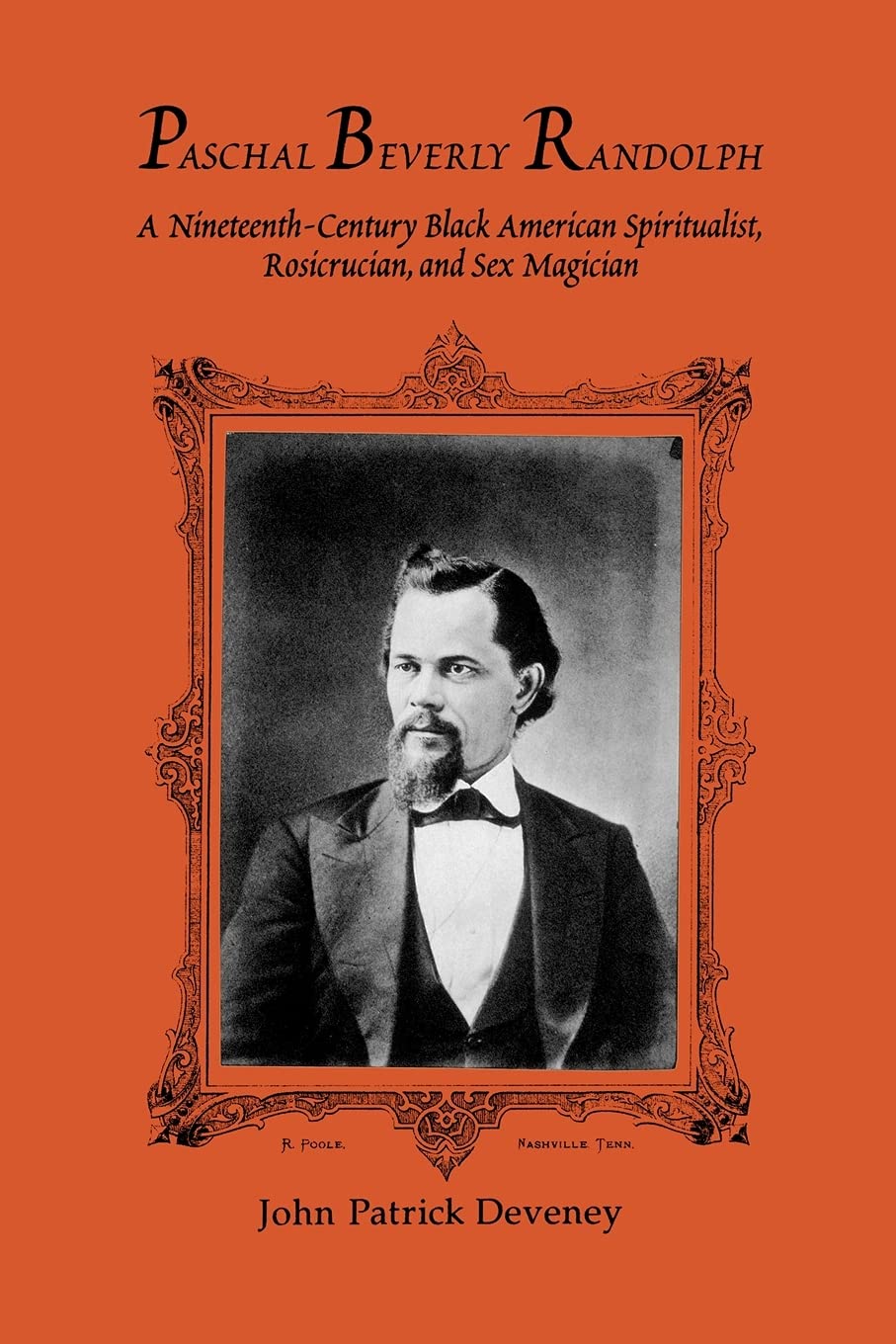
Cover of Paschal Beverly Randolph: A Nineteenth-Century Black American Spiritualist, Rosicrucian, and Sex Magician
Product Description:
For readers who want to explore the remarkable life and lasting influence of Paschal Beverly Randolph, this groundbreaking biography by historian John Patrick Deveney remains the definitive scholarly resource. It traces Randolph’s extraordinary journey from the streets of New York’s Five Points to becoming one of the nineteenth century’s most influential figures in Spiritualism and Western occultism.
Book Highlights:
- The first comprehensive scholarly biography devoted to Paschal Beverly Randolph.
- Explores Randolph’s work as a Spiritualist, Rosicrucian, author, lecturer, and pioneering occult thinker.
- Examines his travels through Europe, Egypt, and the Ottoman Empire and how they shaped his spiritual philosophy.
- Documents his influence on later esoteric movements, including Helena Blavatsky and the Theosophical Society.
- Includes the complete text of Randolph’s two most important surviving manuscripts on sexual magic for historical study.
Why You’ll Enjoy This Book:
Whether your interest is American Spiritualism, nineteenth-century history, Rosicrucian traditions, or the origins of modern occult movements, this carefully researched volume provides valuable historical context and insight into one of America’s most intriguing and often overlooked figures. It separates documented history from legend while examining Randolph’s enduring impact on esoteric thought.

Known as The Man Who Notices, Mike Lamp is a theatrical hypnotist and psychic performer with more than twenty years of live stage experience. His work emphasizes observation, psychological influence, and measured presentation rather than spectacle or provocation. Performances are tailored for adult audiences, private events, and professional settings where control, clarity, and atmosphere matter.

Leave a Reply
You must be logged in to post a comment.