25
Jun
Hypnosis Myths and Legends: The Surprising Stories That Started Them All
Hypnosis Myths and Legends Have Been Around Longer Than You Think
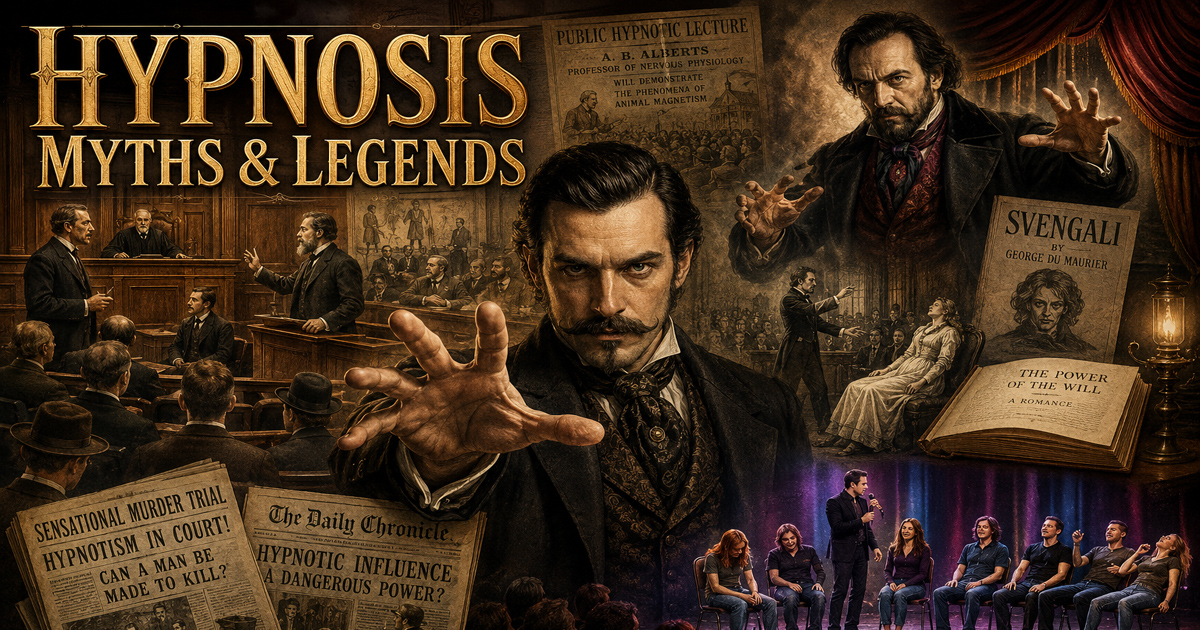
Hypnosis Myths and Legends have grown from a fascinating mix of real history, courtroom drama, sensational newspapers, and fictional characters that shaped public opinion for generations.
If you grew up watching old movies or reading thriller novels, you already have a picture of what a hypnotist is. A mysterious figure with piercing eyes, a swinging watch, and the ability to make anyone do anything. That picture is wrong in almost every detail, but it is so vivid and so old that it has outlasted every attempt to correct it.
Hypnosis myths and legends did not come from ignorance alone. They came from real trials, real newspapers, real novels, and real stage performances that got tangled together over two centuries until most people stopped being able to tell which parts were true. This article traces those stories back to where they actually started.
Two Hundred Years of Misunderstanding
The confusion started almost immediately. When Franz Anton Mesmer introduced his theory of animal magnetism in Paris in 1778, the medical community was already divided. A royal commission appointed by King Louis XVI, which included Benjamin Franklin among its members, investigated Mesmer’s claims in 1784 and concluded that animal magnetism as a physical force could not be demonstrated. That finding did not end public fascination. It deepened it. Some physicians saw genuine therapeutic potential. Others saw a dangerous charlatan performing elaborate theater for wealthy Parisian clients. Both sides published pamphlets, held public debates, and made arguments that were long on conviction and short on evidence.
By the time James Braid coined the word hypnosis in 1843 and tried to give the subject a respectable scientific foundation, the public imagination had already been running with it for decades. Braid was a Scottish surgeon who initially attended a demonstration to expose it as fraud and left convinced there was something genuine worth studying. That detail matters because it reflects how seriously the subject resisted easy dismissal even among skeptical professionals.The mystery was baked in before the science had a chance to catch up.
When Real Events Became Twisted Stories
What makes hypnosis mythology so durable is that it did not come entirely from fiction. Real criminal trials involved hypnosis as a legal argument. Real medical controversies played out in newspapers. Real stage performers drew enormous crowds and sometimes things went wrong in ways that made headlines. Those genuine events became the seeds that fiction writers, folklore storytellers, and sensational editors planted and grew into something far larger than the original facts ever supported.
Understanding where the myths came from does not make hypnosis less interesting. It makes it considerably more interesting, because the real history turns out to be stranger than most of the legends.
Can a Hypnotist Make Someone Commit Murder?
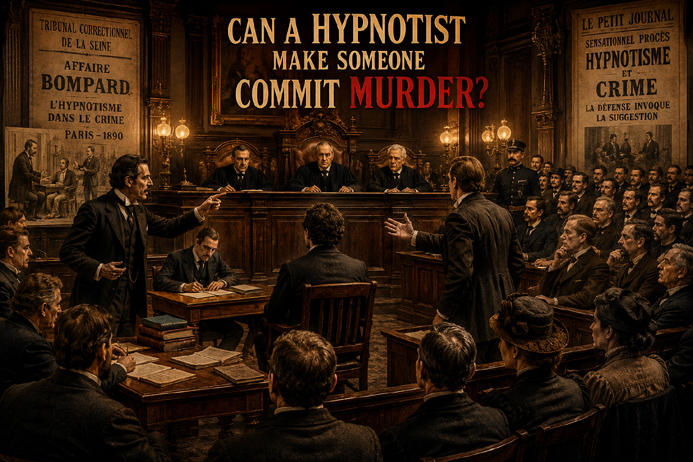
Some of the most enduring Hypnosis Myths and Legends were fueled by famous courtroom cases where hypnosis became part of the legal defense and captured headlines around the world.
The Gabrielle Bompard Trial
In 1890, a young French woman named Gabrielle Bompard stood trial in Paris for the murder of a bailiff named Toussaint-Augustin Gouffé. Her defense was unlike anything a French court had heard before. Her attorney argued that she had been hypnotized by her lover Michel Eyraud and that she had committed the crime while under his hypnotic control, without full awareness or moral responsibility.
The trial drew enormous press coverage across Europe. Two of the most prominent hypnosis researchers of the era, Jean-Martin Charcot and Hippolyte Bernheim, held opposing views on whether hypnotic suggestion could override a person’s will completely. Their disagreement played out publicly through the Bompard case and turned a murder trial into a referendum on the nature of hypnotic influence. The court ultimately rejected the hypnotic defense, but the story of a woman controlled like a puppet by a sinister hypnotist traveled far beyond the courtroom.
The Copenhagen Hypnosis Murders
More than sixty years later, the question came back in Denmark. In 1951, a man named Bjorn Nielsen was convicted in connection with a series of bank robberies in Copenhagen. Prosecutors argued that Nielsen had used hypnosis to compel an accomplice named Palle Hardrup to carry out the crimes, including killings, while acting under post-hypnotic suggestion. The case became known across Europe and reignited every fear the Bompard trial had first introduced.
Psychologists and historians have debated the Copenhagen case ever since. Some believe Hardrup was genuinely manipulated through a combination of prolonged psychological influence and possible hypnotic suggestion. Others argue that what happened was closer to classic coercive persuasion than anything that could be called hypnosis in a clinical sense. The distinction matters enormously, but it rarely survived the journey from academic journal to newspaper headline.
What Victorian Novels and Newspapers Did With These Stories
By the time these trials occurred, fiction writers had already been building the murderous hypnotist for years. George du Maurier published his novel Trilby in 1894, introducing Svengali as the definitive hypnotic villain. Dozens of lesser novels followed the same formula. A mysterious operator with unusual powers, an unwilling subject with no defense, a crime or seduction that would have been impossible without the hypnotic connection.
Newspapers of the era had no interest in slowing the story down. Editors in the late nineteenth century understood that hypnosis sold papers. A trial involving mesmerism, a stage performer whose subject did not wake up, a woman who claimed she could not remember what she had done because she had been in a trance. These stories ran on front pages and were reprinted across continents. The more dramatic the claim, the wider it traveled.
What Modern Researchers Actually Say
There is no convincing scientific evidence that hypnosis allows one person to override the deeply held moral values of another and turn them into a remote-controlled criminal. Researchers who have studied the question seriously, including Irving Kirsch and Graham Wagstaff, have consistently found that hypnotized individuals retain awareness of what they are doing and will refuse suggestions that cross genuine ethical lines.
The famous historical cases remain genuinely controversial. Historians and psychologists still debate what actually happened with Hardrup and Nielsen. But the debate is about coercive psychology, prolonged manipulation, and the nature of influence. Not about a hypnotist pointing a finger and switching off a person’s conscience.
Bridey Murphy Hypnosis: The Day One Session Changed Everything Forever
Can You Get Stuck in Hypnosis Forever?
Where the Legend Came From
Stage performers from the nineteenth century onward occasionally played with the dramatic possibilities of a subject who seemed reluctant to emerge from trance. Newspapers picked up stories of subjects who supposedly could not be awakened after a public demonstration. A few of those stories described subjects being carried home still in trance, or waking up hours later with no memory of how they got there.
None of those stories held up to investigation, but they did not need to. They spread through the same channels as every other hypnosis legend, friend to friend, town to town, decade to decade, gaining detail and drama with each telling. By the twentieth century the “never woke up” story had become one of the most common fears people brought to hypnotists before agreeing to be subjects.
What Actually Happens When a Session Ends
Hypnosis is not a switch that gets flipped and then requires a password to reverse. It is a naturally occurring state that people move in and out of regularly, including during ordinary daydreaming, deep reading, and highway driving. If a hypnotist simply stopped speaking and left the room, a subject would either drift into natural sleep and wake up normally, or gradually return to ordinary waking awareness on their own.
No documented medical case has ever established that a person became permanently unable to emerge from a hypnotic state as a direct result of hypnosis. The fear is understandable given the mythology surrounding the subject. The reality is that the human mind does not need a hypnotist’s permission to come back to itself.
Stuck in a Hypnotic State? The Reassuring Truth About Hypnosis Safety
Can Someone Hypnotize You Without Your Permission?
Svengali and the Birth of a Stereotype
George du Maurier’s 1894 novel gave the world one of its most durable villains. Svengali is a music teacher who hypnotizes a young singer named Trilby and uses his control over her to make her a famous performer entirely dependent on his presence. Without him she cannot sing. With him she has no will of her own. When he dies she collapses on stage mid-performance and never recovers.
The novel was an enormous commercial success and was adapted for the stage almost immediately. The name Svengali entered the English language as a synonym for any manipulative figure who controls another person through psychological means. The image of the hypnotist as someone who could seize control of a stranger’s mind without consent was now permanently embedded in popular culture, and it had a specific face and a specific name attached to it.
Hollywood, Television, and the Swinging Watch
Film accelerated everything. From the silent era through the golden age of Hollywood and into television, the hypnotist appeared again and again as a figure of sinister capability. The swinging watch or pendant became a visual shorthand that required no explanation. Audiences had been trained to recognize it instantly. The subject’s eyes would go glassy, the voice would go flat, and the operator would begin issuing commands.
Television kept the image alive through decades of dramas, comedies, and variety shows where hypnosis was played for either laughs or chills. By the time most people alive today formed their first impressions of hypnosis, those impressions had been shaped almost entirely by entertainment rather than any direct experience or reliable information.
Why Cooperation Is the Whole Point
Willingness is not a minor footnote in how hypnosis works. It is central to the entire process. Hypnosis requires the subject to follow along, to accept suggestions, to allow their attention to be guided in a particular direction. A person who actively resists, who refuses to engage, who does not want the experience to happen, is not a good candidate for hypnosis regardless of how skilled the operator is.
This does not mean that social pressure, authority, and expectation have no influence. They do. But that influence operates through the subject’s own psychology, not around it. The idea that a hypnotist can reach into a stranger’s mind and take control without any cooperation from that stranger belongs entirely to fiction.
Arthur Ford Séance: The Shocking Truth Behind the Night Houdini Came Back
Does Hypnosis Force People to Tell the Truth?
Hypnosis in the Courtroom and the Police Station
During the 1960s and 1970s, law enforcement agencies in the United States and elsewhere began experimenting with hypnosis as an investigative tool. The theory was straightforward and appealing. A witness who could not consciously recall details of a crime might be able to access those details under hypnosis, where the usual barriers to memory were supposedly lowered. Investigators trained in hypnotic techniques began working with witnesses and victims to recover information that standard interviews had not produced.
Some of those sessions appeared to produce useful leads. Witnesses recalled license plate numbers, physical descriptions, and sequences of events that they had not been able to report previously. The technique gained enough credibility that it was used in high-profile cases and discussed seriously in law enforcement journals.
The Recovered Memory Debate
The problem that researchers eventually identified was fundamental. Hypnosis does not function like a video recorder that can be rewound to a cleaner version of a memory. Memory itself is reconstructive rather than reproductive. Every time a person recalls an event, they are rebuilding it from fragments, and that rebuilding process is influenced by suggestion, expectation, and the questions being asked.
Under hypnosis, subjects become more responsive to suggestion, not less. A researcher or investigator who asks leading questions, even unintentionally, can shape what a hypnotized subject recalls. Worse, the subject often emerges from the session with increased confidence in the accuracy of what they remembered, even when what they remembered was partly or entirely a construction rather than a genuine retrieval.
Why Forensic Hypnosis Became Far More Limited
As the research accumulated, courts in the United States began restricting or excluding testimony from witnesses who had been hypnotized during the investigation. The concern was not that hypnosis produced lies exactly, but that it produced confident false memories that were nearly impossible to distinguish from accurate ones, even by the person holding them.
Forensic hypnosis did not disappear entirely, but it became far more tightly regulated. The story is a good example of how a genuine and well-intentioned application of hypnosis ran into the limits of what the technique can actually do reliably.
Are Stage Hypnotists Hiding Something Dangerous?
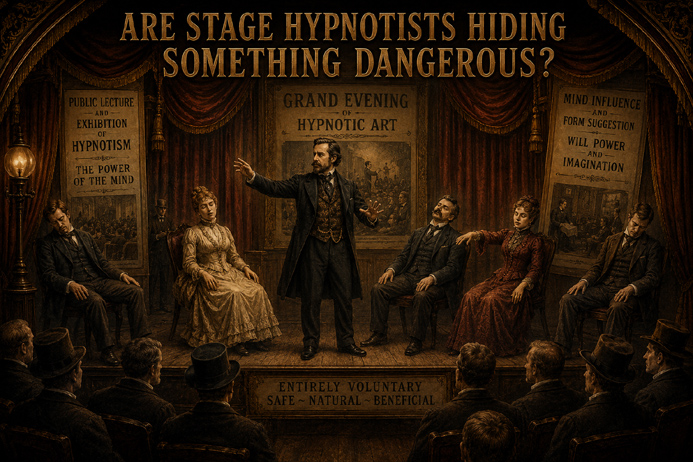
Many Hypnosis Myths and Legends were reinforced by public stage demonstrations that audiences often misunderstood long before modern psychology explained what they were actually seeing.
What the Fear Is Really About
Some people who watch a stage hypnosis show come away unsettled rather than entertained. The sight of ordinary audience members doing unexpected things in front of a crowd raises a question that feels important. If those people can be made to act that way, what else could they be made to do? And what exactly is the performer doing that produces that result?
The fear is understandable, and it deserves a serious answer rather than dismissal. It comes from a genuine place, which is the recognition that something real is happening on that stage even if the mythology around it is largely wrong.
Expectation, Willingness, and the Psychology of Performance
What happens on a stage hypnosis show involves real psychological principles operating in a specific social environment. Volunteers have chosen to come forward. They are in front of an audience that expects them to participate. The performer has skill in identifying responsive individuals and in creating an atmosphere where suggestion carries weight. Social pressure, the desire to be entertaining, and genuine hypnotic responsiveness all contribute to what the audience sees.
None of that is secret and none of it requires anything sinister. The same principles that explain why people laugh louder at a comedy club than watching the same material at home, or why a sporting crowd amplifies individual emotion, explain a great deal about what happens when a skilled performer works with willing volunteers in a theater.
Why the Performance Works Without Any Dark Secret
Stage hypnosis works because human beings are genuinely responsive to suggestion, genuinely influenced by social context, and genuinely capable of entering altered states that allow for experiences they would not have in ordinary waking life. That is not a trick. It is not a danger. It is a fascinating fact about human psychology that stage performers have been demonstrating publicly for more than two centuries.
The craft involved in doing it well is real and takes years to develop. A skilled stage hypnotist reads an audience the way a seasoned musician reads a room. The ability to identify responsive volunteers quickly, establish rapport under pressure, and guide a group experience with precision and humor is not something that arrives without serious work and serious study. The darkness that mythology has layered on top of that craft is not real. The craft itself absolutely is.
Where Did Hypnosis Myths and Legends Really Come From?
Fiction
Novelists made hypnotists into villains because it worked perfectly as a dramatic device. A hypnotist villain required no elaborate backstory to explain why they were dangerous. The danger was built into the premise. Readers already understood, or thought they understood, what a hypnotist could do. That shared assumption gave fiction writers an enormous shortcut, and they used it for well over a century.
Folklore
People love telling stories about hypnosis because the stories occupy a specific sweet spot. They feel believable because they involve a real phenomenon, but they also feel impossible because the things described go far beyond ordinary experience. That combination is exactly what makes a story travel. Friend of a friend legends about hypnosis show up across cultures and across generations because the subject seems to invite exaggeration naturally.
Newspapers
Late nineteenth century newspaper editors discovered early that hypnosis stories sold papers. A trial involving a hypnotic defense, a stage performer whose subject collapsed, a woman who claimed she had been controlled against her will. These stories were printed with enthusiasm and very little skepticism. They were reprinted across continents. The more dramatic the claim, the more widely it traveled, and accuracy was rarely the first consideration.
Real History
There really were medical debates, criminal trials, and public demonstrations. Mesmer’s sessions in Paris were real events attended by real people. The Bompard trial happened. The Copenhagen case happened. Early researchers genuinely disagreed about what hypnosis could and could not do, and some of those early claims were extravagant by any modern standard. Real history provided the seed. Fiction, folklore, and newspapers grew something much larger around it, and the two became so tangled that most people eventually stopped knowing where the history ended and the legend began.
The Two Worlds Hypnosis Has Always Lived In
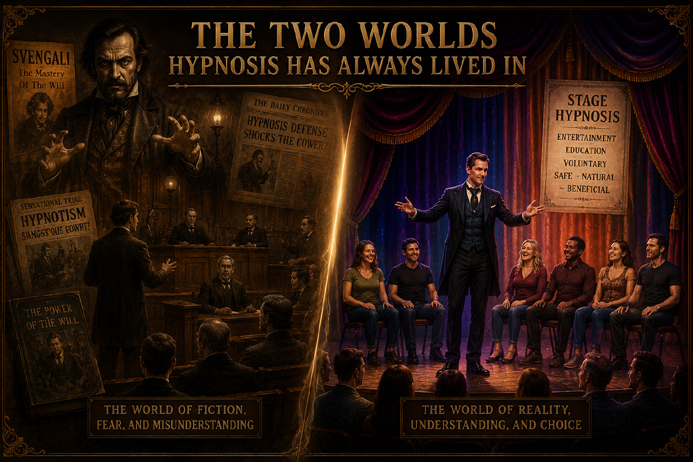
The history of Hypnosis Myths and Legends has always existed between two worlds, one built by fiction and fear, and the other grounded in voluntary participation and real human psychology.
Hypnosis has one of the most unusual histories of any subject in psychology. For more than two hundred years it has lived in two worlds at once. One is built from scientific research, clinical practice, and careful observation of what the human mind actually does under suggestion. The other is built from novels, stage plays, sensational headlines, and stories repeated from one generation to the next until they feel like established fact.
The myths did not come from stupidity or pure invention. They came from real events that got stretched, real fears that found a perfect vehicle, and real performances that looked like magic to audiences who had no other framework for what they were seeing. That history is worth knowing, not because it makes hypnosis seem ordinary, but because the actual story turns out to be far more interesting than the legends ever were.
Understanding the difference between what hypnosis is and what two centuries of mythology made it into does not reduce the subject. It opens it up in ways that most people who think they already know what hypnosis is have never had the chance to experience.

Known as The Man Who Notices, Mike Lamp is a theatrical hypnotist and psychic performer with more than twenty years of live stage experience. His work emphasizes observation, psychological influence, and measured presentation rather than spectacle or provocation. Performances are tailored for adult audiences, private events, and professional settings where control, clarity, and atmosphere matter.



Leave a Reply
You must be logged in to post a comment.