18
Jun
Arthur Ford Séance: The Shocking Truth Behind the Night Houdini Came Back
Arthur Ford’s Incredible Message From Beyond
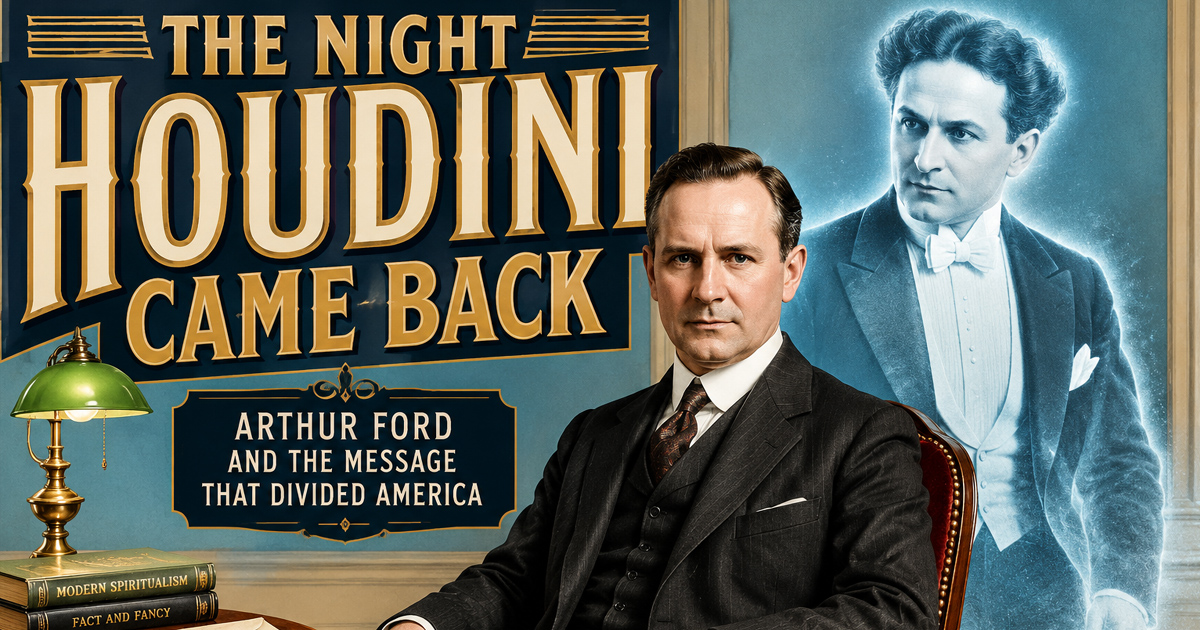
The famous Arthur Ford Séance became one of the most controversial events in psychic history when messages allegedly from Harry Houdini were revealed.
Harry Houdini died on Halloween night, October 31, 1926. He was 52 years old, and he left behind a world that had watched him escape from handcuffs, locked trunks, submerged crates, and sealed milk cans for three decades. But the one thing the great Houdini could not escape was death itself. What followed in the years after his passing became one of the most debated stories in the history of American spiritualism.
A medium named Arthur Ford claimed to have done what no one else had managed to do. He claimed to have received a message from the other side, delivered in a secret code that only Houdini and his wife had ever known. The Arthur Ford séance of January 8, 1929, shocked the country, made headlines from coast to coast, and has never been fully explained to everyone’s satisfaction.
Arthur Ford Séance and the Man Behind the Messages
To understand what happened on that January night in 1929, it helps to understand who Arthur Ford was and how he arrived at that moment. Ford was not an obscure figure operating on the fringes of American society. By the time he sat down with Bess Houdini, he was one of the most recognized mediums in the country, with a reputation that had been built carefully over nearly a decade.
A Medium America Could Not Ignore
Arthur Augustus Ford was born on January 8, 1896, in Titusville, Florida, into a Southern Baptist family. His early religious life was restless. He moved through Episcopalianism, the Baptists, Unitarianism, and finally the Disciples of Christ, attending Transylvania College in Lexington, Kentucky, where he trained for the ministry. He was ordained and served a congregation in Barbourville, Kentucky before his life took a turn that no seminary had prepared him for.
During his service in World War I, Ford began to experience something he could not explain. He reported hearing the names of soldiers around him, and those names would appear on the casualty lists days later. Whether that experience was genuine perception or a mind under wartime stress finding patterns in grief, it convinced Ford that he possessed an ability beyond ordinary knowledge. By 1921 he had committed fully to spiritualism and emerged as a trance medium, working through a spirit guide he called Fletcher, a presence that would remain his claimed contact point for the rest of his life.
How Ford Built His Reputation Before Houdini
Through the early and mid 1920s Ford built a following in New York City, where he founded a Spiritualist congregation and developed a reputation for detailed and evidential mediumship. In 1927 he traveled to Great Britain, where his demonstrations drew serious attention. Sir Arthur Conan Doyle, the author of Sherlock Holmes and one of the most committed Spiritualists of his generation, attended one of Ford’s lectures and was deeply impressed, publicly describing Ford’s demonstration as one of the most remarkable things he had witnessed in over four decades of psychical investigation.
That endorsement carried weight. Conan Doyle was not a naive observer. He was a man who had spent years examining psychic claims with at least some degree of critical attention. His praise put Ford on an entirely different level of public credibility and set the stage for what was coming.
Houdini’s Lifelong War Against Fraudulent Mediums
Harry Houdini’s relationship with spiritualism was complicated and deeply personal. He was not simply a professional skeptic who enjoyed debunking claims for sport. His campaign against fraudulent mediums grew from grief, from the death of his mother Cecelia Weiss in 1913, and from his furious reaction to the charlatans who exploited that grief by pretending to channel her voice.
Read my article on Houdini Debunking Psychics: The Ruthless Truth
The Secret Code Only One Person Knew
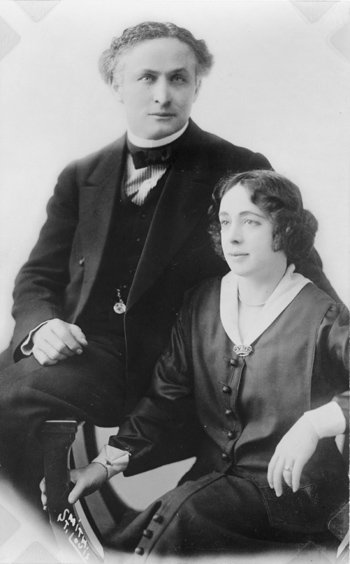
The bond behind the Arthur Ford séance
Despite his public war against mediums, Houdini held a private hope that genuine communication with the dead might be possible. He and his wife Beatrice, known as Bess, devised a secret code drawn from a mentalist routine they had used together during their vaudeville performing years. The code was a word substitution system built around the phrase Rosabelle, a song that held deep personal meaning for both of them. Houdini’s plan was straightforward.
If survival after death was real, and if any communication was genuinely possible, he would use that code to prove it. Only Bess would recognize the correct message. Anyone else who claimed to bring word from Houdini without delivering that precise code in the correct form was, by definition, a fraud.
Why Houdini Trusted No One
Houdini’s distrust of mediums was not abstract. He had spent years attending séances in disguise, documenting the methods used to deceive grieving families, and testifying before Congress about the harm caused by fraudulent psychic practitioners. He knew every trick. He had invented several of them himself in his earlier performing days. That knowledge made him a formidable and relentless investigator, and it made the secret code all the more significant. It was designed by a man who understood deception from the inside and had constructed a test that he believed could not be faked.
The Arthur Ford Séance That Shocked America
Houdini died on October 31, 1926, from peritonitis following a ruptured appendix. Bess honored his wishes by holding annual séances on Halloween, offering a ten thousand dollar reward to any medium who could deliver the correct coded message. For two years, no one came close. Then Arthur Ford arrived.
The Room Where It Happened
In January 1929, Ford’s associate Francis Fast brought word to Bess that Ford was prepared to attempt contact. Bess was not well. She had fallen down a flight of stairs the week before and was also battling influenza. A reporter named Rea Jaure of the New York Evening Graphic described Bess as being in a state of semi-delirium from her illness and medication. Despite this, she agreed to allow the séance to proceed at her home on January 8, 1929. The date was significant to anyone paying attention. It was Arthur Ford’s thirty-third birthday.
The Message That Stopped the Country
During the séance, Ford entered a trance state and began to speak through his spirit guide Fletcher. What came through was a specific sequence of words built around the name Rosabelle, followed by the substitution code that spelled out the word BELIEVE. The full decoded message was delivered as: Rosabelle, Answer, Tell, Pray, Answer, Look, Tell, Answer, Answer, Tell.
According to the code system Houdini and Bess had devised, that sequence translated to the single word Believe, the word Houdini had chosen as his message to her if he ever made contact from the other side. Ford concluded the transmission with words attributed to Houdini himself: Tell the world, Sweetheart, that Harry Houdini still lives and will prove it a thousand times.
What the Secret Code Actually Revealed
The morning after the séance, Bess confirmed to the New York World that the message was correct. She stated publicly that she had no idea what combination of words Harry would use and that when the word believe came through, it was a genuine surprise to her. Ford produced a signed document from Bess acknowledging that he had delivered the correct message. The Arthur Ford séance had apparently done what two years of claimants had failed to do.
The Words Bess Had Never Made Public
The code rested on a substitution system tied to the words of the song Rosabelle, a song Bess had sung in her early vaudeville days that Houdini had always associated with her. Each word in the song corresponded to a letter of the alphabet, allowing a sequence of words to spell out a hidden message. The specific word chosen as the test message, BELIEVE, was described by those close to Houdini as deeply personal, reflecting his private longing to find genuine evidence of survival after death.
Why National Attention Was Inevitable
The combination of elements was irresistible to the American press. A world-famous magician who had spent his career debunking mediums. A grieving widow offering a fortune to anyone who could prove contact. A young reverend entering a trance and delivering a message so precise that the widow herself confirmed it on the record. By January 9, 1929, the story was everywhere.
Bess Houdini Responds
Bess Houdini’s initial reaction was one of genuine confirmation. She had signed Ford’s document. She had spoken to the press. She had acknowledged the message as correct. For a brief window of time, the Arthur Ford séance appeared to have settled one of the most famous wagers in the history of psychical research.
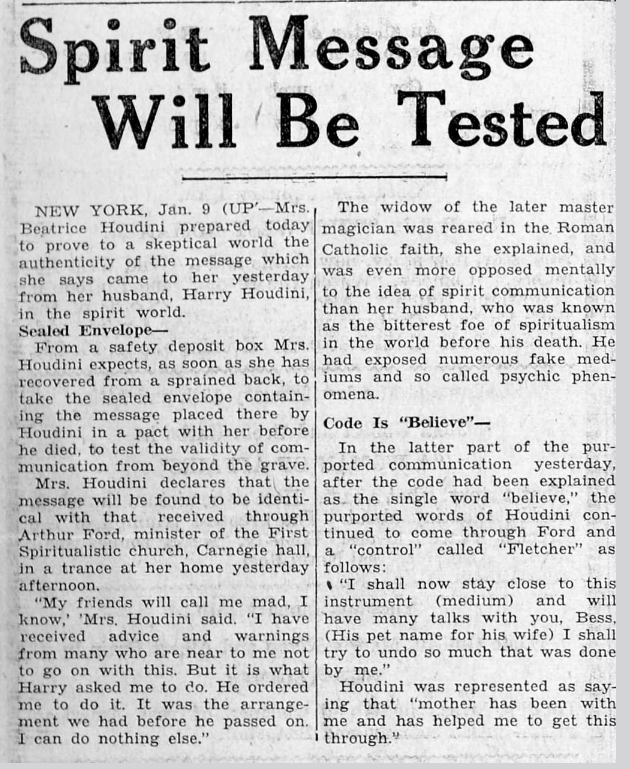
How the Arthur Ford séance made headlines
Her Initial Confirmation and What She Said
In her statement to the New York World on January 9, 1929, Bess was quoted directly, expressing surprise at the specific word that came through. Her confirmation was not hedged or cautious. It was unambiguous. For Ford, the signed letter and the public statement represented the clearest possible validation. For the American public, the story of a dead escape artist delivering a coded message from beyond the grave was something that no amount of skepticism could make less compelling.
The Publicity That Followed and Why It Mattered
The aftermath transformed Ford’s public profile overnight. He had already been a respected figure within Spiritualist circles. Now he was a household name. Newspapers that had never covered a séance devoted front page space to the story. Ford became, in the language of the time, the man who talked with the dead, a description that would follow him for the rest of his life and eventually become the title of a biography published in 1973.
Skeptics Push Back Hard
The challenge to the Arthur Ford séance did not take long to arrive. Within days of Bess’s confirmation, the alternative explanation was already forming in newsrooms across the country.
The Arguments Against Ford
On January 10, 1929, just two days after the séance, Edward Churchill of the New York Evening Graphic declared the Ford séance a hoax, claiming that Ford had admitted obtaining the code directly from Bess. Ford denied this. Bess later withdrew her confirmation and repudiated the séance entirely. The situation became complicated further by the discovery that the code used between Houdini and Bess had been published the previous year in Harold Kellock’s 1928 biography Houdini: His Life-Story. If Ford had access to that book, he had access to the code without any supernatural assistance.
Allegations of Prior Knowledge and Leaked Information
Milbourne Christopher, one of the most thorough investigators of psychic claims in the twentieth century, argued that the code was not nearly as secret as it had been presented. Witnesses alleged that Ford had told journalist Rea Jaure at her apartment that Bess had given him the code directly. It was also noted that in 1927, Bess had told a reporter for the Brooklyn Eagle that any authentic communication from Houdini would include the word forgive, a message from Houdini’s mother that Houdini had longed to hear.
Ford had used that first, delivering the word forgive in a séance the year before, in 1928, before attempting the full Houdini code in January 1929. Ford’s own literary executor and biographer, Canon William V. Rauscher and Allen Spraggett, later acknowledged they had found evidence that the séance had been faked. Ford himself, until his death in 1971, always maintained that it was genuine.
Newspapers Could Not Get Enough
Whatever the truth behind the séance, the press coverage it generated was unlike anything the Spiritualist movement had seen in years. The story had everything that editors required. Fame, death, mystery, a secret code, a grieving widow, and a reverend who claimed to speak for the dead.
How the Story Spread Across America
From New York the story moved quickly to papers across the country. The specific details, the name Rosabelle, the coded word sequence, the signed document, the widow’s confirmation, gave journalists concrete material to work with rather than the vague impressions that most séance accounts produced. Readers who had never given a moment’s thought to spiritualism found themselves drawn in by the precision of the claim and the credibility of the widow’s initial response.
What Fame Did to Ford After the Séance
The coverage turned Ford into a figure who existed beyond the boundaries of the Spiritualist community. He lectured to mainstream audiences. He was invited to speak at conventional churches. He attracted the attention of researchers, journalists, and curious members of the public who wanted to see for themselves what this man could do. The fame was not without cost. The controversy never fully left him, and the questions about how he had obtained the code shadowed his reputation for decades. Ford also struggled privately with alcohol dependency throughout much of his adult life, a fact documented by his biographers and acknowledged by those close to him.
Did the Arthur Ford Séance Actually Contact Houdini?
Nearly a century after that January evening in 1929, the Arthur Ford séance remains genuinely open as a historical question. Not because the evidence is evenly balanced, but because the human elements involved resist simple resolution.
The Case for Belief
Bess Houdini confirmed the message on the record. She signed a document. She expressed surprise at the specific word that came through. Ford never collected the ten thousand dollar reward, which he could have pursued legally. He maintained the authenticity of the séance for the rest of his life without ever wavering publicly. Sir Arthur Conan Doyle, a man who had examined psychic claims for four decades, supported Ford’s credibility. And the coded message itself, delivered in the correct sequence with the correct substitution system, was not something a casual guess could produce.
The Case for Doubt
The code had been published in a book the year before. Witnesses claimed Ford had received the information from Bess directly. Bess herself later withdrew her confirmation. She was ill and described as semi-delirious at the time of the séance. Ford’s own biographers found evidence of deception. The journalist who was present alleged Ford had admitted the source of his information. And Ford’s formal psychic testing by the American Society for Psychical Research had produced not a single successful result.
Arthur Ford’s Lasting Legacy in Psychic History
Arthur Ford lived until January 4, 1971, dying just four days before what would have been his seventy-fifth birthday. He had spent nearly fifty years as a public figure in American spiritualism, and the Houdini séance, for all its controversy, was only one chapter in a long and complicated career.
Read Daniel Dunglas Home: Remarkable Historical Evidence
Why the Séance Still Matters Today
The Arthur Ford séance endures not because it proved anything definitively but because it asked a question that human beings have never stopped asking. What happens after death? Is any form of communication possible across that boundary? Houdini, a man who had dedicated years of his life to proving that it was not, had nevertheless arranged a test on the slim chance that he was wrong. That combination of skepticism and private hope is more honest than most people are willing to be about the subject, and it gives the story a human depth that no amount of debunking can entirely dissolve.
Ford’s Place Among the Most Discussed Mediums in History
Ford went on to gain national attention again in 1967, nearly four decades after the Houdini séance, when he appeared on television and claimed to deliver messages from the deceased son of Episcopal Bishop James Pike. The broadcast reached millions of viewers and reignited debates that the Houdini séance had first sparked. He founded the Spiritual Frontiers Fellowship in 1955, an organization built around integrating psychic and spiritual inquiry into mainstream religious life. Whatever judgment history makes of his methods, his place in the record of American spiritualism is permanent.
The Arthur Ford séance of January 8, 1929, has never been proven genuine and has never been definitively proven false. Bess confirmed it and then denied it. Ford claimed it and never backed away. The code may have been stolen or it may have been received. The widow may have been deceived or she may have been briefly, genuinely convinced. What remains, almost a century later, is the image of a famous escape artist who spent his life proving that mystery could always be explained, and the quiet, stubborn question of whether, in the end, he found one final trick that even he could not account for.
Further Reading & Resources
📖 Read: Analysis of an Arthur Ford Séance
🔍 Arthur Ford hoax

Known as The Man Who Notices, Mike Lamp is a theatrical hypnotist and psychic performer with more than twenty years of live stage experience. His work emphasizes observation, psychological influence, and measured presentation rather than spectacle or provocation. Performances are tailored for adult audiences, private events, and professional settings where control, clarity, and atmosphere matter.


Leave a Reply
You must be logged in to post a comment.