14
Mar
The Sun Tarot Card Meaning: Clear Guide to Powerful Symbolism
The Sun Tarot Card Meaning: Powerful Clarity Unlocked
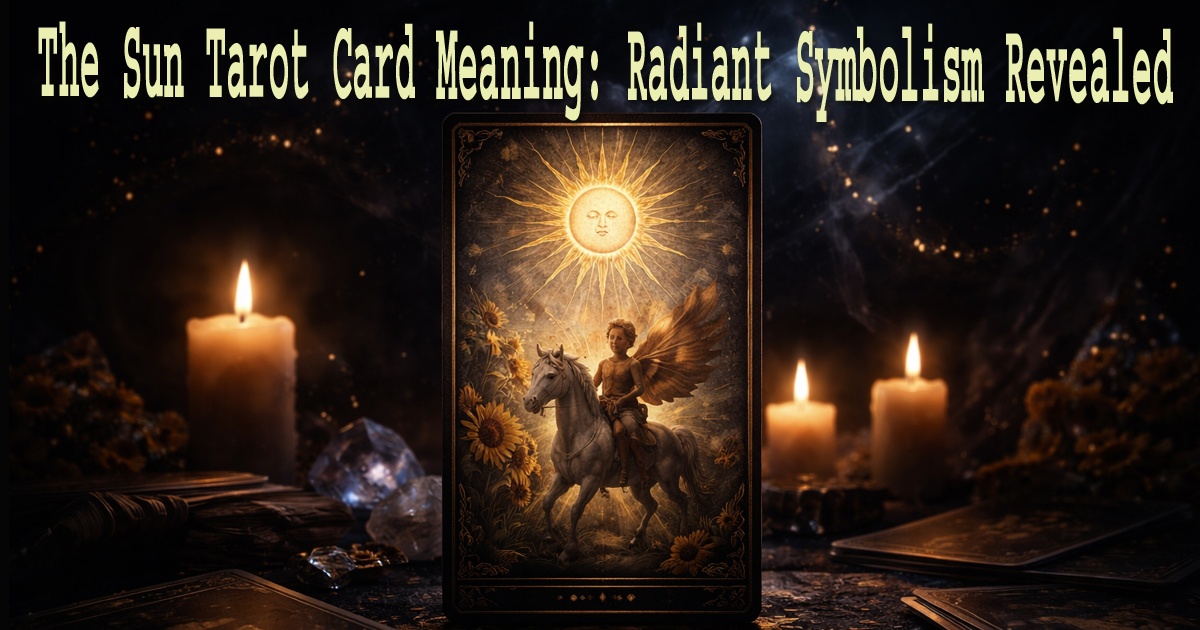
The Sun Tarot Card Meaning represented through radiant solar light and Major Arcana symbolism
What the Card Represents
The Sun Tarot Card Meaning sits at the heart of one of the most recognizable images in the entire tarot tradition. A radiant sun dominates the upper portion of the card. Below it, a young child rides a white horse, arms open, a red banner streaming behind. Sunflowers line a low stone wall. The imagery carries no ambiguity. This is warmth, clarity, and the uncomplicated joy that arrives when confusion finally lifts.
Within the Major Arcana, The Sun occupies position nineteen, numbered XIX in Roman numerals as it appears on the card itself. It follows The Moon, card XVIII, a card of illusion and hidden depths, and precedes Judgement, card XX. This placement is deliberate. After the disorientation and shadow play of The Moon,
The Sun arrives as resolution. The spiritual journey in tarot moves the seeker through stages of darkness and uncertainty before delivering this moment of radiance. The Sun does not promise safety from future challenges. It marks a point of arrival, a place where things become visible and knowable again. Crucially, it is one of the few cards in the Major Arcana that carries an essentially unconditional quality, even in reversal its core meaning bends rather than breaks.
Read Major Arcana Secrets: Shocking Dark Origins Revealed Exclusive Article
Symbolism Within the Image
Every element in the card carries symbolic weight. The child represents the self that has moved through experience and emerged into simplicity, not the innocent self that has not yet encountered difficulty, but the self that has passed through The Moon‘s confusion and arrived at something clearer. Riding freely, without armor or concealment, the figure embodies the kind of ease that comes not from ignorance but from having passed through difficulty. The white horse suggests purity and forward movement, not urgency but steady confidence.
The Sun Tarot Card Meaning draws on layered natural and celestial symbols that have remained consistent across centuries of tarot tradition.
The sunflowers, four of them in the Rider-Waite-Smith image, traditionally associated with devotion and orientation toward light, reinforce the sense that the card’s energy turns instinctively toward what is life-giving. Four is a number of stability and grounding, suggesting that this joy has a firm foundation beneath it.
The sun itself does not merely illuminate. In tarot card archetypes, it represents consciousness, the capacity to see clearly and without distortion. More precisely, it represents solar consciousness as distinct from lunar consciousness. Where The Moon deals in reflection, impression, and the unconscious, The Sun deals in direct knowing, the kind of awareness that does not require interpretation because the thing itself is simply visible. The face depicted within the sun varies across different deck traditions, sometimes serene, sometimes beaming, always present.
In the Rider-Waite-Smith deck specifically, the sun’s face carries a quality of benign attention rather than authority, which distinguishes it from older solar symbolism where the sun as divine overseer carried considerably more weight of judgment. This solar face watching over the scene suggests not judgment but witnessing, a quality of awareness that supports rather than scrutinizes. Tarot card archetypes like this one accumulate layers of meaning through centuries of use, and The Sun is among the most stable in its symbolism across virtually every tradition of tarot interpretation.
The earliest known printed tarot decks, produced in northern Italy during the fifteenth century, did not include The Sun as a standard named card in every edition. Some early sequences omitted or repositioned solar imagery entirely, and the card’s fixed placement at position nineteen was not universally settled until printed decks became more standardized in the late fifteenth and early sixteenth centuries.
The Sun Upright Meaning
The Sun upright meaning centers on clarity, vitality, and honest optimism. When this card appears in a reading, the conditions described tend to favor visibility. What has been murky becomes legible. What has been withheld tends to surface. The Sun upright meaning does not guarantee outcomes but describes an environment where conditions align well, where things are what they appear to be.
In practical terms, the upright position often accompanies periods of genuine progress. Projects find footing. Relationships feel easier. Health and energy tend toward stability. The Sun upright meaning carries no warning but it does carry a kind of instruction, however subtly: to take full advantage of what clarity offers, since it does not always persist indefinitely. The Sun’s gift is not passive, it requires the seeker to actually step into the light rather than remain at its edges. In readings focused on the spiritual journey in tarot, this position often marks a point where the seeker has done sufficient inner work to move forward without as much resistance.

The white horse associated with The Sun Tarot Card Meaning carries a quality of steady forward presence that aligns with the upright card’s emphasis on clarity and momentum.
The Sun Reversed Meaning
The Sun reversed meaning does not transform the card into something sinister. Reversal, in most established tarot interpretations, introduces complication rather than opposite meaning. The energy represented by the card remains fundamentally positive, but something interrupts its full expression.
The Sun reversed meaning often points to a temporary dimming rather than an absence of light. Confidence wavers. Clarity is available but not fully reached. Sometimes the card reversed appears when someone is close to a breakthrough but has not yet arrived at it, when the light is present at the edges but not yet flooding the entire picture. In readings addressing the spiritual journey in tarot, The Sun reversed can signal that more inner attention is needed before the kind of radiance suggested by the upright position becomes fully accessible.
In some interpretive traditions, The Sun reversed meaning also raises questions of ego, specifically the difference between genuine confidence and the performance of confidence, between authentic vitality and the forced cheerfulness that masks unresolved difficulty. The child’s uninhibited energy, when working against its natural direction, can tip toward overconfidence or willful blindness to inconvenient information. This is rarely a dramatic warning but worth noting as a possibility in the broader context of a reading. Major Arcana symbolism tends to operate at a level of principle rather than specific event, and reversal adds nuance without undermining the card’s essential character.
In the Tarot of Marseille tradition, which dominated European tarot production for roughly three centuries before the Rider-Waite-Smith deck appeared, The Sun card frequently depicted two standing children facing each other beneath the solar disc, a compositional choice that art historians have linked to twin symbolism in medieval manuscript illustration rather than to any specific esoteric doctrine.
The Sun in the Context of the Major Arcana
Understanding Major Arcana symbolism requires looking at individual cards in relation to the sequence around them. The Sun does not exist in isolation. Its position after The Moon and before Judgement places it at a pivotal moment in the larger arc of the Fool’s journey, that foundational narrative structure through which tarot card archetypes are often understood.
The Moon, which precedes it, deals with what lies beneath the surface, with perception shaped by fear or desire, with the parts of experience that resist easy categorization. The Sun, arriving next, resolves that tension through exposure. It is not that the night’s complexity disappears, but that daylight makes navigation possible in ways that moonlit ambiguity cannot. Judgement, which follows, deals with evaluation and calling, a moment of reckoning with what one has become. The Sun’s placement between these two cards gives it a function that is almost transitional, a necessary rest stop between inner confusion and outer reckoning.
How The Sun Appears Across Different Deck Traditions
The Rider-Waite-Smith deck, published in 1909 and illustrated by Pamela Colman Smith under Arthur Edward Waite’s direction, established the image of the child and horse that has since become canonical. Smith’s contribution to this image is frequently underacknowledged, yet the warmth and accessibility of The Sun card in its modern form owes as much to her artistic sensibility as to any interpretive tradition. Earlier decks handled the card differently.
Some earlier decks, particularly those predating the Rider-Waite-Smith standardization, placed two children within the card, representing duality moving toward unity, the sense that opposing inner forces have been reconciled. Others used figures of adult humans beneath the solar disc, foregrounding maturity over innocence. Some decks dispensed with human figures entirely, offering only the sun itself, surrounded by geometric rays or natural imagery.
Despite these variations, the core of The Sun Tarot Card Meaning has remained consistent across these different treatments. The card signals illumination, vitality, and the return of coherence. Deck designers working in widely different visual traditions have converged on these qualities because the symbolism is embedded in the card’s structural position and historical use, not merely its imagery. This stability makes The Sun one of the more accessible cards for readers at any level of experience.
Etteilla, the French occultist who produced the first tarot deck designed specifically for divination in 1789, assigned The Sun a divinatory meaning centered on country life, contentment, and the satisfaction of modest ambitions, a considerably more domestic interpretation than the expansive clarity and vitality that later esoteric traditions would attach to the card.
Practical Considerations in Reading
When The Sun Tarot Card Meaning surfaces in a reading, the surrounding cards shape how its energy applies. A card of difficulty placed alongside The Sun does not cancel its meaning but contextualizes it. The clarity offered by The Sun may be exactly what is needed to navigate whatever difficulty the adjacent card describes. A reading heavy with cards suggesting transition or uncertainty benefits from The Sun’s presence as a kind of anchor, a reminder that some portion of the situation is working in the seeker’s favor.

The Sun Tarot Card Meaning takes on greater precision when considered within the full arrangement of a reading rather than in isolation.
The Sun Tarot Card Meaning also carries particular weight in readings that address long-standing questions. Where other cards might address immediate circumstances, The Sun tends to describe conditions at a foundational level, the underlying quality of a period in the seeker’s life rather than a single event or outcome. This is consistent with how Major Arcana symbolism generally operates, speaking in the language of conditions and principles rather than the more specific language of daily events.
Readers experienced with tarot card archetypes often note that The Sun is among the most straightforward cards to interpret without losing accuracy, though straightforward is not the same as simple. The card’s apparent ease of reading can cause less experienced readers to move past it too quickly, missing the specific quality of clarity it describes in the context of the surrounding spread. Its warmth does not mislead. Its optimism is not naivety but earned clarity.
The spiritual journey in tarot requires cards that represent difficulty, shadow, and complexity, and the deck provides many of those. The Sun’s role is to represent the other side of that experience, the place the journey is heading toward even when it cannot be seen from within the difficulty.
Editor’s Reflection
What draws people to a card like this one is not always the promise of good news but the relief of straightforwardness. The Sun Tarot Card Meaning has persisted across centuries of shifting deck traditions and interpretive fashions because it addresses something simple: the experience of being able to see clearly after a period when clarity was not available. That is not a minor distinction. Much of what makes difficult periods hard to navigate is not the circumstances themselves but the inability to read them accurately. The Sun does not resolve every question a reading raises. It describes a quality of light, a condition in which honest assessment becomes possible.
For those who spend time with this card, whether in active readings or quiet study, The Sun Tarot Card Meaning tends to prompt a particular kind of reflection. What does clarity actually feel like when it arrives, and how reliably do people recognize it in the moment rather than only in hindsight? Is the child on the horse a figure of innocence, or of something harder-won, a simplicity that comes after experience rather than before it? And when this card appears in a reading alongside more complicated cards, what does it change about how the surrounding difficulty is understood?

Known as The Man Who Notices, Mike Lamp is a theatrical hypnotist and psychic performer with more than twenty years of live stage experience. His work emphasizes observation, psychological influence, and measured presentation rather than spectacle or provocation. Performances are tailored for adult audiences, private events, and professional settings where control, clarity, and atmosphere matter.



Leave a Reply
You must be logged in to post a comment.