26
Jun
Ted Serios Psychic Photographer: The Remarkable True Story Science Could Not Explain
Ted Serios Psychic Photographer Began as the Last Person Anyone Expected
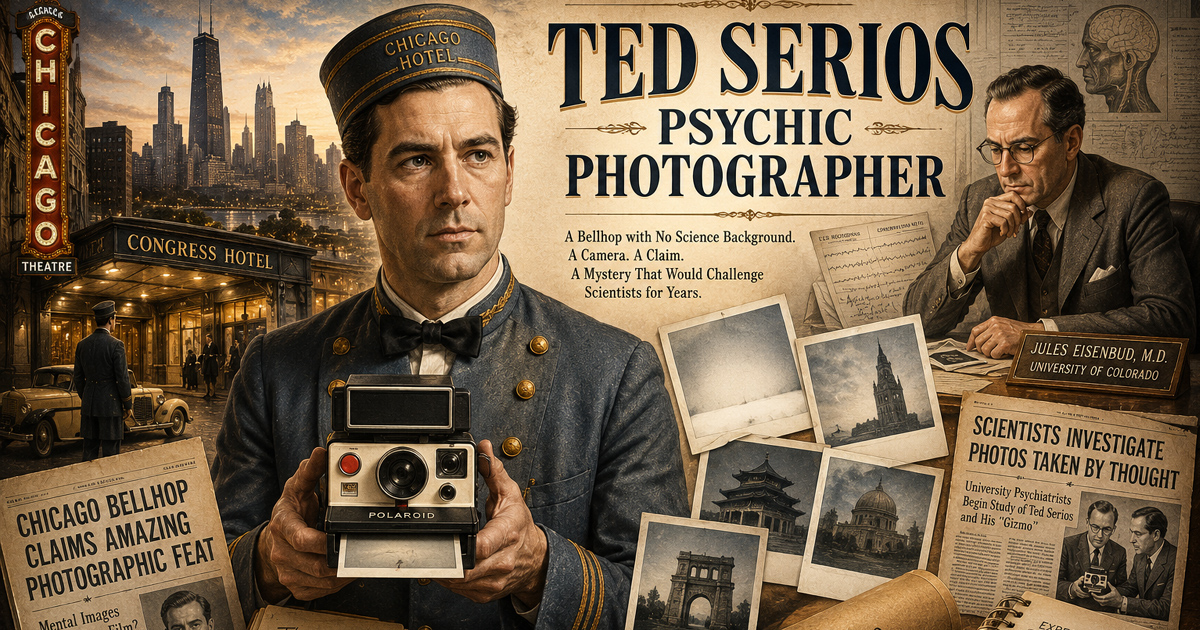
Ted Serios Psychic Photographer introduces the remarkable story of an ordinary Chicago bellhop whose unusual photographs sparked years of scientific investigation and worldwide debate.
Most unexplained stories in psychic history begin with someone unusual. A medium from a prominent family, a mystic with a following, a performer who built a career around mysterious abilities. The story of Ted Serios begins in a Chicago bar with a bellhop who liked to drink and claimed he could put pictures on film using nothing but his mind.
What happened next is not a story about whether that claim was true. It is a story about what serious investigators did with it, how long they stayed with it, and why the case of Ted Serios psychic photographer remains one of the strangest chapters in the history of psychic research more than sixty years after it began.
A Bellhop, a Bar, and a Strange Claim
Theodore Julius Serios was born in Chicago around 1918, though some sources place his birth year as early as 1919. He worked for years as a bellhop at the Chicago Hilton, living a modest and largely unremarkable life by any conventional measure. He drank heavily and moved through the margins of Chicago’s working class neighborhoods without drawing particular attention.
Somewhere in the early 1960s, Serios began telling people that he could project mental images onto Polaroid film. He would hold a camera to his face, concentrate, and the developed photograph would sometimes show an image that had no obvious connection to the room or setting where the picture was taken. Buildings, landscapes, partial structures, and blurred impressions appeared on photographs that should have shown nothing more than a man’s face pressed against a lens.
He demonstrated the ability in bars and informal gatherings before anyone with scientific credentials took notice. The audiences were small, the setting was casual, and the claim was exactly the kind of thing that gets dismissed before it is ever properly examined.
How Word Reached the Scientific Community
The path from Chicago bar to university laboratory ran through a Chicago woman named Pauline Oehler, who had a serious interest in parapsychology and was among the first people outside Serios’s immediate circle to document his demonstrations with any degree of care. Serios was not promoting himself through any established channel. He was not seeking fame or building a commercial operation around his claimed ability. He was simply showing people what he said he could do and letting the results speak for themselves.
Word eventually reached Jules Eisenbud, a psychiatrist at the University of Colorado School of Medicine in Denver. Eisenbud had an existing interest in parapsychology that was already somewhat outside the mainstream of his profession. When he heard about Serios he did not dismiss the claim. He arranged to meet him in Chicago in 1964, witnessed a demonstration that he later described as unlike anything he had encountered in his medical career, and made a decision that would define the next several years of his professional life and cost him a measurable degree of professional standing among colleagues who considered the entire enterprise beneath serious inquiry.
Bridey Murphy Hypnosis: The Day One Session Changed Everything Forever
The Photographs That Started an Investigation
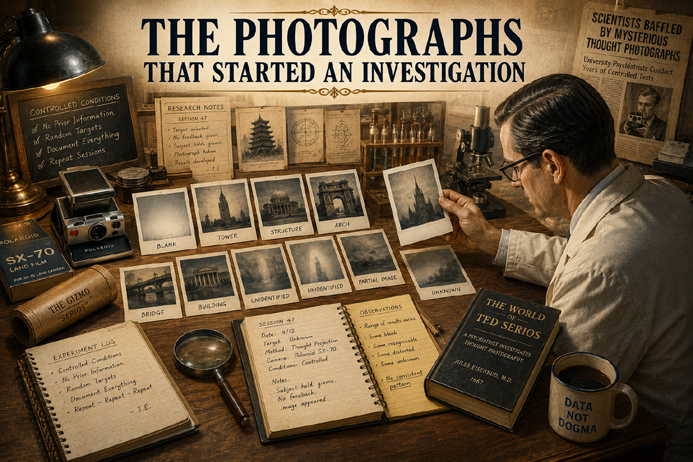
The Ted Serios Psychic Photographer case centered on hundreds of Polaroid photographs that researchers carefully documented while searching for a conventional explanation.
What the Polaroids Actually Showed
Over the course of the investigation, Serios produced hundreds of Polaroid photographs under conditions that ranged from informal to carefully controlled. The results fell into several distinct categories that investigators found difficult to reduce to a single explanation.
Many photographs were blank, showing only the white or blackened surface of an unexposed or overexposed Polaroid print. These were called whities and blackies respectively and accounted for a significant portion of the total output. On their own they proved nothing in either direction.
A smaller but more significant portion showed recognizable images. Some depicted buildings that were later identified as real structures, including what appeared to be a Canadian Mountie post and portions of Westminster Abbey, neither of which Serios had any obvious reason to have on his mind or any conventional means of projecting onto film. Others showed distorted or partial images that resembled known locations without matching them precisely, as if the mental projection had arrived slightly out of focus.
A few photographs showed images that investigators could not match to any known location or source at all. These were the ones that kept the investigation alive long after simpler explanations had been proposed and examined.
The Gizmo and Why It Became Controversial
Serios rarely held the camera directly against his face without using a small cylindrical tube he called his gizmo. It was typically made from a rolled piece of cardboard or a short section of plastic tubing, roughly an inch in diameter and an inch or so in length. He held it between his eye and the camera lens when producing the photographs.
Critics identified the gizmo immediately as the most likely vehicle for fraud. A small lens or transparency concealed inside the tube could theoretically project a pre-prepared image onto the film without any supernatural mechanism required. Two investigators writing in Popular Photography magazine in 1967 argued that the gizmo made the entire case explainable through ordinary photographic trickery and demonstrated how a similar effect could be produced using a small optical device.
Supporters of the investigation pushed back. Eisenbud and others pointed out that photographs had been produced under conditions where the gizmo had been examined and found to contain nothing, where different gizmos supplied by investigators had been substituted, and in at least some cases where no gizmo was used at all. The fraud argument did not collapse the case as cleanly as critics suggested, and the debate over the gizmo became one of the central fault lines of the entire controversy.
What Made Some Photographs Harder to Dismiss
The strongest cases for Eisenbud and his supporters were not the impressive images alone. They were the circumstances under which specific images were produced. Sessions where investigators had handled the camera throughout, where the film had been supplied and loaded by researchers rather than Serios, and where the gizmo had been inspected before use produced some of the most striking results in the entire record.
The Canadian Mountie post photograph was particularly discussed because it matched a specific real location that Serios appeared to have no prior knowledge of or connection to. The Westminster Abbey image generated similar discussion. Neither photograph constituted proof of anything on its own. But both appeared in the record under conditions that made the simplest fraud explanations harder to apply without additional assumptions.
The reader weighing these cases is doing exactly what investigators did for years. The evidence does not resolve cleanly in either direction. That unresolved quality is precisely what made the case so difficult to close.
Jules Eisenbud and the Investigation That Defined the Case
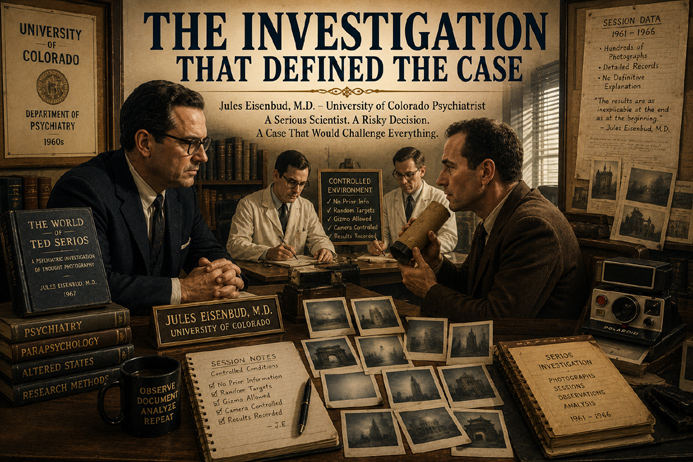
The Ted Serios Psychic Photographer investigation became famous because psychiatrist Jules Eisenbud spent years documenting the experiments under increasingly controlled conditions.
Who Jules Eisenbud Was
Jules Eisenbud was not a credulous amateur looking for confirmation of beliefs he already held. He was a clinical professor of psychiatry at the University of Colorado School of Medicine with a conventional academic career behind him and a genuine professional reputation at stake. He had published serious work in his field and moved in circles where taking a Chicago bellhop’s psychic photography claims seriously was not a neutral act.
His interest in parapsychology predated Serios and was itself already a source of friction with more conservative colleagues. But his approach to the Serios investigation was methodical rather than credulous. He documented sessions carefully, invited outside observers including skeptics, and attempted to control variables in ways that would satisfy scientific scrutiny. Whether he succeeded in that aim became part of the controversy itself.
What Eisenbud Actually Did
Eisenbud worked with Serios from 1964 through the late 1960s, conducting sessions in Denver and elsewhere, accumulating a photographic record that eventually ran to hundreds of prints. He brought in other investigators, photographers, and scientists to observe and evaluate what was happening. He corresponded with critics and engaged with their objections rather than dismissing them.
In 1967 he published The World of Ted Serios through William Morrow, laying out the full record of the investigation in detail. The book included photographs, session notes, responses to skeptical arguments, and Eisenbud’s own analysis of what the evidence did and did not support. It was not a popular science book written for a general audience. It was a serious attempt to present a complete evidentiary record for professional evaluation.
The book drew immediate and fierce criticism from skeptics and equally strong support from parapsychologists. It remains the primary documentary record of the Serios case and the starting point for anyone who wants to engage with the evidence seriously rather than through secondhand summaries.
Hypnosis Myths and Legends: The Surprising Stories That Started Them All
Why the Investigation Itself Became the Story
The photographs produced by Ted Serios are interesting. The fact that a credentialed university psychiatrist spent years investigating them under controlled conditions and could not produce a definitive explanation is more interesting still.
Eisenbud was not naive about what he was doing. He understood the professional risk. He engaged with magicians and photographers who argued for fraud. He adjusted his methods in response to criticism. And at the end of years of careful work he still could not say with certainty that he had witnessed deliberate deception, nor could he say with certainty that he had witnessed something that required a paranormal explanation.
That outcome is not a failure of investigation. It is an honest record of what the evidence actually produced. In a field where definitive answers are rare and extraordinary claims attract both true believers and determined debunkers, Eisenbud’s refusal to land cleanly on either side is itself a significant part of the historical record.
The Believers and the Skeptics
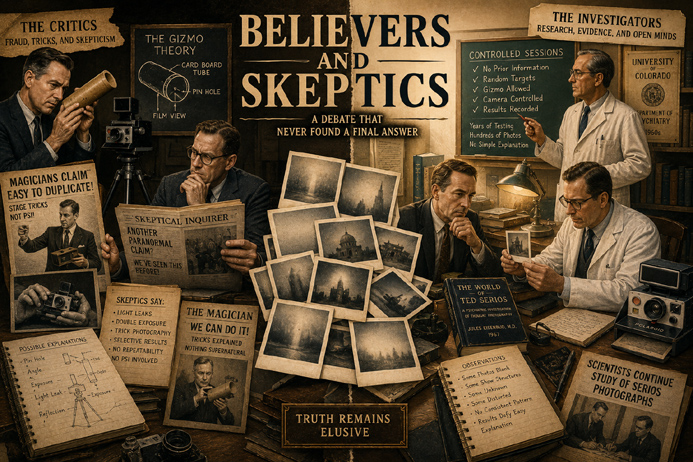
The Ted Serios Psychic Photographer controversy remains one of parapsychology’s most enduring debates, with skeptics and supporters still disagreeing over what the evidence actually showed.
What the Critics Said
The skeptical case against Serios rested primarily on the gizmo, on the informality of early sessions, and on the demonstration by the Popular Photography investigators that similar effects could be produced through ordinary optical trickery. James Randi, who made a career of investigating and exposing claimed psychic phenomena, argued that the Serios case was a straightforward example of conjuring dressed up as parapsychology.
Critics also pointed to the decline in Serios’s output over time. The strongest photographs came relatively early in the investigation. As controls tightened and scrutiny increased, the results became less impressive and eventually Serios stopped producing recognizable images almost entirely. Skeptics argued this pattern was exactly what you would expect from a fraud who found his methods increasingly difficult to execute under closer observation.
What the Supporters Said Back
Eisenbud and supporters of the investigation argued that the decline in output was consistent with the variability seen in other areas of parapsychological research, where performance under stress and heightened observation often deteriorates regardless of whether the phenomenon is genuine. They pointed to the sessions conducted under tight controls early in the investigation as the evidentiary core of the case, arguing that those results had never been satisfactorily explained through the fraud hypothesis alone.
Supporters also noted that no one ever caught Serios in an act of deliberate fraud. No concealed device was found in his gizmo during a session. No pre-prepared transparency was discovered. The fraud argument required assuming that Serios was skilled enough to defeat careful observation repeatedly over years without a single clean exposure. That assumption was not impossible, but it was not as simple as critics sometimes presented it.
Arthur Ford Séance: The Shocking Truth Behind the Night Houdini Came Back
Why Nobody Won the Argument
The Serios case closed without a verdict. There was no confession, no definitive exposure, and no controlled demonstration that satisfied all parties. Serios himself faded from public attention in the late 1960s and died in 2006 without the case ever reaching a conclusion that either side fully accepted.
What remained was a body of photographic evidence, a detailed investigative record, and a disagreement that reflected broader and still unresolved questions about how science should handle claims that sit at the edges of what current models can accommodate. The argument did not end. It simply stopped having new material to work with.
Thoughtography Did Not Begin or End With Ted Serios
Uri Geller and the Stanford Research Institute
The investigation of Serios was not an isolated event in the history of serious scientific engagement with claimed psychic phenomena. In the early 1970s, Uri Geller, the Israeli performer known for claimed metal bending and other psychic demonstrations, was investigated at the Stanford Research Institute in California by physicists Russell Targ and Hal Puthoff.
The Stanford Research Institute investigations were published in the journal Nature in 1974 and generated immediate controversy similar in character to the Serios debate. Supporters pointed to the controlled conditions and the credentials of the investigators. Critics argued that the controls were insufficient and that the results reflected experimenter bias and inadequate fraud prevention rather than genuine phenomena. The pattern of the argument was remarkably similar to what Eisenbud had encountered a decade earlier.
The Broader Question Serios Raised
What the Serios investigation introduced into serious scientific discussion was a specific and testable question. Can the human mind interact with physical recording equipment in ways that current scientific models do not account for? That question is not the same as asking whether psychic phenomena exist in a general sense. It is a narrower and more concrete claim that in principle could be evaluated through controlled experiment.
The difficulty was that every attempt to evaluate it ran into the same problem. Results that appeared promising under looser conditions became harder to reproduce as controls tightened. That pattern appeared consistently enough across multiple investigators and multiple claimed abilities that it became one of the central puzzles of parapsychological research rather than evidence for or against any specific claim.
Modern Attempts to Detect Thought on Film
The arrival of digital photography and increasingly sensitive recording equipment has not produced a new generation of thoughtographers whose results have satisfied scientific scrutiny. Researchers at the Princeton Engineering Anomalies Research laboratory, founded by Dean of Engineering Robert Jahn in 1979, and operated for nearly thirty years before closing in 2007. They investigated whether human intention could influence random physical systems including electronic equipment over a period of nearly thirty years. Their published findings suggested small but statistically measurable effects. The work remains deeply contested and has not achieved mainstream scientific acceptance, but it represents the most sustained institutional research effort in this area ever conducted at a major American university.
The question Serios raised has not been answered. It has simply moved into different experimental territory with different tools and the same unresolved outcome.
The Strange Case That Never Fully Closed
Ted Serios died in 2006. His precise age at death is not consistently documented across available sources. He is largely forgotten outside the narrow community of people who follow the history of psychic research seriously. He left behind hundreds of Polaroid photographs, a book length investigation by a credentialed scientist, a body of skeptical literature arguing for fraud, and no definitive resolution of any kind.
More than sixty years after those first demonstrations in Chicago bars, cameras still cannot photograph thoughts in any way that science has confirmed or accepted. Yet the strange case of Ted Serios psychic photographer remains one of the most unusual chapters in psychic research history, not because the photographs were necessarily genuine, and not because the fraud case was airtight, but because a serious investigator looked at the evidence carefully for years and came away unable to deliver the clean answer that either side wanted.
That is not the ending most people expect from a story about a Chicago bellhop and a cardboard tube. But it is the honest one. And in a subject where honest endings are rarer than dramatic ones, it may be the most interesting ending of all.

Known as The Man Who Notices, Mike Lamp is a theatrical hypnotist and psychic performer with more than twenty years of live stage experience. His work emphasizes observation, psychological influence, and measured presentation rather than spectacle or provocation. Performances are tailored for adult audiences, private events, and professional settings where control, clarity, and atmosphere matter.


Leave a Reply
You must be logged in to post a comment.