31
Mar
Leo Symbolism Meaning: Powerful Fire Sign Insights
Leo Symbolism Meaning: Powerful Fire Sign Insights
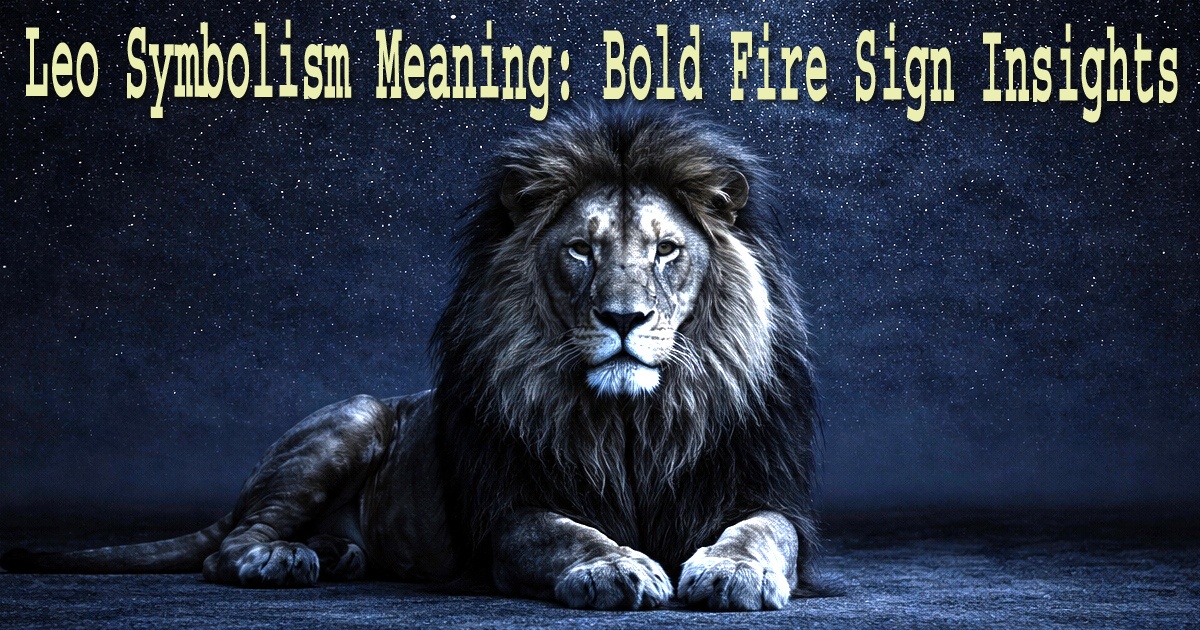
Leo symbolism older than you think
The Lion and Its Place
Leo symbolism begins with the lion, one of the oldest and most consistent images in human spiritual imagination. Across Egypt, Mesopotamia, and the Mediterranean world, the lion carried meanings that were never casual. It was the animal of kings, of solar power, of the threshold between the human and the divine. When early sky-watchers assigned the lion to this particular cluster of stars, they were not making an arbitrary choice.
The Babylonians called it the Great Lion, UR.GU.LA, and its brightest star, known to us as Regulus, carried the title of King of Heaven. That star’s position at the heart of the constellation, literally at the lion’s chest, gave the whole figure its regal center long before Greek or Roman traditions elaborated on it They were placing into the heavens a creature that already carried enormous symbolic weight, and the constellation absorbed that weight and held it across thousands of years of interpretive tradition.
The lion is not a subtle symbol. It announces itself. That quality, the quality of presence without apology, became central to how Leo was understood in every tradition that worked with it. The image of the lion resting in full sun, untroubled and unhurried, is as good a visual summary of the sign’s core meaning as any interpretive text.
Read about Zodiac Meaning Explained: Clear Guide to Symbolism in our Exclusive Article
The Fire Element and What It Carries
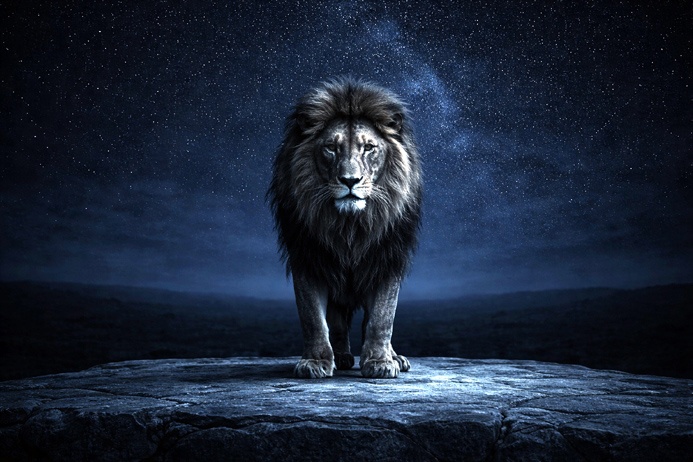
Leo Symbolism The lion confirms nothing to anyone
Fire, as a symbolic element, is concerned with transformation, initiation, and the animating force that moves things from potential into form. Fire sign symbolism across traditions tends to emphasize will, drive, and the self as an active principle, and the lion sits squarely within that current. But Leo’s Fire is not the quick igniting spark of Aries, nor the expansive and philosophical flame of Sagittarius. It is sustained, radiant, and centered.
In the classical triplicities, the three Fire signs were understood to express the element across three modes, cardinal, fixed, and mutable. Leo holds the fixed position, which is why its Fire does not rush or scatter. Fixed signs consolidate and sustain what cardinal signs initiate. Leo’s fire does not move toward something. It becomes something. It burns the way the sun burns, steadily and from a fixed point.
The elemental tradition that informs much of Western metaphysical thinking places Fire in a specific relationship to consciousness. Fire corresponds to spirit, to the animating will, to the force that insists on its own existence. For Leo, this translates into a relationship with selfhood that is not incidental. The sign is structured around the question of what it means to exist fully and without apology in the world.
In ancient Egypt, the sphinx was oriented to face the rising sun at the spring equinox, and some researchers in archaeoastronomy have argued the monument was aligned with the constellation Leo as it appeared on the horizon during that period in deep antiquity.
The Archetype at the Center
The Leo archetype is one of the more legible ones in the zodiac, which is part of what makes Leo symbolism so durable across different interpretive systems. The king, the sovereign, the one who holds the center while others orbit, this is the shape the archetype takes in most traditions. It is not a metaphor for political power specifically, though political power has often used it. It is a metaphor for the kind of authority that comes from within, the authority of someone who knows who they are and does not require external confirmation of that fact.
Most traditions that work with zodiac symbolism read Leo through a lens of royalty and solar power, and that reading holds because the archetype supports it consistently. The sovereign at the center of court, the sun at the center of the solar system, the heart at the center of the body. That last correspondence is not incidental.
Traditional medical astrology assigned Leo rulership of the heart and upper back, which made the sign responsible in symbolic terms for the organ that sustains all others. The center that gives life rather than merely commanding it. Leo’s archetype is always the central thing, the thing around which other things organize. That centrality is not arrogance in its healthy expression. It is function. Something has to hold the center, and Leo is the sign assigned that task.
Identity as a Spiritual Function
There is a strand of metaphysical thinking that treats individual identity as an illusion to be overcome, and Leo stands in interesting tension with that view. Leo identity symbolism does not treat the self as a problem to be dissolved but as a structure to be refined. The sign’s work, in this framing, is not the erasure of selfhood but its clarification, the burning away of what is false so that what is genuine can stand in its place.
Leo spiritual meaning, in this sense, is less about ego in the pejorative sense and more about the cultivation of a coherent inner authority. The distinction matters. Ego as inflation, as need for validation, as the performance of importance, is the shadow territory. But the self as a grounded, expressive, responsible presence is what the sign points toward in its most developed form. That is a spiritual project, not a psychological one, and it is one that requires sustained engagement rather than a single moment of insight.
The Latin word leo is borrowed directly from the Greek leon, which itself may derive from a pre-Greek Mediterranean language, suggesting the lion’s symbolic weight in this region predates classical Greek civilization entirely.
The Sun Connection
Leo’s planetary ruler is the Sun, and that rulership carries a specific technical weight in the older tradition. In classical astrology the Sun does not merely influence Leo, it has its domicile there, meaning Leo is the one sign the Sun rules by house. Every other planet shares its rulership across two signs. The Sun and Moon each rule only one, which places Leo in a structurally singular position in the symbolic architecture of the zodiac.
Leo metaphysical meaning is inseparable from the Sun, and the qualities traditionally assigned to that body, light, vitality, centrality, become the qualities Leo is understood to carry. The Sun does not reflect. It generates. That distinction shapes everything about how Leo is interpreted. Where other signs receive and process energy, Leo is understood to originate it, at least symbolically. It is the source rather than the mirror, the lamp rather than the window.
In traditions that treat the Sun as the symbol of the higher self, the divine spark individuated into form, Leo becomes the sign most directly associated with that spark. The soul expressing itself through a particular life, with particular gifts, in a particular direction. That is the Sun’s symbolic work, and by extension, it is Leo’s.
Courage, Will, and the Inner Throne
Leo energy traits across metaphysical traditions cluster around courage, creative will, and a certain kind of visibility that is not vanity but presence. The courage associated with Leo is not the reckless bravery of someone who does not feel fear. It is the courage of someone who feels it and acts anyway because the call to express, to create, to lead is stronger than the pull toward safety and concealment.
The creative will is significant here. Leo is consistently associated with creativity, but not in the narrow sense of artistic production. The deeper meaning is the will to bring something into existence that was not there before. That is an act of solar power in symbolic terms, an act of generation. The inner throne is the place from which that generation happens, the stable center of a self that knows what it values and what it is for.
Regulus, the brightest star in the Leo constellation, was one of the four Royal Stars of ancient Persia, alongside Aldebaran, Antares, and Fomalhaut, each assigned to guard one of the four cardinal directions of the sky.
Leo in Cosmological Context
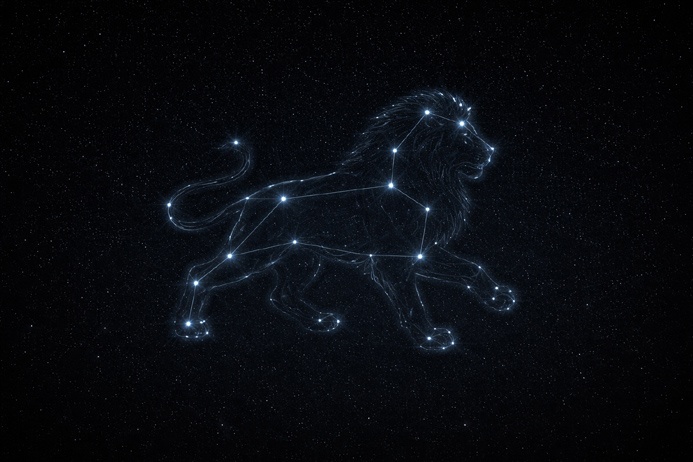
Leo Symbolism Fixed in the sky for centuries
Leo symbolism appears in cosmological frameworks that map the sky as a living symbolic field, where each sign carries a specific energetic function. In these frameworks, the twelve signs are not merely personality categories. They are stations in a cycle, each one addressing a distinct aspect of existence. Leo’s station is the middle of the solar year, the height of summer’s power, and that placement is not accidental.
Within those systems, the sign is understood to govern the middle of summer in the northern hemisphere, the height of solar power, the point where light reaches its fullest expression before beginning its turn. That placement gives Leo its cosmological meaning, the sign of maximum illumination, of the world fully lit. What was hidden in winter is visible now. What was potential in spring has become actual. Leo presides over the moment of fullness.
Expression as a Sacred Act
The Fire element meaning within Leo is connected specifically to the idea of self-expression as something close to a spiritual obligation. This is a strong claim, and it is worth sitting with. The reasoning within metaphysical traditions that hold this view goes something like this: if the self is understood as a particular expression of a larger animating principle, then to suppress or deny that expression is to withhold something from the whole. The lion that does not roar is not being humble. It is failing its function.
That framing transforms expression from a personal indulgence into something with larger stakes. The creative act, the generous act, the act of showing up as oneself fully and without reduction, these become forms of spiritual participation rather than self-promotion. Leo’s symbolism insists on this, and it is perhaps the most counterintuitive of the sign’s teachings in a culture that tends to treat self-effacement as the higher virtue.
The Shadow Side of the Lion
Leo symbolism Presence that requires nothing back
The full picture of Leo symbolism includes its shadow, and that shadow is instructive. The qualities that make the sign powerful in its developed form become distortions when they operate from insecurity rather than groundedness. The sovereign becomes the tyrant. The radiant presence becomes the demand for attention. The creative will becomes the need to have every room organized around one’s own concerns.
The shadow of Leo is not a different thing from its light. It is the same qualities operating from a contracted place. The need for recognition is the healthy desire for acknowledgment gone sour. The performance of importance is the genuine inner authority untethered from its roots. Understanding this is part of what makes the sign’s symbolism genuinely useful rather than merely flattering. The lion that is at ease in its own skin does not need the room to confirm it. That ease is the goal, and the distance between needing confirmation and not needing it is where the sign’s real work lives.
Editor’s Reflection
What stays with you after spending time with any symbolic system is how much it asks of you in return. Leo symbolism, at its core, is not really about lions or crowns or any of the imagery that surrounds it. It is about the uncomfortable proposition that existing fully is a form of responsibility, that the self is not something to apologize for but something to develop, and that the difference between presence and performance is worth understanding.
There is something in Leo symbolism worth sitting with longer than a single reading allows. What does it mean to you to hold the center without needing the room to confirm it? Is the instinct toward self-expression something you think of as a spiritual act, or does that framing feel like a stretch? And where do you draw the line, personally, between genuine inner authority and the kind of visibility that is really just noise?

Known as The Man Who Notices, Mike Lamp is a theatrical hypnotist and psychic performer with more than twenty years of live stage experience. His work emphasizes observation, psychological influence, and measured presentation rather than spectacle or provocation. Performances are tailored for adult audiences, private events, and professional settings where control, clarity, and atmosphere matter.


Leave a Reply
You must be logged in to post a comment.