6
Apr
Capricorn Symbolism Meaning: Bold Earth Sign Insights
Capricorn Symbolism Meaning: Bold Earth Sign Insights
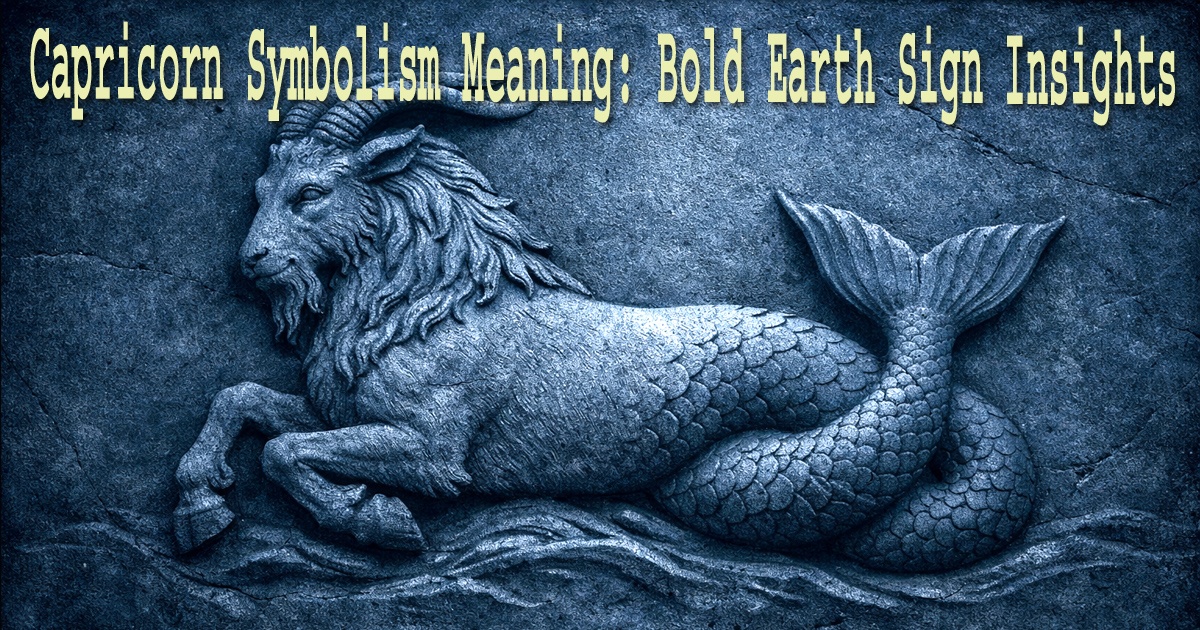
Capricorn symbolism carved in stone
The Sign and Its Foundations
Capricorn occupies the tenth position in the zodiac wheel, covering the period from roughly December 22 through January 19. It is one of the four cardinal signs, meaning it initiates a season. In the northern hemisphere that season is winter, marked by the solstice, but it is worth noting that the cardinal quality itself is not seasonal in origin. It describes a mode of action, one that begins, sets things in motion, and establishes conditions for what follows.
Cardinal energy is associated with drive, initiative, and the capacity to begin things. In Capricorn, that initiating quality is expressed through structure, patience, and a deliberate approach to long-term goals. Capricorn symbolism is rooted in these qualities, and understanding them requires looking at the sign from multiple angles, including its ruling planet, its element, its glyph, and its mythological associations.
Read about Zodiac Meaning Explained: Clear Guide to Symbolism in our Exclusive Article
The Sea-Goat as Symbol
The glyph of Capricorn is often described simply as the goat, but the full traditional symbol is the sea-goat, a creature with the body of a goat and the tail of a fish. This unusual hybrid figure has its clearest early form in the Babylonian god Enki, known as the Goat-Fish, and appears in cuneiform astronomical records dating to around 1000 BCE or earlier. The Greeks inherited the figure through Hellenistic transmission and folded it into their own mythological framework, associating it with the story of Pan and the god Chronos.
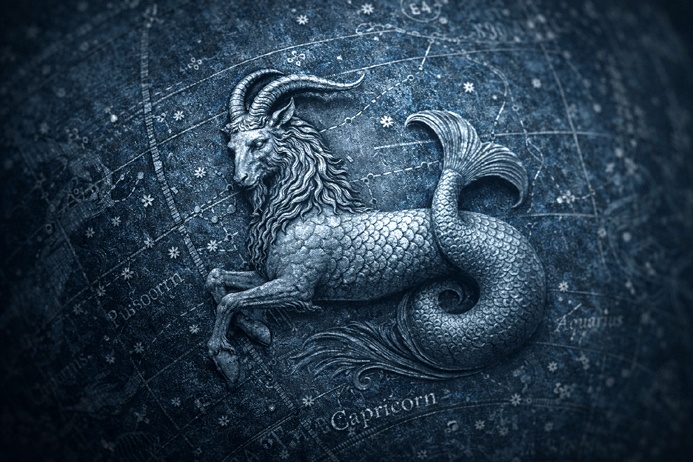
Capricorn symbolism The sea-goat mapped in the world
The goat half speaks to sure-footed ambition, the ability to climb difficult terrain without losing balance. The fish tail connects the sign to the deep, subterranean waters of the unconscious and to the primordial. Capricorn symbolism draws heavily from this dual nature, combining worldly practicality with something older and harder to name. The sea-goat is not simply a symbol of achievement. It carries the weight of what lies beneath achievement, the instincts, the drives, the deeper foundations that make sustained effort possible.
The Babylonian god Enki, whose Goat-Fish form is the earliest known precursor to the Capricorn sea-goat, was also associated with fresh water, wisdom, and the crafts of civilization, not merely celestial timekeeping.
Saturn and the Influence of Its Ruler
Saturn governs Capricorn, and no other planetary ruler shapes a sign more thoroughly. Saturn in traditional astrology is associated with time, limitation, discipline, and the principle of earned reward. As the outermost planet visible to the naked eye, Saturn was considered the boundary of the known cosmos, and its position at the edge of the visible sky gave it dominion over endings, enclosures, and the weight of necessity. It rules both Capricorn and Aquarius in the traditional scheme, though the two expressions of that rulership differ considerably.
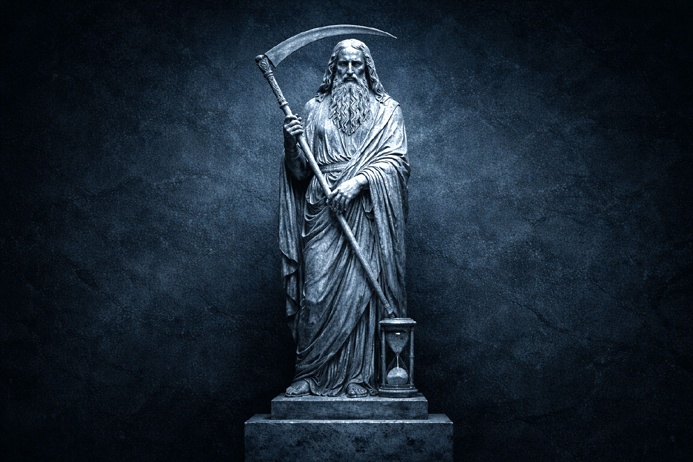
Capricorn symbolism Saturn’s weight, carved and still
It rules structures, boundaries, and the consequences of action. In the context of Capricorn symbolism, Saturn’s influence translates into the sign’s reputation for seriousness, its respect for hierarchy, and its orientation toward mastery over time rather than quick result. Saturn-ruled signs tend to mature in reverse, carrying weight early and finding ease later in life. Capricorn fits this pattern precisely. The influence of Saturn also brings a quality of restraint, not coldness as it is sometimes characterized, but a conserving of energy and expression until the moment is right.
Earth Element and Practical Orientation
Capricorn is one of three earth signs, alongside Taurus and Virgo, and the earth element brings a grounding, material orientation to all three. For Capricorn, the earth element reinforces the sign’s connection to the physical world, to tangible outcomes, and to the kind of work that produces lasting results. Earth signs in general are associated with reliability, patience, and the ability to work within existing structures rather than against them.
Capricorn symbolism within the earth element is distinct from Taurus and Virgo because of the cardinal quality layered over it. Where Taurus is fixed and Virgo is mutable, Capricorn moves. It builds. It initiates the kind of structures that are meant to outlast the builder.
Cuneiform tablets recovered from the library of Ashurbanipal at Nineveh include star catalogs in which the Goat-Fish constellation is listed among the stars of the month of Tebetu, corresponding to December and January in the Babylonian calendar.
The Tenth House and Social Position
Capricorn rules the tenth house in the natural wheel, the house traditionally associated with career, public reputation, authority, and the relationship an individual has with the broader social order. This house sits at the very top of the chart, the midheaven, the most visible point. The connection between Capricorn symbolism and the tenth house is not accidental.
Both are concerned with how a person is perceived in the world, what they build publicly, and how they handle responsibility and authority. The tenth house governs legacy in a practical sense, not fame for its own sake, but what endures after the work is done. Capricorn symbolism carries this association with a kind of solemn pride.

Capricorn symbolism The chart’s summit, drawn by hand
Mythological Threads
The sea-goat has roots in the figure of Pricus, a creature from Greco-Roman mythology said to be the father of all sea-goats and a favored companion of Chronos. The identification of Chronos, the god of time, with Cronus, the Titan father of the Olympians, is a later conflation and not universally accepted in classical scholarship. The astrological tradition tends to treat them as effectively merged, particularly in the context of Saturn’s rulership, but the distinction is worth noting when following the mythological thread carefully.
According to the story, Pricus could reverse time to prevent his children from crawling onto land and losing their divine nature, but eventually he accepted the inevitable and became a constellation. The story layers well with Capricorn symbolism: the relationship with time, the tension between what is natural and what is imposed, and the eventual acceptance of limitation as a condition of existence rather than a defeat. Chronos himself connects directly to Saturn, and that thread ties the mythology back to the ruling planet without any gap in the logic.
Capricorn in Aspect and Chart Context
When Capricorn planets form aspects with outer planets or luminaries in a natal chart, the expression of Capricorn symbolism changes in notable ways. A Capricorn Sun in opposition to a natal Moon in Cancer produces a constant tension between public duty and private need. A Capricorn Mars trine to Taurus Venus brings a steadiness to ambition.
The sign already carries, reinforcing patience with pleasure in the work itself. Squares to Aries or Libra placements create friction between Capricorn’s preference for structure and those signs’ priorities of assertion or balance. Each aspect shifts the quality without erasing the fundamental character. Saturn’s influence remains present in all of them, but the texture changes depending on which planets are in conversation.
The Cardinal Quality in Practice
Cardinal signs begin things. In Capricorn, that beginning is rarely sudden or dramatic. The cardinal quality here operates through planning, through setting the conditions for a long effort before the effort itself begins. Capricorn symbolism in this context is about the launch that looks like preparation, the moment of initiation disguised as careful thought.
Other cardinal signs, Aries, Cancer, and Libra, initiate more visibly. Capricorn tends to begin quietly and sustain longer. The cardinal quality in Capricorn is perhaps the most underestimated aspect of the sign because it contradicts the popular image of Capricorn as slow or overly cautious. Capricorn moves when it moves, and it typically moves with full commitment.
Got questions? Talk to Mike directly Here.
Reputation, Responsibility, and the Long View
More than almost any other sign, Capricorn is associated with reputation, not vanity, but the recognition that how one is perceived in the world has practical consequences. Capricorn symbolism treats reputation as a resource, something built carefully over time and protected through consistent behavior. The sign’s relationship with responsibility follows the same logic.
Responsibility in Capricorn’s framework is not a burden to be resented but a measure of how much has been earned and how much can be trusted. Saturn’s teaching, which is ultimately the teaching that Capricorn embodies, is that the world responds to effort over time, that structures built carefully tend to hold, and that what is rushed or inflated tends to collapse. The sea-goat climbs one step at a time, but it climbs.
The Romans celebrated Saturnalia, a festival honoring Saturn, during the period we now associate with Capricorn season, a calendrical overlap that reinforced Saturn’s identification with the sign in later Western astrological tradition.
Capricorn Across the Chart
Capricorn energy does not belong only to those born under the sun sign. Capricorn symbolism operates wherever the sign and its ruler appear in a natal chart. A person with Capricorn rising carries a Saturnine appearance and manner, often reserved in presentation and more comfortable once trust is established. Capricorn on the cusp of the second house brings a careful, strategic approach to resources. A Capricorn midheaven places the themes of public role and professional legacy at the very top of the individual chart.
The midheaven is not a house cusp in the same sense as the ascendant but is the degree of the ecliptic culminating at the moment of birth, and when Capricorn holds that degree, Saturn becomes the chart’s ruler of professional direction. This is a meaningfully different condition from simply having the Sun in Capricorn, since it makes Saturn’s house, sign, and aspects the primary indicators of how vocation and public standing will develop.
Saturn’s house placement tells the rest of the story, indicating where discipline is most demanded and where the rewards of sustained effort are most likely to concentrate. The sign does not operate in isolation, but its core themes remain consistent regardless of placement.
Editor’s Reflection
What stays with you after spending time with Capricorn symbolism is less the ambition and more the patience behind it. The sea-goat is not in a hurry, and that is not a flaw. Saturn’s long arc, the slow build, the preference for what lasts over what impresses: these are not obstacles to be overcome but the actual substance of the sign. Most of what gets written about Capricorn focuses on achievement, but the older tradition is more interested in endurance, in what holds when the conditions are difficult and the outcome is uncertain.
The questions Capricorn raises are worth sitting with. How much of what we call ambition is actually patience dressed up in more acceptable language? When you look at Capricorn symbolism across a full chart, not just the sun sign, does the picture match the people in your life who carry it, or does it complicate them? And what does it say about a sign so associated with time that its ruling planet was, in the oldest mythological threads, connected to a figure who consumed his own children rather than yield what he had built, and yet whose eventual overthrow made the current order possible?

Known as The Man Who Notices, Mike Lamp is a theatrical hypnotist and psychic performer with more than twenty years of live stage experience. His work emphasizes observation, psychological influence, and measured presentation rather than spectacle or provocation. Performances are tailored for adult audiences, private events, and professional settings where control, clarity, and atmosphere matter.



Leave a Reply
You must be logged in to post a comment.