4
Apr
Sagittarius Symbolism Meaning: Powerful Fire Sign Insights
Sagittarius Symbolism Meaning
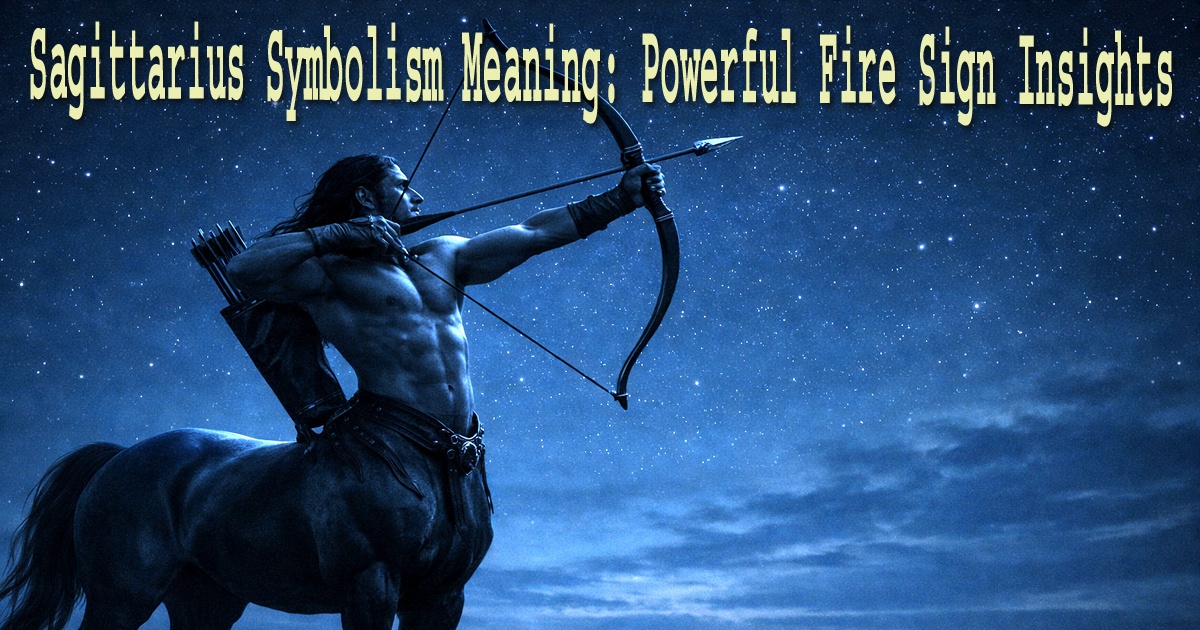
Sagittarius starts with the archer
The Archer and Its Arrow
Sagittarius symbolism begins with the archer, a figure that has carried consistent meaning across centuries of astrological writing. The image is deceptively simple. A being draws a bow and releases an arrow into the distance, not at a target that is already visible, but toward a horizon that has not yet been reached. That detail matters. Most archer imagery in other traditions concerns precision, hitting a known mark.
In Sagittarius, the arrow is aimed at something further out, something conceptual rather than physical. The arrow aimed skyward is the most direct image within Sagittarius symbolism, pointing toward aspiration rather than conquest. It is a sign interested in the journey of understanding, in the act of seeking itself.
Read about Zodiac Meaning Explained: Clear Guide to Symbolism in our Exclusive Article
Fire, Philosophy, and Forward Motion
The fire element within Sagittarius is not the contained fire of Aries or the fixed intensity of Leo, but something closer to a traveling flame. Fire in this sign moves. It spreads across territory, crosses borders, and does not stay in one place long enough to become a controlled burn. This has practical implications in astrological interpretation.
Sagittarius is associated with restlessness, yes, but the restlessness serves a purpose. It is the mechanism that keeps the sign engaged with new terrain, new ideas, new frameworks for making sense of experience. The philosophical dimension here is not incidental. Sagittarius is the fire sign most directly connected to the life of the mind, to systems of belief, and to the question of what all this experience actually means.
The constellation Sagittarius was recorded by the Babylonian astronomer-scribes in the MUL.APIN star catalogue, dating to approximately 1200 BCE, where it was identified as the god Pabilsag, a winged figure with a scorpion tail rather than a centaur form.
Jupiter’s Reach

Jupiter’s reach shapes every Sagittarius placement
Jupiter governs Sagittarius, and that rulership shapes Sagittarius symbolism in every direction, emphasizing expansion, generosity, and a persistent appetite for meaning. In traditional astrology Jupiter rules both Sagittarius and Pisces, but Sagittarius is the diurnal domicile, the daytime home, where Jupiter’s outward, solar, and philosophically assertive qualities are most naturally expressed.
Jupiter is the largest planet in the solar system, and its symbolic weight in astrology follows accordingly. It governs abundance, optimism, and the tendency to think in large terms. Under Jupiter, Sagittarius becomes a sign that is inherently oriented toward more, more knowledge, more experience, more territory, more understanding. This can read as excess in some charts, particularly when the expansive energy finds no useful container. But at its core the Jovian influence is genuinely generous. It is not acquisition for its own sake. It is the impulse to fill in the picture, to keep adding detail to a view of the world that never feels quite complete.
The Centaur Figure
The centaur at the center of Sagittarius symbolism draws from Greek mythology, where the figure most directly linked to the constellation is Crotus, a skilled archer and companion of the Muses, placed among the stars as a reward for his intellectual and physical gifts. The Chironic association, though widely repeated, belongs more properly to other astrological traditions and should not be treated as the primary mythological source here.
The centaur is half horse, half human. The lower body is animal, built for speed and instinct. The upper body is human, capable of reason, language, and philosophy. In astrological terms this split describes a sign that lives in two registers simultaneously, the visceral and the intellectual, the immediate experience and the interpretation of that experience. That dual nature is not a flaw in Sagittarius symbolism but its organizing principle, the recognition that higher understanding requires some grounding in raw experience. Abstract thought untethered from lived encounter eventually grows thin. The centaur form insists that the two cannot be cleanly separated.
In Ptolemy’s second-century Almagest, Sagittarius contains a notable concentration of stars that ancient observers associated with the Milky Way’s galactic center, making it one of the densest regions of observable stars in the classical night sky.
Color, Season, and Natural Correspondences
The colors most associated with Sagittarius symbolism lean toward purple and deep blue, shades historically linked to philosophical thought and ecclesiastical authority. These are not the bright primary colors of the more assertive fire expressions. They are colors of depth, of dusk, of the sky just before full dark. Sagittarius covers the period from late November through late December in the northern hemisphere, a season of shortening days and long cold nights.
The natural world is pulling inward, but the Sagittarian impulse runs counter to that, reaching outward even as the light contracts. The sign’s association with foreign travel and distant places fits this context. When the immediate environment closes down, the imagination turns to what lies beyond it.
The Ninth House Connection
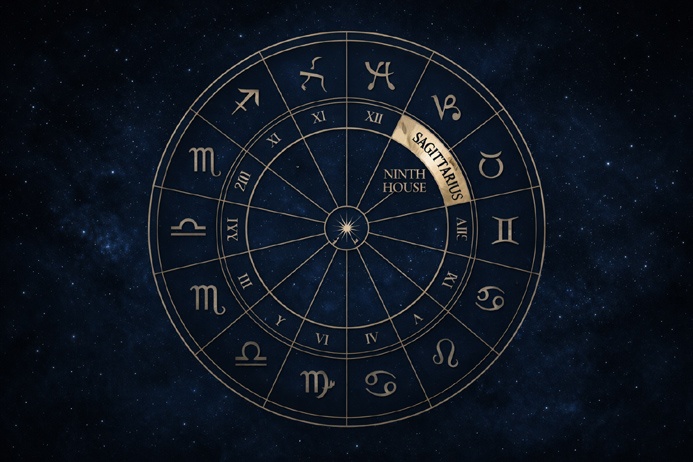
The ninth house governs further than most signs reach
The ninth house is the natural home for Sagittarius symbolism, governing long travel, higher education, religion, law, and the pursuit of broad philosophical frameworks. Each of these ninth-house domains shares a common thread: they all require leaving behind the familiar and engaging with systems larger than the individual. Long travel means physical encounter with different cultures and assumptions. Higher education means formal engagement with bodies of knowledge that predate any single student.
Religion and law both represent attempts to codify meaning and conduct at a civilizational scale. Sagittarius symbolism finds its clearest expression in ninth-house themes because both are fundamentally concerned with what lies beyond the immediate and the familiar. The ninth house does not ask what works here. It asks what is true, and how far one has to travel to find out.
Arabic astronomical tradition named the brightest star in Sagittarius Rukbat, meaning “knee of the archer,” indicating that medieval Islamic astronomers mapped the constellation’s anatomy with considerable anatomical specificity distinct from the Greek centaur reading.
How Sagittarius Symbolism Appears in Practice
In practice, Sagittarius symbolism surfaces in the way a strongly Sagittarian chart tends to orient itself toward questions of meaning before questions of security. A prominent Sagittarius stellium or a strongly placed Jupiter often correlates with individuals who find security itself less motivating than direction. They need to feel they are moving toward something worth reaching. Material comfort matters less than a reason to keep going.
Writers and teachers with prominent Sagittarius placements often demonstrate Sagittarius symbolism through a compulsive need to synthesize, to pull disparate ideas toward a single coherent view. The sign is not satisfied with isolated facts. It wants to know how those facts fit together, what the larger pattern looks like, and whether that pattern has anything useful to say about how to live.

Full draw, aimed past what is visible
The Mutable Quality
The mutable quality refines Sagittarius symbolism in one final important way, distinguishing it from the initiating drive of Aries and the sustaining force of Leo. Mutable signs occupy the transitional position in each seasonal cycle, and in classical Hellenistic astrology they carry the designation ‘common,’ reflecting their shared nature between two seasonal states. They arrive when one season is ending and another has not yet begun, and their function is adaptation, preparation, the gathering of what has been learned before conditions change.
In Sagittarius this manifests as flexibility of belief. The sign holds its beliefs with genuine force, but it also has the capacity to update those convictions when experience demands it. The openness to travel, to foreign encounter, to exposure in higher education, all of it serves this mutable function. Every new landscape is an opportunity to test whether the current map still holds.
Editor’s Reflection
What makes Sagittarius symbolism hold up across so many centuries of astrological use is probably its internal consistency. The archer, the centaur, the ninth house, Jupiter’s reach, the mutable flexibility, all of it points in the same direction. A sign built around the act of seeking, not arriving. That coherence is unusual. Many signs carry contradictions that require careful interpretation. This one reads almost like a single sustained argument about what happens when a mind refuses to stop at the edge of what it already knows.
There is something worth sitting with in the idea that Sagittarius symbolism places the journey above the destination. What does it mean to organize a life around questions rather than answers? And for those with strong Sagittarius placements, does the restlessness ever resolve into something that feels like enough, or does the horizon always stay one step ahead? These are worth thinking about, not as problems to solve but as descriptions of a particular kind of experience that not everyone shares and not everyone understands.

Known as The Man Who Notices, Mike Lamp is a theatrical hypnotist and psychic performer with more than twenty years of live stage experience. His work emphasizes observation, psychological influence, and measured presentation rather than spectacle or provocation. Performances are tailored for adult audiences, private events, and professional settings where control, clarity, and atmosphere matter.



Leave a Reply
You must be logged in to post a comment.