1
Apr
Virgo Symbolism Meaning: Bold Earth Sign Insights
Virgo Symbolism Meaning: Bold Earth Sign Insights

Virgo Symbolism Ancient grain, modern meaning
The Virgin and Her Place
Virgo symbolism draws from one of the oldest continuous threads in Western astrology, running from Babylonian sky records through Hellenistic interpretation and into the living tradition practiced today. The sign has accumulated a great deal of popular shorthand over the decades, most of it reductive, most of it focused on a narrow slice of the sign’s actual range. Neat, critical, anxious, perfectionistic, these characterizations are not entirely wrong, but they describe behavior at the surface without accounting for what produces it.
Understanding Virgo symbolism starts with accepting that the sign is not primarily about personality quirks but about a particular relationship between precision and purpose. The sign is oriented toward function in the deepest sense. Not correctness for its own sake, but the kind of discriminating attention that makes things actually work. Everything else follows from that foundation, and the tradition is rich enough to reward careful examination at every layer.
Read about Zodiac Meaning Explained: Clear Guide to Symbolism in our Exclusive Article
The Virgin Figure and What It Actually Represents
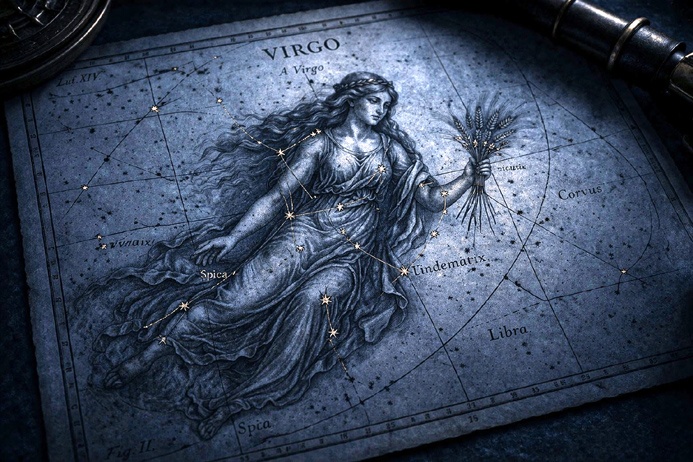
The Virgin figure central to Virgo symbolism is not a statement about sexuality or purity in any moralistic sense. The older layers of this archetype point toward self-sufficiency and wholeness, the condition of being complete in oneself rather than defined by merger or dependence on an external source. In ancient depictions, the figure associated with this sign was often shown holding a shaft of wheat, connecting her directly to cultivation, discernment, and the careful tending of what has been grown over a long season.
The figure also appears in the sky as the constellation, with the bright star Spica marking the shaft of grain in her hand. Mythologically, this figure was linked in various traditions to Demeter, to Erigone, and to Isis, figures who carried both practical authority and the grief that comes from deep investment in the mortal world. What matters astrologically is the quality of self-containment, attentiveness, and useful skill that the image encodes across its many historical expressions.

Virgo Symbolism Every grain earns its place.
Mercury’s Role in Shaping Virgo’s Character
Mercury’s dual rulership over Gemini and Virgo creates a useful contrast that sharpens the sign’s meaning considerably. Gemini takes Mercury’s communicative and curious energy and moves it outward, laterally, toward connection and exchange with the world around it. Virgo takes the same planetary influence and turns it inward and downward, toward analysis, sorting, and the careful refinement of what already exists. The same planet operates quite differently depending on the sign’s element and modality. Virgo is mutable earth, which means it adapts and bends at the end of a season rather than initiating or fixing, occupying the transitional phase between high summer and autumn, always working within a material and practical frame rather than an abstract one.
Mercury here is less interested in generating new ideas than in evaluating, organizing, and improving what is already at hand. That evaluative quality runs through every expression of the sign, whether it shows up in writing, in craft, in medicine, in accounting, or in any other domain where getting the details right is the whole point.
The Babylonian star catalog known as MUL.APIN, dating to around 1200 BCE, records an early version of the Virgo constellation under the name “The Furrow,” associating it with the goddess Shala and the concept of grain cultivation.
The Sixth House Connection
The sixth house, which Virgo rules by natural affinity, anchors Virgo symbolism in the most concrete and daily-life-oriented sector of the chart. This is the house of work as it is actually performed, health as it is actively maintained, service rendered in practical terms, and the daily routines that either support or undermine everything else. It is not the house of career achievement or public standing, which belong to the tenth, but the house of what happens on an ordinary Tuesday. Planets placed in the sixth house are put to useful work in an immediate sense, asked to function rather than to shine.
The sixth house is also traditionally associated with the body’s functioning systems, digestion, and the ongoing calibration of physical life. Older sources extended this further, assigning it significations of servants, animals kept in service, and those who labor in supporting roles. All of it connects to Virgo’s orientation toward useful, often unacknowledged work. Virgo’s natural resonance with this house is strong and consistent across interpretive traditions, and it reflects the sign’s core preoccupation with what is useful, what is functioning, and what requires adjustment.
Earth Element and Practical Expression
The earth element is essential to reading Virgo symbolism correctly, distinguishing it sharply from the other two earth signs, Taurus and Capricorn. Taurus works with earth through sensory engagement, through attachment to what is solid, pleasurable, and enduring. Capricorn works with earth through structure, long-term ambition, and the patient construction of lasting form. Virgo symbolism in the earth context is less about accumulation or structure than about refinement.
The Virgo mode of engaging with material reality is analytical and corrective rather than acquisitive or architectural. It sees what is present, assesses its condition, and asks what could function better. This is why Virgo placements often figure prominently in the lives of people genuinely skilled at troubleshooting and refinement, whether the domain is the physical body, a workflow, a written text, a financial system, or any technical process requiring close, sustained attention.
Spica, the brightest star in the Virgo constellation and one of the twenty brightest stars visible from Earth, was used by the ancient Greek astronomer Hipparchus to detect the precession of the equinoxes around 127 BCE.
Key Traits Rooted in the Symbol
Virgo Symbolism Stars mapped, meaning preserved.
The glyph most associated with Virgo symbolism is a stylized M with a closed or looped tail, though its precise origins are debated among historians of astrological notation. Some interpreters link it to a cursive rendering of the Greek word for maiden, others read it as a pictographic encoding of the concept of containment and internalized energy. Looked at carefully, the glyph supports the idea of contained, inward-facing energy in a way that contrasts instructively with neighboring signs.
Where Scorpio’s glyph ends in an outward-pointing arrow, Virgo’s loops back on itself. The visual language of the glyph, whatever its actual historical etymology, fits the sign’s observable behavior: attention directed inward and downward rather than projected outward toward new territory or external conquest. The sign’s well-documented capacity for detailed observation, constructive criticism, and methodical improvement flows naturally from this fundamental orientation. The sign does not scatter. It focuses, and that focus is the whole point.
Virgo in the Natal Chart
When a practitioner evaluates Virgo symbolism within an individual natal chart, the position of Mercury becomes the first variable to examine. A person with the Sun in Virgo but Mercury in Leo will express the sign’s analytical quality with considerably more theatrical confidence and a stronger desire for recognition than someone with Mercury also placed in Virgo. A person with Mercury in Libra will bring a more relational and aesthetically oriented sensibility to the same Virgo attentiveness.
The sign does not operate in isolation from its ruling planet’s condition, and Virgo is particularly sensitive to Mercury’s placement because the rulership connection is so direct and tight. Aspects to Mercury from outer planets, its house position, and any planets in close conjunction will each modify how the Virgo energy actually shows up in behavior, communication style, and areas of natural skill. Reading a Virgo placement well means reading Mercury first and reading it carefully.
In medieval European astrology, Virgo was assigned rulership over the human digestive system not because of Mercury’s influence but through a system called melothesia, which mapped each zodiac sign to a specific region of the body in sequence from head to foot.
Seasonal Timing and the Harvest Signature

Virgo Symbolism Attention as a form of care.
Virgo symbolism carries a distinct seasonal signature: the sign runs from late August through late September in the Northern Hemisphere, coinciding with harvest. This is a period of active assessment and focused labor, when the growing season is drawing toward its close rather than fully concluded, and the work is precisely that transitional sorting: what is ready, what is not, what can be preserved, and what must be left. Not everything that grew through the spring and summer will survive the selection process of harvest. Judgment is applied. Criteria matter here.
That agricultural timing is not incidental to the sign’s character. It shapes the sign’s fundamental orientation toward quality over quantity, toward careful selection over broad enthusiasm, and toward the kind of sustained critical attention that preserves what is truly useful while setting aside what is not. The harvest context also explains Virgo’s natural awareness of limits, conditions, and thresholds. Abundance, in this framework, is not a given but the earned result of attentive, sustained, well-directed work across an entire season.
Editor’s Reflection
What runs through all of it, finally, is a kind of quality that resists easy labeling. Virgo symbolism is not about fussiness or fear. It is about the capacity to pay close attention to what is real and to care, practically, about whether things work. That is not a small thing. In a tradition full of dramatic archetypes and sweeping mythological themes, Virgo holds a particular place: the one who stays, tends, and notices.
The questions worth sitting with are quieter ones. Where in your own chart does this kind of careful, corrective attention show up, and does it feel like a burden or a strength? When you encounter Virgo symbolism in someone else’s life, what do you actually see: rigidity, or a form of devotion to function that most people never develop? And what does it mean, in practical terms, to treat discernment not as criticism but as a form of care?

Known as The Man Who Notices, Mike Lamp is a theatrical hypnotist and psychic performer with more than twenty years of live stage experience. His work emphasizes observation, psychological influence, and measured presentation rather than spectacle or provocation. Performances are tailored for adult audiences, private events, and professional settings where control, clarity, and atmosphere matter.




Leave a Reply
You must be logged in to post a comment.