4
Mar
The Justice Tarot Card Meaning: Clear Guide to Powerful Symbolism
The Justice Tarot Card Meaning: Powerful Symbol Guide

The Justice Tarot Card Meaning represented through the classic symbolism of balance, truth, and moral clarity.
The Justice Tarot Card Meaning carries weight that most readers feel immediately. There is something in this card that stops casual browsing. The figure seated between stone pillars, sword raised, scales balanced in hand, presents an image that needs very little explanation to register its intention. Justice, as a concept and as a card, communicates directly. That quality of directness is worth exploring before moving into the specifics of interpretation, because it shapes how the card behaves within a reading. The Justice Tarot Card Meaning does not soften or hedge. It presents its subject matter plainly, which is part of what makes it so distinctive within the deck.
Read Major Arcana Secrets: Shocking Dark Origins Revealed Exclusive Article
What the Card Represents in the Major Arcana
The Justice card occupies position eleven in the Rider-Waite-Smith deck and most decks that follow its sequence. In the Thoth tarot and certain earlier systems, Justice trades positions with Strength, placing it at eight. This is not a minor editorial difference. Crowley and Harris made a considered structural argument about the energetic relationship between these two cards, and readers working with different decks should know which system they are using before assuming a fixed position.
Its position within the Major Arcana places it roughly at the midpoint of the fool’s journey, the arc of development that the major cards collectively trace. By this point in the sequence, the seeker has encountered formative forces including the High Priestess, the Hierophant, the Wheel of Fortune, and others that represent fate, structure, and inner knowing. Justice arrives as a reckoning, a point where accumulated choices become visible.
The Justice Tarot Card Meaning within the Major Arcana framework is not limited to legal or social fairness, though those associations are present. The card addresses the broader principle of cause and consequence. Every action generates a return, and Justice is the card that makes that principle explicit. This is the principle the Western esoteric tradition sometimes calls karma, though Waite himself was careful not to frame it in Eastern terms.
The card operates within a moral universe where accountability is structural, not punitive. It does not promise reward or punishment in any moralistic sense. It observes that equilibrium is the natural condition toward which things tend. This is why the card carries a certain neutrality. The figure does not look pleased or troubled. The expression is composed, attentive, oriented toward discernment rather than verdict.
Major Arcana symbolism throughout the deck relies on figures and objects that compress meaning efficiently, and Justice is particularly economical in this regard. The sword indicates the clarity of rational thought. The scales indicate measurement, balance, the weighing of competing values or claims. The red robe beneath the grey cloak suggests that feeling and passion exist underneath the formal exterior, present but contained. The white shoe visible at the hem is easy to miss, but it carries the same symbolic logic as the white wand held by the Magician, pointing toward the spiritual foundation beneath the formal presentation of power. The crown is modest, not elaborate, placing authority in reason rather than display.
The earliest known tarot decks, produced in northern Italy in the mid-fifteenth century, included Justice as one of the trump cards, suggesting the concept was considered foundational to the deck’s moral and allegorical structure from the very beginning of the tradition.
Symbolism Within the Card Image
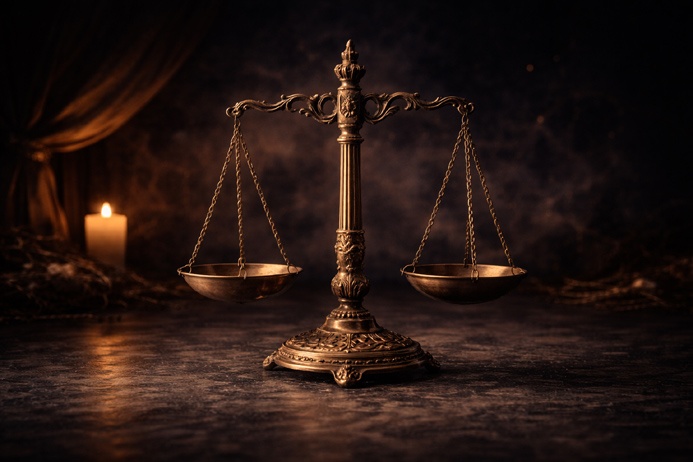
The Justice Tarot Card Meaning draws heavily on the scales as a symbol of measured, impartial evaluation.
Reading tarot card archetypes well requires patience with layers. The Justice figure sits rather than stands, suggesting deliberation rather than impulse. In Waite’s own commentary in The Pictorial Key to the Tarot, he describes Justice as representing equity and rightness, and the seated posture carries exactly that quality. A standing figure acts. A seated figure weighs. A throne or seat of judgment is an ancient image across cultures, and its presence here connects this card to traditions of formal evaluation that predate the tarot by centuries.
The two pillars flanking the figure echo the pillars that appear with the High Priestess and the Hierophant, linking Justice to a recurring architectural symbol in the deck. These pillars mark thresholds, and their repetition is deliberate. Justice does not stand outside this lineage of gatekeeping figures. It belongs to it, with the distinction that what passes through this particular threshold is not mystery or doctrine, but consequence.
The sword is double-edged, which is a detail that rewards attention. A double-edged sword cuts in both directions, meaning that the truth Justice reveals does not favor any single party automatically. Whatever the situation brought to this card for examination, Justice will apply the same standard to all sides. This is not a card that grants exceptions or accepts special pleading. The Justice Tarot Card Meaning, understood through this imagery, is fundamentally about impartiality, the kind of evaluation that does not start with a preferred conclusion.
The scales are held in the left hand, associated traditionally with the receptive, intuitive side of experience. The sword is in the right hand, associated with action and rational assertion. The Justice Tarot Card Meaning is embedded in this balance between reception and action, between listening and deciding. The card does not privilege one over the other. Good judgment requires both. This left-right division in the card quietly undermines any reading of Justice as purely cold or intellectual. The intuitive hand holds the scales. That placement is not accidental.
In the Marseille tarot tradition, which dominated European card printing for several centuries before the Rider-Waite-Smith deck appeared, Justice was depicted without a blindfold, a deliberate distinction from the classical figure of Justitia, implying that tarot Justice sees clearly rather than operating without sight.
The Justice Upright Meaning
The Justice upright meaning centers on accountability, clarity, and the honest assessment of a situation. When this card appears upright in a reading, it generally signals that a process of fair evaluation is either underway or needed. Legal matters, contracts, formal agreements, and decisions that carry long-term consequences all fall within its scope. It can indicate that a verdict or conclusion approaching in the near term will reflect the actual facts of the situation rather than politics or preference.
Beyond external circumstances, the Justice upright meaning also speaks to the internal work of self-evaluation. The card asks whether personal standards are being applied honestly, whether the judgments made about self and others are grounded in actual evidence or in feeling and assumption. This is not a harsh examination. It is more like a careful audit, conducted without blame, focused on understanding what is actually present.
The Justice Tarot Card Meaning when upright can suggest that a situation the reader has been uncertain about will clarify. The details that seemed blurred or contested will become readable. There is a quality of resolution that this card in the upright position often signals, not necessarily a comfortable resolution, but a clear one. Readers who encounter this card upright are generally being invited to trust a process of evaluation rather than resist it.
Spiritual journey in tarot is not always dramatic. Sometimes a card like Justice represents a quieter, more interior kind of progress, the point at which a person stops rationalizing and simply sees things as they are. That moment of honest seeing is itself a spiritual accomplishment, and the card honors it.

Symbolic depiction representing The Justice Tarot Card Meaning through balance, truth, and karmic order.
The Justice Reversed Meaning
The Justice reversed meaning introduces a different set of considerations. When the card appears inverted, the themes of balance, clarity, and accountability do not disappear, but they face obstruction. Bias, avoidance, self-deception, or external manipulation can all appear through a reversed Justice card.
The Justice Tarot Card Meaning in reversal sometimes points to a reluctance to face consequences. A person may be aware on some level that a situation requires honest reckoning but is finding reasons to delay or deflect that process. The scales tip when weight is added to one side and removed from the other, and reversed Justice often signals exactly that kind of imbalance, deliberate or unconscious.
In some readings, the Justice reversed meaning addresses situations where fairness is genuinely absent, where the process meant to produce a just outcome has been compromised. This does not mean the situation is hopeless. It is an observation about the current state of things, a flag indicating that clarity and integrity need to be actively pursued rather than assumed.
Tarot card archetypes in reversal tend to show the shadow quality of their upright expression, and Justice is consistent with that pattern. Where upright Justice represents clear-eyed assessment, reversed Justice can represent willful blindness. Where upright Justice suggests resolution, reversed Justice may indicate ongoing stagnation rooted in unresolved responsibility.
Justice in Combination With Other Cards
Tarot readings rarely rest on a single card, and The Justice Tarot Card Meaning shifts in texture depending on what surrounds it. Paired with a card like the Tower, Justice may indicate that a disruptive revelation is the mechanism through which balance is restored. Paired with the Star, it suggests that the honest reckoning this card calls for opens the way toward genuine renewal.
When Justice appears near cards associated with communication, such as the suit of Swords in general, or specific cards like the Page of Swords, the emphasis tends to fall on the need for truthful speech, testimony, or documentation. The situation may hinge on what is said clearly and accurately. In these combinations, The Justice Tarot Card Meaning narrows toward precision, toward the specific word or fact that determines whether a situation resolves fairly or remains tangled.
Spiritual journey in tarot often becomes visible in the patterns across multiple positions in a spread, and Justice combined with cards earlier in the Major Arcana sequence suggests the reader may be approaching a turning point that earlier choices have been building toward. Combined with cards later in the sequence, it suggests that the work of honest accounting has already begun and that further progress depends on following through.

The Justice Tarot Card Meaning uses the double-edged sword to represent the clarity of rational judgment applied without favor.
How Readers Work With This Card
Experienced readers tend to treat The Justice Tarot Card Meaning as a prompt toward clarity rather than a verdict. The card does not condemn or reward. It illuminates. A reading in which Justice appears prominently is generally one that calls for honesty above comfort, for looking at what is actually present rather than what would be preferred.
The Justice Tarot Card Meaning, taken as a whole across its upright and reversed positions, its symbolism and its placement in the Major Arcana, describes a consistent principle. Situations have weight. Choices accumulate. The scales are always in motion, even when no one is watching. This card makes that motion visible, and asks the reader to look at it without flinching.
The spiritual journey in tarot applies here in a grounded sense. The journey the card describes is not mystical ascent. It is the ordinary but difficult work of seeing situations accurately and responding with integrity. That kind of clarity is its own form of progress, and Justice marks it with appropriate gravity.
Arthur Edward Waite assigned Justice to the Hebrew letter Lamed in his esoteric correspondence system, a letter associated in Kabbalistic tradition with the ox goad, an instrument of directed force and correction, adding a layer of purposeful pressure to the card’s symbolism that is rarely discussed in general reading guides.
Editor’s Reflection
What draws people to The Justice Tarot Card Meaning is rarely the spectacle of the image. It is the quiet insistence of it. The figure does not gesture toward the viewer or demand attention. It simply sits, and holds its instruments, and waits. That patience is the point. Among all the cards in the Major Arcana, few communicate so plainly that the work of honest evaluation is ongoing rather than finished, ordinary rather than exceptional.
The Justice Tarot Card Meaning tends to surface differently for different people, and that variation is worth sitting with. Some encounter it at moments of genuine external reckoning, others at quieter personal crossroads where no one else would even notice a decision had been made. It is the ordinary but difficult work of seeing situations accurately and responding with integrity, which is perhaps why Justice has never been among the deck’s more popular cards.
Comfort and clarity are not always the same thing, and this card has never pretended otherwise. What does Justice ask of you when it appears, and does your answer change depending on where you are in life? If you have worked with this card over time, has your sense of what it means to be fair, to yourself or to others, shifted in ways you did not expect?

Known as The Man Who Notices, Mike Lamp is a theatrical hypnotist and psychic performer with more than twenty years of live stage experience. His work emphasizes observation, psychological influence, and measured presentation rather than spectacle or provocation. Performances are tailored for adult audiences, private events, and professional settings where control, clarity, and atmosphere matter.


Leave a Reply
You must be logged in to post a comment.