28
Feb
The Hierophant Tarot Card Meaning: Clear Guide to Powerful Symbolism
The Hierophant Tarot Card Meaning: Essential True Symbolism

The Hierophant Tarot Card Meaning illustrated with traditional triple crown, blessing gesture, and crossed keys of spiritual authority
The Hierophant Tarot Card Meaning in Context
The Hierophant Tarot Card Meaning begins not with a single image but with a long lineage of symbolic thought. The Hierophant is the fifth card of the Major Arcana, numbered five in most traditional decks and positioned between the Emperor and the Lovers. That placement is not incidental. It situates this figure at a hinge point in the symbolic journey of the major cards, somewhere between the structures of earthly authority and the first stirrings of personal choice.
The card’s presence in any reading carries the weight of that in-between position. It speaks to inherited wisdom, organized belief, and the role of the teacher or guide who transmits knowledge from one generation to the next.
In the Rider-Waite tradition, the Hierophant is depicted as a robed religious authority seated between two pillars. He holds a triple cross scepter, raises one hand in a gesture of blessing, and faces two initiates kneeling before him. At his feet are two crossed keys. The symbolism is dense and deliberate. The pillars echo those from the High Priestess card, though here they frame an outward institution rather than an inner mystery.
The triple cross suggests a mediating function across three levels of awareness, the conscious, the subconscious, and the superconscious, with the Hierophant positioned as the figure who moves between them. The keys reference the power to open or close access to sacred understanding. Everything in the image points toward formalized tradition and the passage of that tradition through structured means.
Read Major Arcana Secrets: Shocking Dark Origins Revealed Exclusive Article
The Hierophant Tarot Card Meaning and the Major Arcana
Understanding The Hierophant Tarot Card Meaning requires some familiarity with how the Major Arcana operates as a whole. The twenty-two major cards are often read as a progression through archetypal experiences, sometimes called the Fool’s Journey. The Hierophant arrives after the Emperor has established order and before the Lovers introduce the question of personal values. His role in this sequence is to represent the systems that societies build to make sense of the world. Religion, education, ceremony, and moral codes all fall within his domain. He is not a figure of blind obedience so much as one of transmitted learning, the keeper of accumulated human understanding in its more organized forms.
Major Arcana symbolism tends to operate at a deeper level than the minor cards. Where a minor arcana card might point to a specific event or feeling, the Hierophant speaks to something more foundational. He addresses questions about where a person’s beliefs come from, what community they belong to, and what kind of guidance they trust. These are not small questions. They shape identity over the course of a lifetime.
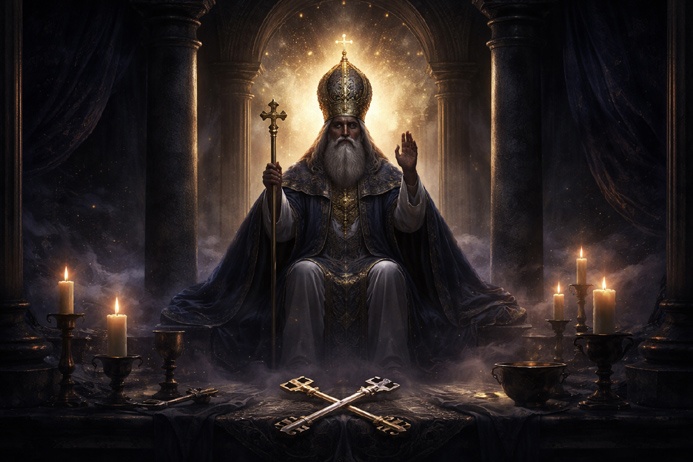
The Hierophant Tarot Card Meaning portrayed within a shadowed temple setting, emphasizing tradition, sacred authority, and Major Arcana symbolism
The Hierophant Tarot Card Meaning in Upright Position
The Hierophant upright meaning centers on guidance, tradition, and the value of working within established systems, a theme that runs through much of the card’s interpretive history. When this card appears upright in a spread, it often signals a time when conventional wisdom genuinely applies, when seeking a mentor, joining a community, or following an established path offers real value. There is nothing dismissive about this card. The upright Hierophant acknowledges that human beings benefit from shared structures, that not every question needs to be answered alone.
When upright is frequently associated with formal education, religious institutions, marriage ceremonies, and any context where tradition provides a meaningful framework. A reader encountering this card might consider where in the querent’s life a structured approach is being called for. This is not a card that demands spiritual conformity. It is a card that asks whether the querent is willing to learn from what has already been established, to apprentice themselves to a body of knowledge rather than attempting to reinvent everything from scratch.
The Hierophant upright meaning can also point to the figure of a mentor or advisor whose guidance comes from experience rather than inspiration alone. Doctors, professors, clergy, and counselors all carry a flavor of this archetype. When the card appears in a position related to relationships or community, it often speaks to the rituals that bind people together, shared traditions, ceremonies, and agreements that carry collective meaning.
There is a practical dimension to The Hierophant Tarot Card Meaning in this position that is sometimes overlooked. The card does not only apply to grand spiritual questions. It appears in readings about career paths that require formal credentialing, about families navigating established roles, about groups seeking to maintain coherent values across time. The Hierophant holds the thread of continuity.
The title Hierophant derives from the Greek hierophantes, meaning one who reveals sacred things. The term was used in ancient Eleusis to designate the priest who presided over the Eleusinian Mysteries, one of the most significant initiatory rites in the ancient Greek world.
The Hierophant Tarot Card Meaning in Reversed Position
The Hierophant reversed meaning shifts the energy considerably. Where the upright card speaks to the value of tradition, the reversed position often points to its limitations. A reversed Hierophant may indicate that established systems have become rigid, that rules are being followed without understanding, or that an institution is prioritizing its own preservation over genuine need. It can also point toward an unconventional path to the sacred, not the absence of structure but the beginning of a self-constructed one. The figure who was once a wise guide has perhaps become a gatekeeper who restricts rather than enables.
The Hierophant reversed meaning can also describe an individual who is actively rejecting conventional structures, sometimes for good reason. There are moments in life when inherited belief systems no longer fit, when the querent has grown beyond the containers they were handed. The reversed card may signal that it is time to question what has been accepted without examination. That questioning is not depicted here as rebellion for its own sake. It is a natural and necessary stage in developing an authentic relationship with one’s own values.
In reversed position, the card can indicate tension between personal conscience and group expectation, or between innovation and institutional conservatism. In career readings, it sometimes appears when someone is chafing under bureaucratic constraints or considering departing from a conventional professional path. In matters of belief, it may reflect a period of honest doubt or the beginning of a more personal spiritual inquiry that moves beyond received doctrine.
Early tarot decks produced in northern Italy during the fifteenth century depicted this figure as the Pope rather than a generalized spiritual authority. The shift toward the more neutral title Hierophant became standard in the occult revival traditions of the nineteenth century, largely through the influence of French esotericists working with the Tarot de Marseille.
Spiritual Journey Symbolism and the Hierophant
Spiritual journey in tarot is not a single arc but a series of encounters with different kinds of wisdom. The Hierophant represents one mode of encountering that wisdom, through community, through lineage, through forms that have been tested over time. This is distinct from the High Priestess, who represents inner knowing, or the Hermit, who represents solitary inquiry. The Hierophant’s knowledge is relational and institutional. It is wisdom held in common.
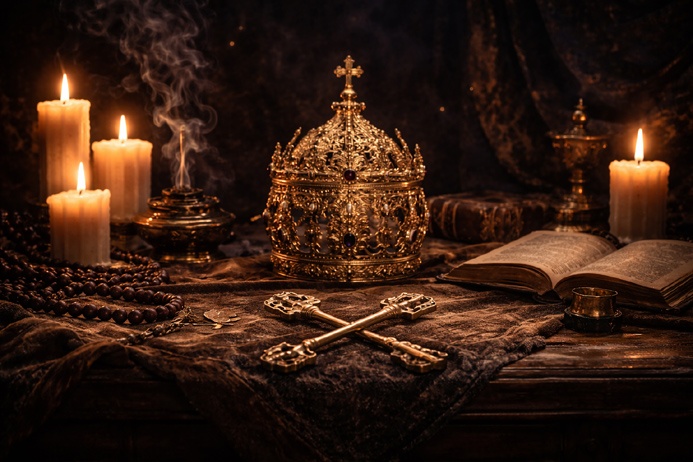
The Hierophant Tarot Card Meaning illustrated with traditional triple crown, blessing gesture, and crossed keys of spiritual authority
Tarot card archetypes function best when read as positions on a spectrum rather than fixed moral categories. The Hierophant is neither better nor worse than the Hermit or the High Priestess. Each archetype addresses a different relationship to knowledge and guidance. The Hierophant’s territory is the sacred contract between a tradition and its participants, the mutual obligation that gives ceremony its meaning.
The Hierophant Tarot Card Meaning within this context asks the reader to consider what traditions are genuinely sustaining and which ones have outlived their usefulness. That is not a question the card answers definitively. It opens the inquiry.
Practical Notes for Reading the Card
When The Hierophant Tarot Card Meaning is being considered in a live reading, the surrounding cards matter considerably. A Hierophant surrounded by cups cards reads differently than one surrounded by swords. In an emotional context, the figure may speak to the comfort of shared ritual or the weight of familial expectations. In a more conflict-oriented spread, the card might point to authority being questioned or structures coming under pressure.
Readers with experience in Major Arcana symbolism tend to approach the Hierophant with some patience. The card rarely delivers a blunt directive. It invites reflection on the relationship between the individual and the larger structures they inhabit, whether those are institutions, families, religious communities, or professional fields. Its message is not simple, but it is consistent. There is value in what has been accumulated. There is also a responsibility to understand why it was accumulated, and whether it still serves.
In the Thoth Tarot designed by Aleister Crowley and painted by Lady Frieda Harris, the Hierophant is associated with the Hebrew letter Vav and the astrological sign Taurus, a correspondence that differs in emphasis from Waite’s version and reflects a distinct interpretive lineage within twentieth century tarot development.
Editor’s Reflection
What makes The Hierophant Tarot Card Meaning worth returning to is the way it resists easy resolution. The card does not tell a person what to believe or which institution deserves loyalty. It simply marks the fact that human beings have always organized their understanding of the world into forms they can share with one another, and that those forms carry both genuine value and genuine limitation. The Hierophant sits with that tension rather than resolving it, which is perhaps why readers continue to find the card useful across very different life circumstances.
For those drawn to The Hierophant Tarot Card Meaning, a few questions tend to stay open. Where does a person find the line between honoring a tradition and simply deferring to it? Is there a difference between the guidance of an institution and the guidance of a genuinely wise person working within one? And when inherited structures begin to feel constraining rather than sustaining, what does that tension ask of someone? These are not questions with tidy answers, but they are the kind that this card, more than most, has a way of quietly placing on the table.

Known as The Man Who Notices, Mike Lamp is a theatrical hypnotist and psychic performer with more than twenty years of live stage experience. His work emphasizes observation, psychological influence, and measured presentation rather than spectacle or provocation. Performances are tailored for adult audiences, private events, and professional settings where control, clarity, and atmosphere matter.


Leave a Reply
You must be logged in to post a comment.