2
Mar
The Strength Tarot Card Meaning: Clear Guide to Powerful Symbolism
The Strength Tarot Card Meaning: Proven Timeless Wisdom

The Strength Tarot Card Meaning represented through a calm, archetypal image of inner power and quiet courage
What the Card Depicts
Any serious reading of the Strength Tarot Card Meaning begins with the image itself. In most traditional decks, the card shows a figure, usually a woman, gently but firmly holding open or closing the jaws of a lion. The woman wears a white robe, a symbol of purity of intention, and above her head floats the lemniscate, the horizontal figure eight that also appears above the Magician. Around her waist and head, flowers are often woven into garlands. The lion, large and golden, does not resist. The posture of both figures suggests not conquest but cooperation. This is not a scene of struggle. It is a scene of understanding.
The card carries the Roman numeral VIII in the Rider-Waite tradition and most decks that follow it, though in the Marseille tradition and older arrangements, Strength was numbered XI and Justice VIII. Aleister Crowley‘s Thoth deck, which calls the card Lust rather than Strength, also uses XI. The Rider-Waite tradition, which became the dominant reference point for English-language tarot interpretation in the twentieth century, placed Strength at eight and Justice at eleven.
Arthur Edward Waite made this transposition deliberately, and Pamela Colman Smith’s illustration gave the card its most enduring visual form. That placement matters because it affects how the narrative arc of the Major Arcana is read. Strength appears after the Chariot, which represents willpower applied through external force, and the contrast is deliberate. Where the Chariot controls through command, Strength works through patience and inner stability.
Read Major Arcana Secrets: Shocking Dark Origins Revealed Exclusive Article
The Symbolism Beneath the Surface
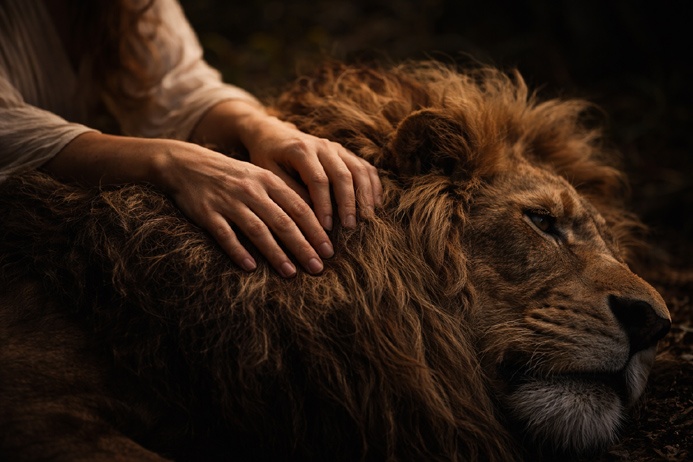
The Strength Tarot Card Meaning expressed through direct, fearless contact between human presence and instinctual force
The Strength Tarot Card Meaning draws on a symbolic vocabulary that tarot inherited rather than invented, one that was already centuries old by the time the earliest known tarot decks appeared in fifteenth century northern Italy. European manuscript illumination, heraldry, and religious allegory each assigned consistent meaning to particular visual elements, and a reader familiar with that tradition would have recognized the codes at work here without requiring explanation. The card borrows that established language and then quietly redirects it toward an unexpected conclusion.
Clarity of motive and the absence of hidden agenda were each represented in that inherited tradition through specific visual codes. The Strength Tarot Card Meaning deploys several of them simultaneously, and their combination is not accidental. Each element reinforces the others, building toward a single unified statement about the nature of the encounter being depicted. In Pollack’s reading, this layering of inherited symbols is precisely what gives the Major Arcana its density. The cards do not explain themselves. They accumulate meaning through visual compression.
What gives the image its staying power is the way it reframes a familiar confrontation. In most traditional symbolic contexts, the meeting of civilized restraint and raw natural force ends in one of two ways, domination or defeat. This card proposes a third possibility, one that requires neither aggression nor surrender. hat third possibility is the card’s genuine contribution to the symbolic language it inherited, separating Strength from simpler images of heroic conquest in European allegorical tradition. It is also what makes the card psychologically alive. The tension is never fully resolved, and that irresolution is the point.
In early printed Tarot de Marseille decks from the sixteenth and seventeenth centuries, the Strength card was sometimes called La Force and depicted a figure breaking or holding a column rather than engaging a lion. The lion imagery became the more consistent standard as the Marseille tradition stabilized.
The Upright Reading
The Strength upright meaning centers on qualities that are easy to name but genuinely difficult to practice. Courage, patience, and the capacity to remain calm in circumstances that provoke reaction are the core themes. When this card appears upright in a reading, it tends to indicate that the situation calls for steadiness rather than force, for a willingness to stay present with something difficult rather than push it away or overpower it.
The Strength Tarot Card Meaning in its upright position also points toward self-knowledge. To handle a lion without violence requires knowing the lion, and to know the lion is to know something of yourself. In practical terms, the card often suggests that what appears threatening or ungovernable is more approachable than it looks. It encourages a kind of honest confidence, not the confidence that comes from having all the answers, but the confidence that comes from trusting one’s own capacity to meet difficulty without collapsing.
The Strength upright meaning also extends to relationships with others. The calm authority depicted in the card applies equally well to moments of conflict with another person as it does to internal struggle. The card does not advise domination or submission. It advises something closer to respectful persistence, a willingness to hold a position without escalating, to influence through steady presence rather than pressure.
In questions about work or creative effort, Strength upright often signals endurance. The task may be demanding. The timeline may be longer than expected. The card suggests that the capacity to continue, to tolerate frustration without abandoning the effort, is exactly what is needed.

The Strength Tarot Card Meaning expressed through calm restraint and quiet courage beneath a midnight sky
The Reversed Reading
The Strength reversed meaning introduces a different quality of challenge. When the card appears inverted, the integration depicted in the upright image becomes disrupted. The reversed position can suggest that the instinctual forces symbolized by the lion are not being engaged honestly, either because they are being denied altogether or because they are being allowed to dominate without guidance.
The Strength Tarot Card Meaning in its reversed aspect sometimes points to exhaustion. The patient, sustained effort that the upright card calls for takes genuine energy. A reversal can indicate that this energy is running low, that what once felt manageable now feels overwhelming. It does not necessarily mean failure. It may simply indicate that rest, reassessment, or a different approach is needed before the effort continues.
The Strength reversed meaning can also point toward self-doubt. Where the upright card carries an implicit confidence in one’s ability to manage difficulty, the reversed position may reflect a loss of that confidence. Anxiety, hesitation, and a tendency to interpret normal friction as evidence of deeper inadequacy are all possibilities. The image of the woman and the lion, when inverted, might suggest a scene where neither figure holds the steady center. Both are uncertain.
At the same time, the Strength reversed meaning does not automatically signal weakness. In some readings it appears as a correction, a signal that the approach being taken is too forceful, that what is needed is less control and more willingness to let the situation breathe. The reversed card can invite a question about whether effort is being applied in the right direction.
When Arthur Edward Waite and Pamela Colman Smith produced the Rider-Waite deck in 1909, Waite deliberately transposed Strength and Justice from their Marseille positions. He offered only partial explanation for this decision in his published writings, and the full reasoning remains a matter of ongoing discussion among tarot scholars.
Strength Within the Major Arcana
Major Arcana symbolism treats each card as a stage in a larger sequence, and the Strength card occupies a position that carries specific weight within that structure. It arrives after the Chariot, which is often read as a card of external achievement and disciplined will. The movement from seven to eight, from Chariot to Strength, is a movement inward. External victories have been secured. Now the work becomes interior.
The Strength Tarot Card Meaning as part of the spiritual journey in tarot reflects this inward turn. The challenges depicted in later cards of the Major Arcana, the Hermit’s withdrawal, the Wheel’s unpredictability, the Hanged Man’s suspension, all require the kind of inner stability that Strength represents. Without the capacity to remain calm in the face of instinct and impulse, the deeper stages of the journey would be difficult to navigate.
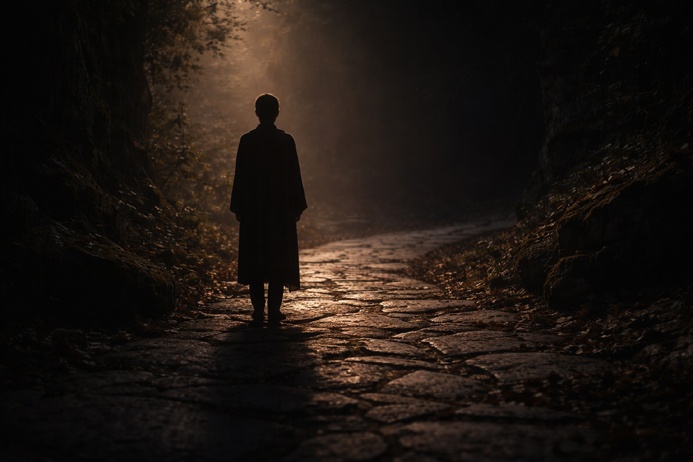
The Strength Tarot Card Meaning marks a shift inward along the spiritual journey of the Major Arcana
Tarot card archetypes in the Major Arcana tend to present not isolated qualities but relationships between qualities. Strength is not simply courage in isolation. It is courage that has been tempered by gentleness. It is will that has been made patient. The woman in the image has not abandoned her intelligence or her softness to engage the lion. She brings all of it, and that completeness is what makes the contact possible.
The Strength Tarot Card Meaning connects naturally to the idea that transformation rarely happens through force. The Major Arcana symbolism consistently returns to this theme in various forms. Power that endures is usually power that has learned to work with resistance rather than simply against it. The Strength card makes this principle visible in a single, clear image.
The lemniscate symbol above the Strength figure appears in only two cards in the Rider-Waite deck, Strength and the Magician. Its selective placement is considered intentional, linking these two cards within the broader symbolic architecture of the Major Arcana as points where conscious direction of energy is the central theme.
How the Card Functions in Readings
This card’s meaning shifts depending on context, position, and the cards that surround it. In a reading focused on personal challenge, it tends to appear as encouragement, though encouragement of a quiet and serious kind. It does not promise easy resolution. It suggests that the capacity to face difficulty with integrity is present, whether or not it feels that way at the moment.
The Strength Tarot Card Meaning also tends to ask something of the reader or the person being read for. It is not a passive card. The scene it depicts requires participation. The lion does not tame itself. The patience and clarity represented in the image are not given; they are practiced. In that sense, the card functions less as a statement about what will happen and more as a description of what is possible when the inner work is taken seriously.
Editor’s Reflection
What the Strength Tarot Card Meaning ultimately points toward is something fairly simple, even if it takes time to absorb. The figure in the image is not exceptional. She is not armored or armed. She is present, and she is steady, and that steadiness is what makes the encounter with the lion possible. The card does not describe a hero. It describes a quality of attention that most people have experienced in some form, those moments when anxiety gives way to clarity and what was feared becomes what is faced.
For anyone who has sat with the Strength Tarot Card Meaning across different seasons of life, the card tends to mean something different at different times. What reads as encouragement during one period might read as a gentle challenge during another. That variability is worth thinking about. What does patience with instinct look like in your own experience, and does it feel like strength or like something harder to name? When you have encountered the lion in your own life, whatever form it took, what made the difference between turning away and staying present?

Known as The Man Who Notices, Mike Lamp is a theatrical hypnotist and psychic performer with more than twenty years of live stage experience. His work emphasizes observation, psychological influence, and measured presentation rather than spectacle or provocation. Performances are tailored for adult audiences, private events, and professional settings where control, clarity, and atmosphere matter.


Leave a Reply
You must be logged in to post a comment.