6
Feb
Aura Reading Practices: Essential Methods Revealed
Aura Reading Practices: Methods, Training, and Interpretive Traditions

Soft-focus observation techniques form the foundation of traditional aura reading practices
The concept of the aura a luminous field said to surround living beings has appeared in spiritual traditions across centuries and cultures. While the existence of such fields remains outside mainstream scientific validation, aura reading practices continue to attract practitioners who describe specific methods for perceiving, interpreting, and teaching what they understand as subtle energy patterns around the human body.
These practices rest on the premise that trained observers can detect information about a person’s physical, emotional, or spiritual state through visual or intuitive means. Whether understood as genuine perception or as a form of focused intuition, aura reading practices represent a distinct category within contemporary metaphysical work.
Read Pendulum Dowsing Techniques: Master Question Framing Exclusive Article
Historical Context and Cultural Foundations
References to luminous fields around holy figures appear in religious art spanning Christian, Buddhist, Hindu, and Islamic traditions. Halos, nimbi, and aureoles depicted in paintings and iconography suggest long-standing cultural recognition of light as a symbol of spiritual presence or development.
The modern formalization of aura reading practices emerged primarily in the late nineteenth and early twentieth centuries, coinciding with the Theosophical movement and broader Western interest in Eastern philosophies. Writers such as Charles Leadbeater and Annie Besant published detailed descriptions of aura color meanings and their supposed correspondence to emotional and spiritual states. These early texts established much of the interpretive framework still referenced in contemporary aura reading training.
The term “aura” derives from the Greek word for breeze or breath, originally used in classical texts to describe subtle emanations around objects before entering metaphysical vocabulary in the 19th century.
Methods of Perceiving Auras
Practitioners describe several approaches to perceiving auras, often categorized by the sensory mode involved. Visual methods remain most commonly discussed, though many practitioners report using multiple perceptual channels.
The most widely taught technique for developing aura sight involves soft-focus gazing. Students are instructed to look slightly beyond or around a person rather than directly at them, preferably against a plain white or neutral background in soft, natural lighting. Practitioners report that this peripheral vision technique allows subtle color fields to become visible. Some describe these colors as translucent or shimmering, while others report solid bands of light.
A second category involves what practitioners term clairvoyant perception methods. These techniques rely less on physical sight and more on internal visualization. Practitioners describe receiving impressions or mental images of colors and patterns when focusing attention on another person. This approach is often taught as complementary to visual techniques, with students encouraged to note whether impressions arise through external sight or internal knowing.
Kinesthetic sensing represents a third approach. Some practitioners report feeling temperature changes, tingling sensations, or pressure when moving their hands near another person’s body. These tactile impressions are sometimes interpreted as boundaries or qualities within the energy field, though they do not provide color information directly.
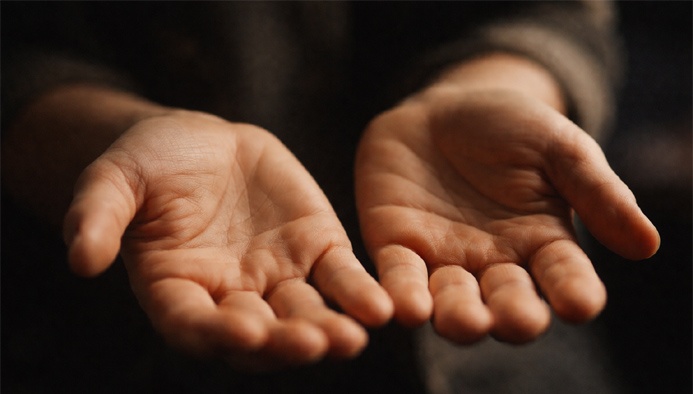
Calm observational moment associated with aura reading practices and sensing energy fields.
Interpreting Aura Colors
The interpretation of aura colors follows frameworks passed down through teaching lineages and written texts. While individual practitioners may develop personal associations, certain color correspondences appear consistently across aura reading practices.
Red typically appears in interpretations related to physical vitality, passion, anger, or survival instincts. Practitioners describe darker reds as indicating unresolved anger or physical tension, while bright reds suggest active energy or strong life force.
Practitioners also report observing gradations and combinations. A person rarely displays a single uniform color. More commonly, the inner layer close to the physical body may show one dominant hue, while outer layers reveal different colors entirely. The etheric double, visible as a narrow band immediately surrounding the body, is often described as bluish-gray or colorless, distinct from the emotional and mental layers beyond it.
Orange is traditionally associated with creativity, sexuality, emotional expression, and social connection. Muddy orange tones are sometimes interpreted as emotional confusion or blocked creative energy.
Yellow corresponds to mental activity, optimism, and intellectual engagement. Bright yellows indicate clear thinking, while pale or dirty yellows might suggest anxiety or overthinking
Green appears in interpretations involving healing, growth, balance, and heart-centered emotions. A bright, clear green is consistently observed in the auras of physicians, nurses, and natural healers. Muddy or olive greens may suggest jealousy or, in some cases, deceit.
Blue relates to communication, truth, calm, and spiritual awareness. Different shades carry different associations within aura reading practices, with deeper blues suggesting intuitive development and lighter blues indicating peaceful emotional states.
Interpreting aura colors also involves attention to brightness, clarity, and spatial distribution. Practitioners report that the same color may carry different meanings depending on its intensity or location within the field. A murky color near the physical body might be interpreted differently than a clear, bright hue extending several inches outward.
Semyon Kirlian’s 1939 photographic experiments with high-voltage electrical fields created images showing coronas around objects, leading to decades of debate about whether such techniques captured actual energy fields or merely documented electrical discharge patterns.
Teaching Aura Reading
The transmission of aura reading practices occurs primarily through direct instruction, workshops, and apprenticeship-style relationships. Most contemporary aura reading practices begin instruction with exercises designed to increase visual sensitivity and broaden perceptual awareness.
Common introductory exercises include observing the space around one’s own hands, practicing with willing partners, and working with plants or animals before progressing to human subjects. Students are often encouraged to keep journals documenting their impressions, noting which conditions seem to enhance or inhibit their perceptual experiences.
Many teachers emphasize the importance of grounding and centering practices before attempting aura observation techniques. Meditation, breath work, or simple physical exercises are presented as ways to stabilize one’s own energy before attempting to perceive another person’s field.
Instructors also address the distinction between imagination and genuine perception. Students learning aura reading practices are typically encouraged to notice the difference between colors they think should be present and colors that appear spontaneously or unexpectedly. This self-monitoring approach is presented as essential for developing reliable perception.
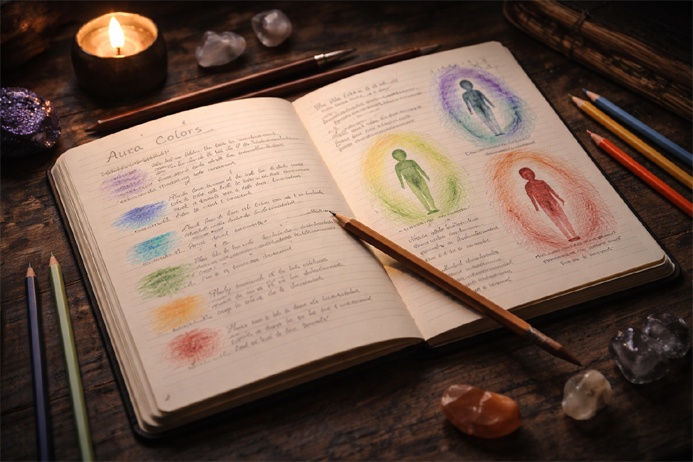
Personal workspace used for recording observations and training in aura reading practices.
Chakra Color Correspondence
Many contemporary aura reading practices incorporate concepts from yogic and tantric traditions regarding chakras, or energy centers within the body. Each chakra is associated with specific colors, and practitioners often describe seeing these colors in the aura layers corresponding to particular chakras.
The root chakra at the base of the spine corresponds to red. The sacral chakra in the lower abdomen relates to orange. The solar plexus chakra connects to yellow. The heart chakra is associated with green or pink. The throat chakra corresponds to blue. The third eye chakra at the forehead relates to indigo or deep purple. The crown chakra at the top of the head is linked to violet or white.
Practitioners using chakra color correspondence as an interpretive framework report that imbalances or blockages in specific chakras may appear as absent colors, muddy hues, or distortions in the corresponding area of the aura. This integrated approach allows readers to connect their observations with specific aspects of a person’s life or development.
Advanced practitioners report that while these correspondences provide useful frameworks, individual variations occur. Some persons display colors shifted from typical positions, particularly those engaged in intensive spiritual practices or those with unusual constitutional patterns.
Read Master Crystal Ball Scrying Methods for Divination Practice Exclusive Article
Aura Photography Interpretation
Since the 1970s, devices claiming to capture images of the aura have appeared in metaphysical contexts. The most common technology, based on principles similar to Kirlian photography, measures electrical responses from a person’s hands and translates this data into color images displayed around a photograph.
Practitioners trained in aura photography interpretation use these images as visual aids for discussion with clients. The photographs provide consistent color information that can be analyzed according to the same interpretive frameworks used in direct aura observation techniques. Whether the colors captured represent actual energy fields or biofeedback translated into visual form remains debated even among practitioners.
Some readers find the photographs useful for teaching purposes, as they provide concrete images for students learning to recognize color qualities and patterns.
Walter Kilner, a British physician, published “The Human Atmosphere” in 1911 describing his use of specially treated glass screens containing dicyanin dye, which he claimed allowed observers to see auric fields that were otherwise invisible to normal sight.
Intuitive Aura Assessment
Beyond structured color interpretation, many practitioners incorporate what they describe as intuitive aura assessment. This approach emphasizes direct knowing or spontaneous insight rather than systematic analysis. Practitioners report receiving impressions about a person’s emotional state, health concerns, or life circumstances while observing their energy field.
This intuitive component distinguishes aura reading practices from purely visual exercises. Experienced readers often describe a simultaneous awareness of colors, sensations, and knowing that arises without conscious analytical effort. Teaching this aspect proves more challenging than instructing visual techniques, as it relies on internal validation and personal development of trust in one’s perceptions.
Ethical Considerations and Responsible Practice
Responsible practitioners of aura reading practices acknowledge several ethical considerations. Offering unsolicited readings constitutes a serious breach of etiquette. Making definitive statements about another person’s health or future oversteps the proper role of the reader, which is to report observations, not pronounce judgments. Many teachers emphasize that aura observations should be presented as impressions rather than diagnoses.
The potential for projection seeing one’s own expectations or biases rather than another person’s actual energy field represents another concern. Experienced practitioners often recommend ongoing self-examination and openness to being wrong as essential aspects of maintaining integrity in this work.
Additionally, the question of whether aura reading practices involve actual perception of objective phenomena or represent a form of heightened intuition using visual metaphor remains open. Honest practitioners typically acknowledge uncertainty about the mechanism while maintaining confidence in the practical usefulness of their observations.
Continuing Development
Practitioners describe aura reading practices as skills requiring ongoing development rather than one-time learning. Subtle energy observation appears to deepen with regular practice, dedicated attention, and willingness to refine one’s perceptual abilities over time.
Many readers report that their initial perceptions evolve significantly with experience. Colors that seemed clear in early practice may later reveal layers of nuance. The ability to distinguish between different qualities of the same color, or to notice patterns in how the field moves or changes, develops gradually.
These practices have persisted across changing cultural contexts, maintaining communities of practitioners and clients regardless of questions about their ultimate mechanism. Whether understood as literal perception, symbolic intuition, or focused attention that enhances interpersonal awareness, aura reading practices continue to evolve within contemporary metaphysical communities.
Common Obstacles and Misperceptions
Beginning students frequently report frustration when their observations prove inconsistent or when they perceive nothing at all during early attempts. Teachers consistently report this as typical in early training. The capacity develops unevenly, often emerging more readily with certain individuals or in particular conditions before becoming reliable.
Another common difficulty involves distinguishing afterimages the optical phenomenon that occurs when staring at an object from genuine subtle energy observation. Afterimages appear in complementary colors and remain static. True aura perception reveals colors that shift, flow, and respond to the subject’s thoughts and emotions in real time.
Students also tend to expect dramatic, vivid colors immediately. More often, initial perceptions appear as faint, translucent veils or slight distortions in the air. Only with patient practice do the colors become more distinct and easier to maintain in awareness.
Editor’s Reflection
What emerges from examining aura reading practices is not a clear verdict on their objective reality, but rather a picture of systematic methods passed down through communities of practice. These techniques rest on claims of perception that remain unverifiable by conventional means, yet they persist because practitioners report finding them useful. Whether the colors and impressions arise from genuine extrasensory perception or represent a structured form of intuitive reading may matter less than the fact that people continue to develop and refine these skills with apparent consistency across different teaching lineages.
For readers drawn to explore these methods, several questions remain worth considering. What would it mean if aura reading practices represent a trainable perceptual skill rather than a fixed ability some possess and others lack? How might cultural context shape what colors practitioners report seeing, and does that variability suggest subjective interpretation or simply different frameworks for describing the same phenomena? And if someone develops apparent proficiency in these techniques, what responsibility accompanies claiming to perceive information about another person that they cannot verify for themselves?

Known as The Man Who Notices, Mike Lamp is a theatrical hypnotist and psychic performer with more than twenty years of live stage experience. His work emphasizes observation, psychological influence, and measured presentation rather than spectacle or provocation. Performances are tailored for adult audiences, private events, and professional settings where control, clarity, and atmosphere matter.




Leave a Reply
You must be logged in to post a comment.