22
Jun
Stage Hypnosis vs Therapy Hypnosis: The Surprising Truth About Both
Stage Hypnosis vs Therapy Hypnosis: The Surprising Truth About Both
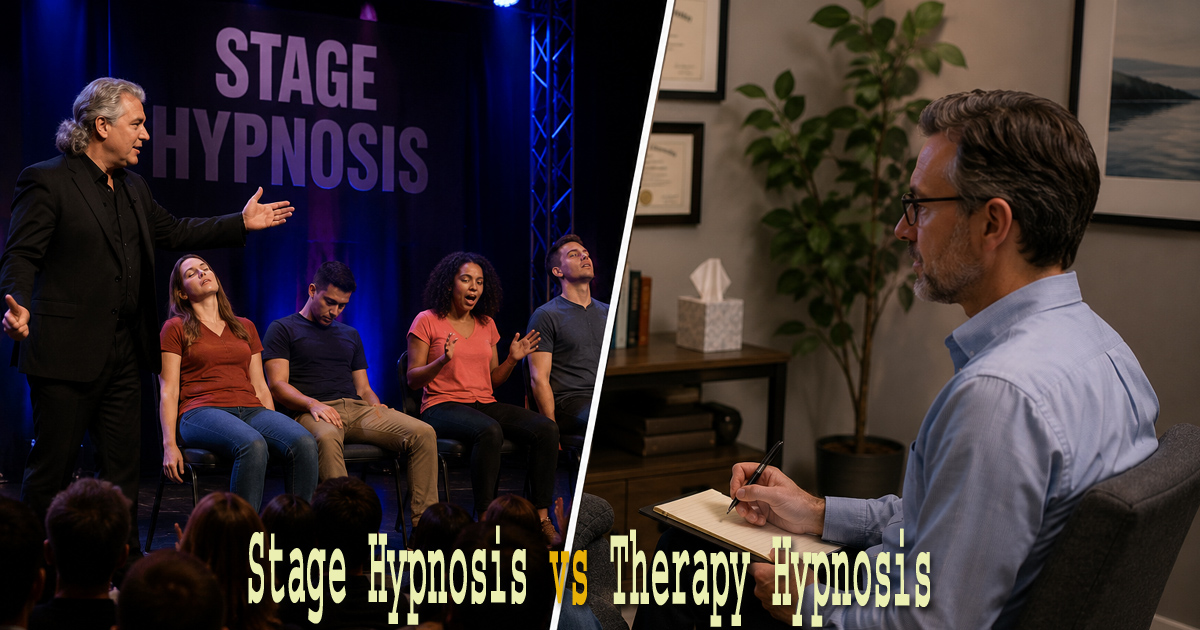
Stage Hypnosis vs Therapy Hypnosis share the same foundation but serve very different purposes.
Stage hypnosis vs therapy hypnosis is a comparison most people have never thought to make, simply because they assume the two are the same thing. They are not. While both involve a hypnotist guiding someone into a state of heightened suggestibility, the purpose, the setting, the techniques, and the outcomes could not be more different. Understanding those differences does more than satisfy curiosity. It changes how you think about hypnosis entirely, and it can help you decide which form of the experience is actually relevant to your own life.
The confusion between stage and therapy hypnosis is understandable. Most people’s only exposure to hypnosis comes from watching a stage show or seeing a dramatized version on television, which blends entertainment trappings with vague clinical associations until the two feel interchangeable. In reality, a stage hypnotist and a clinical hypnotherapist are doing fundamentally different work, even when the surface level mechanics look similar from the outside.
Stage Hypnosis vs Therapy Hypnosis: Why Understanding Both Is Genuinely Empowering
Getting clear on the stage hypnosis vs therapy hypnosis distinction puts you in a much stronger position as a consumer of both experiences. If you are watching a show and wondering whether what you are seeing is real, understanding the stage context answers that question. If you are considering hypnotherapy for a personal challenge and feeling uncertain about whether it is legitimate, understanding the clinical context answers that one too. Both forms of hypnosis have real value, and neither one undermines the other when they are understood on their own terms.
The empowering part of this understanding is that it removes the mystery from both experiences at once. Stage hypnosis stops looking like a trick and starts looking like a skilled performance built on genuine psychology. Therapy hypnosis stops looking like entertainment and starts looking like the serious clinical tool it actually is. Once you can see both clearly, you can engage with either one confidently and intelligently.
Why People Assume They Are the Same Thing
The assumption that stage and therapy hypnosis are identical usually comes from the fact that both start in the same place, a person being guided into a relaxed, focused, suggestible state by someone else’s voice. That shared starting point is visible and recognizable, so it is easy to conclude that everything that follows must also be the same. The differences only become apparent when you look at what each practitioner does once that initial state has been established, and those differences turn out to be substantial.
Movies and television have also contributed heavily to the confusion by portraying hypnosis as a single universal phenomenon that works the same way in every context. A stage show routine gets edited to look therapeutic. A therapy session gets dramatized to look theatrical. By the time most people encounter real hypnosis in either form, their mental model of what it is has already been shaped by portrayals that blur the line between the two rather than drawing it clearly.
Is Stage Hypnosis Real? The Surprising Truth Behind the Show
The One Thing Both Have in Common
At the foundation of both stage hypnosis and therapy hypnosis lies the same core mechanism, the hypnotic state itself. In both cases, the practitioner guides the subject into a condition of narrowed focus and heightened suggestibility where the critical faculty of the mind becomes less active and incoming suggestions are processed more directly by the subconscious mind. This bypassing of the critical faculty is the single most important mechanism in all of hypnosis, and it was identified and documented long before modern neuroscience arrived to confirm it with brain imaging technology.
This shared foundation is what makes both forms of hypnosis genuine, and it is the reason why the skills of an experienced stage hypnotist and a trained hypnotherapist overlap more than most people realize.
Both also require the subject’s willing participation to work effectively. Neither stage nor therapy hypnosis can be imposed on an unwilling person, and both depend on a degree of trust and openness between the practitioner and the subject. This shared requirement for cooperation is part of what separates both forms of hypnosis from the mind control mythology that surrounds them in popular culture.
What Stage Hypnosis Is Designed to Do

Volunteers react to a horse race suggestion during a live stage hypnosis performance.
Stage hypnosis has one primary purpose, to entertain a live audience. Every decision a stage hypnotist makes, from which volunteers to select to which suggestions to use to how quickly to move through the show, is driven by that single goal. The experience of the volunteers on stage matters, and a good stage hypnotist takes their wellbeing seriously, but the ultimate measure of success in stage hypnosis is whether the audience is engaged, laughing, and amazed.
This entertainment focus is not a criticism of stage hypnosis. It is simply an honest description of what the art form is designed to do. A stage hypnotist is a performer and a hypnotist in equal measure, and the best practitioners in the field are genuinely skilled at both aspects of their work. The theatrical elements of the show, the pacing, the humor, the dramatic reveals, are not decoration layered on top of hypnosis. They are an integral part of what makes stage hypnosis its own distinct and legitimate art form.
The Role of the Audience in Stage Hypnosis
The audience is not a passive observer in a stage hypnosis show. They are an active ingredient in the experience. Their laughter, their reactions, and their collective energy create a social dynamic that actually amplifies the hypnotic responses of the volunteers on stage. When a volunteer hears the audience laugh at something they just did, that social feedback reinforces their willingness to continue following suggestions, which deepens the experience for everyone involved.
This audience dynamic is entirely absent from therapy hypnosis and it represents one of the most significant practical differences between the two forms. A stage hypnotist learns to harness group energy and social dynamics as part of their craft. A hypnotherapist works in a quiet, private space specifically designed to eliminate those social pressures so the client can focus entirely on their own inner experience without performance anxiety or audience awareness interfering with the therapeutic process.
Hypnotized on Stage: The Amazing Truth About How It Feels
Why Speed and Drama Matter on Stage
A stage hypnotist typically works with a group of volunteers and needs to produce visible, dramatic results quickly enough to hold the audience’s attention throughout the show. This means selecting for the most responsive subjects, using rapid induction techniques designed to produce fast results, and choosing suggestions that create entertaining visible reactions rather than subtle internal shifts. Speed and drama are professional requirements in the stage context, not shortcuts or signs of superficial work.
The rapid induction techniques used by skilled stage hypnotists, such as the handshake interrupt, the instant stand and sleep, and the waking hypnosis approach, require years of practice to execute safely and effectively. They are among the most technically demanding skills in all of hypnosis precisely because they must work reliably on an unrehearsed subject in front of a live audience with no margin for error
Therapy hypnosis operates on a completely different timeline. A hypnotherapist might spend the first session simply building rapport and understanding the client’s history before any formal hypnosis work begins. Subsequent sessions can involve slow, methodical work on deeply held patterns, beliefs, or responses that require multiple sessions to shift. The patience that would bore a stage audience is exactly what makes clinical hypnotherapy effective for genuine personal change.
What Therapy Hypnosis Is Designed to Do

A hypnotherapy session focuses on personal goals in a private professional setting.
Therapy hypnosis, more commonly called hypnotherapy, is designed to produce lasting positive change in the client’s thoughts, feelings, behaviors, or physical responses. It is a clinical tool applied to real personal challenges, and its measure of success is not audience applause but documented improvement in the client’s life outside the therapy room. This fundamental difference in purpose shapes every aspect of how hypnotherapy is practiced compared to stage hypnosis.
Hypnotherapy operates within an ethical and professional framework that prioritizes the client’s well being above all else. Sessions are confidential, the client’s goals drive the work, and the hypnotherapist’s role is to facilitate the client’s own inner resources rather than to perform for anyone. This client centered approach is the polar opposite of the audience centered approach that defines stage hypnosis, even though both practices draw from the same underlying psychological phenomenon.
The One on One Nature of Hypnotherapy
The private one on one setting of hypnotherapy is not just a logistical detail. It is fundamental to how the work functions. Without an audience watching, without social pressure or performance expectations, a client in hypnotherapy can access much deeper and more vulnerable aspects of their inner experience than a volunteer on stage ever would. This depth of access is what allows hypnotherapy to address things like chronic anxiety, phobias, unresolved trauma, and deeply ingrained habits that would never come up in an entertainment context.
The therapeutic relationship itself, built over multiple sessions between a skilled hypnotherapist and a trusting client, is also a significant part of what makes hypnotherapy work. This relationship has no equivalent in stage hypnosis, where the hypnotist and the volunteers are typically strangers meeting for the first and only time in front of a live crowd.
What Conditions Hypnotherapy Is Used to Treat
Clinical hypnotherapy has documented applications across a wide range of conditions and challenges. Pain management is one of the most well researched areas, with hypnosis used effectively in surgical settings, during dental procedures, and in the management of chronic pain conditions. Hypnotic analgesia, the production of reduced or absent pain perception through hypnotic suggestion, has been documented in peer reviewed literature for decades.
One of the clearest demonstrations that the hypnotic state produces genuine physiological changes rather than mere psychological compliance. Anxiety and stress related disorders respond well to hypnotherapy, as do phobias, sleep difficulties, irritable bowel syndrome, and habit change work including smoking cessation and weight management.
Trauma work using hypnotherapy requires specialized training and is practiced carefully by qualified clinicians who understand both the power and the responsibility involved in accessing deeply buried emotional material. This level of clinical application is as far removed from stage hypnosis as surgery is from a magic show, even though both a surgeon and a magician might technically be said to work with their hands.
The Key Differences Between the Two
Setting out the stage hypnosis vs therapy hypnosis differences side by side makes the distinction unmistakably clear. Stage hypnosis happens in public, in front of crowds, for entertainment. Therapy hypnosis happens in private, one on one, for healing. Stage hypnosis is fast, dramatic, and group oriented. Therapy hypnosis is patient, subtle, and deeply personal. Stage hypnosis measures success by audience reaction. Therapy hypnosis measures success by the client’s real world outcomes.
Neither form is superior to the other because they are not in competition. They serve entirely different human needs and exist in entirely different professional and social contexts. Understanding that distinction is what allows a person to appreciate both forms of hypnosis for what they actually are rather than judging one by the standards of the other.

Both stage hypnosis and hypnotherapy begin with a state of focused attention and increased responsiveness to suggestion.
Different Goals, Different Techniques
The suggestions used in stage hypnosis are specifically crafted to produce entertaining visible behavior in a group setting. They are playful, often humorous, and designed to look impressive from a distance. The suggestions used in hypnotherapy are tailored to the individual client’s specific challenge and are often subtle enough that an outside observer would not notice anything dramatic happening at all. A client working through a fear of flying might simply be guided through a calm imaginary journey, which looks nothing like the dramatic stage responses audiences expect from hypnosis.
Induction techniques also differ significantly between the two contexts. Stage hypnotists favor rapid inductions that produce fast visible results in responsive subjects. Hypnotherapists tend to use longer, more gradual inductions that ease the client into progressively deeper states of relaxation and focus, taking the time needed to establish the depth most useful for the specific therapeutic work ahead.
Different Standards of Training and Ethics
A clinical hypnotherapist is typically trained to a professional standard that includes understanding of psychology, ethics, contraindications, and safe practice guidelines. Many hold additional qualifications in counseling, psychology, or medicine. Their work is governed by professional bodies that set ethical standards and provide accountability for client safety. This level of professional structure exists because the clinical context involves vulnerable people seeking help with real personal challenges.
Stage hypnosis training focuses on performance skills, crowd management, rapid induction techniques, and entertainment craft. The ethical standards are real and important, particularly around volunteer safety and informed consent, but they are different in nature from clinical ethics because the context is different. A responsible stage hypnotist does not need a psychology degree, but they do need a thorough understanding of hypnosis, genuine respect for their volunteers, and the skill to manage any unexpected responses that arise during a live performance.
Behavioral Habits Under Hypnosis That Drive Powerful Change
Can a Stage Hypnotist Also Be a Therapist?
Yes, and some of the most respected figures in the history of hypnosis have worked skillfully in both arenas. Ormond McGill himself, widely known as the Dean of American Hypnotists, was both a celebrated stage performer and a serious student and practitioner of clinical hypnosis. His landmark work The Encyclopedia of Genuine Stage Hypnotism, first published in 1947, remains one of the most comprehensive and authoritative treatments of stage hypnosis ever written.
While his later clinical work demonstrated that the same practitioner could bring the highest standards of integrity and skill to both arenas of the profession. His work demonstrated that the two forms of hypnosis are not mutually exclusive and that mastery of one can genuinely deepen understanding of the other.
That said, working effectively in both areas requires distinct training, clear boundaries, and a strong ethical framework that keeps the two roles from bleeding into each other inappropriately. A hypnotist who performs on stage on Saturday night and sees therapy clients on Monday morning needs to be completely clear about which role they are in at all times, and their clients and audiences need to be equally clear about what kind of experience they are signing up for.
When the Two Worlds Cross Over
The most natural crossover between stage and therapy hypnosis happens at the level of foundational skill. A hypnotist who has spent years on stage developing sharp observation skills, rapid induction techniques, and the ability to read and respond to human behavior in real time brings genuine practical advantages to clinical work. Equally, a hypnotherapist with deep clinical training brings a more nuanced understanding of the psychological depth possible in hypnosis to their stage work, which often results in a more thoughtful and ethically grounded performance.
Some practitioners also use their stage profile to raise public awareness of hypnotherapy as a legitimate clinical tool, leveraging entertainment visibility to reduce the stigma and misunderstanding that still surrounds the therapeutic application of hypnosis in some communities.
Why Keeping the Roles Separate Matters
Despite the legitimate overlap between the two worlds, keeping the roles of stage hypnotist and clinical hypnotherapist clearly separate is important for the protection of the public. A stage show volunteer has consented to an entertainment experience. A therapy client has consented to a clinical process aimed at personal change. Blurring those boundaries, even with good intentions, can create confusion about what the person has actually agreed to and what level of professional accountability applies to the practitioner they are working with.
Clear separation also protects the integrity of both practices. Stage hypnosis deserves to be appreciated as the skilled entertainment art form it is, without being burdened with clinical expectations it was never designed to meet. Therapy hypnosis deserves to be taken seriously as a clinical tool, without being dismissed because it shares a name with something people associate primarily with comedy shows.
Which Type of Hypnosis Is Right for You?
The stage hypnosis vs therapy hypnosis question ultimately comes down to what you are actually looking for. Both forms offer genuine value and both are rooted in the same real psychological phenomenon. The right choice depends entirely on whether you are seeking entertainment and a memorable experience or genuine personal change supported by a trained professional.
There is no wrong answer here, and choosing one does not close the door on the other. Many people who attend a stage show out of curiosity later seek out hypnotherapy for a specific personal goal, having seen enough of hypnosis in action to take its potential seriously. And many hypnotherapy clients find that watching a skilled stage hypnotist perform deepens their appreciation for the breadth and versatility of the phenomenon they experienced in a clinical setting.
If You Want Entertainment and a Unique Experience
If your interest in hypnosis is primarily driven by curiosity about the experience itself, a love of live performance, or the appeal of trying something genuinely unusual, stage hypnosis is the right place to start. Look for a reputable professional performer with a track record of safe, entertaining shows, volunteer with an open and playful mindset, and enjoy the experience for exactly what it is. You do not need any prior knowledge of hypnosis to have a great time, and whether you end up deeply hypnotized or simply entertained from your seat, a well run stage hypnosis show is genuinely unlike anything else.
If You Want Real Personal Change
If you are dealing with a specific challenge, whether that is anxiety, a phobia, a habit you want to break, chronic pain, or something else that is genuinely affecting your quality of life, clinical hypnotherapy is worth serious consideration. Look for a qualified practitioner with recognized training credentials, ideally one who is a member of a professional hypnotherapy association in your country. Be prepared to invest time in the process, since real change rarely happens in a single session, and approach the work with the same openness and trust you would bring to any other form of professional therapeutic support.

Known as The Man Who Notices, Mike Lamp is a theatrical hypnotist and psychic performer with more than twenty years of live stage experience. His work emphasizes observation, psychological influence, and measured presentation rather than spectacle or provocation. Performances are tailored for adult audiences, private events, and professional settings where control, clarity, and atmosphere matter.



Leave a Reply
You must be logged in to post a comment.