21
Jun
Is Stage Hypnosis Real? The Surprising Truth Behind the Show
Is Stage Hypnosis Real? The Surprising Truth Behind the Show
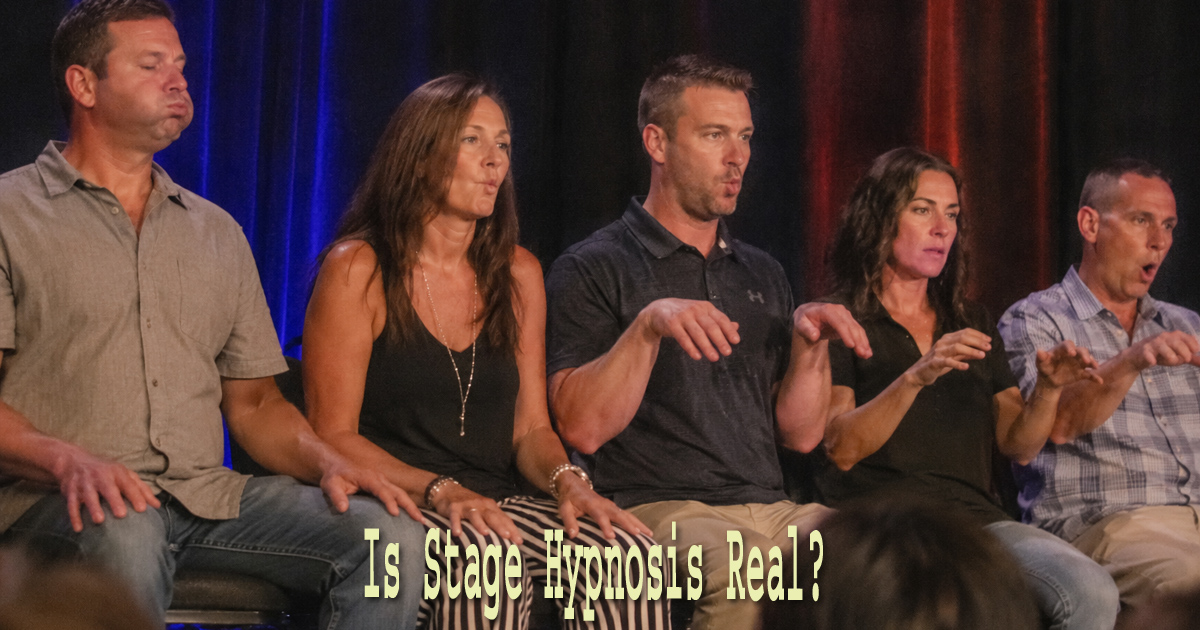
Is stage hypnosis real here volunteers are responding to suggestion during a live stage hypnosis show
Is stage hypnosis real, or is the whole thing just a well rehearsed act with willing performers? It is one of the most common questions audiences ask after watching a hypnosis show, and it is a fair one. When you see someone on stage clucking like a chicken or forgetting their own name on cue, skepticism is a natural response. The truth, however, is more fascinating than either extreme, and understanding what is actually happening behind the performance changes the way you watch a stage hypnosis show forever.
Skepticism about stage hypnosis is not new. It has followed the art form for well over a century, fueled by dramatic portrayals in movies, misunderstandings about how hypnosis actually works, and the occasional performer who has leaned too hard into theatrical exaggeration. But dismissing stage hypnosis as pure acting ignores a substantial body of evidence showing that the core experience is genuine, even when the entertainment framing around it is carefully crafted for maximum audience enjoyment.
Is Stage Hypnosis Real? Why the Experience Is More Genuine Than People Think
The short answer is yes, is stage hypnosis real in the sense that something genuinely psychological is happening to the volunteers on stage. The hypnotic state itself is not invented for entertainment purposes. It is a documented, measurable shift in the way the brain processes attention, suggestion, and imagination, and it occurs in responsive individuals whether they are in a clinical setting or under stage lights in front of a live crowd.
What the stage version adds is a performance layer around a real psychological phenomenon. The hypnotist shapes the suggestions to be entertaining and the volunteers respond to those suggestions in ways that look dramatic and funny to the audience. But the underlying mechanism, a state of heightened suggestibility that makes following along feel natural and effortless, is entirely genuine for the people experiencing it.
Hypnotized on Stage: The Amazing Truth About How It Feels
Why People Assume It’s Just Acting
The acting assumption usually comes from one of a few places. Some audience members have seen poorly run shows where the hypnotist pushed volunteers into increasingly exaggerated behavior that looked more like improv comedy than genuine trance. Others have read claims online from former volunteers who described going along with suggestions out of social pressure rather than genuine hypnotic response. And many people simply find it hard to believe that something so dramatic could happen so quickly and visibly to an ordinary person pulled from the audience.
These doubts are understandable, but they tend to conflate the performance wrapper around hypnosis with the psychological core of it. The fact that stage hypnosis is entertaining does not make it fake, in the same way that a live music performance being enjoyable does not make the musicians less skilled. The entertainment value and the genuine phenomenon can and do coexist.
What Separates Real Hypnosis From a Staged Performance
The clearest sign that is stage hypnosis real lies in the responses that would be nearly impossible to fake convincingly for the duration of a full show. Genuine hypnotic responses include things like catalepsy, where a volunteer’s arm becomes rigid and stays elevated without conscious effort, post hypnotic suggestion responses where a volunteer reacts to a predetermined cue after coming out of trance, or genuine amnesia for a specific word or name that the volunteer struggles to recall even when they clearly want to.
These are phenomena with precise technical names that have been documented and studied in hypnosis literature for generations. These are not easy behaviors to simulate over and over in front of a crowd for thirty to sixty minutes without cracking.
A true stage hypnotist also monitors volunteers closely throughout the show, watching for signs of genuine response and adjusting their approach for those who are not responding as deeply. This kind of real time calibration is a telltale sign of a legitimate performance rather than a scripted act with plants, since a scripted show would not require that level of ongoing adjustment.
The Science Behind Stage Hypnosis

Relaxed state commonly observed in stage and clinical hypnosis
One of the strongest arguments for why is stage hypnosis real comes from the scientific research conducted over the past several decades. Hypnosis is not a fringe topic in psychology. It is a recognized and actively studied phenomenon with a growing body of research supporting its legitimacy as a distinct cognitive state.
Clinical hypnosis is used in pain management, anxiety treatment, and behavioral change programs around the world. The same core mechanism that makes therapeutic hypnosis effective is what stage hypnotists harness for entertainment purposes. The setting differs, but the psychological state involved is the same.
What Brain Activity Reveals About Hypnosis
Brain imaging technology has made it possible to observe what actually happens inside the brain during hypnosis, and the results consistently show real, measurable changes rather than the normal patterns of conscious relaxation or daydreaming. Studies using functional MRI scans have shown reduced activity in areas associated with self monitoring and critical evaluation during hypnosis, particularly in the anterior cingulate cortex, which acts as the brain’s conflict monitoring center. This reduction helps explain why the critical faculty, the part of the mind that normally filters and questions incoming suggestions, becomes less active, allowing suggestions to pass more directly into the subconscious mind where they produce genuine behavioral responses.
These brain changes cannot be faked or consciously manufactured on demand. A person simply trying to act hypnotized while remaining fully conscious would not produce the same neurological patterns as someone in a genuine hypnotic state. This distinction is one of the most compelling pieces of scientific evidence that the answer to is stage hypnosis real is firmly yes.
Why Hypnosis Is Recognized in Psychology
The American Psychological Association recognizes hypnosis as a legitimate therapeutic tool with documented applications in clinical settings. The British Medical Association accepted hypnosis as a valid medical procedure as far back as 1955, and the American Medical Association followed with its own endorsement in 1958. These are not recent developments born of modern research alone.
The legitimacy of hypnosis has been established across more than a century of serious scientific and medical inquiry. This recognition reflects decades of research demonstrating that hypnosis produces measurable effects on perception, memory, and behavior that go beyond simple placebo or social compliance. When a scientific body with the APA’s standards of evidence accepts something as legitimate, it carries significant weight against dismissive claims that hypnosis is purely theatrical.
Stage hypnosis operates in the entertainment space rather than the clinical one, but its foundation rests on the same psychological principles that earned hypnosis its place in legitimate therapeutic practice. The difference is in how the hypnotic state is used, not in whether the state itself is real.
How Hypnosis Works: Scientific Explanations and Theories
Could the Volunteers Be Plants or Actors?
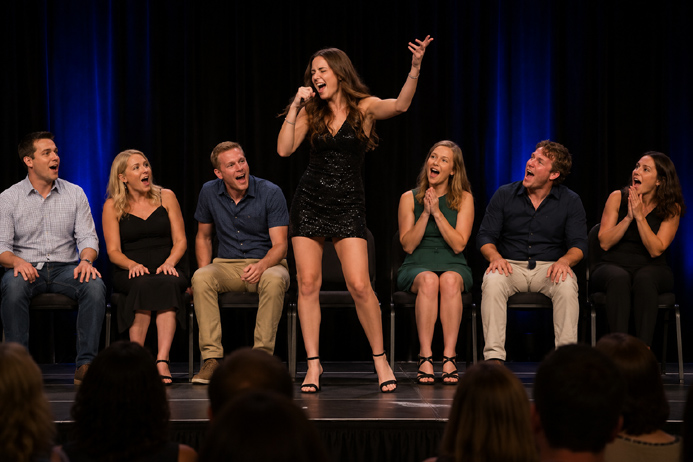
Example of behavioral response under hypnosis
The plant theory is probably the single most common skeptical explanation for stage hypnosis, and it deserves a direct response. The idea that every impressive volunteer is secretly a paid actor placed in the audience ahead of time sounds plausible until you examine the logistics of running a stage hypnosis show regularly across different venues and audiences.
Maintaining a rotating cast of convincing actors across dozens or hundreds of shows per year would be an expensive, complicated, and logistically challenging operation that would almost certainly have produced credible whistleblowers by now. The reality is that most stage hypnotists work without plants because they simply do not need them.
How Real Stage Shows Select Volunteers
The volunteer selection process in a genuine stage hypnosis show is deliberately transparent and visible to the entire audience. Suggestibility tests are performed in full view of everyone present, and only the people who show the strongest physical responses to those tests are invited on stage. This process happens live, unrehearsed, and in front of witnesses, which makes it one of the hardest parts of the show to fake convincingly if plants were being used.
Any audience member watching closely can see exactly why certain people are selected and others are not. The ones who stay in their seats are simply not responding to the early suggestion tests in a way that suggests strong hypnotic susceptibility, and no amount of theatrical staging changes that visible reality.
Why Faking It Would Be Harder Than It Looks
Sustaining a convincing fake hypnotic response for the duration of a full stage show is genuinely difficult. A real volunteer under hypnosis responds naturally and consistently because they are following suggestions without conscious effort. Someone faking it has to maintain conscious awareness, monitor their own performance, keep track of what they are supposed to be doing at each moment, and do all of this in front of a live audience that is watching them closely.
Experienced hypnotists are also trained to notice when a volunteer is consciously performing rather than genuinely responding. Small inconsistencies in timing, eye movement, and physical behavior stand out clearly to someone who has spent years watching genuine hypnotic responses. A room full of planted actors would be spotted by any competent hypnotist within the first few minutes of the show.
Why Some People Don’t Respond at All
One of the most convincing pieces of evidence that is stage hypnosis real is actually something most audiences overlook entirely. Not everyone who participates in the early stages of a show ends up staying on stage. A significant portion of any audience shows little to no response to the suggestibility tests, and those people are simply not selected. If the whole thing were scripted, there would be no reason to leave anyone out.
This natural variation in response is entirely consistent with what the research on hypnotic susceptibility shows. Roughly ten to fifteen percent of any given population falls into the highly hypnotizable range, the somnambulists, who are the ideal stage hypnosis subjects and the ones most likely to produce dramatic visible responses. A similar percentage shows very little response at all, while the majority fall into a middle range of light to medium hypnotic depth that is better suited to clinical or one on one work than to stage performance. The majority of people fall somewhere in the middle, which is exactly the distribution a real selection process would produce.
Suggestibility Varies From Person to Person
Hypnotic susceptibility is a stable individual trait, similar in some ways to other cognitive differences like creativity or working memory. It does not change dramatically based on mood or motivation, which means that some people will consistently respond well to hypnotic suggestion while others consistently will not, regardless of how willing they are to participate. This individual variation is one of the clearest signs that hypnosis is a real phenomenon rather than a performance, since a truly scripted show would simply make everyone respond equally.
Research has also shown that hypnotic susceptibility can be measured reliably using standardized scales, and that scores on these scales predict how people respond in both clinical and stage settings. This predictability is a hallmark of a genuine psychological trait rather than a performance variable.
What Happens to Volunteers Who Don’t Go Under
In a well run stage hypnosis show, volunteers who do not respond deeply to the induction are quietly and respectfully guided back to their seats. They are not forced to fake responses or kept on stage to fill a quota. This practice of releasing non responsive volunteers is standard among professional hypnotists, and it is something that would make no sense in a fully scripted show where every volunteer was already a paid actor. A skilled hypnotist learns to make this transition gracefully, thanking each departing volunteer warmly so the audience sees the release as a natural and respectful part of the process rather than a failure, which protects both the volunteer’s dignity and the integrity of the performance.
The fact that hypnotists routinely end up with fewer volunteers on stage than they started with is one of the most honest and overlooked indicators that the selection process is genuine. Real responsiveness is the only currency that matters in a legitimate stage hypnosis performance.
Is Stage Hypnosis Real for Everyone Who Volunteers?
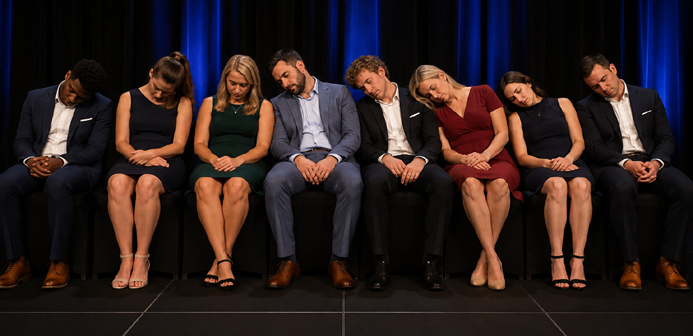
Audience participants focused during induction phase
The honest answer is that the depth of response varies from person to person, and not every volunteer on stage will experience an equally deep or dramatic hypnotic state. Some will enter a light suggestible state where following along feels natural but not overwhelming. Others will move into a deeper trance where suggestions feel almost irresistible and awareness of the audience fades significantly. Both experiences are genuine, they simply represent different points on the spectrum of hypnotic depth.
What matters for answering the question of is stage hypnosis real is not whether every volunteer hits the same depth of trance, but whether the underlying psychological mechanism is genuinely operating. The evidence strongly supports that it is, for the volunteers who respond, the experience is real, even if the entertainment framing around it is carefully designed for maximum audience impact.
The Honest Answer Based on Evidence
Stage hypnosis is real in the sense that matters most. The psychological state it produces in responsive volunteers is genuine, measurable, and consistent with everything the scientific community understands about hypnosis as a legitimate phenomenon. It is not magic, it is not mind control, and it is not a room full of actors. It is a skilled hypnotist working with a real psychological mechanism to create an entertaining experience that happens to look almost too good to be true.
The theatrical elements of a stage show, the music, the pacing, the suggestions designed for laughs, are layered on top of something authentic. Stripping away the entertainment wrapper still leaves a real psychological experience at the core, which is ultimately the most honest answer to whether stage hypnosis is real.
Why Belief Isn’t Required for It to Work
Perhaps the most compelling final point is that hypnosis does not require the volunteer to believe in it beforehand. Skeptical volunteers who step on stage out of curiosity or to prove a point have gone on to become some of the most deeply hypnotized participants in a show. This happens because hypnotic susceptibility is a cognitive trait, not a belief system, and it operates independently of conscious opinion about whether hypnosis is legitimate.
If stage hypnosis were simply a matter of willing performance, it would only work on true believers. The fact that it regularly works on skeptics too is one of the most straightforward and convincing demonstrations that something genuinely real is happening every time a stage hypnotist takes the microphone.

Known as The Man Who Notices, Mike Lamp is a theatrical hypnotist and psychic performer with more than twenty years of live stage experience. His work emphasizes observation, psychological influence, and measured presentation rather than spectacle or provocation. Performances are tailored for adult audiences, private events, and professional settings where control, clarity, and atmosphere matter.



Leave a Reply
You must be logged in to post a comment.