25
Jun
Joan Brandon Hypnotist: The Powerful True Story History Almost Forgot
Joan Brandon Hypnotist: The Woman Nobody in Hypnosis Talks About Anymore
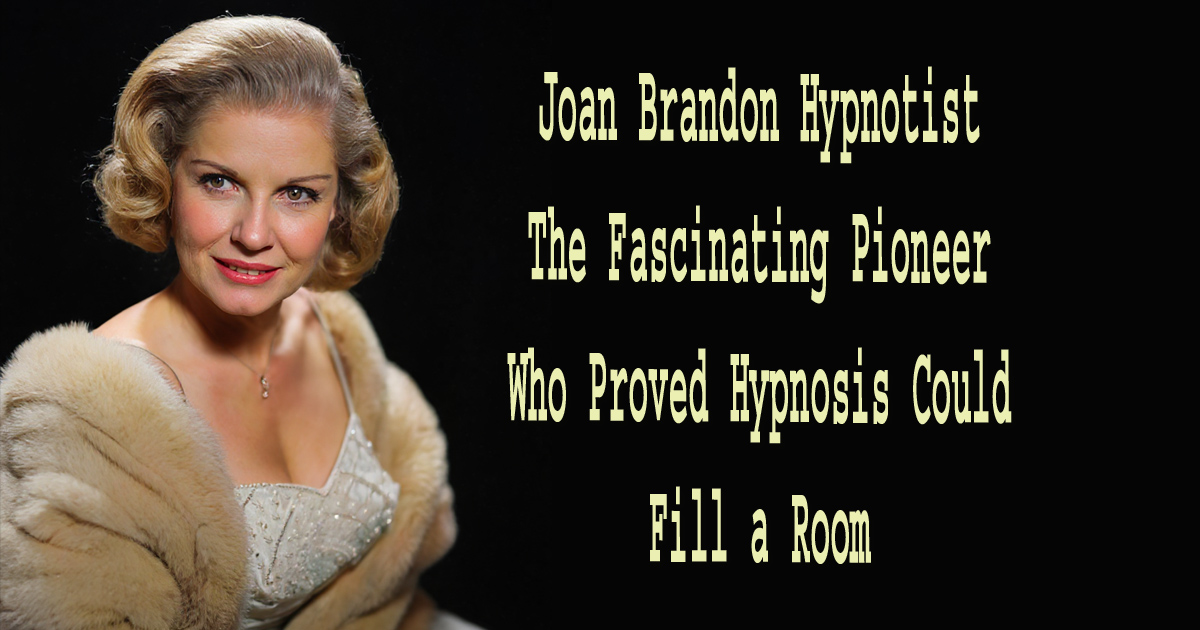
Joan Brandon hypnotist drew 22,000 people in four days in 1955. Discover the powerful true story of the pioneer history almost forgot.
There is a particular kind of invisibility that falls on people who were genuinely ahead of their time. Not the invisibility of failure or mediocrity but the invisibility of having done something so far outside what anyone expected that the record keepers of the era did not quite know where to put them. Joan Brandon, hypnotist, performer, and pioneer, has suffered exactly that kind of invisibility.
She drew 22,000 paying customers in four days at an armory in 1955. Billboard magazine documented it. She performed at the New York Palace Theater on Broadway at least four times. She appeared on BBC television in London, on a Paris station, and on NBC in New York. She published four books on hypnosis between 1953 and 1959. She hypnotized native volunteers in London, Paris, Barcelona, and Rome after learning enough of their languages overnight using self-hypnosis. She appeared on national television in 1960 and the entire celebrity panel failed to identify her as the genuine hypnotist among the impostors.
And almost nobody in hypnosis today knows her name. This article is an attempt to begin correcting that.
Born Honey Bee Finberg: A Life Built for the Stage
Joan Brandon was not born into ordinary circumstances. She arrived in the world on February 12, 1914, in New Orleans, Louisiana, with the given name Honey Bee Finberg, the daughter of Abraham Lincoln Finberg, a traveling performer who worked under the name The Great Brandoni. Her mother was Helen English Finberg. She had three brothers, and the family moved constantly, with Joan attending as many as twelve different grade schools before she finished her education.
The Father Who Started It All
Al Finberg was a working entertainer in the truest sense. He traveled constantly with theatrical stock companies, doing magic, mental tricks, and escapes. He could remember over a hundred objects by word association and picked audience members at random to tell them personal things about themselves. He taught his daughter everything he knew. That itinerant childhood shaped Joan in ways that would define her entire career. She learned early that every audience was a new audience and every night you had to earn the room from scratch. That lesson, absorbed before she was a teenager, would serve her for the rest of her performing life.
From Dance Duo to The Blond Deceiver
Joan began performing as a childhood dance duo with her brother Nils, billed as Bunny and Honey Bee. By sixteen she was headlining a theater tour across the United States. She married theatrical agent Jack Hirsk in 1931, a union that would last forty-eight years and that gave her access to top venues through agencies including William Morris and the Music Corporation of America.
By 1936 she was headlining in vaudeville as That Gorgeous Blond Deceiver, performing sleight of hand, her signature bar act Any Drink Called For, and a blacklight dancing cane routine. She led her own orchestra, toured Australia at the Tivoli Theatre in Melbourne, and returned in November 1941 on one of the last ships to safely leave before wartime travel restrictions closed the Pacific routes. She was billed as The First Lady in Magic and claimed to be the first female magician to be televised on BBC London, a Paris station, and NBC New York.
Pat Collins Hypnotist: Iconic Hip Legacy
The Pivot That Changed Everything
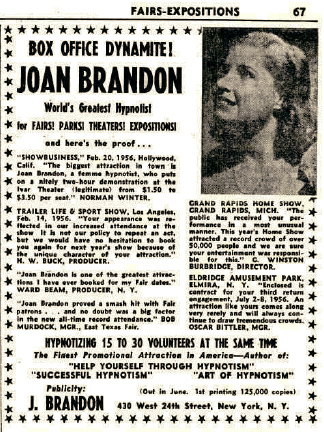
Advertisement in Bilboard
By 1950 the novelty of her magic act was beginning to wear thin. Several reviews had been mild. She was experienced and skilled but audiences had grown familiar with what she did, and familiarity is the enemy of wonder.
Why She Left Magic Behind
From roughly 1950 to 1953 she developed a longer one-woman show that incorporated the exposure of phony spirit mediums, escapes, and eventually hypnosis. It was a period of genuine creative reinvention driven by the instinct of a performer who understood that she needed something capable of commanding a full evening in a way that magic no longer could. Hypnosis was the answer. When she began incorporating it the response was immediate. Audiences that had seen magic acts had not seen this. The sensation was genuine and the word spread.
The First Experiments With Hypnosis on Stage
By 1953 she had made the decision fully. She dropped the magic, committed entirely to hypnosis, and billed herself as The World’s Greatest Hypnotist. She was thirty-nine years old. What followed was the most successful period of her career, a run of packed houses, held-over engagements, front page newspaper stories, and attendance figures that would have been remarkable for any performer of the era regardless of gender.
22,000 People in Four Days: The Numbers That Tell the Real Story
In June 1955, Billboard magazine reported that Joan Brandon drew 22,000 paid admissions in four days at an armory. That figure appeared in print in the most widely read entertainment trade publication in the country. It was not a promotional claim. It was a documented attendance record in a credible industry source.
What It Took to Fill an Armory in 1955
An armory in 1955 was not a small venue. These were large civic spaces capable of holding thousands of people, typically used for military functions and large public gatherings. Filling one for four consecutive days with paying customers who came specifically to watch a single performer hypnotize people on stage was an extraordinary commercial achievement. Admission prices of one and two dollars put hypnosis within reach of ordinary working families. At those price points drawing 22,000 admissions meant an enormous number of individual decisions by individual people to see what this woman could do. Word of mouth at that scale does not happen by accident. It happens when something is genuinely remarkable enough that the people who saw it cannot stop talking about it.
How Her Audiences Compared to Other Entertainers of the Era
Billboard’s coverage placed her attendance figures in the same conversation as mainstream entertainers of the period. She was not being covered as a curiosity. She was being covered as a commercially significant performer whose box office numbers warranted serious trade attention. For a woman working in a field almost entirely dominated by men, in an era when female headliners faced significant structural disadvantages, those numbers represent something beyond entertainment. They represent a genuine breakthrough achieved through skill and the willingness to do something nobody had done before.
The Woman Who Learned Three Languages Overnight
Of all the remarkable things documented about Joan Brandon hypnotist, the account she gives in her own book Successful Hypnotism of a European tour may be the most extraordinary. She describes performing in London, then Paris the next day, then Barcelona two days later, then Rome a day after that. At no point prior to this tour had she studied French, Spanish, or Italian.
London, Paris, Barcelona, Rome
The challenge she faced was fundamental to the practice of hypnosis itself. Nobody can be put into the trance state unless they understand the language of the hypnotist perfectly. She was performing in cities where the volunteers spoke languages she had never studied. Her solution was to memorize enough of each language, including the accents and the phrasing required for a hypnotic induction, the night before each performance. She accomplished this using self-induced autohypnosis.
What She Proved About the Practical Power of Self-Hypnosis
What that account demonstrates is a sophisticated and practical understanding of self-hypnosis as a tool for accelerated learning and performance preparation. She was not describing magic. She was describing a disciplined application of hypnotic principles to a real professional problem. That story belongs in any serious discussion of what hypnosis can actually accomplish in the hands of someone who truly understands it.
The Books, the Television, and the $10,000 Challenge
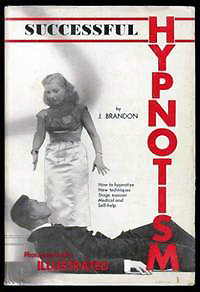
Front Cover if the book Successful Hypnotism
Between 1953 and 1959 Joan Brandon published four books on hypnosis. Help Yourself Thru Hypnotism and Self Hypnosis in 1953. The Art of Hypnotism and Successful Hypnotism both in 1956. The Science of Self Hypnosis in 1959. Four books in six years covering induction techniques, medical applications, and self-hypnosis principles, written by a working performer at the height of her career.
Four Books on Hypnosis at a Time When Almost Nobody Was Writing Them
Dave Elman’s landmark Findings in Hypnosis would not appear until 1964. When Joan Brandon was publishing in the mid-1950s, serious practical literature on hypnosis for a general audience was extremely thin. She was not following a trend. She was creating one, writing accessibly about a subject she understood from the inside at a time when almost nobody with her level of practical experience was putting that knowledge into print. Her books are still available today through major retailers. They have been digitized and republished. The knowledge in them has not aged out. The woman who wrote them has simply been forgotten.
The Game Show Appearance That Nobody on the Panel Could Win
On May 26, 1960, Joan Brandon appeared on To Tell the Truth. The format required a celebrity panel to identify the genuine person among three contestants all claiming the same identity. She appeared as a professional hypnotist. The panel was completely fooled. Not one of the four celebrity panelists correctly identified her. The votes came in one, one, one, one, a perfectly split result that gave the contestants the full prize award. She also offered a standing $10,000 reward to any audience member who could prove she was a fraud, documented in advertisements from her 1964 engagements. No record exists of anyone ever collecting it.
History of Hypnosis Explained: The Surprising Truth
Why Joan Brandon Hypnotist Deserves a Place in the History of the Craft
Writing from inside this profession after more than twenty years on stage, the achievement of Joan Brandon hypnotist looks different than it might from the outside. Filling a room is hard. Filling an armory is extraordinarily hard. Doing it as a woman in the 1950s in a field where cultural expectations ran entirely against you, doing it well enough that Billboard tracked your attendance and front page stories followed you from city to city, required skill, resilience, and professional discipline that commands genuine respect.
She understood hypnosis not as a mystery to be performed but as a discipline to be practiced. She wrote about it that way, taught it that way, and demonstrated it before medical professionals. The hypnosis community has a long tradition of honoring its pioneers. Mesmer, Braid, Elman, Erickson. These names are taught and cited and discussed. Joan Brandon belongs in that conversation, not as a footnote about a female performer in a male-dominated field, but as a genuine practitioner whose commercial success, published work, and applied understanding of the craft place her among the most significant figures in the twentieth century history of stage hypnosis.
Final Thoughts on Joan Brandon and the Stories We Forget to Tell
Joan Brandon died on August 1, 1979, at the age of sixty-five. She had been married to Jack Hirsk for forty-eight years. Beyond those bare facts the historical record grows thin quickly. That thinness is itself a statement about how the industry valued women who did not fit the expected mold.
But the 22,000 people who paid to see her in four days at that armory in 1955 knew what they were watching. The Billboard reporter who documented the numbers knew it was worth noting. The celebrity panel on To Tell the Truth who could not identify her knew they had encountered someone genuinely out of the ordinary.
Joan Brandon hypnotist was the real thing. It is past time the field that owes her something said so out loud.

Known as The Man Who Notices, Mike Lamp is a theatrical hypnotist and psychic performer with more than twenty years of live stage experience. His work emphasizes observation, psychological influence, and measured presentation rather than spectacle or provocation. Performances are tailored for adult audiences, private events, and professional settings where control, clarity, and atmosphere matter.


Leave a Reply
You must be logged in to post a comment.