9
Mar
The Tower Tarot Card Meaning: Clear Guide to Powerful Symbolism
The Tower Tarot Card Meaning: Bold Honest Breakdown
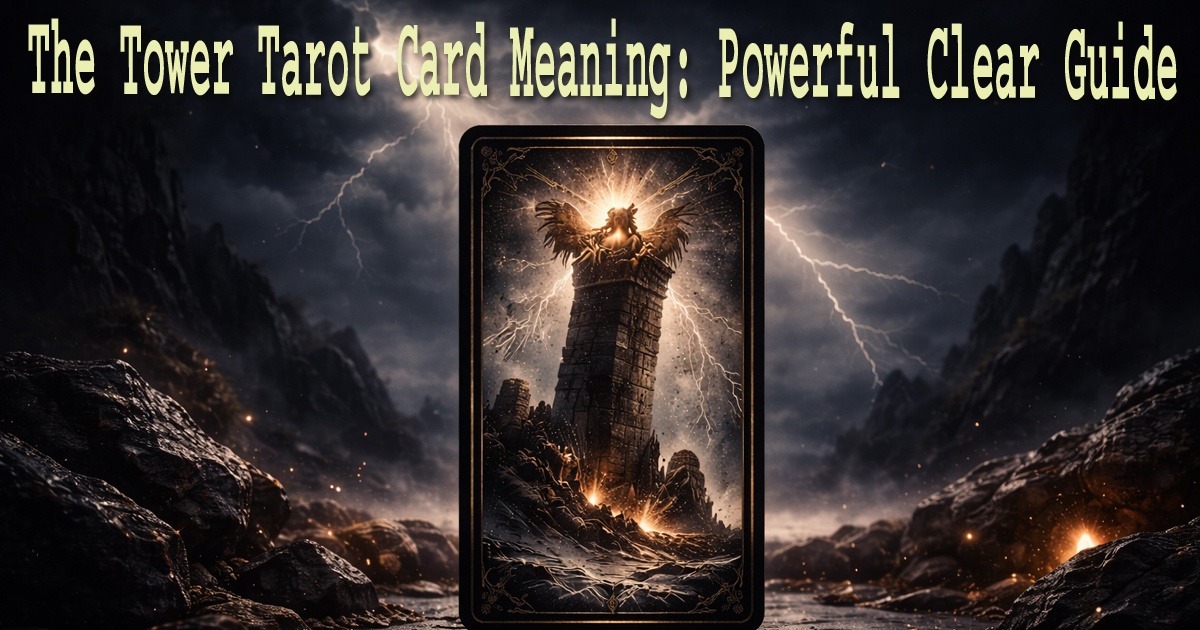
A symbolic visual interpretation of The Tower Tarot Card Meaning with the tarot card standing upright during a violent lightning storm
What the Card Shows
The Tower tarot card meaning begins with an image that is hard to mistake. A tall stone tower stands on a rocky peak, struck by lightning, flames bursting from its windows, and two figures falling headlong toward the ground below. The crown at the top of the tower has been knocked loose by the force of the bolt, and twenty-two yod shapes, the Hebrew letter associated with divine presence and the spark of creation, fall alongside the two figures in the Rider-Waite image, a detail that quietly complicates any reading of the card as purely destructive.
Everything about the image suggests sudden rupture, the violent undoing of something that was built to last. In the standard Rider-Waite illustration, the sky is dark and the lightning bolt is drawn in a jagged, decisive line, as though the strike came without warning and without mercy. The card does not soften what it shows.
The tower itself is the key symbol. Towers in historical iconography represent human ambition reaching upward, the desire to build something permanent and protected from the uncertainties below. In tarot symbolism, that aspiration becomes the source of the problem. What is built on false foundations, rigid pride, or willful ignorance will eventually be brought down.
The bolt of lightning is the agent of that correction, and it carries no judgment beyond the fact of the event itself. In traditional symbolism, lightning descending from sky to earth represents divine or cosmic force breaking into human-made structures, a distinction worth noting because it frames the Tower’s disruption as coming from outside the structure’s own logic entirely.
Read Major Arcana Secrets: Shocking Dark Origins Revealed Exclusive Article
The Tower in the Major Arcana
The Tower tarot card meaning sits within a sequence. It is the sixteenth card of the Major Arcana, numbered XVI, and it follows The Devil, card XV, which concerns attachment, compulsion, and the chains people build around themselves. Notably, The Tower precedes The Star, card XVII, whose imagery of calm and renewal directly answers the devastation The Tower depicts. The placement is not accidental. Where The Devil shows a slow accumulation of binding forces, The Tower describes the moment those forces break open. The architecture of the Major Arcana treats the two cards as part of the same movement, one building toward the other.
Major Arcana symbolism throughout the deck traces a long arc from innocence through experience, from the open optimism of The Fool to the integrated wholeness of The World. The Tower occupies the difficult middle of that arc, where the lessons are delivered with force rather than subtlety. It is worth noting that XVI sits between two cards that deal with bondage and liberation on one side and hope and recovery on the other, which gives the card its precise function in the sequence as the necessary breaking point between those two states.
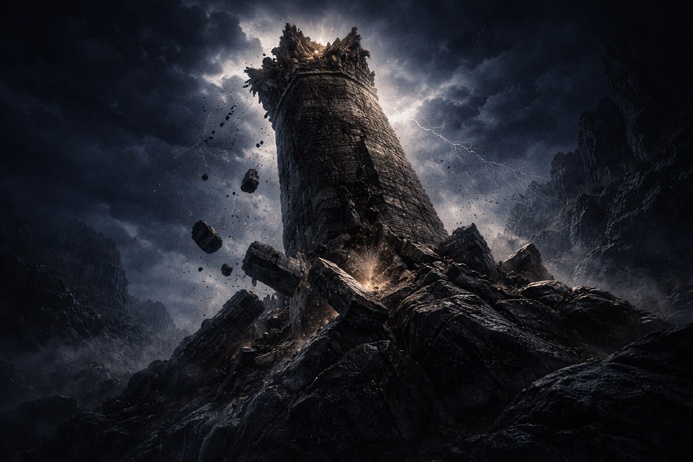
The Tower Tarot Card Meaning finds its structural logic in the Major Arcana’s sequence, where collapse is positioned not as an ending but as a necessary passage between what was built and what comes next.
Cards in this range deal with encounter and reckoning. The Chariot tests will, The Hermit tests patience, and The Tower tests everything that has been built on assumption. The spiritual journey in tarot often runs through discomfort, and this card is one of its sharpest passages.
Each Major Arcana card functions as an archetype, a recognizable pattern of experience that repeats across human life in different forms. The Tower archetype covers any moment of sudden revelation or collapse. The structure that falls can be a belief system, a relationship, a professional identity, or a self-image that no longer matches reality.
The Tower card was not always numbered XVI in early tarot decks. In some fifteenth and sixteenth century Northern Italian decks, the card appeared without a fixed number and was occasionally titled La Maison Dieu, meaning The House of God, a label that framed the lightning strike as divine intervention rather than destruction.
The Tower Upright Meaning
The Tower upright meaning centers on disruption that is swift and often unwelcome. When this card appears in a reading in its upright position, it generally indicates that something in the querent’s situation is about to change in a way they cannot fully control. The Tower tarot card meaning in this orientation is not subtle. A wall is coming down, and the energy of the card suggests that resisting the collapse will not be productive.
The Tower upright meaning does not carry malice. The card is not about punishment. It is about structures that have outlived their usefulness or were built on premises that could not hold. A career built on performance rather than genuine skill, a relationship founded on mutual projection rather than honest connection, a belief held out of fear rather than real conviction, these are the kinds of things that The Tower tends to address. The lightning is a clarifying force, not a punishing one.
For the querent, the practical experience described by The Tower upright meaning is often one of shock followed by clarity. The thing that falls away had been blocking the view. The Tower tarot card meaning in the upright position acknowledges that the moment of collapse is painful, but it does not suggest the collapse was avoidable or that it was wrong to happen.
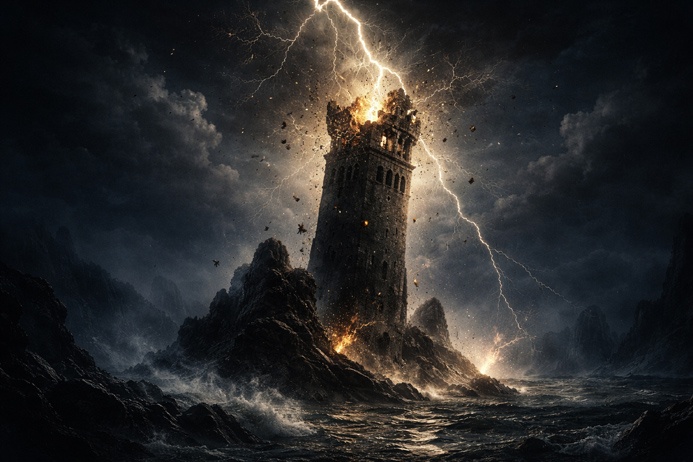
A dramatic visual interpretation of The Tower Tarot Card Meaning, showing lightning striking a crumbling tower during a violent midnight storm
The Tower Reversed Meaning
The Tower reversed meaning introduces more complexity. When the card appears inverted, the imagery of catastrophic release is still present, but the energy described is different in character. The Tower tarot card meaning in reversal often points to a collapse that is being delayed, avoided, or experienced in a prolonged and grinding way rather than as a sudden event.
In some readings, The Tower reversed meaning suggests that the querent is aware something needs to change but is working hard to prevent the change from happening. They may be reinforcing a structure that is already failing, pouring effort into maintaining something that has fundamentally been compromised. The experience is less like a lightning strike and more like a slow erosion, with the querent often aware of the deterioration but not yet willing to let the structure fall.
The Tower reversed meaning can also indicate that a period of upheaval has recently passed and the querent is still processing its effects. The card in this position sometimes describes aftermath rather than anticipation. What has already changed is still being integrated, and the work of understanding what fell and why has not yet been completed.
The Tower tarot card meaning when reversed does not suggest the lesson has been escaped. It tends to suggest that the lesson is still in process, either approaching in slow form or settling into place after the acute phase has passed.
In the Tarot de Marseille tradition, which predates the Rider-Waite deck by roughly two centuries, the figures falling from the tower are often depicted as small and nearly identical, with no crown shown among them, a compositional choice that places the emphasis on the structure’s failure rather than on the status of those affected.
Tarot Card Archetypes and Human Experience
Tarot card archetypes work because they map recognizable experiences in shorthand. The Tower does not require unusual circumstances to appear relevant. Its territory is anywhere that stability was assumed and then disproven. That covers a wide range of ordinary human experience. People encounter Tower moments in the middle of ordinary lives, when a trusted institution fails them, when a long-held belief is suddenly shown to be wrong, or when a version of themselves they had been maintaining can no longer be sustained.
The spiritual journey in tarot is not a journey toward comfort. The Major Arcana places its most demanding cards in the path for a reason. The experiences they describe are the ones that actually change people, not the pleasant ones. The Tower tarot card meaning, whether upright or reversed, belongs to that category of experiences that carry real cost and, often, real consequence. The card does not pretend otherwise.
What makes The Tower a coherent part of the Major Arcana symbolism rather than simply an omen of disaster is the implication contained in the image itself. The figures falling from the tower are still falling. They have not hit the ground yet. The card captures the moment between the old structure and whatever comes next. That interval, frightening as it is, is also the point at which something genuinely new becomes possible.
The figures falling from the tower are still falling. They have not hit the ground yet.
Replacement: The figures falling from the tower are still falling. They have not hit the ground yet. In the Rider-Waite image, one of those figures wears a crown, suggesting that no rank or position makes a person immune to the kind of collapse the card describes.
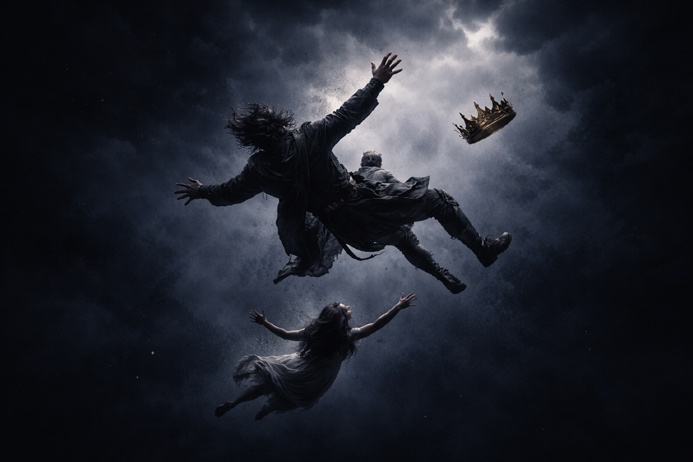
The Tower Tarot Card Meaning places every person equally within the archetype, as the falling crown in this image reflects the card’s implication that no rank or position offers protection from the collapse of false structures.
Reading The Tower in Context
No single card in a tarot reading carries its meaning in isolation. Its meaning shifts depending on what surrounds it. Paired with cards that suggest resources, support, or forward movement, it can describe a necessary and manageable disruption. Paired with cards of confusion, loss, or stagnation, it can indicate a more difficult and prolonged period.
Readers who work with the card consistently note that its appearance does not always refer to dramatic external events. The Tower can mark an internal moment, a point where a person’s own understanding breaks open and reassembles in a different form.
This inner experience is often quieter than the card’s imagery implies, more a sudden recognition than a visible catastrophe, but its effect on how a person sees themselves or their circumstances can be just as complete. The symbolism accommodates that reading. The tower in the image is the mind’s own construction as much as any external circumstance.
Arthur Edward Waite, who commissioned the Rider-Waite deck published in 1909, wrote in his accompanying text that The Tower was among the cards he deliberately obscured in public commentary, suggesting he considered its deeper interpretive layers unsuitable for general readership at the time.
Editor’s Reflection
What the Tower describes, at its core, is an encounter with reality as it actually is rather than as it has been arranged to appear. The Tower tarot card meaning holds that single idea across all its variations, upright and reversed, whether the experience arrives gently or with force. The card does not invent the collapse it depicts. It recognizes something that was already in motion.
For those who have sat with the card after a reading, a few questions tend to surface naturally. When a Tower moment arrives in ordinary life, is there a way to tell the difference between a structure worth defending and one that has simply become familiar? Does the card feel different depending on whether the disruption it describes is internal or external? And looking back, are the moments that most resemble The Tower tarot card meaning the ones that, in time, turned out to matter most?

Known as The Man Who Notices, Mike Lamp is a theatrical hypnotist and psychic performer with more than twenty years of live stage experience. His work emphasizes observation, psychological influence, and measured presentation rather than spectacle or provocation. Performances are tailored for adult audiences, private events, and professional settings where control, clarity, and atmosphere matter.



Leave a Reply
You must be logged in to post a comment.