28
Jun
Martin St James Hypnotist: The Fascinating Life of the Man Australia Could Not Stop
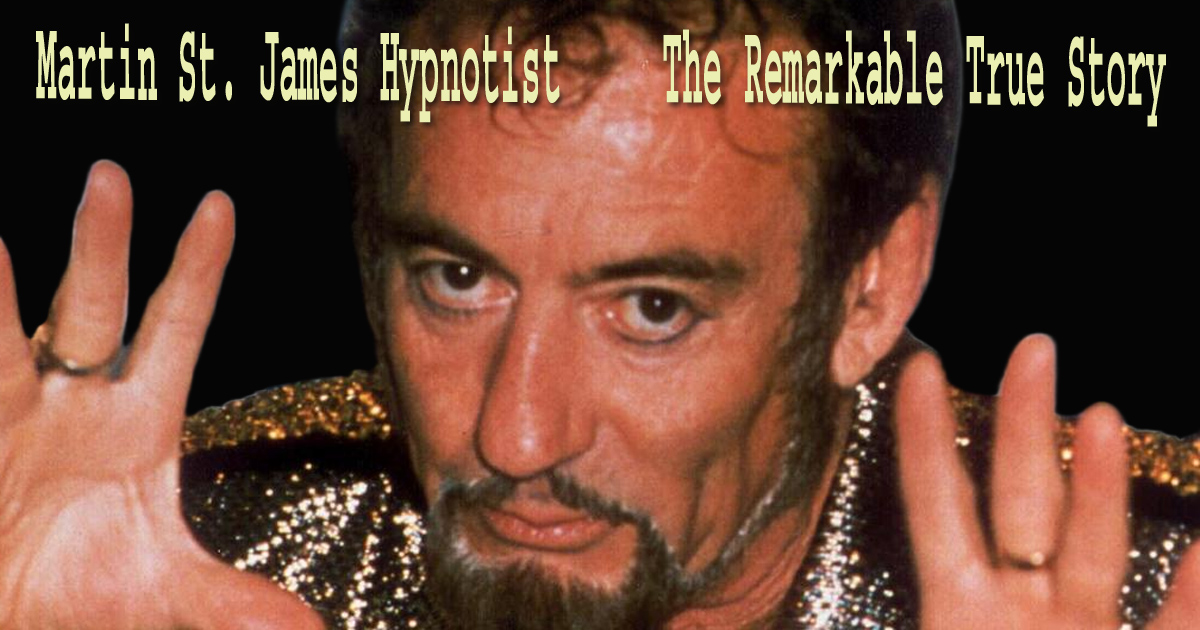
Martin St James Hypnotist Promo Shot
Began His Life in the Last Place Anyone Would Expect
There is a certain kind of life that defies the place it started in. Martin St James was born Joseph Stanley Overell Simmonds in the remote goldfields of Western Australia, as far from a theater stage as it is possible to get on a continent that already sits at the edge of the world. He died eighty years later on Queensland’s Gold Coast, having hypnotized more than 1.5 million people across fifty years, been arrested by Australian police, banned by the BBC, barred from performing in three states, and become a father for the last time at the age of seventy seven.
The story of Martin St James hypnotist is not the story of someone history forgot. It is the story of someone the establishment tried repeatedly to stop and could not. Every time a government body fined him, every time a broadcaster banned him, every time a state legislature made his performances illegal, he found another stage, another country, another audience willing to sit in the dark and watch something they could not explain.
This is that story, from the beginning.
Norseman, Western Australia and a Childhood at the Edge of Everything
The Western Australian goldfields in the 1930s were not a place that produced entertainers. They produced miners, laborers, and people with a practical relationship to hardship. Norseman, the remote gold mining town where young Joseph Simmonds spent his childhood, sat in a landscape of red dust and low scrub hundreds of miles from the nearest city. It was the kind of place where survival required more imagination than the landscape seemed to offer.
What the goldfields did produce, apparently, was a boy with an unusual interest in the way suggestion worked on other people. The isolation of a remote mining community meant that entertainment was something you created rather than consumed, and the young Simmonds had both the inclination and the audience of curious children that any aspiring performer requires.
Joan Brandon Hypnotist: The Powerful True Story History Almost Forgot
The First Time He Tried Hypnosis
Long before he had a stage name, a gold locket, or an audience paying to see him work, Joseph Simmonds conducted his first informal experiment in suggestion at a local waterhole in Norseman. The details that survive are spare, but the outcome was significant enough that he remembered it as the moment his fascination with hypnosis began.
It was not a polished demonstration. It was a boy trying something he had read about or heard about, on a friend willing to go along with it, in a setting that could not have been less theatrical. But something happened that day that stuck. Whatever he witnessed in that first experiment stayed with him through the circus years, the caravan years, the singing cowboy years, and the fifty years of professional performance that followed.
A Singing Cowboy, a Broken Down Circus, and the Beginning of Something Bigger
Rocky Martin and the Big Top That Had No Top
Around 1951, a teenager calling himself Rocky Martin arrived in Port Lincoln, South Australia, with a traveling circus called The Big Top. The name was more aspirational than accurate. The operation used a roofless canvas enclosure rather than a proper tent, performed in regional towns with limited audiences, and operated on the kind of budget that required its performers to be flexible about what they were willing to do for a crowd.
Rocky Martin was a singing cowboy. He performed songs, worked the crowd with the kind of improvisational patter that would later serve him well as a hypnotist, and learned the fundamental lesson of regional Australian entertainment in the early 1950s, which was that an audience in a small town will forgive almost anything except being bored. The circus was struggling. The canvas had no roof. But the boy from Norseman was developing skills that no formal training could have given him.
Selling Pies from a Caravan to Stay Alive
The circus could not sustain him and he knew it. During the off seasons and the lean periods between bookings, Martin St James supported himself by selling pies from a caravan on the foreshore of Port Lincoln. It was unglamorous work for a young man who believed he had something genuine to offer an audience, but it kept him alive and it kept him in the region where his reputation was slowly beginning to build.
The pie caravan years are easy to romanticize from a distance, and harder to live through in real time. What they represent in the arc of his life is the period between the idea and the execution, the years when the ambition is clear but the path is not. He was not yet Martin St James. He was still Rocky Martin, selling pies, waiting for the right room and the right audience to show him what he could actually do.
The First Hypnosis Show at Port Lincoln Civic Hall
Around 1953, Martin St James walked onto the stage of the Port Lincoln Civic Hall and held up a large gold locket on a chain. It was his first dedicated hypnosis performance, billed as a variety show but built around the demonstration that had been forming in his imagination since that afternoon at the waterhole in Norseman.
He selected twelve to fourteen volunteers from the crowd, which in a regional South Australian town in 1953 meant selecting from an audience that was simultaneously curious and deeply skeptical. Hypnosis was not a familiar entertainment form in rural Australia at that time. What he asked those volunteers to do ranged from serving imaginary tables to performing hula dances to executing ballet steps that no working class Port Lincoln man would have agreed to in his ordinary waking state.
The crowd laughed, stared, and went home talking. That was the beginning. Everything that followed, the television series, the international tours, the arrests, the BBC ban, the 1.5 million people, grew directly from that first room full of skeptical South Australians and a gold locket swinging under a civic hall light.
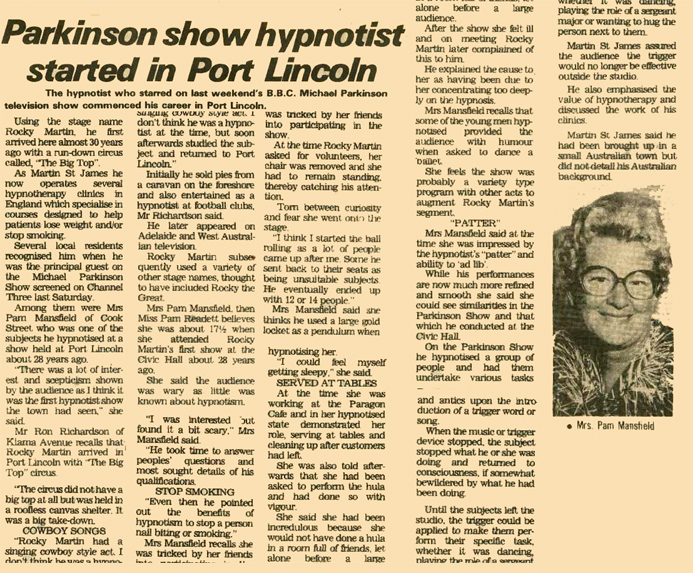
Newspaper Article on Martin St James Hypnotist Show
From the Australian Outback to American Television
How an Unknown Australian Ended Up on The Merv Griffin Show
By the mid 1960s, Martin St James had built enough of a reputation in Australian regional entertainment to make the leap that most performers in his position never attempted. He took his act to the United States, and in 1965 he appeared on The Merv Griffin Show, one of the most watched talk and variety programs in American television at the time.
The distance between Port Lincoln Civic Hall and a national American television studio was not merely geographic. It represents a transformation in scale, in expectation, and in the kind of performer a man has to become to hold an audience that has seen everything. St James held that audience. The American appearances, including a performance at Millsaps College in Mississippi that was described in the college press as stupendous, established him as something more than a regional Australian curiosity. He was an international act now, and he knew how to perform like one.
Spellbound and the Television Series That Changed Everything
In 1969, Martin St James produced and hosted Spellbound, a television series broadcast during peak viewing hours across Australian capital cities. It was not a modest production. The series aired in prime time, featured live hypnosis demonstrations with studio volunteers, included educational segments designed to explain what audiences were watching, and was built around St James’s signature character the Moon Man alongside host Garry Meadows.
Spellbound became the third highest rated program in Australia in its debut year. That ranking placed a stage hypnosis series alongside the mainstream entertainment that dominated Australian prime time in 1969, and it did so not through novelty alone but through the genuine entertainment value of watching ordinary people do extraordinary things under suggestion in front of a live studio audience. The series made Martin St James a household name in a way that no amount of regional touring could have accomplished.
The Night Spellbound Came to Britain
The British version of Spellbound followed in the 1970s, produced for ITV with adaptations suited to British broadcasting standards and British audience expectations. Where the Australian series had run as a regular program, the UK version emphasized specials and one-off productions, but the core of the format remained intact. Live volunteers, genuine hypnotic demonstrations, and a performer who had now spent twenty years developing the craft in front of audiences on multiple continents.
The ITV run extended St James’s reach into Europe and established him as a recognizable name in British entertainment. He also hosted Die Martin-St-James-Show in Germany from 1976 to 1977, adding German television to a resume that already included Australia, the United States, and the United Kingdom. By the late 1970s, the boy from Norseman was performing in languages and cultures that the goldfields of Western Australia could not have prepared him for, and doing it successfully enough to keep getting booked.
The Man Australia Kept Trying to Stop
Arrested at Festival Hall
In October 1969, the same year Spellbound debuted as one of Australia’s highest rated television programs, Martin St James performed at Festival Hall in Melbourne and was arrested by Victorian police. The charge was breach of the Psychological Practices Act 1965, specifically performing hypnosis in a public place without the consent of the Victorian Psychological Council.
He was convicted in a Magistrates’ Court in October 1970 and fined two hundred dollars plus costs. He appealed to the County Court in February 1971, arguing that his act involved auto-hypnosis rather than hypnosis imposed on others and therefore fell outside the Act’s definition. The appeal court rejected the argument and upheld the conviction. The fine was paid. The performances continued.
The arrest at Festival Hall was not an isolated incident. It was the opening round of a legal conflict between Martin St James and Australian state authorities that would continue for more than a decade and spread across multiple jurisdictions. He was not the kind of man who responded to a two hundred dollar fine by reconsidering his career.
Banned from Three States
Following legislative changes in the early 1980s, Victoria, South Australia, and Tasmania each moved to prohibit unlicensed demonstrations of hypnosis, effectively making Martin St James’s stage performances illegal in three of Australia’s six states. The laws were not written specifically to target him, but he was their most visible target in practice.
His response was to keep performing in those states and accept the arrests that followed. He was not making a reckless decision. He was making a deliberate argument, that laws designed to regulate clinical psychological practice had no legitimate application to entertainment hypnosis conducted responsibly before consenting adult audiences. The argument was principled, the arrests were real, and the Australian legal system’s response was to keep fining him while he kept showing up.
The practical consequence was that his Australian work became concentrated in New South Wales, Queensland, and Western Australia, the states where performance remained legally possible. The controversy generated by the bans and the arrests gave him a public profile that favorable press coverage alone could never have produced. In Australia, Martin St James became known as the hypnotist the government kept trying to silence.
The BBC Incident That Nobody Has Fully Explained
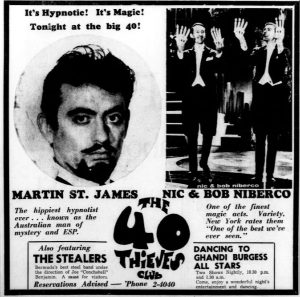
Advertisement for Martin St James Hypnotist Show
In 1980, Martin St James appeared on the BBC’s Christmas special hosted by Michael Parkinson, one of the most prominent television occasions in the British broadcasting calendar. What happened during that appearance has never been fully documented in any public record, but the outcome is not in dispute.
Among the volunteers St James hypnotized that evening were individuals later identified as being connected to MI5, the British domestic intelligence service. Under hypnosis, according to accounts that have circulated since, some of those volunteers disclosed information that should not have been disclosed on a live Christmas television broadcast. The BBC banned Martin St James following the incident.
The full details of what was said, by whom, and what consequences followed beyond the BBC ban have never been made part of any public record. Whether the information disclosed was genuinely sensitive, whether the incident was less dramatic than accounts suggest, or whether the relevant parties had strong reasons for silence remains an open question. What is not open to question is that a stage hypnotist from the Australian outback was banned by the BBC after a Christmas special involving British intelligence volunteers, and that no full public explanation has ever been offered for why.
Hypnosis Myths and Legends: The Surprising Stories That Started Them All
The Life Behind the Stage
Twenty Children and a Life Lived at Full Volume
Martin St James was the father of twenty children across multiple relationships spanning his adult life. For a man who spent fifty years in almost continuous motion across Australia, the United States, the United Kingdom, Europe, Japan, and Asia, twenty children represents a personal life lived at a scale that matched his professional one in almost every respect.
The details of his earlier relationships and the circumstances surrounding most of those twenty children are not part of the public record in any detail. What is clear is that fatherhood was not a peripheral fact of his biography. It was woven through a life that moved constantly, performed everywhere, and left a mark on every continent it touched.
Australia’s Oldest Father at Seventy Seven
In 2011, when Martin St James was seventy seven years old, his wife Theresa gave birth to their son Leo. The birth made St James Australia’s oldest father on record at that time, a distinction that attracted its own media attention and added one more improbable chapter to a life that had already accumulated more than most people could invent.
He had married Theresa in 1999 after meeting her in 1994. Together they had four children, Jeanda, Anya, Martika, and Leo. The youngest arrived when his father was four years from death and already battling the health issues that would define his final years.
What St James wrote about Leo in a birthday card has survived in the public record because it says something true about a man who had seen and done more than almost anyone in his profession. He wrote that the boy’s existence made him really believe life is worthwhile living. From a man who had performed for 1.5 million people, been arrested on multiple continents, and spent fifty years building something from nothing in the Australian outback, that sentence carries considerable weight.
Chronic Fatigue, Cancer, and Coming Back Through Self Hypnosis
In 1995, Martin St James was diagnosed with chronic fatigue syndrome, a condition that effectively ended his ability to perform at the level he had maintained for four decades. The illness was serious enough to remove him from active touring for an extended period and force a confrontation with the limits that his body was finally imposing on a career that had previously seemed to operate outside ordinary physical constraints.
His recovery, which he described as beginning in 1997, drew on self hypnosis, spiritual practices, and the support of family and friends. The man who had spent fifty years using hypnotic suggestion on other people turned the same tool on himself and, by his own account, it worked. He also survived cancer at an earlier point in his life, a fact mentioned in accounts of his final years without specific detail about timing or type.
The recovery from chronic fatigue was not a return to the stage as he had known it. It was a transition into a different kind of work, one that drew on everything he had learned but expressed it differently. The hypnosis centre on the Gold Coast was the next chapter, and it would be the last one.
The Final Chapter and the Legacy He Left Behind
The Hypnosis Centre on the Gold Coast
In 2004, Martin St James established a hypnosis centre in Broadbeach on Queensland’s Gold Coast. The shift from international touring to a fixed therapeutic practice represented a significant change in the texture of his professional life, though not in its underlying subject. Hypnosis had been his vehicle for fifty years. Now it became his treatment room.
He developed hypnotherapy recordings aimed at practical self help applications including smoking cessation and stress management, drawing on the accumulated knowledge of a career that had taken him from a Port Lincoln civic hall to prime time television on four continents. The recordings extended his reach beyond the Gold Coast practice and gave his later years a productive focus that the health challenges of the previous decade had threatened to remove entirely.
He continued working from the centre until his health prevented it. He died on May 14, 2015, from a massive stroke at his Gold Coast home, surrounded by family. He was eighty years old.
Sleep You Bastard and the Book That Told It All
In 1993, Martin St James published his autobiography under a title that captured his personality more precisely than any formal biography could have managed. Sleep You Bastard: The True Misadventures of the World’s Greatest Hypnotist, illustrated by Ray Whitton, laid out the career in his own voice, with the humor and self awareness of a man who understood exactly how improbable his life had been and found that improbability genuinely funny.
The title alone tells you something important about how he saw himself. Not as a mystic. Not as a scientist. Not as a victim of unjust persecution by Australian state governments and the BBC. As a performer with a gift for making people do things they would not ordinarily do, who had spent fifty years finding that funny and sharing the joke with anyone willing to sit in the dark and watch.
What Martin St James Hypnotist Actually Proved
The career of Martin St James did not prove that hypnosis is magic. It did not prove that governments are wrong to regulate public performances or that the BBC made an error in 1980. What it proved is something more durable and more interesting than any of those arguments.
It proved that a boy born Joseph Simmonds in the goldfields of Western Australia, who joined a circus with no roof and sold pies from a caravan to stay alive, could build something that lasted fifty years, reached 1.5 million people on five continents, survived arrests in multiple jurisdictions, survived a BBC ban, survived chronic fatigue and cancer, and produced a son at seventy seven who made him believe life was worthwhile living.
Australia tried to stop him. The BBC tried to stop him. His own body tried to stop him. None of it worked for long. That is the story of Martin St James hypnotist, and it is one of the most remarkable stories the history of stage performance has produced.
Further Reading & Resources
📖 Read: Spellbound production meeting with Martin St James

Known as The Man Who Notices, Mike Lamp is a theatrical hypnotist and psychic performer with more than twenty years of live stage experience. His work emphasizes observation, psychological influence, and measured presentation rather than spectacle or provocation. Performances are tailored for adult audiences, private events, and professional settings where control, clarity, and atmosphere matter.

Leave a Reply
You must be logged in to post a comment.