25
Jun
Bridey Murphy Hypnosis: The Day One Session Changed Everything Forever
Bridey Murphy Hypnosis: The Night That Started Everything
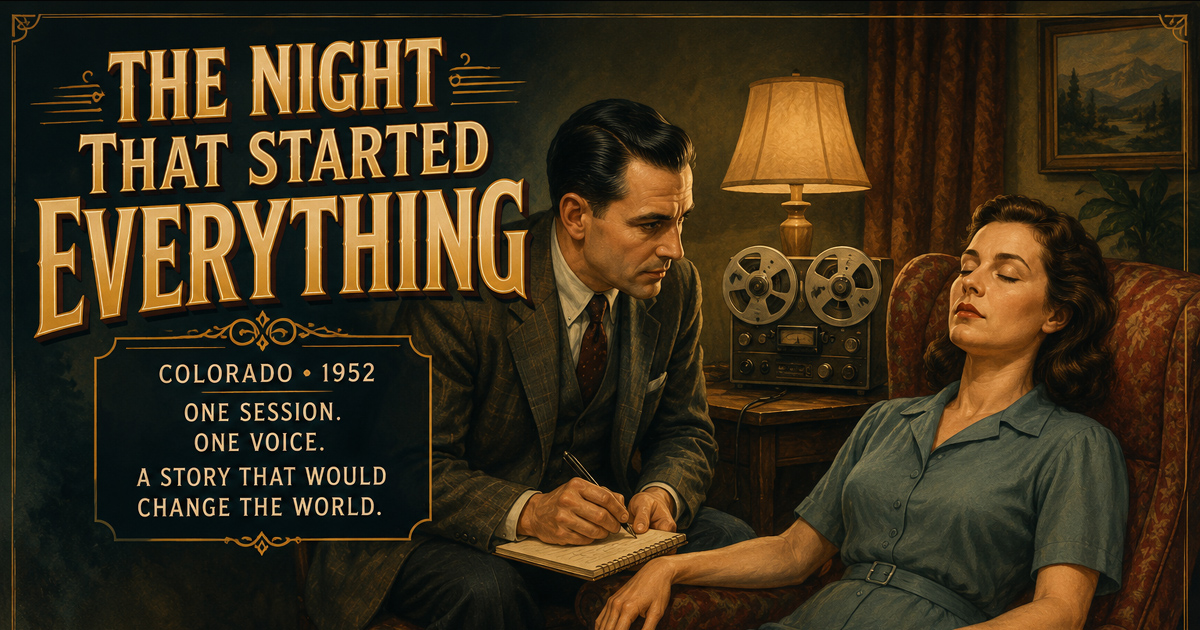
The famous Bridey Murphy hypnosis session transformed one evening in Colorado into one of the most discussed hypnosis stories in modern history.
On the evening of November 29, 1952, a man named Morey Bernstein held a candle in front of a young woman’s face at a dinner party in Pueblo, Colorado. Keep your eyes on the flame, he told her. And while I talk to you, you will become sleepier and sleepier.
What followed in the next few hours would eventually generate two hundred thousand book sales in two months, a Paramount film, a 25-fold increase in hypnosis book sales, come as you were parties across America, a Reincarnation cocktail, a Stan Freberg parody record, and an industry built around past life regression that continues generating serious money today. Nobody in that room saw any of that coming. Including Morey Bernstein.
Who Was Morey Bernstein
Morey Bernstein was born in 1919 in Pueblo, Colorado. He graduated from the Wharton School of Business and inherited the family business selling heavy machinery, farm equipment, and plumbing supplies. He was not a professional hypnotist or a researcher. He was a businessman who had discovered hypnosis as a party trick after watching a friend perform it in the late 1940s.
What distinguished Bernstein was what he did once the interest took hold. He read everything available on the subject. He began using hypnosis therapeutically, working with a local physician on psychosomatic cases and reportedly achieving results with conditions including migraines and insomnia. He had also become deeply interested in the writings of Edgar Cayce, the Kentucky farmer who under trance accurately diagnosed the illnesses of thousands of people he had never met. By 1952 Bernstein had developed a specific theory that hypnotic regression could take subjects not just back to childhood but beyond birth entirely. Virginia Tighe was the subject willing to test that theory.
Who Was Virginia Tighe
Virginia Tighe was born on April 27, 1923, in Madison, Wisconsin. At the time of the sessions she was a twenty-nine year old housewife in Pueblo whose husband owned a local car dealership. She had two children and had never been to Ireland. She possessed exactly one quality that made her ideal for Bernstein’s experiment. She was willing to try.
What happened when she agreed would follow her for the rest of her life and not always in ways she welcomed. She insisted on a pseudonym throughout and was skeptical about reincarnation even when it came to her own experience. When Bernstein told her he was planning to write a book she reportedly said if I had known what was going to happen I would never have lain down on that couch.
Arthur Ford Séance: The Shocking Truth Behind the Night Houdini Came Back
Before Bridey Murphy Nobody Was Talking About Past Lives
To understand why the Bridey Murphy hypnosis case hit the American public with the force it did you need to understand what the landscape looked like before it arrived.
What Hypnosis Looked Like to the Public in 1952
In 1952 hypnosis was still viewed with deep suspicion by most Americans. It was associated with stage performers and Svengali-type manipulation. The medical establishment regarded it with skepticism bordering on hostility. Serious practitioners existed but worked in relative obscurity. Dave Elman was teaching hypnosis to physicians in private courses. Academic researchers were conducting careful laboratory studies. But none of that had reached public consciousness in any meaningful way. Hypnosis was still largely a curiosity at best and a carnival act at worst.
Why Past Lives Were Not Part of the Conversation
Reincarnation existed within certain religious traditions but it was not something most ordinary Americans thought about. There was no past life regression therapy industry. There were no books aimed at a popular audience on accessing previous lifetimes through hypnosis. The cultural space that Bridey Murphy would eventually fill simply did not exist. Bernstein’s sessions created it.
Past Life Regression: The Surprising Truth About Hypnosis and Your Past Lives
The Day the Story Broke and Everything Changed
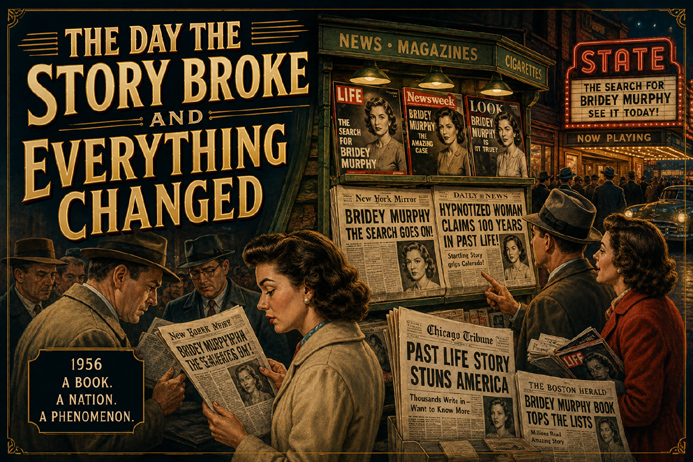
After the book appeared in 1956, Bridey Murphy hypnosis became front-page news and sparked a nationwide conversation.
Bernstein conducted six hypnotic sessions with Tighe between November 1952 and October 1953, recording and transcribing each one. Under hypnosis Tighe spoke in a convincing Irish brogue, claiming to be Bridget Kathleen MacCarthy Murphy, born December 20, 1798, in Cork, Ireland. She described her father, a barrister named Duncan MacCarthy, her husband Brian McCarthy, a move from Cork to Belfast, and her death in 1864 after falling down a flight of stairs.
She recounted attending her own funeral. She sang Irish songs. She danced a jig. She described shops, street names, customs, and details of nineteenth century Irish life with a fluency that seemed impossible for a woman who had never left America.
The story first went public as a four part series by reporter William J. Barker in the Denver Post Empire Magazine supplement in 1954. The articles were picked up by newspapers across the United States and around the world. The public response was immediate and overwhelming.
The Search for Bridey Murphy, Bernstein’s book, was published by Doubleday in January 1956. His publishers had initially printed only ten thousand copies. Within two months there were two hundred thousand in circulation. The book spent twenty-six weeks on the New York Times bestseller list and was eventually published in thirty languages across thirty-four countries.
The Search for Bridey Murphy in Ireland
Journalists, historians, and investigators descended on Ireland looking for evidence. The Chicago Daily News sent its London reporter. The Denver Post sent William Barker for three weeks. Irish law firms were hired. County records were searched. Some details checked out. A barrister named John McCarthy had worked in Belfast. Tighe’s descriptions of the Antrim coastline were considered very accurate. A grocer named Farr had existed in Cork. But no birth, marriage, or death record for Bridey Murphy could be found. The absence of documentary evidence did not stop the phenomenon. It barely slowed it down.
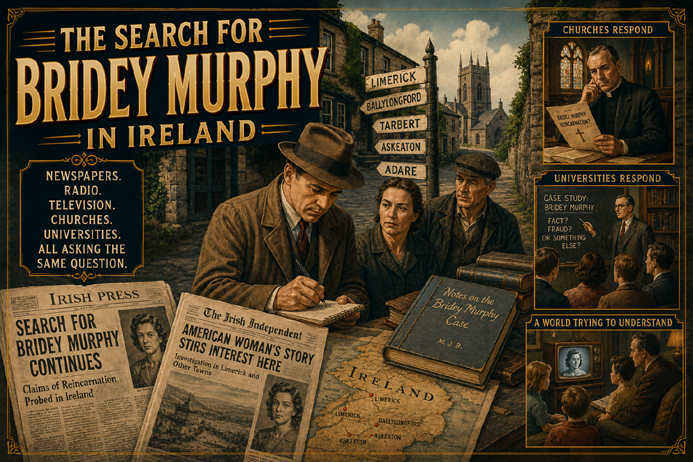
The worldwide fascination with Bridey Murphy hypnosis inspired reporters, churches, universities, and investigators to search for answers in Ireland.
How Churches and Universities Responded
The Bridey Murphy hypnosis case landed in 1950s America like a stone dropped in still water. Churches warned their congregations about reincarnation. Universities convened panels. The Journal of the American Society for Psychical Research published a detailed examination in 1960. The New York Times would later describe the incident as a 1950s phenomenon rivaling the Hula-Hoop.
Hollywood Noticed and So Did Everyone Else
Paramount Pictures had purchased the film rights before the book was even published. The 1956 film, directed by Noel Langley who had worked on The Wizard of Oz screenplay, starred Teresa Wright as Ruth Simmons. It brought Bridey Murphy to movie theaters at precisely the moment the book was generating maximum cultural saturation.
The Film That Brought Bridey Murphy to Movie Theaters
The film was neither a masterpiece nor a disaster. What it accomplished was something more culturally significant than either. It planted the image and the idea of hypnotic past life regression into the popular imagination of millions of Americans who had not read the book and might never have encountered the story otherwise. A Hollywood production lent a kind of legitimacy to a subject that academic journals and newspaper articles alone could not have achieved.
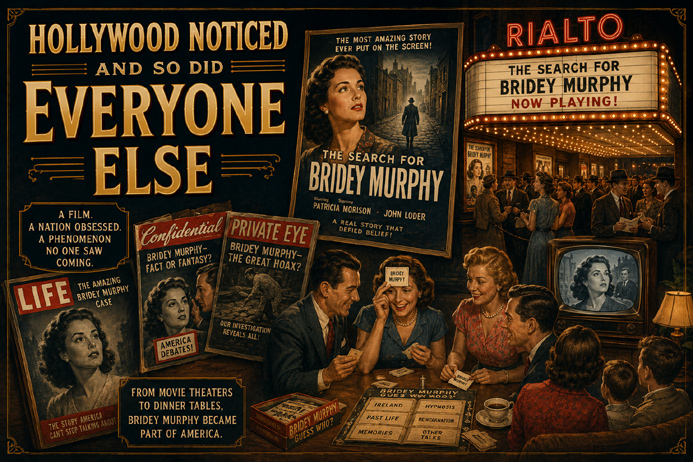
Hollywood helped turn Bridey Murphy hypnosis from an unusual story into one of the biggest cultural sensations of the 1950s.
When Past Lives Became a Cultural Phenomenon
Come as you were parties became a national sensation where guests dressed as they believed they would have appeared in a previous life. Popular songs were written including The Ballad of Bridey Murphy. A Reincarnation cocktail appeared in bars. Parents began greeting newborns with welcome back. Stan Freberg recorded a satirical sketch parodying the LP recording of the first session. By 1956 Bridey Murphy was not just a story. She was a cultural reference point that everyone in America understood.
The Billion Dollar Industry Nobody Saw Coming
Here is what Morey Bernstein’s dinner party experiment actually produced in the long run and why it matters far beyond the question of whether Bridey Murphy was real.
Books on hypnosis saw a 25-fold increase in sales in the immediate aftermath of the Bridey Murphy publication. That single statistic captures something important. An amateur hypnotist in Pueblo, Colorado, conducting private sessions with a willing housewife, accidentally created a mass market for hypnosis literature that had not previously existed.
How Regression Therapy Became a Legitimate Practice
The direct line from Bridey Murphy to the modern past life regression therapy industry runs through a Yale-trained psychiatrist named Brian Weiss. Born in 1944, Weiss graduated from Columbia University in 1966 and Yale Medical School in 1970. He went on to become Head of Psychiatry at Mount Sinai Medical Center in Miami. In 1980 one of his patients began discussing past life experiences under hypnosis. Weiss did not believe in reincarnation. He was astonished, skeptical, and ultimately unable to dismiss what he was witnessing.
His 1988 book Many Lives Many Masters became an international bestseller and brought past life regression from the fringes of alternative therapy into a conversation that included mainstream medical professionals and millions of ordinary readers. He has since claimed to have regressed more than four thousand patients.
A paper published by the National Institutes of Health directly credits the Bridey Murphy case as the starting point for the movement to use past life regression as therapy in psychiatry. One evening in Colorado in 1952 triggered a chain of events that eventually produced a recognized, practiced, and commercially significant therapeutic modality.
The Numbers Behind What Bridey Murphy Started
Today past life regression therapy is offered by practitioners in virtually every country in the world. Training programs exist. Professional associations exist. Books, courses, conferences, and online sessions generate substantial revenue annually. YouTube channels devoted to guided past life regression have millions of views. Brian Weiss alone has trained hundreds of practitioners through his workshops. Whether or not Bridey Murphy ever lived in Cork in 1798 has essentially nothing to do with the scale of what her story created.
History of Hypnosis Explained: The Surprising Truth
The Debunking That Did Not Stop Anything
The skeptical investigation began almost immediately and produced results genuinely damaging to the literal interpretation of Tighe’s sessions.
What the Investigators Actually Found
The most significant finding came from the Chicago American newspaper. Investigators discovered that a woman named Bridie Murphy Corkell had lived across the street from Virginia Tighe’s childhood home in Chicago. Her maiden name was Murphy. Her first name was Bridie. Additional investigation revealed Tighe’s birth parents were both partly Irish and that she had lived with them until age three. She had a Scotch-Irish aunt. She had used an Irish brogue in theatrical plays as a teenager. The concept of cryptomnesia, the unconscious recall of forgotten information that surfaces later without the person recognizing it as memory, was extensively discussed in relation to the case.
Why the Debunking Did Not Matter
None of it stopped anything. The believers conceded that investigations had failed to prove Bridey Murphy had existed but pointed out with equal force that they had also failed to prove she had not. The cultural phenomenon was already in motion. The regression therapists were already setting up practices. The New York Times captured the attitude of Bridey believers in Bernstein’s 1999 obituary, noting that while the investigations failed to prove she had lived as described, they also failed to prove she had not. That position has sustained the Bridey Murphy story through seventy years of skeptical attack.
What I Actually Thinks About What Happened That Night
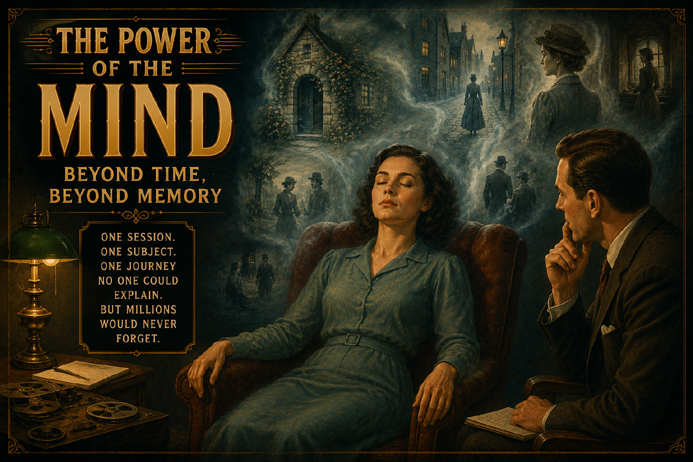
Whether viewed as memory, imagination, or something else entirely, Bridey Murphy hypnosis continues to raise fascinating questions about the human mind.
This is the section that most articles about Bridey Murphy never include because most people writing about this case have never actually hypnotized anyone.
What Bernstein Got Right Without Knowing It
Morey Bernstein stumbled onto something real in that Colorado living room even if what he found was not what he thought he had found. Virginia Tighe was by multiple accounts a highly responsive hypnotic subject, deeply imaginative, cooperative, and capable of accessing vivid inner experience under suggestion. The recordings confirm she entered genuine somnambulistic states. She remembered nothing of the sessions afterward. These are not the characteristics of deliberate fraud. They are the characteristics of a genuinely gifted hypnotic subject.
What Bernstein did not understand, because he was an amateur working without proper training, is that a highly responsive subject in deep somnambulism does not retrieve stored footage of previous lives. What they do is construct richly detailed, emotionally coherent, internally consistent narratives from the raw material available to them, including forgotten childhood memories, cultural fragments, emotional needs, and the subtle leading of the hypnotist’s questions.
That process is not conscious invention. It feels completely real to the subject. The brogue was real to her. The memories were real to her. The grief at her own funeral was real to her. None of that requires reincarnation to explain and all of it requires a genuine and deep hypnotic state to produce.
What the Session Tells Us About the Power of Hypnotic Suggestion
What the Bridey Murphy hypnosis sessions actually demonstrate, stripped of the reincarnation framework, is something genuinely extraordinary about the creative and reconstructive power of the hypnotized mind. A woman with Irish neighbors in childhood, Irish relatives, theatrical experience with an Irish brogue, and fragments of forgotten cultural absorption could, under hypnotic guidance, produce a narrative so vivid and emotionally authentic that it convinced everyone in the room including herself.
That is not a lesser achievement than discovering a genuine past life. In many ways it is a more remarkable one. Bernstein was trying to prove reincarnation and accidentally proved something about the nature of hypnosis that deserved its own serious investigation.
My Final Thoughts on Bridey Murphy and the World She Accidentally Created
The Bridey Murphy hypnosis case has been part of the cultural record for over seventy years. It has been investigated, debunked, defended, satirized, filmed, and cited in NIH publications. Morey Bernstein died in 1999 having lost his fortune and reportedly become a recluse. Virginia Tighe died in Denver in 1995, as the New York Times put it perhaps for the second time, still reluctant to claim with certainty that she had been Bridey Murphy.
What they left behind is the modern past life regression movement, an industry of books and therapists and conferences and YouTube channels and training programs that would not exist without one candle-lit evening in Pueblo, Colorado.
Whether someone believes the claims has become almost beside the point. Before November 29, 1952, nobody was throwing past life parties or booking regression therapy sessions or building careers around guiding people back through previous lifetimes. After that date they were.
One session. One candle. One woman willing to lie down on a couch and see what happened. Seventy years later we are still finding out.

Known as The Man Who Notices, Mike Lamp is a theatrical hypnotist and psychic performer with more than twenty years of live stage experience. His work emphasizes observation, psychological influence, and measured presentation rather than spectacle or provocation. Performances are tailored for adult audiences, private events, and professional settings where control, clarity, and atmosphere matter.


Leave a Reply
You must be logged in to post a comment.