9
Apr
Pisces Symbolism Meaning: Bold Water Sign Insights
Pisces Symbolism Meaning: Bold Water Sign Insights
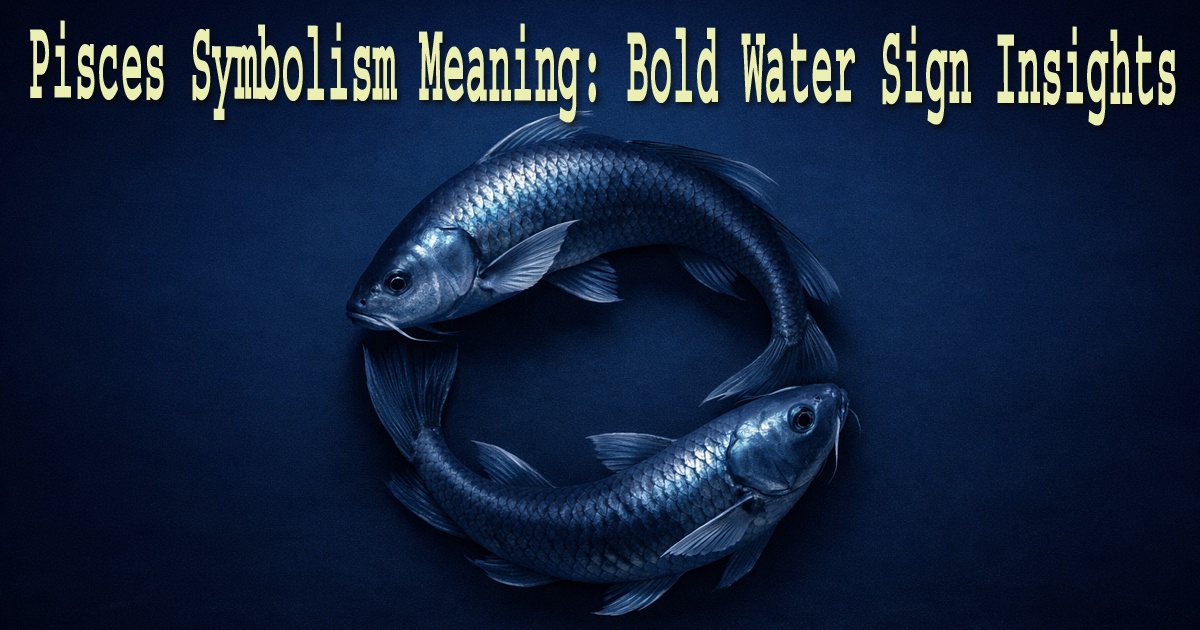
Pisces symbolism starts with two fish
The Two Fish of Pisces
Pisces symbolism begins with its most recognizable image: two fish swimming in opposite directions, bound together by a cord. This image appears in Babylonian star catalogs long before the Greek tradition formalized the constellation, and it has carried consistent meaning across cultures that never had direct contact with one another. The two fish do not simply represent duality. They represent the tension between two modes of being that cannot be separated, each pulling toward a different current while remaining joined at the center.
In the tropical zodiac, Pisces occupies the final position, the twelfth sign, which gives it an unusual quality among the signs. It inherits something from every sign that precedes it, not as a collection of traits but as a kind of accumulated awareness. The symbolism of the fish moving in opposite directions reflects this: one fish faces forward into the unknown, the other looks back at what has already been lived. Neither direction is wrong. The cord between them is the point.
Read about Zodiac Meaning Explained: Clear Guide to Symbolism in our Exclusive Article
Planetary Rulership and Its Symbolic Weight
Jupiter ruled Pisces for centuries before Neptune was discovered in 1846. Modern practitioners gradually adopted Neptune as co-ruler, though traditional astrologers continued to assign Jupiter as sole ruler within the classical system. Both planets contribute meaningfully to Pisces symbolism. Jupiter expands, seeks understanding, and moves toward meaning on a broad scale. Neptune, as a modern planet, carries associations developed through observation of events and later astrological interpretation from the nineteenth century onward. Its assignment to Pisces remains a matter of convention rather than classical authority.
Within that modern framework, it is described as dissolving boundaries, working through image and impression, and resisting the kind of sharp definition that other planetary energies prefer. Together they describe a sign that is simultaneously philosophical and permeable, one that reaches for the whole picture while remaining sensitive to what cannot be fully named.
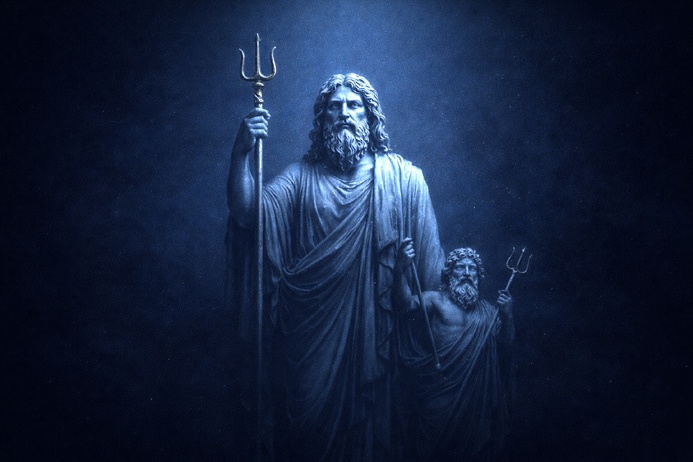
Pisces Symbolism Two rulers, one water sign
Neptune’s association with the ocean is not incidental. The ocean in astrological symbolism is not primarily about emotion, though emotion is present. It is about the undifferentiated, the space before form, the place where individual shapes become less distinct. When Pisces symbolism draws on Neptune, it draws on that quality: the capacity to sense what is beneath the surface of a situation before any analysis has taken place.
The Twelfth House and the Territory It Governs
The twelfth house, which Pisces is said to correspond to in natural house associations, is one of the more misread areas of the horoscope. It has been called the house of loss, of hidden enemies, of confinement. These older labels are not entirely wrong but they miss the underlying logic. The twelfth house describes experience that exists outside ordinary social circulation: retreat, solitude, work done quietly and without credit, and the layer of consciousness that sits below waking awareness. Pisces symbolism fits this territory precisely because the sign operates by absorption rather than assertion.
What the twelfth house and Pisces share is a relationship to things that cannot be easily categorized or displayed. A planet in the twelfth often functions without the native being fully aware of it. Pisces as a sign has a similar quality in that its influence tends to work through atmosphere and feeling rather than through clear statement. This is not vagueness for its own sake. It is a different mode of intelligence, one that is oriented toward the whole rather than the part.
The earliest surviving depiction of two fish joined by a cord in a zodiacal context appears in cuneiform astronomical texts from the Mul.Apin series, dated to around 1000 BCE, making it one of the oldest continuously recognized zodiac images.
Mutable Water and the Quality of Adaptability
Pisces is the third water sign and the third mutable sign, making it water in its most yielding and responsive form. Where Cancer holds and Scorpio intensifies, Pisces disperses. The mutable quality means Pisces is oriented toward transition, toward the end of one cycle and the approach of the next. In the seasonal logic of the tropical zodiac, Pisces arrives as winter is ending, when conditions are shifting but have not yet resolved into spring. That timing is built into the symbolism.
Mutable signs generally show flexibility, and in Pisces this is expressed through receptivity. Pisces symbolism consistently returns to this theme: the capacity to receive impression, to be shaped by what surrounds it, to hold more than one emotional register at once. This is a structural feature of the sign, not a personality flaw. Water takes the shape of its container. Mutable water takes the shape of its container and then moves on when the container changes.
Aspects and Pisces in the Natal Chart
When Pisces symbolism is active through a natal placement, the house and aspects attached to that placement do much of the interpretive work. A Pisces Sun conjunct Saturn will differ significantly from a Pisces Sun conjunct Uranus, and the interpreter should account for that difference rather than defaulting to a general description of the sign. Pisces provides the coloring, the emotional register, the quality of perception. The planet and its aspects determine what that perception is directed toward and how it expresses itself in actual behavior.
Planets in Pisces tend toward indirect expression. Mars in Pisces, for instance, does not push in a straight line. It maneuvers, feels its way forward, and is often more effective through patient effort than through direct confrontation. Venus in Pisces is in exaltation, which is a traditional dignity indicating a particularly harmonious fit between planetary nature and sign territory. The reason given in classical astrology is that Venus in Pisces can love without condition, that the dissolving quality of the sign allows Venus to extend beyond the usual bounds of preference and attachment.
In ancient Egyptian astronomical ceilings, the fish associated with Pisces were sometimes shown as different species, one representing the Nile perch and one a tilapia, reflecting local fauna rather than generic fish.
The Fixed Stars Within Pisces
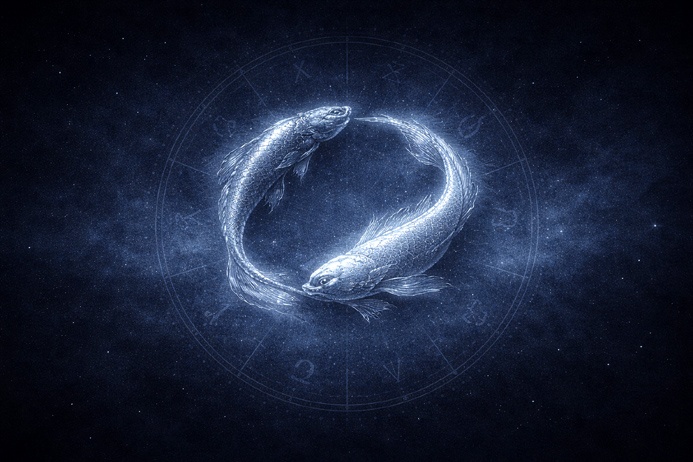
Pisces Symbolism The Fixed Stars of Pisces
The constellation of Pisces contains several fixed stars that traditional astrologers have interpreted within the overall frame of Pisces symbolism. Fomalhaut, one of the four royal stars of Persian astronomy, sits in the late degrees of Aquarius by modern constellation boundary but falls within Pisces by traditional ecliptic longitude, and most classical and Renaissance astrologers placed it within Pisces territory for horoscopic purposes. The fish imagery in the surrounding star groups reinforced, for early astronomers and astrologers alike, the sense that this region of the sky was concerned with water, with depth, and with what lies beneath ordinary visibility.
Fixed stars in Pisces do not override the sign’s symbolism. They add texture and specificity, pointing to themes that run through the sign’s territory with particular sharpness. Fomalhaut in particular has long been linked to the ability to pursue an elevated aim, and the caution that accompanies that ability: that without discernment, aspiration drifts into illusion. This is consistent with what Pisces symbolism suggests more broadly, the importance of maintaining some thread of clarity within the sign’s natural expansiveness.
The cord connecting the two Pisces fish was interpreted by some medieval Arabic astronomers as a celestial river or channel rather than a physical rope, giving it cosmological significance beyond the sign itself.
Pisces in Mundane and Historical Astrology
In mundane astrology, Pisces and its ruling planet Jupiter, and by modern extension Neptune, have been associated with large institutions, places of withdrawal, and collective movements operating below the level of ordinary political life. The planetary ruler in play at any given time shapes which layer of that symbolism is most active. Hospitals, monasteries, prisons, and charitable organizations all fall within the traditional Pisces territory. This is not arbitrary. The twelfth house rulership and the sign’s orientation toward the hidden and the communal make these associations coherent within the system’s own logic.
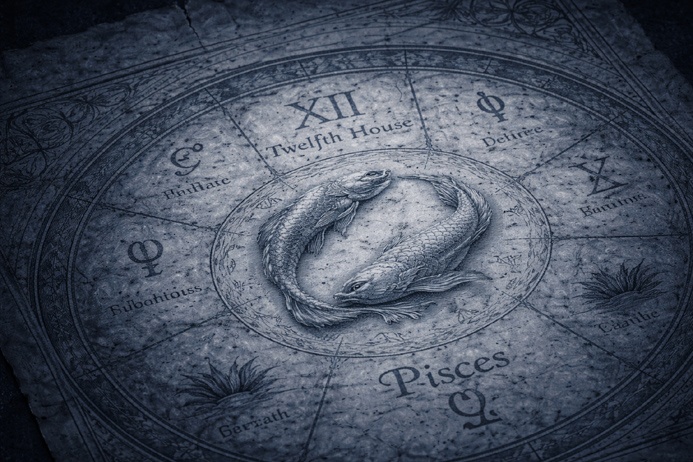
Pisces Symbolism, Last sign, oldest story.
Historical astrologers, following the theory of great conjunctions formalized by Abu Ma’shar in the ninth century and later transmitted through Guido Bonatti and Renaissance writers, paid close attention to the sign in which those conjunctions occurred. Periods associated with Pisces in those cycles were often described in terms of spiritual upheaval, dissolution of existing structures, and the emergence of movements rooted in compassion or collective yearning. Whether those descriptions hold up historically is a matter for historians. Within the astrological tradition, Pisces symbolism has consistently described the end of cycles and the preparation for what follows, a role that suits the twelfth sign’s position at the close of the zodiacal wheel.
Got questions? Talk to Mike directly Here.
The Exaltation of Venus and Its Meaning
Venus reaches her exaltation in Pisces, and this traditional assignment illuminates something central to Pisces symbolism. Exaltation in classical astrology means a planet functions with unusual ease and expressiveness in a given sign. For Venus, that ease in Pisces comes from the sign’s capacity to transcend the usual conditions of preference and desire. Ordinary Venusian energy seeks beauty, harmony, and attachment to specific objects of affection. In Pisces, those objects become less fixed. The affection becomes more diffuse, more willing to extend itself without demanding return.
This does not imply that Pisces is selfless in a moralistic sense. The exaltation simply describes a technical fit between planetary energy and sign territory. Venus in Pisces can appreciate without possessing. It can love at a distance, across time, or in ways that have no practical resolution. Pisces symbolism supports this because the sign’s entire orientation is toward what exceeds ordinary categories, toward the experience that cannot be fully contained in any single form or relationship.
Editor’s Reflection
What remains after reading through Pisces symbolism is less any single idea and more the overall impression the sign leaves. There is a mode of awareness here oriented not toward naming things but toward sensing the space between them. The twelfth sign carries the whole zodiac inside it in some quiet way, and the fish swimming in opposite directions are an honest picture of what that feels like from the inside.
The questions Pisces symbolism tends to raise are not easily answered, which may be part of the point. What does it mean to perceive something before you can articulate it? Is the dissolving quality of this sign a limitation, or is it doing something that sharper energies simply cannot do? And where, in your own chart or your own experience, do you recognize that pull between two directions that somehow belong together?

Known as The Man Who Notices, Mike Lamp is a theatrical hypnotist and psychic performer with more than twenty years of live stage experience. His work emphasizes observation, psychological influence, and measured presentation rather than spectacle or provocation. Performances are tailored for adult audiences, private events, and professional settings where control, clarity, and atmosphere matter.




Leave a Reply
You must be logged in to post a comment.