8
Mar
The Devil Tarot Card Meaning: Clear Guide to Powerful Symbolism
The Devil Tarot Card Meaning: Bold Honest Breakdown

Atmospheric scene illustrating The Devil Tarot Card Meaning and its symbolism of attachment, temptation, and illusion within the Major Arcana.
Among the seventy-eight cards of the tarot deck, few carry as much immediate visual weight as the fifteenth card of the Major Arcana. The Devil Tarot Card Meaning is often misread on first encounter, largely because the imagery draws on centuries of religious and mythological symbolism that most people recognize but few stop to examine carefully. Understanding what this card actually represents, within the tarot’s own symbolic language, requires setting aside assumptions and looking at the card’s structure on its own terms.
The Major Arcana traces a symbolic journey through stages of human experience. Each card represents a significant force or condition that the subject of the reading encounters along that path. The Devil does not sit at the end of this journey, nor at its beginning. It occupies a middle position, specifically between Temperance at fourteen and The Tower at sixteen. That sequence is not incidental. Temperance represents careful integration and balance. When that balance fails or is abandoned, The Devil follows. When the condition The Devil describes reaches its breaking point, The Tower arrives. The three cards form a coherent arc.. That placement is not accidental.
Read Major Arcana Secrets: Shocking Dark Origins Revealed Exclusive Article
The Imagery and Its Roots
The Rider-Waite-Smith version of this card, which became the most widely reproduced tarot design of the twentieth century, shows a horned, winged figure seated on a black platform or altar. Below this figure stand two human forms, a man and a woman, each loosely chained at the neck. The chains are notably slack, a detail that rewards attention.
The figures are not bound so tightly that escape would be impossible. They are held, but not without agency. Equally worth noting: both figures have small horns and tails, subtle details showing they have begun to take on the qualities of what holds them. The longer the chains go unexamined, the more the captive begins to resemble the captor.
The central figure borrows heavily from the nineteenth-century occultist Eliphas Levi’s illustration of Baphomet, published in 1854, a symbolic composite associated with the reconciliation of opposites, materialism, and duality. Pamela Colman Smith drew on this image directly when rendering the card for Arthur Edward Waite. One hand is raised in a gesture that mirrors, but reverses, the blessing posture seen in other cards. A torch held downward in the other hand suggests illumination directed not toward higher understanding but toward the earth, toward appetite and instinct.
The inverted pentagram above the figure’s head reinforces this sense of reversal. In Levi’s original system, the upright pentagram represented spirit governing matter. Inverted, it signals matter pulling downward over spirit, which is precisely the condition The Devil card is mapping.
The Devil Tarot Card Meaning draws its power from contrast. Everywhere in this image, the viewer finds echoes of other cards, The Lovers most obviously, but inverted or distorted. Where The Lovers card shows a divine figure presiding over a free union, The Devil card shows a darker figure presiding over captivity. The emotional resonance of that contrast is part of what makes the card so effective as a symbolic statement.
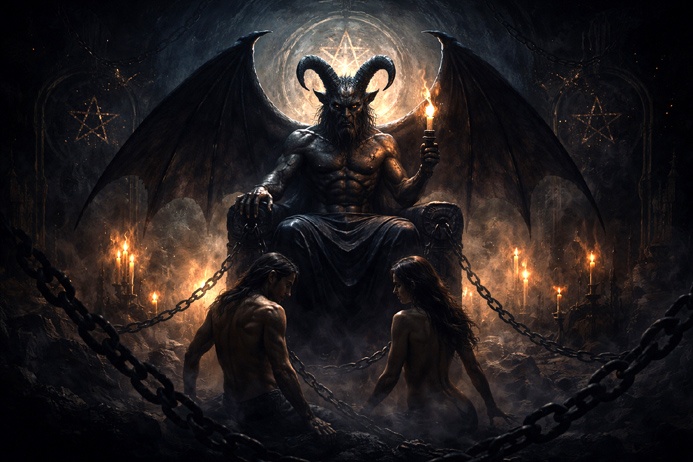
Symbolic representation illustrating The Devil Tarot Card Meaning within the Major Arcana and the spiritual journey of tarot archetypes.
Upright Interpretation
The Devil upright meaning centers on bondage, whether literal or figurative, chosen or unconscious. But Waite himself was careful to distinguish this card from evil in any absolute sense. In his Pictorial Key to the Tarot, he described it as a card of the material world in its most entrapping form, not a card of sin. That distinction matters enormously to how a reader approaches it. In a reading, this card most often points toward patterns of behavior that have become self-reinforcing. Addiction falls under this symbolism, but so does compulsion in a broader sense: obsessive thinking, relationships built on dependency, financial entrapment, or any condition in which a person continues a course of action despite recognizing its costs.
This is not a card of external punishment. The chains in the image are the person’s own, and the slack in those chains is meaningful. The Devil Tarot Card Meaning in its upright position does not suggest that escape is impossible. It suggests instead that the chains have not yet been examined, that the person wearing them may not have recognized how loosely they actually fit. The discomfort pointed to by this card is real, but so is the potential for recognition and change.
Tarot card archetypes function as mirrors, and The Devil is one of the sharper ones. It reflects back patterns that are often easier to see in others than in oneself. Material excess, avoidance of responsibility, surrender to pleasure at the expense of growth, all of these fall within the card’s range of meaning. None of them are permanent conditions. They are states the card is bringing into view.
In practical readings, the upright card often appears when a person is deeply engaged with something that provides short-term relief but longer-term cost. This might be a habit, a relationship, a job, or a set of beliefs. The Devil Tarot Card Meaning in these contexts is best understood as an invitation to examine rather than a verdict.
The goat-headed Baphomet figure that Eliphas Levi published in 1854 was itself a synthesis drawn from multiple earlier sources, including the Knights Templar trial records of 1307, in which accused members were said to have worshipped an idol by that name, though no visual depiction existed at the time.
Reversed Interpretation
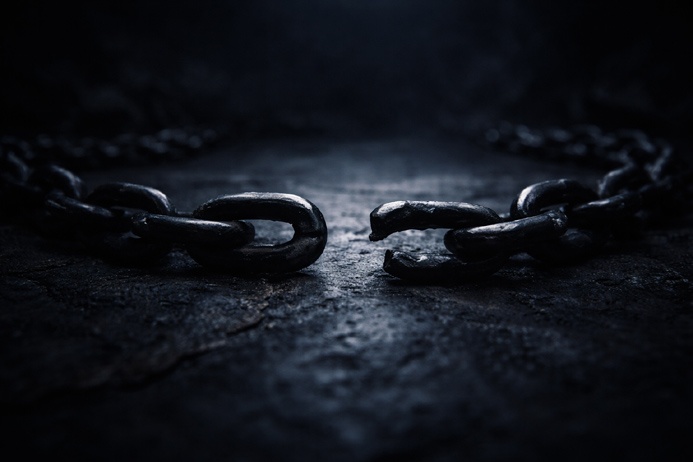
A single opened link captures the transitional quality at the heart of The Devil Tarot Card Meaning in its reversed position.
The Devil reversed meaning shifts the card’s focus from entanglement toward release. When reversed, this card often signals that a period of bondage, whether conscious or not, is ending or beginning to loosen. The person in the reading may be in the early stages of recognizing a pattern they had not previously seen clearly. They may be pulling back from something that held them, beginning to exercise choices they had forgotten they possessed.
Some readers interpret the reversed position as indicating that the person is actively working to break free from a limiting condition. Others see it as a warning that the appeal of a destructive pattern remains strong, that the temptation to return is present even as the person moves away. Both readings are legitimate, and context determines which applies.
The Devil reversed meaning is not simply a softened version of the upright card. It carries its own particular quality, a sense of transition, of standing at the moment just before or just after a significant threshold. The spiritual journey in tarot, as it moves through the Major Arcana, returns repeatedly to moments of choice. The reversed Devil represents one such moment with unusual clarity.
The Devil in Spread Positions
Where this card falls within a spread affects its meaning considerably. In a position representing the past, it may indicate a period of entanglement that has already shaped the current situation. In a position representing the present, The Devil Tarot Card Meaning points toward active conditions the person is currently living with. In a position representing future potential, it may suggest a risk of falling into familiar traps, or alternatively, an encounter with desire that will require clear-eyed handling.
Adjacent cards matter as much as position. When The Devil appears near cards of transformation such as The Tower or Death, the reading often points toward a significant disruption of existing patterns. When it appears near more stable cards, it may indicate that the entanglement is well-established and comfortable in a way that makes it harder to recognize. This card’s core meaning does not change fundamentally based on surrounding cards, but its emphasis shifts.
Arthur Edward Waite originally considered omitting The Devil card from the Rider-Waite-Smith deck entirely, viewing the card as potentially misleading to inexperienced readers, before ultimately retaining it with modified imagery intended to emphasize psychological entrapment rather than theological evil.
The Role of the Fifteenth Card in Major Arcana Symbolism
The fifteenth alcove sitting deeper in shadow than all others gives architectural form to The Devil Tarot Card Meaning and its place within the Major Arcana sequence.
The spiritual journey in tarot, as traditionally understood, moves from innocence through complexity toward integration. The Major Arcana symbolism is not a linear moral progression but a map of human experience that includes both expansive and contracting forces. The Devil belongs to the contracting half of that map, the section that deals with encounters with limitation, shadow, and the denser aspects of material life.
Card fifteen is sometimes discussed in terms of its relationship to card five, The Hierophant, through numerological reduction, since one plus five equals six, which is The Lovers. That triangular relationship among Hierophant, Lovers, and Devil is significant: each card deals with a form of union or binding, but at markedly different levels of freedom and awareness. Both cards deal with structure and authority, but where The Hierophant represents external spiritual order, The Devil represents internal compulsion. That contrast sits at the center of what the fifteenth card is doing within the larger sequence. The Devil Tarot Card Meaning, in this broader context, is about the encounter with the self’s own darker organizing principles.
Major Arcana symbolism at this stage of the journey is less concerned with moral categories than with recognition. The figure in this card is not purely evil in the tarot’s own framework. It is a representation of forces within human experience that are real, powerful, and demanding of honest attention. The card does not ask for condemnation. It asks for clarity.
Understanding The Devil in Practice
Readers who approach this card with dread sometimes miss its more practical implications. The Devil Tarot Card Meaning, stripped of cultural baggage, is fundamentally about what holds a person in place when they might otherwise move. That is neither a catastrophic message nor a particularly unusual one. Most people, at most points in their lives, are navigating some version of the condition this card describes.
The slack chains in the image are the detail that keeps the card honest. They acknowledge that the situation is real without suggesting it is permanent. The Devil Tarot Card Meaning is not a sentence. It is a description of a condition, offered with the assumption that description itself can be useful, that seeing something clearly is the first step toward any meaningful response to it.
In early Italian tarot decks predating the Rider-Waite-Smith design, the figure on the fifteenth card was sometimes depicted not as Baphomet but as a conventional medieval devil with wings and cloven hooves, and in some Northern Italian variants the card was titled simply Il Diavolo with no additional symbolic apparatus around the chained figures.
Editor’s Reflection
What stays with most people who sit with this card long enough is not the horned figure or the chains, but the detail nobody mentions first: the chains are loose. The Devil Tarot Card Meaning, at its core, is less about darkness than about the ordinary human tendency to stay put inside conditions that could, with some honest attention, be changed. The card does not moralize. It observes, and that restraint is what gives it lasting weight within the Major Arcana’s larger map of experience.
The Devil Tarot Card Meaning tends to provoke strong reactions, which itself says something worth sitting with. What patterns feel most recognizable when this card appears? And when the chains in the image are described as loose, does that read as reassuring, or does it make the situation feel more complicated rather than less?

Known as The Man Who Notices, Mike Lamp is a theatrical hypnotist and psychic performer with more than twenty years of live stage experience. His work emphasizes observation, psychological influence, and measured presentation rather than spectacle or provocation. Performances are tailored for adult audiences, private events, and professional settings where control, clarity, and atmosphere matter.



Leave a Reply
You must be logged in to post a comment.