13
Jan
Ethics and Boundaries in Your Psychic Practice Explained Clearly
Ethics and Boundaries in Your Psychic Practice Made Clear

Ethics and Boundaries in Your Psychic Practice
Ethics and Boundaries in Your Psychic Practice are often discussed as voluntary standards rather than enforceable rules. Practitioners typically describe ethics as a personal responsibility shaped by experience, training, and shared community norms, not by licensing or formal regulation.
Discussions around ethics rarely focus on whether psychic ability is real. Instead, they center on conduct, responsibility, and restraint. Practitioners frequently frame their work as interpretive and symbolic, placing limits on what a reading is meant to accomplish. Those limits are not presented as weaknesses, but as the foundation of ethical practice.
Ethics and boundaries are also used as a way to define professional identity. By emphasizing what they will not do, practitioners often seek to separate their work from coercion, exploitation, or emotional dependency. In this context, boundaries are not restrictions on insight but guardrails around influence.
Explore the article on 19th Century American Spiritualism
Overview of Ethics in Psychic Practice
Ethics in psychic work are usually described as voluntary standards rather than enforceable rules. Practitioners often speak of ethics as a personal responsibility shaped by experience, training, and community norms, not by licensing or regulation.
Some ethical frameworks focus on honesty in presentation. This includes how abilities are described, how certainty is avoided, and how symbolism is explained. Ethical conduct, in this sense, is tied to transparency about the limits of interpretation rather than claims of accuracy.
Other practitioners describe ethics as behavioral consistency. They emphasize predictable conduct, stable boundaries, and a clear separation between personal belief and professional interaction. These standards are often discussed as a way to maintain trust over time, especially in repeat sessions.
Ethics and Boundaries in Your Psychic Practice are commonly framed as safeguards rather than promises. The goal, as many practitioners describe it, is not to convince but to avoid harm, confusion, or undue influence. Ethical practice is presented as a method of containment, keeping the work within a defined scope that clients can understand and evaluate for themselves.
Informed Consent and Client Expectations
Once ethical scope is established, many practitioners focus on defining the nature of the session.
Consent in psychic work is often described as contextual rather than contractual. Practitioners may explain what kind of experience is being offered, how information is presented, and what role the client plays in interpreting it. This explanation is meant to establish shared understanding rather than formal agreement.
Some practitioners provide this information briefly, while others treat it as an essential introduction. They may clarify that a reading does not replace personal judgment, professional advice, or independent decision-making. These limits are commonly stated without emphasis, positioned as part of normal practice rather than as warnings.
Uncertainty is often addressed indirectly. Instead of listing limitations all at once, practitioners may remind clients throughout the session that impressions can shift or feel incomplete. This approach frames uncertainty as inherent to the process rather than as a flaw.
Ethics and Boundaries in Your Psychic Practice are reinforced through expectation management. Session length, format, and interaction style are often outlined in advance so clients know what participation involves. By shaping expectations early, practitioners frame consent as an act of clarity, defining the boundaries of the session before interpretation begins rather than limiting it afterward.
Emotional and Psychological Boundaries

Ethics and Boundaries in Your Psychic Practice shown through a calm, respectful consultation between practitioner and client.
Beyond consent and expectations, influence is where ethical concern tends to sharpen.
Many practitioners identify emotional dependency as one of the clearest boundary violations. A reading that encourages repeated urgency, emotional reliance, or the belief that clarity only comes through the practitioner is widely described as unethical. To counter this, practitioners often stress self-reflection and personal agency.
Psychological boundaries are also discussed in terms of tone. Ethical frameworks commonly discourage dramatization, exaggerated language, or emotionally charged delivery. The concern is not emotion itself, but escalation that reduces a client’s ability to reflect or choose freely.
Fear-based messaging receives particular scrutiny. Practitioners frequently describe fear as a powerful tool that distorts judgment. Ethical discussions often caution against invoking threats, negative outcomes, or impending danger, especially when such statements cannot be verified or contextualized.
Ethics and Boundaries in Your Psychic Practice are often defined here by restraint. Knowing when to stop, soften language, or redirect a conversation is treated as a core ethical skill. Emotional distance, in this view, is not indifference but protection against manipulation.
Health, Legal, and Financial Disclaimers
Alongside emotional limits, certain topics are commonly placed outside the scope of psychic work.
Practitioners often state plainly that they do not diagnose illness, interpret laws, or provide financial advice. These boundaries are usually framed as role clarity rather than disclaimers meant to deflect responsibility.
How these limits are communicated varies widely. Some practitioners rely on written statements included on websites, booking forms, or intake materials. Others prefer verbal reminders, especially when discussions move toward sensitive areas involving health, disputes, or money.
Ethics and Boundaries in Your Psychic Practice are reinforced through repetition rather than emphasis. Ethical discussions often note that emotional situations can cause clients to overlook limits, making it necessary to restate them calmly when relevant.
Language choice plays a central role. Practitioners may avoid reassurance, predictions, or directive phrasing that could be mistaken for advice. By maintaining neutral wording, they keep responsibility for decisions with the client while preserving the interpretive nature of the session.
Handling Sensitive Topics
Not every subject is treated as appropriate for every session.
Many practitioners describe setting boundaries around topics such as death, serious illness, trauma, and financial hardship. These boundaries may be stated upfront or applied as situations arise, depending on the practitioner’s approach.
When sensitive subjects are addressed, practitioners often describe slowing the pace of the session. Statements become more qualified, and emphasis shifts away from outcomes toward reflection. This measured approach is intended to reduce emotional intensity.
Trauma is frequently discussed as a special case. Ethical frameworks often emphasize that heightened emotional states can increase suggestibility. In such situations, practitioners may redirect the conversation, offer general observations, or decline to continue the topic.
Ethics and Boundaries in Your Psychic Practice are reflected in the decision to withhold information. Declining to address a subject is often framed as ethical judgment rather than avoidance, prioritizing emotional safety over completion of a reading.
Confidentiality and Privacy
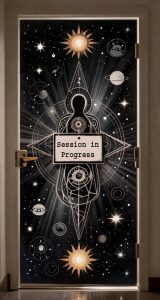
Ethics and Boundaries in Your Psychic Practice represented through privacy and confidentiality during a session.
Privacy is commonly described as an ethical obligation, even in informal settings.
Practitioners often state that session content is treated as confidential unless permission is given to share it. This boundary is often framed as necessary because clients may disclose information they have never shared elsewhere, sometimes without realizing the weight of what they are revealing. This includes personal details, emotional disclosures, and interpretations offered during a reading.
Some practitioners extend confidentiality to how sessions are discussed publicly. Ethical discussions may discourage sharing client stories, even anonymously, if details could be recognizable or sensitive.
Ethics and Boundaries in Your Psychic Practice are reinforced by discretion outside the session itself. Practitioners may describe avoiding casual conversation about clients or using sessions as examples in teaching without consent.
Confidentiality is often framed less as secrecy and more as respect. The emphasis is on protecting trust rather than withholding information.
Power Dynamics Between Practitioner and Client
Even with clear boundaries in place, authority in psychic work is largely symbolic.
Practitioners often acknowledge that belief, expectation, and suggestion can create perceived authority even without formal power. Ethical discussions frequently point out that this authority can arise unintentionally, simply through confidence, repetition, or the client’s desire for certainty.
Some frameworks encourage practitioners to position themselves as facilitators rather than guides. This includes inviting clients to question interpretations and reminding them that meaning is subjective.
Ethics and Boundaries in Your Psychic Practice are tested when authority goes unexamined. Ethical approaches often stress humility, avoiding claims that elevate the practitioner above the client’s judgment or autonomy.
Managing power dynamics is presented as an ongoing responsibility rather than a fixed rule. Awareness, not control, is the ethical goal.
Fees, Refunds, and Fair Business Practices
Money introduces its own set of ethical concerns.
Practitioners often discuss transparency in pricing, session length, and services offered. Clear fees are framed as a way to prevent pressure or misunderstanding.
Some ethical guidelines address refund policies directly. While practices vary, the emphasis is usually on fairness and clarity rather than guarantees.
Ethics and Boundaries in Your Psychic Practice extend to how repeat sessions are encouraged. Ethical discussions often caution against upselling based on fear, urgency, or promises of resolution.
Business practices are treated as part of ethical conduct, not separate from it. How money is handled reflects how power and trust are managed.
Teaching Ethics in Psychic Training
Ethics are often taught alongside technique.
Training programs and mentorships frequently include discussions about boundaries, client interaction, and professional conduct. These lessons are usually framed as experience-based rather than rule-driven.
Some teachers emphasize case studies, while others rely on personal codes of conduct. The goal is often to develop judgment rather than compliance.
Ethics and Boundaries in Your Psychic Practice are presented in training as skills that develop over time. Ethical awareness is treated as something learned through reflection, not memorization.
Teaching ethics is often described as teaching restraint, not ability.
Criticism, Regulation, and Self-Policing
Psychic practice exists with limited external oversight.
In response, many practitioners emphasize self-regulation and community accountability. Ethical discussions often include how misconduct is addressed within informal networks.
Criticism, both internal and external, is sometimes framed as necessary pressure. Practitioners may argue that ethical clarity helps distinguish responsible practice from exploitation.
Ethics and Boundaries in Your Psychic Practice are often defended as the primary form of regulation available. Without formal enforcement, conduct becomes the measure of legitimacy.
In this context, ethics are not presented as abstract ideals. They function as practical tools that define limits, manage influence, and preserve trust.
Further Reading & Resources
📖 Read: Ethics and Boundaries in Your Psychic Practice
🔍 Ethics and Boundaries in Your Psychic Practice

Known as The Man Who Notices, Mike Lamp is a theatrical hypnotist and psychic performer with more than twenty years of live stage experience. His work emphasizes observation, psychological influence, and measured presentation rather than spectacle or provocation. Performances are tailored for adult audiences, private events, and professional settings where control, clarity, and atmosphere matter.




Leave a Reply
You must be logged in to post a comment.