18
Jun
How Psychic Media Sells Certainty to Uncertain People: The Shocking Truth Audiences Never See
The Shocking Truth The Audiences Will Never See
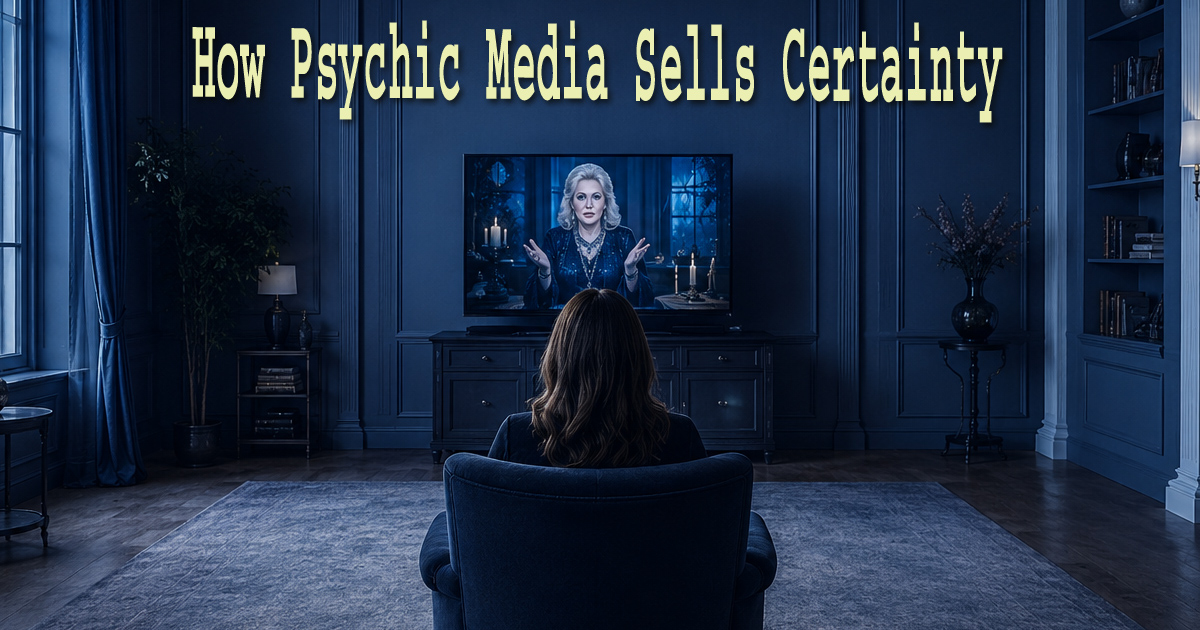
How Psychic Media Sells Certainty: The screen glows. Someone is waiting.
Turn on any cable channel late at night and the odds are good you will find one. A calm, confident figure sitting across from someone in distress, offering words that seem to arrive from somewhere beyond ordinary knowing. The studio is warm. The music is soft. The audience leans forward. What looks like a spiritual encounter is also, without contradiction, a carefully constructed media product. Understanding how psychic media sells certainty requires looking past the performance and into the machinery that makes it work so reliably on so many people.
This is not a piece about whether psychic ability is real. It is a piece about how television, streaming platforms, and online content have built a thriving industry around the human need to feel less lost. That industry has rules, formulas, and economic incentives. And the audience, more often than not, is not the customer. It is the product.
How Psychic Media Sells Certainty to Uncertain People
The first thing psychic media does well is find its audience at exactly the right moment. Grief, anxiety, relationship breakdown, financial fear. These are not random demographics. They are emotional states that make people unusually receptive to the promise of clarity. Psychic media does not create vulnerability. It locates it, and then it speaks directly to it with a fluency that feels, to the person watching, like being understood for the first time in a long while.
The Emotional Climate That Makes Audiences Vulnerable

How Psychic Media Sells Certainty: She stopped asking questions here.
Psychologists have long documented what happens to critical thinking under conditions of high emotional stress. It narrows. The mind becomes less interested in evaluating evidence and more interested in finding relief. Psychic media is formatted to meet people in that narrowed state. The pacing is slow and reassuring. The language is warm and inclusive. The presenter never challenges the audience. They validate it.
This is not manipulation in the crude sense. It is design. Every element of a psychic media production, from the set dressing to the camera angles to the music that swells beneath a tearful reunion, is chosen to lower resistance and raise emotional temperature simultaneously. The result is a viewing experience that feels deeply personal even when it is being broadcast to millions.
Also Read Clairvoyant Visions Exposing Shocking Misleading Claims
Why Uncertainty Is the Product’s Best Friend
Certainty, genuinely delivered, would actually destroy the format. If a psychic medium told a grieving widow exactly where her husband’s will was hidden, named the lawyer, gave the address, and turned out to be correct, the show would have nowhere left to go. The format depends on uncertainty remaining just present enough to keep the audience hoping, while certainty is dangled close enough to keep them watching.
This is the central tension that how psychic media sells certainty exploits so effectively. The promise is resolution. The product is the journey toward it. As long as the audience believes resolution is one more episode away, the format survives. The uncertainty is not a flaw in the product. It is the engine.
The first dedicated psychic telephone hotline service in the United States launched in 1990 and generated an estimated 700 million dollars in revenue within its first four years of operation before the FTC intervened with regulation in 1995.
The Mechanics Behind the Message
Strip away the emotional atmosphere and what remains is a set of repeatable techniques that any media critic would recognize across genres. Psychic media did not invent these techniques. It inherited them from talk shows, reality television, and tabloid journalism, and then refined them for a specific audience with a specific need.
Language Designed to Sound Like Proof
Watch any successful psychic media program with the sound on but your eyes closed and pay attention to the sentence structures being used. You will notice a pattern. Statements are delivered with the confidence of facts but constructed with the flexibility of guesses. “I’m getting a sense of someone with a name beginning with M.” “There’s an energy here connected to water.” “Does the number seven mean anything to you?”
These constructions are not accidental. They are optimized for what researchers call the Barnum effect, the well-documented tendency of people to accept vague, general statements as uniquely personal and accurate. The language sounds specific because it is delivered with conviction. But its actual information content is low enough to fit almost anyone sitting in that studio chair. The audience hears precision. The format delivers probability.
The Edit That Removes Every Miss

Psychic Media Format Design: Every miss ends up on the floor.
What viewers see on screen is not a reading. It is a version of a reading that has been through an editing suite. Misses, long silences, confused responses, flat rejections, and moments where the subject clearly signals that nothing is landing, these do not make the final cut. What remains is a highlight reel assembled to support a single narrative. The practitioner knows things they could not otherwise know.
This is not unique to psychic media. Reality television operates on the same principle. But in psychic media the edit carries a heavier burden because the claims being made are presented as factual rather than entertaining. The viewer at home has no way of knowing how long the session ran, how many attempts preceded the one they are watching, or how many subjects were filmed before one who responded well was selected for broadcast.
How Psychic Media Sells Certainty Through Personality and Trust
Technique alone does not explain the loyalty psychic media commands. The format works as well as it does because it wraps its mechanics in something that feels genuinely human. Warmth. Empathy. The apparent willingness to sit with someone in their pain without flinching. These qualities are real in many practitioners and they are also, in a media context, extremely effective tools for building the kind of trust that suspends critical evaluation.
The Host, the Expert, and the Believer
Most successful psychic media productions use a three-part social architecture that will be familiar to anyone who has studied persuasion. There is a host or presenter who represents the neutral, curious everyperson. There is the psychic practitioner who carries the authority of specialized knowledge. And there is the subject, the ordinary person whose emotional journey the audience is invited to share.
This triangle is enormously effective because it gives every viewer a point of entry. Skeptics can align with the host. Believers can align with the practitioner. Anyone who has experienced loss or uncertainty can align with the subject. The format does not ask the audience to choose a position. It makes all positions feel welcome, which is itself a form of persuasion.
Uri Geller’s 1973 appearance on The Tonight Show with Johnny Carson was deliberately set up by Carson, a former amateur magician, who supplied his own props to prevent preparation, resulting in Geller failing to demonstrate any abilities during the broadcast.
When the Format Becomes the Argument
Over time, repeated exposure to a media format produces something researchers call parasocial familiarity. The audience begins to feel they know the personalities involved. They trust them not because they have evaluated their claims but because they have spent hours in their company. At this point the format itself has become the argument for its own credibility.
This is where how psychic media sells certainty operates at its most sophisticated level. The viewer is no longer weighing evidence. They are maintaining a relationship. And relationships, as any media strategist will tell you, are far more durable than arguments. A person can be talked out of a belief. They are much harder to talk out of a loyalty.
What the Audience Gets and What It Costs Them
It would be dishonest to frame this purely as exploitation. Many people who consume psychic media report genuine comfort, reduced grief, and a restored sense of meaning following the experience. Those outcomes are real. The question worth sitting with is not whether the comfort is genuine but whether the means of delivering it are as honest as they appear, and what the audience gives up in exchange for the relief it receives.
The Comfort of Feeling Known
At its best, psychic media offers something that secular culture often fails to provide. A framework for loss that does not end with absence. The idea that the people we have loved and lost are not simply gone but present in some form, aware of us, and capable of communicating care. For a grieving parent, a widowed spouse, or someone estranged from a person who died before reconciliation was possible, that framework is not trivial. It can be genuinely healing.
The comfort is real. What produces it is a more complicated question. Whether the comfort comes from an actual connection with the deceased or from a skilled media format designed to create that impression, the emotional relief experienced by the viewer lands in the same place. Psychic media understands this, and it uses that understanding to build an audience that returns not because it has been convinced but because it has been comforted.
The Miss Cleo campaign, one of the most recognized psychic media operations in American television history, employed hundreds of paid actors reading from scripts and was the subject of a 500 million dollar FTC complaint filed in 2002.
The Price of Borrowed Certainty
The Price of Borrowed Certainty: The answer was never in there.
The cost is harder to see but it is there. An audience that outsources its need for certainty to a media product becomes, over time, less practiced at sitting with uncertainty on its own terms. The appetite for resolution grows. The tolerance for ambiguity shrinks. And the media product, which depends on that appetite remaining strong, has every incentive to feed it rather than reduce it.
How psychic media sells certainty is ultimately a story about a very old human need meeting a very modern delivery system. The need to know that things mean something. That loss is not final. That someone, somewhere, can see what we cannot. Those needs are not weaknesses. They are part of what it means to be human. The question each viewer must eventually answer for themselves is whether the certainty being sold to them is worth the price printed on the other side of the ticket.
Further Reading & Resources
📖 Read: Miss Cleo: How a TV Reporter Uncovered Psychic Scam

Known as The Man Who Notices, Mike Lamp is a theatrical hypnotist and psychic performer with more than twenty years of live stage experience. His work emphasizes observation, psychological influence, and measured presentation rather than spectacle or provocation. Performances are tailored for adult audiences, private events, and professional settings where control, clarity, and atmosphere matter.


Leave a Reply
You must be logged in to post a comment.