28
Mar
Gemini Symbolism Meaning: Bold Air Sign Insights
Gemini Symbolism Meaning
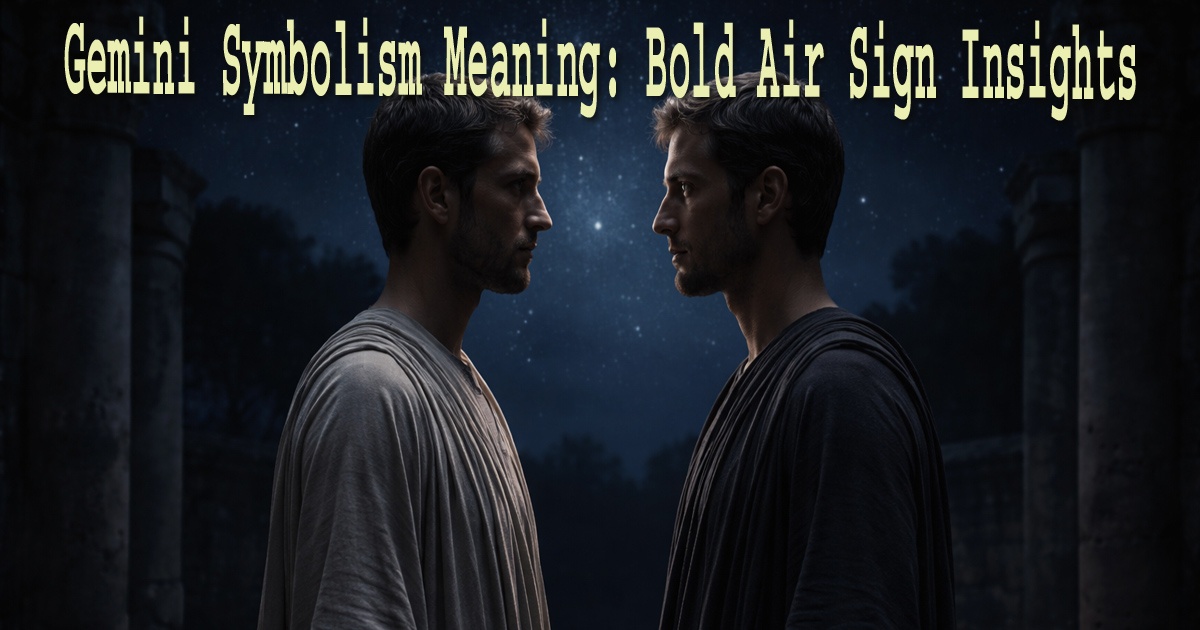
The twin figures at the heart of Gemini symbolism represent duality, identity, and the passage of meaning between two points of consciousness.
The Twins and There Place
The sign of Gemini has occupied a central position in symbolic traditions for centuries, carrying layered meanings that extend well beyond simple personality sketches. Gemini symbolism encompasses a rich framework of ideas about identity, duality, communication, and the nature of the mind itself. To engage seriously with this subject is to enter a world of metaphysical thinking that treats the zodiac not as a calendar curiosity but as a map of consciousness and cosmic structure.
Read about Zodiac Meaning Explained: Clear Guide to Symbolism in our Exclusive Article
What the Twins Represent
The image of the Twins is among the most immediately recognized symbols in the zodiac, and it anchors Gemini symbolism in a way that sets this sign apart from nearly all others. The classical identification is with Castor and Pollux, the Dioscuri of Greek and Roman tradition, one of whom was mortal and one immortal. Their story made the duality of Gemini explicit in mythological terms: the tension between the perishable and the enduring held within a single symbolic pairing.
Where most signs are depicted by a single creature or object, Gemini presents two figures in relationship, side by side. This pairing is not incidental. Within metaphysical frameworks, the two figures represent the fundamental split at the heart of conscious experience: the self and its reflection, the known and the unknowable, the interior life and its outward expression.
Some traditions understand the Twins as two aspects of a single soul, perpetually in dialogue. Others read them as the tension between the mortal and the immortal self, a duality that generates awareness rather than simply describing personality. Gemini symbolism, in this reading, is less about double-mindedness as a flaw and more about the generative power of holding two perspectives simultaneously.
The constellation Gemini was used by ancient Phoenician sailors as a navigational reference, and the two brightest stars, Castor and Pollux, were called the twin stars of the sea, believed to protect ships from storm.
The Air Element and Its Metaphysical Significance
Air sign symbolism across the zodiac carries a consistent set of associations with thought, breath, transmission, and the invisible structures that connect one thing to another. In the case of Gemini, these associations take on a particular character. Air here is not the sweeping philosophical Air of Aquarius or the refined relational Air of Libra.
The Air element meaning in Gemini is closer to breath in its most immediate sense: quick, responsive, present in the moment, moving between objects and ideas without fixing on any single one for long. Gemini energy traits in the metaphysical sense are inseparable from this elemental quality. The sign is understood as a conduit rather than a container, a means of transmission rather than a vessel of accumulation. In older cosmological frameworks, this positioned Gemini as a sign associated with the passage of information between realms, between the divine and the human, between the individual mind and the collective understanding.

The restless movement of wind and open sky reflects the core Gemini symbolism of the Air element as a force of transmission rather than containment.
Gemini as Archetypal Messenger
The Gemini archetype has long been connected to the figure of the messenger in world mythological traditions. Mercury, the Roman deity associated with Gemini, was the messenger of the gods and the guide of souls, a figure who could pass freely between the celestial, terrestrial, and underworld realms. He was unique among the Olympians in holding this triple passage, carrying communications not only between gods and mortals but escorting the dead to the underworld as well.
This mythological alignment is not accidental within metaphysical belief systems. Gemini symbolism carries within it the idea that some entities exist precisely to move between defined categories, to translate, to carry meaning across a threshold. This is not a secondary function but a primary cosmic role. Zodiac symbolism Gemini centers on this translating capacity, suggesting that the sign represents a principle of mediation fundamental to how the cosmos organizes and communicates its own structure. Where other signs are understood as forces that build, preserve, or transform, Gemini is the force that relays.
Identity, Multiplicity, and the Gemini Self
Gemini identity symbolism raises questions about the nature of selfhood that connect directly to broader metaphysical concerns about consciousness and individuality. If the self is always in conversation with an other, even if that other is simply another version of itself, then identity is understood as dynamic rather than static, relational rather than singular. Gemini metaphysical meaning in this context points toward a model of consciousness that is fundamentally plural.
The self, from this vantage point, is not a fixed point but a moving relationship between possibilities. This is not instability in the negative sense; it is a recognition that awareness requires contrast, that knowing anything involves knowing it in relation to something else. Gemini energy traits reflect this orientation toward contrast and comparison, toward the generation of meaning through juxtaposition rather than through isolation.
In Babylonian astronomical records predating Greek zodiacal codification, the constellation now identified as Gemini was referred to as the Great Twins and associated with the minor gods Meshlamtaea and Lugalirra, deities of the underworld entrance rather than sky messengers.
Gemini Spiritual Meaning Across Traditions
Gemini spiritual meaning has been interpreted differently across the many traditions that have engaged seriously with zodiacal symbolism, but certain themes recur with notable consistency. The sign appears in connection with the idea of the intermediary soul, a concept given its clearest classical expression in the Platonic and Neoplatonic traditions, where the pneumatic or astral body was understood as the vehicle of the soul moving between divine and material existence.
Renaissance Hermetic philosophy, particularly as developed by Marsilio Ficino, preserved and extended this framework, treating Mercury and the Geminian principle as governing the function of translation between orders of being. This is the part of the self understood as a bridge between the material and the immaterial, between the dense physical world and the more refined planes of being. The Gemini metaphysical meaning in this context represents a principle of translation and traversal rather than a fixed identity.
The spiritual meaning of the sign, then, is bound up with movement, with the capacity to exist in more than one register at once without being dissolved by the contradiction. Several esoteric systems have treated this as an advanced spiritual function rather than a beginner’s quality, suggesting that the capacity to hold duality without collapsing it into false unity is a mark of genuine understanding rather than mere confusion.

The twin figures of Gemini symbolism appeared in manuscript traditions long before modern horoscope culture reduced them to personality types.
The Role of Gemini in Cosmological Structure
Within the broader structure of zodiacal cosmology, Gemini occupies a position that carries structural as well as symbolic significance. As the third sign of the zodiac, it follows Aries, which represents the initial impulse of being, and Taurus, which represents the consolidation of substance and form. Gemini then marks the emergence of discriminating intelligence, the first point at which the individual mind distinguishes itself from raw experience and begins to categorize, name, and communicate what it perceives.
In classical terms this corresponds to the rational faculty awakening within the soul. Zodiac symbolism Gemini situates the sign at this precise threshold, the point at which interior awareness becomes relational awareness. This placement reinforces the archetype of the Twins as a symbol of emergence into complexity rather than retreat from it. Gemini metaphysical meaning at this structural level suggests that the sign represents the birth of communication itself within the cosmological sequence, the moment at which being becomes capable of speaking and of listening.
The Roman practice of invoking Castor and Pollux before battle was so embedded in military culture that their temple in the Forum Romanum served as the official place where the Roman Senate certified the weights and measures used in trade.
Language, Thought, and the Gemini Principle

The threshold between two distinct states is one of the oldest visual expressions of Gemini symbolism and the sign’s role as cosmic mediator.
It would be difficult to discuss Gemini energy traits without addressing the central role that language and thought play in the sign’s symbolic profile. Within most metaphysical frameworks that engage with zodiacal symbolism, Gemini is associated not merely with talking but with the underlying cognitive faculty that makes language possible: the capacity to move rapidly between categories, to see analogies, to notice that one thing resembles another in a way that generates new understanding.
Air sign symbolism in Gemini’s case is thus closely tied to the idea of the mind as a field of swift connections rather than a repository of stored conclusions. This has implications for how Gemini symbolism is understood as a spiritual principle. The sign is not about the accumulation of wisdom so much as the movement of insight, the spark that passes between two points and illuminates both in the process.
Editor’s Reflection
What draws people back to Gemini symbolism, generation after generation, is probably not the personality traits listed in popular horoscopes. It is something quieter and more persistent: the sense that the Twins are pointing at something real about how minds work, how meaning travels, how identity refuses to stay still when examined closely. The sign, in its metaphysical framing, is less a description of a type of person than a meditation on the nature of consciousness itself, on what it means to know anything at all in a world where knowing always seems to require a second perspective.
The questions Gemini symbolism raises are ones that most people have felt without necessarily having the language for them. Is the self something that exists before it enters into relationship, or does it only take shape in the act of reaching toward something else? When two apparently contradictory things are both true at once, is that a problem to be resolved or a condition to be understood? And if the deepest form of intelligence is the ability to move freely between ideas without being captured by any of them, what does that suggest about how we think, how we communicate, and what we are actually doing when we try to make sense of experience?

Known as The Man Who Notices, Mike Lamp is a theatrical hypnotist and psychic performer with more than twenty years of live stage experience. His work emphasizes observation, psychological influence, and measured presentation rather than spectacle or provocation. Performances are tailored for adult audiences, private events, and professional settings where control, clarity, and atmosphere matter.


Leave a Reply
You must be logged in to post a comment.