10
Mar
The Star Tarot Card Meaning: Clear Guide to Powerful Symbolism
The Star Tarot Card Meaning: Bold Guide to Hope

The Star Tarot Card Meaning illustrated through a radiant star reflecting over tranquil water in a nocturnal landscape
What The Star Represents in the Major Arcana
The Star Tarot Card Meaning begins with its position in the Major Arcana, where it appears as card seventeen, placed between The Tower and The Moon. That placement is not incidental. After the upheaval symbolized by The Tower, The Star arrives as a point of stillness and orientation. It does not promise rescue or resolution. It offers something quieter: a fixed point of light in a dark sky, something to navigate by. Understanding this card requires holding that context in mind throughout, because the symbolism draws almost all of its power from contrast, from what came before and what has not yet arrived.
The Major Arcana as a whole traces what many tarot readers describe as a journey through cycles of experience, challenge, and inner development. The Star occupies a particular stretch of that journey, the part that comes after crisis but before clarity is fully established. The Moon and The Sun follow it, and together the three cards form a sequence moving from hope, to confusion, to illumination. Within that sequence, The card anchors the moment of quiet renewal, the pause where exhaustion gives way to something like peace.
Read Major Arcana Secrets: Shocking Dark Origins Revealed Exclusive Article
Visual Symbolism and Card Structure
Most traditional depictions of The Star show a kneeling figure at the edge of water, pouring liquid from two vessels, one onto land and one back into the water. Above the figure, a large eight-pointed star dominates the sky, surrounded by seven smaller stars. Each element carries interpretive weight. The number seventeen reduces numerologically to eight, connecting the card to themes of balance and cyclical movement. Eight is also the number of The Star in some older deck traditions, and its association with cycles of time and return reinforces the card’s core suggestion that renewal is not a singular event but a recurring possibility.
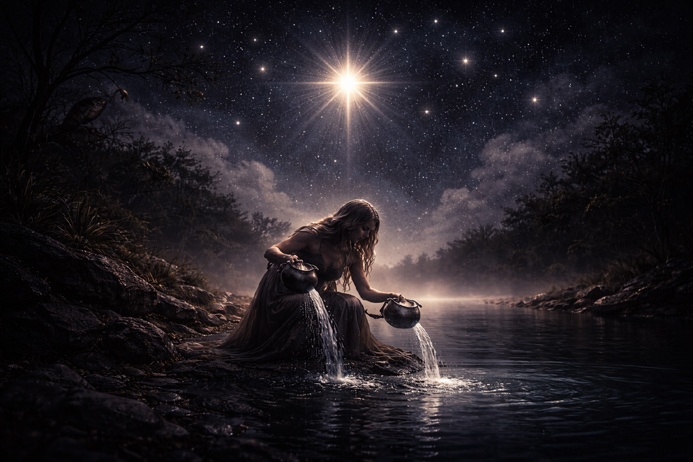
The Star Tarot Card Meaning takes visual form in the balanced act of pouring, one vessel returned to water, one given to earth, beneath a dominant eight-pointed star.
The two vessels and the act of pouring reflect a dual quality central to The Star Tarot Card Meaning: something is being given outward and something is being returned, simultaneously. This is not a card of passive reception. The figure is active, engaged, and present, but the action is gentle rather than forceful. The eight points of the central star are significant within the deck’s own symbolic language, eight being a number associated in Western esoteric tradition with Venus and with cycles of return. The surrounding seven stars are commonly read as representing the seven classical planets, suggesting that the card places the figure at the center of a complete cosmic order, briefly made visible and navigable.
The landscape surrounding the figure is open and calm. A bird, frequently an ibis, perches in a tree nearby. In Egyptian symbolism the ibis is associated with Thoth, the god of wisdom and writing, a connection Waite was almost certainly aware of when the Rider-Waite deck was designed. Its presence suggests that what is being renewed here includes understanding, not only emotional recovery but a return to clearer perception. The sky is clear. There is no storm, no crowd, no visible threat. This visual quietness is deliberate, and it supports The Star Tarot Card Meaning as a card of recovery and restoration rather than triumph or achievement.
The Star card appeared in the earliest known tarot decks produced in northern Italy during the fifteenth century, where it was depicted without a human figure, showing only a large star or cluster of stars against an open sky, a composition that persisted in several regional traditions well into the sixteenth century.
The Star Upright Meaning
The Star upright meaning centers on renewal, clarity, and a return to trust after difficulty. When this card appears in a reading in its upright position, it typically signals a period of healing, a time when things feel more open and manageable than they did before. It is not a dramatic card. It does not announce great victories or sudden reversals of fortune. Instead, it suggests a quieting of the noise that surrounds difficult periods, and a gradual return to equilibrium.
The Star upright meaning also carries themes of inspiration and purpose. The figure pouring water is often read as an act of generosity, giving freely without calculation. One foot rests on land, one knee touches the water, a posture that traditional readers interpret as the figure standing between the conscious and unconscious realms simultaneously, fully present in both without being consumed by either. The card in this orientation can reflect a period when a person feels connected to something larger than immediate circumstance. That sense of connection is not described in mystical terms within traditional tarot interpretation. It is more accurately described as a restored sense of direction, the experience of feeling oriented again after a period of disorientation.
Hope is frequently associated with this card in its upright position, but that association is worth examining carefully. Waite himself described The Star as the card of hope in his writings, yet he was careful to ground that hope in the imagery of active replenishment rather than passive wishing. The distinction matters in practice. The hope reflected here is not wishful thinking or avoidance of difficulty.
It is the specific kind of hope that comes from having moved through something hard and arrived at a clearer place. The Star Tarot Card Meaning, read upright, is the experience of someone who has not been spared difficulty but has found a way through it, and now stands in a moment of genuine openness.
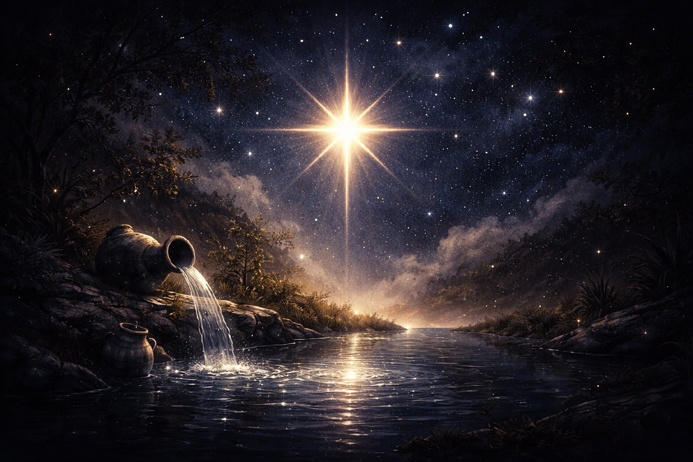
The Star Tarot Card Meaning symbolized by a radiant star reflecting over peaceful waters at night
The Star Reversed Meaning
The Star reversed meaning shifts the card’s energy considerably, though not into its opposite. A reversed Star does not represent despair or catastrophe. It more often reflects a block in the qualities the upright card describes, an inability to access that sense of renewal, a difficulty trusting the possibility of recovery, or a disconnection from one’s own sense of purpose and direction.
The Star reversed meaning can also point to discouragement that has hardened into something more resistant. Where the upright card suggests openness, the reversal can indicate a kind of closing off, a protective withdrawal that, while understandable, prevents the renewal the card otherwise represents. In practice, readers often encounter this reversal when the questioner is struggling to believe that circumstances can genuinely improve, or when past difficulty has made optimism feel naive or dangerous.
There is also a reading of The Star reversed meaning that relates to self-neglect, and this is among the more practically useful interpretations the reversal offers. The pouring figure in the upright card maintains a cycle that sustains itself. In reversal, a reader might ask whether the person in the reading has access to any genuine source of replenishment at all, or whether the conditions for restoration are simply not yet present in their circumstances.
The pouring figure in the upright card is giving outward, but the card also implies a replenishment, a cycle that sustains rather than depletes. In reversal, that cycle can be interrupted. A person may be pouring outward without receiving, giving without restoration, or simply running on less than what is needed for genuine recovery.
Arthur Edward Waite’s written commentary on The Star in The Pictorial Key to the Tarot, published in 1911, identified the large central star as having eight rays specifically to distinguish it from the six-pointed star used elsewhere in the deck, a deliberate structural decision intended to mark the card as carrying its own distinct symbolic register.
The Star Tarot Card Meaning in Different Reading Contexts
Context shapes how any tarot card is interpreted, and The Star Tarot Card Meaning is no exception. In a reading focused on relationships, the card upright may suggest a period of healing between people, a recovery of trust, or the emergence of a connection characterized by honesty and mutual care. It does not predict specific outcomes, and readers who treat it as a promise of resolution tend to miss what the card is actually offering, which is a quality of inner availability rather than an external guarantee. It reflects a quality of energy or circumstance that a reader can work with interpretively.
In a reading focused on work or creative endeavors, The Star often signals that the conditions for meaningful effort are present, not necessarily that success is guaranteed, but that the internal state needed for good work is available. Inspiration, patience, and a sense of purpose are all qualities the card can reflect in this context.
When The Star appears alongside cards that carry heavier or more conflicted energy, its meaning adjusts accordingly. It may function as a moderating presence, a reminder that difficulty is not permanent, or it may appear as a contrast that highlights tension between the questioner’s current experience and what is genuinely possible. Tarot card archetypes do not operate in isolation. Their meanings are relational, shaped by what surrounds them in a spread. The Star appearing beside The Moon, for instance, shifts considerably in tone, the hope it carries complicated by the uncertainty and potential self-deception The Moon introduces. Readers attentive to these relational dynamics tend to find the cards more precise and less generic in their application.
Placement within a spread also matters. The Star appearing in a position representing the past suggests that a period of restoration has already occurred and may be informing present circumstances. In a position representing potential or outcome, it points toward a quality of experience that remains available but has not yet been fully entered into.
Major Arcana Symbolism and the Spiritual Journey in Tarot
The spiritual journey in tarot is not a metaphor for literal travel or a prescription for specific beliefs. It is the structure the Major Arcana provides for thinking about cycles of experience and what they require of a person. The Star’s place in that structure reflects a specific and recognizable human experience: the moment after things have broken open, when the immediate crisis has passed but the future remains uncertain, and what is available is not resolution but a kind of steadiness.
Within the Major Arcana sequence, The Star Tarot Card Meaning is defined by its position as a fixed point of orientation between upheaval and the deeper uncertainty that follows.
Major Arcana symbolism throughout the deck tends to work this way, grounding large human experiences in visual and structural language that a reader can apply interpretively without requiring a shared philosophical framework. The Star, in this respect, is one of the more accessible cards. Its imagery is direct. Its position in the sequence is clear. And The Star Tarot Card Meaning, whether upright or reversed, maps onto experiences that most people recognize, the felt difference between feeling lost and feeling found, between being closed and being open, between exhaustion and the first signs of restoration.
In the Thoth Tarot designed by Aleister Crowley and painted by Lady Frieda Harris, The Star was retitled The Star and assigned the Hebrew letter Heh, whereas Waite assigned it Tzaddi, a difference that generated significant debate among twentieth century esoteric scholars about the correct correspondence between the Major Arcana and the Hebrew alphabet.
Editor’s Reflection
What draws people to The Star Tarot Card Meaning is often less about prediction and more about recognition. There is something in this card that people tend to encounter at a particular kind of moment, not at the height of a crisis, and not after everything has been resolved, but somewhere in the quieter stretch between the two. That quality of in-between steadiness is harder to articulate than triumph or disaster, which may be part of why a card like this one continues to resonate across very different kinds of readers and reading traditions.
It is worth sitting with what The Star Tarot Card Meaning brings up personally, especially in the way it frames hope not as expectation but as orientation. What does it feel like to be genuinely open after a period of difficulty, and how do people recognize that shift when it arrives? Is the kind of restoration this card describes something that happens to a person, or something a person participates in actively, and what, if anything, makes the difference?

Known as The Man Who Notices, Mike Lamp is a theatrical hypnotist and psychic performer with more than twenty years of live stage experience. His work emphasizes observation, psychological influence, and measured presentation rather than spectacle or provocation. Performances are tailored for adult audiences, private events, and professional settings where control, clarity, and atmosphere matter.


Leave a Reply
You must be logged in to post a comment.