3
Mar
The Hermit Tarot Card Meaning: Clear Guide to Powerful Symbolism
The Hermit Tarot Card Meaning: Powerful Truth
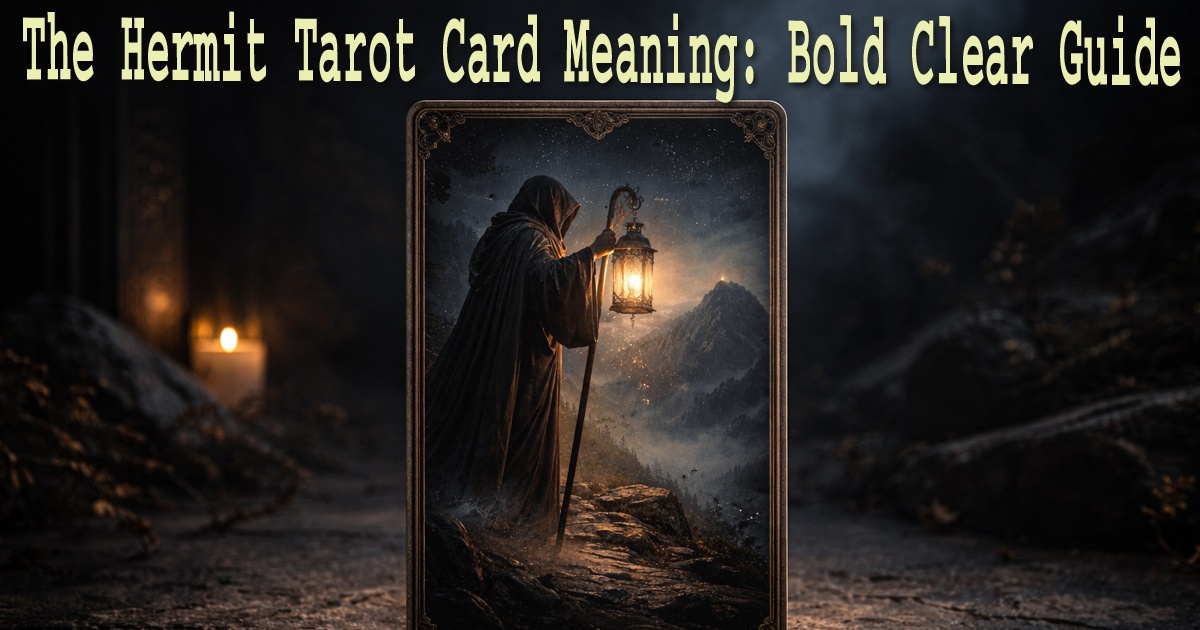
The Hermit Tarot Card Meaning expressed through solitude, inner guidance, and the quiet search for truth
The Hermit Tarot Card Meaning draws on one of the most quietly compelling figures in the entire Major Arcana. Card number nine in the Major Arcana sequence, following Strength as card eight in the Rider-Waite ordering, though some earlier decks such as the Tarot de Marseille place Justice at eight and Strength at eleven, reversing the two the Hermit stands apart from the more dramatic archetypes that surround him. There are no thrones, no celestial bodies, no pairs of figures locked in struggle or reunion. There is only a solitary robed elder on a mountain path, lantern raised, staff in hand, moving forward at his own pace. That simplicity is not a lack of content. It is the content.
The image most readers encounter comes through the Rider-Waite-Smith deck, published in 1910 under the direction of Arthur Edward Waite and illustrated by Pamela Colman Smith. In that version, the Hermit carries a six-pointed lantern housing a single lit star, often identified as the Seal of Solomon, a six-pointed star associated with wisdom and the integration of opposing forces, which in this context suggests the Hermit carries not borrowed light but hard-won inner knowing. His grey robes suggest neither poverty nor wealth. The mountain peak beneath his feet implies elevation already achieved rather than a summit still sought. The Hermit Tarot Card Meaning is rooted in these visual choices, and understanding the symbolism is essential to understanding the card.
The Lantern and the Staff

The Hermit Tarot Card Meaning carried in two simple objects, a lantern for discernment and a staff for endurance
The lantern the Hermit carries does not flood the landscape with light. It illuminates a small, immediate radius. This is deliberate. The Hermit Tarot Card Meaning is not about grand revelation or sudden enlightenment delivered from above. It is about the kind of knowing that comes from moving carefully, step by step, with just enough light to see the next portion of the path. The lantern points downward and forward, suggesting practical application of inner wisdom rather than abstract contemplation.
The staff serves a different purpose. In many traditions, a staff carried by a traveler indicates authority, experience, and the ability to navigate difficult terrain. The Hermit leans on his slightly, which speaks to endurance over time rather than effortless mastery. The Hermit Tarot Card Meaning encompasses both elements together: the light of discernment and the grounded steadiness required to keep walking.
The Mountain Setting
Height in tarot symbolism often indicates perspective, achievement, or the distance from ordinary concerns that comes with sustained effort. The Hermit has climbed. He is not at the base looking upward. Yet he is still moving, still carrying his light, still engaged with the journey. This matters because The Hermit Tarot Card Meaning is frequently misread as purely passive or withdrawn. The card does not show a figure sitting in a cave or refusing the world. It shows someone in motion, even if that motion is slow and deliberate.
The cold grey tones of many traditional renderings of this card reinforce a sense of stillness and austerity, but they are not meant to suggest desolation. A mountain in winter is not barren of meaning. It is simply stripped of distraction.
The earliest known tarot decks produced in northern Italy during the mid-fifteenth century did not include a figure recognizable as the Hermit in the modern sense. The card in those early decks, sometimes called Il Vecchio, meaning the old man, carried an hourglass rather than a lantern, shifting its symbolic emphasis toward time and mortality rather than inner guidance.
The Hermit Upright Meaning
When the card appears in the upright position, the interpretive emphasis falls on voluntary solitude, inner searching, and the earned authority of self-knowledge. The Hermit upright meaning suggests a period of drawing inward, not because the outer world has become hostile, but because something internal requires attention. There is often a sense that answers are not available through consultation with others this time. The searching must be personal.
The Hermit Tarot Card Meaning in its upright form also carries a quietly instructive dimension. The figure with the lantern in traditional imagery is sometimes associated with the role of the guide who has walked a path and now carries the light back to illuminate it for others. This is not the loud teaching of the Hierophant. It is the quiet presence of someone who has something worth knowing and offers it without performance.
In practical readings, the upright Hermit frequently appears around periods of introspection, voluntary withdrawal from social activity, careful deliberation before a decision, or a recognition that certain questions cannot be answered by anyone else. The Hermit Tarot Card Meaning here is not avoidance. It is focused inward attention, applied purposefully.

The Hermit Tarot Card Meaning expressed through quiet solitude and the guiding lantern along a mystical path
The Hermit Reversed Meaning
The Hermit reversed meaning shifts the central themes toward their more difficult expressions. Where the upright card suggests healthy solitude, the reversed position can point to isolation that has become entrenched rather than chosen. The withdrawal is no longer purposeful. It has calcified into avoidance. The lantern is still there, but it is no longer being raised.
The Hermit Tarot Card Meaning in reversal can also suggest the opposite problem: an unwillingness to spend any time with one’s own thoughts. Some readers interpret the reversed Hermit as an indicator of someone who fills every quiet moment with noise and distraction because genuine self-examination feels threatening. Both readings, the excessive withdrawal and the avoidance of inner life, describe a disrupted relationship with solitude and personal reflection.
There is sometimes a social component to the reversal as well. The Hermit reversed meaning may indicate that a person has retreated from community to a degree that is beginning to cause harm, whether through loneliness, rigidity of viewpoint, or the kind of bitterness that can grow when a person stops engaging with other perspectives entirely.
Etteilla, the French occultist who produced the first tarot deck designed explicitly for divination in 1789, assigned the Hermit a meaning centered on treason and deception rather than solitude or wisdom, a departure so significant that later readers largely abandoned his interpretive framework in favor of the more contemplative readings that followed.
Major Arcana Symbolism and the Card’s Position
The Major Arcana functions as a structured sequence describing broad phases and forces in human experience. The Hermit’s placement at card nine puts him past the midpoint of the first decade, after the more externally oriented cards of the Chariot and Strength. The Hermit Tarot Card Meaning reflects that positioning. By the time the journey reaches the Hermit, the outer battles have been fought and something more inward is required.
Tarot card archetypes in the Major Arcana tend to build on one another without being strictly linear, but there is a general movement from outer circumstance toward inner development in the middle cards of the sequence. The Hermit occupies a pivotal place in that movement. He is not the first introspective figure in the sequence, but he is perhaps the most explicitly concerned with looking inward as a sustained practice rather than a passing state.
Spiritual Journey in Tarot

The Hermit Tarot Card Meaning lives in the path itself, narrow, cold, and walked one deliberate step at a time
The concept of a spiritual journey in tarot is embedded in the broader structure of the Major Arcana, and the Hermit is one of its clearest expressions. He does not represent a destination. He represents the practice of the journey itself, the willingness to keep moving even in cold and quiet, to trust what the lantern shows without demanding that it show more. The Hermit Tarot Card Meaning here connects to the older traditions of pilgrimage and contemplative withdrawal that predate tarot by centuries.
Some readers connect the Hermit symbolically to figures such as Diogenes, the Desert Fathers, or the wandering sages of Eastern tradition, each of whom retreated from ordinary life to develop understanding that could not be gained any other way. Waite was deeply familiar with these currents, and the card reflects that awareness. That is not the same as saying the card endorses permanent withdrawal. It is saying that certain kinds of knowing require a particular quality of attention, and that attention is difficult to sustain when surrounded by constant demand.
The Hermit Tarot Card Meaning, taken as a whole, rewards the reader who is willing to sit with it rather than extract a quick answer. The card is itself a small model of what it describes: slow, deliberate, illuminating within a limited but meaningful radius.
The grey robes worn by the Hermit in the Rider-Waite-Smith deck were a conscious departure from earlier colorful renderings. Pamela Colman Smith used grey throughout the deck to indicate figures who exist outside conventional social structures, a design principle she applied consistently but rarely discussed in any surviving correspondence.
Editor’s Reflection
What stays with most people who spend time with this card is not its strangeness but its familiarity. The image of someone walking alone in the cold with only a small lamp to guide them is not exotic or remote. It is recognizable in a way that most Major Arcana figures are not. The Hermit Tarot Card Meaning returns to something quietly human: the moments when outside counsel stops being useful and the only honest next step is to sit with one’s own thoughts and see what is actually there.
For anyone who has encountered this card in a reading, or simply found themselves drawn to its image, The Hermit Tarot Card Meaning raises questions worth considering. What does genuine solitude feel like as distinct from loneliness, and is that distinction easy to hold in practice? When the lantern only lights a small path ahead, is that limitation a frustration or a kind of relief? And how much of what feels like withdrawal is actually a necessary part of figuring something out?

Known as The Man Who Notices, Mike Lamp is a theatrical hypnotist and psychic performer with more than twenty years of live stage experience. His work emphasizes observation, psychological influence, and measured presentation rather than spectacle or provocation. Performances are tailored for adult audiences, private events, and professional settings where control, clarity, and atmosphere matter.



Leave a Reply
You must be logged in to post a comment.