24
Jan
Symbols Change Meaning Over Time: Powerful Truth
Why Symbols Change Meaning Across Cultures and Eras

A collection of symbols demonstrates how symbols change meaning as they travel across cultures, eras, and political movements.
Symbols change meaning as societies evolve, borders shift, and cultural values transform. A mark etched into stone five thousand years ago may have signified protection or divinity. The same mark, reproduced in a different century or continent, can carry associations its creators never imagined. This transformation happens not through deliberate rebranding but through the accumulated weight of historical events, political movements, and the quiet drift of collective memory.
The process through which symbols change meaning is rarely sudden. A symbol used in religious ceremony may begin appearing in secular art. Over generations, its sacred origins fade from common knowledge. What remains is the visual form, now attached to meanings shaped by whoever encountered it most recently. The original intent becomes a footnote, accessible only to scholars or those with direct cultural ties to the source.
Geography plays a role as well. A symbol venerated in one region may be unknown or misunderstood elsewhere. When cultures collide through trade, conquest, or migration, symbols travel without their full context. The receiving culture assigns meaning based on its own frameworks, creating interpretations that diverge sharply from the original.
Read Symbolic Meaning and the Hidden Structure of Belief Exclusive Article
The Psychology Behind Shifting Symbolism
Human beings process symbols through association. The brain links visual forms to emotions, memories, and cultural narratives learned over a lifetime. These associations are not fixed. They change as new experiences layer over old ones, as dominant narratives shift, and as societies reinterpret their own histories.
A symbol’s meaning depends heavily on the context in which it appears. The same image placed in a museum, a political rally, or a piece of commercial advertising will trigger different responses. Context provides the framework through which viewers interpret intent. When context shifts, so does meaning.
Repetition strengthens symbolic associations. A mark seen repeatedly in a particular setting on flags, in propaganda, in religious texts becomes inseparable from that setting in the public mind. Even if the symbol predates its current usage by centuries, the newer association can eclipse older ones simply through visibility and frequency.
Emotional charge also plays a role. Symbols linked to trauma, triumph, or transformation carry weight that neutral images do not. This emotional resonance makes certain symbols particularly vulnerable to reinterpretation. A society that experiences collective trauma may permanently alter its relationship to symbols present during that period, regardless of their prior meanings.
The eye of Horus, used in ancient Egypt as a protective symbol, was later adopted by American conspiracy theorists as evidence of secret societies, demonstrating complete inversion of meaning across millennia.
Historical Examples: From Sacred to Profane
The history of symbolic transformation is rich with examples. Consider the pentagram, a five-pointed star used in ancient Greece to represent mathematical harmony and later adopted by early Christians as a symbol of the five wounds of Christ. By the nineteenth century, occultists had claimed it as a sign of esoteric knowledge. In the twentieth century, it became associated with modern witchcraft and neopaganism. Each era saw the same geometric form but attached entirely different meanings to it, demonstrating how symbols change meaning across cultural boundaries. The reasons symbols change meaning include shifting religious landscapes, the rise and fall of intellectual movements, and the human tendency to claim existing forms for new purposes.
The ouroboros a serpent eating its own tail originated in ancient Egypt as a symbol of cyclicality and renewal. Greek alchemists adopted it to represent the unity of matter and spirit. Carl Jung later interpreted it as an archetype of individuation and the self. Today it appears in contexts ranging from fantasy literature to corporate logos. The image persists, but its significance has been rewritten by each culture that encountered it. When symbols change meaning through such transformations, they carry traces of every interpretation, creating a layered history visible only to those who study their evolution.
The ankh, an ancient Egyptian hieroglyph representing life, was absorbed into Coptic Christianity as a variation of the cross. Twentieth-century counterculture movements then adopted it as a symbol of spiritual seeking outside mainstream religion. Each appropriation added new layers of meaning while distancing the symbol further from its original use.
How Political Movements Redefine Visual Language
Political movements understand the power of symbols and frequently repurpose them to serve ideological goals. A symbol with deep historical roots can be stripped of context and redeployed to evoke entirely different emotions. This process is deliberate. Movements select symbols that carry existing emotional weight, then flood public spaces with new associations until the original meaning becomes secondary or forgotten.
Totalitarian regimes have historically excelled at this practice. They appropriate ancient or religious symbols, saturate propaganda with them, and enforce their revised meanings through state power. Within a generation, citizens may know only the state-sanctioned interpretation. The original context survives only in academic texts or underground resistance.
Revolutionary movements employ similar tactics but with different aims. They reclaim symbols previously used to oppress or marginalize, inverting their meaning as an act of defiance. A symbol once wielded by authority becomes a rallying point for those challenging that authority. This inversion can be so complete that the symbol’s earlier associations become difficult to recover.
Nationalist movements often reach into pre-modern history to find symbols they can present as expressions of ethnic or cultural continuity. These symbols may have had entirely different meanings in their original contexts, but nationalist narratives reshape them to serve contemporary political projects. The gap between historical fact and political mythology widens with each retelling.
The peace symbol, designed in 1958 for nuclear disarmament campaigns by combining semaphore letters N and D, has been reinterpreted by various subcultures as representing everything from anti-war sentiment to 1960s nostalgia.
When Context Overpowers Original Intent
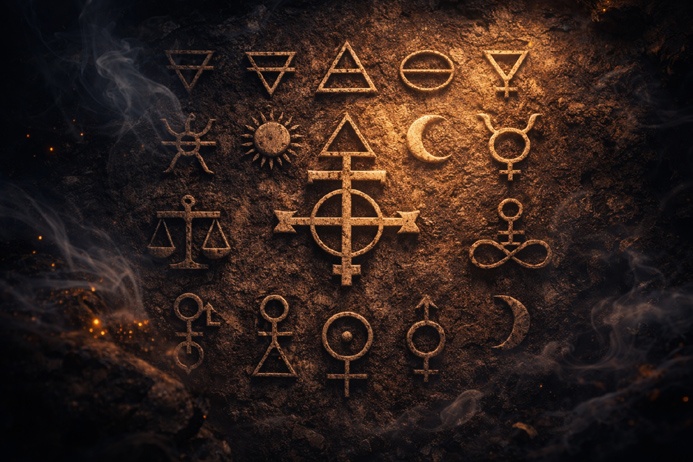
Medieval alchemical notation shows how symbols change meaning when removed from their original context and reduced to decorative elements.
The setting in which a symbol appears often determines how it will be understood, showing how symbols change meaning regardless of what its creators intended. A religious icon removed from a temple and placed in a museum becomes an artifact. The same icon reproduced on commercial merchandise becomes decoration. In each case, the context rewrites the symbol’s function and meaning.
This principle applies across centuries. Medieval alchemical symbols, once guarded as sacred knowledge, now appear in video games and graphic novels as generic markers of magic or mystery. The esoteric systems that gave them meaning have been replaced by visual shorthand designed for quick recognition. Context has reduced complexity to convenience.
Architectural symbols face similar transformations. Ornamental elements created to express religious devotion or civic pride may survive on buildings long after the institutions that commissioned them have vanished. Viewers see the forms but lack the cultural knowledge to interpret them as intended. The symbols become aesthetic rather than communicative.
Digital culture accelerates this process. Symbols circulate globally within hours, detached from explanatory text or cultural context. Users assign meanings based on immediate visual associations or the communities in which they first encounter the images. A symbol that took centuries to develop can be reinterpreted in a matter of weeks.
Why Symbols Change Meaning in the Digital Age
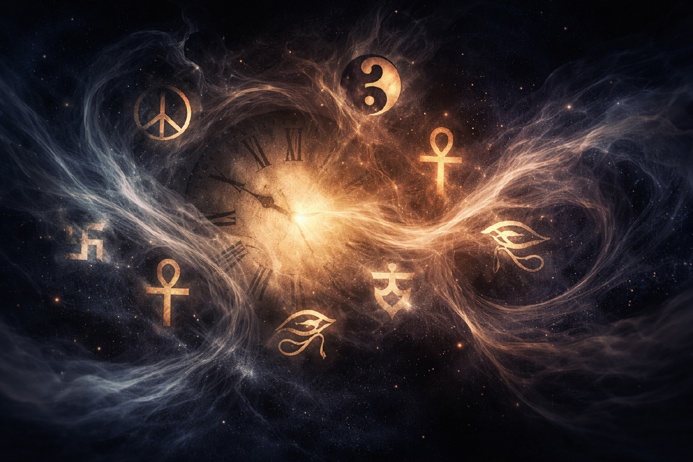
Internet meme iterations illustrate how symbols change meaning rapidly in digital culture through endless remixing and recontextualization.
The internet has fundamentally altered how symbols circulate and evolve. Images that once remained confined to specific geographic or cultural boundaries now travel instantly across the globe. This speed and reach create conditions for rapid semantic drift. A symbol can gain entirely new associations before scholars have documented its original use.
Memes represent an extreme version of this phenomenon. An image or icon is extracted from its source, paired with text, and remixed endlessly. Each iteration adds layers of irony, humor, or commentary. Within months, the symbol’s connection to its origin may be completely severed. Users understand it only through its most recent iterations. Symbols change meaning faster in this environment than in any previous era of human history.
Online subcultures accelerate the process further. Groups adopt symbols as identity markers, flooding their digital spaces with specific interpretations. Outsiders encountering these symbols associate them with the subculture rather than any historical meaning. If the subculture gains visibility, its interpretation can become dominant in the broader culture.
The democratization of symbolic creation also plays a role. Anyone with digital tools can create, modify, and distribute symbols. Traditional gatekeepers religious authorities, academic institutions, cultural elders no longer control symbolic vocabulary. This freedom enables creativity but also enables distortion and appropriation at unprecedented scales.
Japanese family crests called kamon have maintained stable meanings for centuries within Japan while being freely appropriated as decorative elements in Western fashion, creating parallel interpretive tracks for identical visual forms.
Case Study: The Swastika’s Journey Through Time
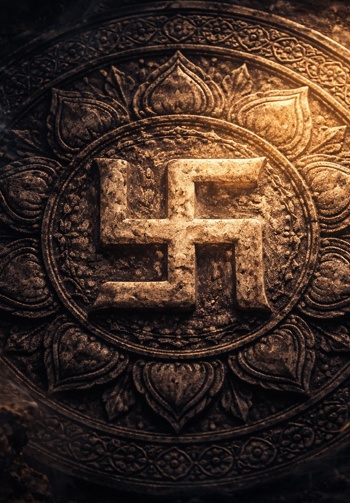
Ancient swastika carving from a Hindu temple demonstrates how symbols change meaning across different cultural and historical contexts.
Few symbols demonstrate the transformation of meaning as starkly as the swastika. For thousands of years, it appeared in Hindu, Buddhist, and Jain traditions as an auspicious symbol representing well-being and good fortune. Archaeological evidence shows its use across ancient Eurasia, from the Indus Valley to pre-Christian Europe, always with positive or neutral connotations.
In the early twentieth century, European occultists and nationalist movements began appropriating the symbol, linking it to theories of Aryan racial superiority. When the Nazi Party adopted it as their emblem in the 1920s, they imposed a singular, toxic meaning that would overshadow millennia of prior use. The swastika became synonymous with genocide, totalitarianism, and hate.
This transformation was so complete in Western consciousness that the symbol’s continued sacred use in Hindu and Buddhist contexts often shocks Western observers unaware of its history. In parts of Asia, the swastika remains visible on temples, religious texts, and street decorations, where it retains its traditional meanings. The same geometric form carries diametrically opposed significance depending on geography and cultural context.
Efforts to reclaim or rehabilitate the symbol in Western contexts have largely failed. The emotional and historical weight of its Nazi associations proves too strong. This case demonstrates how political appropriation, when backed by sufficient violence and propaganda, shows how symbols change meaning so completely that thousands of years of symbolic history can be effectively erased in large portions of the world.
How Symbols Change Meaning Through Appropriation and Reclamation
Appropriation occurs when a dominant culture extracts symbols from a marginalized one, often stripping away context and significance. The symbol becomes aesthetic or exotic, emptied of its original spiritual or cultural weight. This process has accelerated with globalization, as symbols from indigenous and non-Western traditions appear in fashion, entertainment, and commercial branding.
The mechanics are straightforward. A designer or marketer encounters a symbol, finds it visually appealing, and reproduces it without understanding or acknowledging its source. Consumers purchase products bearing the symbol, equally unaware of its origins. Over time, the appropriated symbol becomes associated primarily with the appropriating culture, not the source culture. When symbols change meaning in this way, the shift represents both cultural erasure and economic extraction.
Reclamation operates as a counter-force. Marginalized communities deliberately reclaim symbols that have been used against them, transforming markers of oppression into expressions of pride and resistance. This process requires collective effort and sustained visibility. The community must use the symbol consistently and publicly, paired with narratives that reframe its significance.
Success is not guaranteed. Reclamation efforts can fail if the original negative associations remain too strong or if the broader culture refuses to accept the reframed meaning. The community attempting reclamation must navigate the tension between honoring painful history and creating empowering new narratives. How symbols change meaning through reclamation depends on power dynamics, media representation, and the willingness of observers to recognize shifted contexts.
The Future of Symbolic Interpretation
Technology will continue reshaping how symbols are created, shared, and understood. Artificial intelligence systems now generate images at massive scale, creating new symbols daily. Many of these will be ephemeral, forgotten within hours. Others may crystallize into lasting cultural markers, their meanings shaped by algorithmic distribution and audience response rather than institutional authority.
Augmented reality may add another layer to symbolic interpretation. Physical symbols could trigger digital overlays providing historical context, multiple interpretations, or community-generated commentary. This technology could help preserve symbolic meanings across cultural boundaries, but it could also enable competing groups to impose conflicting narratives on the same visual forms.
The tension between preservation and evolution will intensify. Communities seeking to maintain traditional symbolic meanings will face accelerating pressure from global digital culture, where symbols mutate rapidly and context collapses. Whether traditional knowledge systems can protect symbolic integrity in this environment remains uncertain.
What seems certain is that symbols change meaning at a rate that will not slow. Human beings will continue to assign meaning to visual forms based on their immediate cultural moment. Symbols will continue to travel, to be misunderstood, appropriated, reclaimed, and reinterpreted. The forms may persist across millennia, but their meanings will remain as fluid and contested as the cultures that create them.
Editor’s Reflection
The examples traced in this article span centuries and continents, but the underlying dynamic remains consistent. Visual forms outlast the cultures that created them, and new societies assign meanings based on their own needs and narratives. Watching how symbols change meaning reveals less about the symbols themselves than about the people interpreting them. Each generation inherits a vocabulary of images and decides, consciously or not, what those images will signify.
What symbols have you encountered whose meanings shifted during your lifetime? Have you witnessed a mark or image transform from neutral to charged, or from sacred to commercial? And when you see an ancient symbol used in a modern context, do you wonder what its creators would think, or does that question even matter anymore?

Known as The Man Who Notices, Mike Lamp is a theatrical hypnotist and psychic performer with more than twenty years of live stage experience. His work emphasizes observation, psychological influence, and measured presentation rather than spectacle or provocation. Performances are tailored for adult audiences, private events, and professional settings where control, clarity, and atmosphere matter.


Leave a Reply
You must be logged in to post a comment.