30
Jun
J. W. Dunne Dream Experiments: A Remarkable True Story About Time
J. W. Dunne Dream Experiments Began With a Man Who Should Have Known Better Than to Believe Them

J. W. Dunne believed every dream should be written down immediately. That simple habit became the foundation of the J. W. Dunne Dream Experiments.
In the early 1900s, a British aeronautical engineer began keeping a notebook beside his bed. Every morning, before he spoke to anyone or read a newspaper or allowed the ordinary events of the day to crowd into his mind, he wrote down everything he could remember from the previous night’s dreams. He did this with the same methodical discipline he applied to aircraft design, recording details, noting dates, and comparing what he had written against events that occurred in the days and weeks that followed.
What John William Dunne found in those records disturbed him in the way that only a genuinely unexpected result disturbs a careful investigator. Some of his dreams appeared to describe events that had not yet happened. Not vaguely. Not in the loose symbolic way that allows any dream to be stretched to fit any outcome. Specifically, with details that matched subsequent experience closely enough that coincidence became an increasingly uncomfortable explanation the longer he kept looking.
The J. W. Dunne dream experiments produced one of the most unusual books of the twentieth century, attracted the serious attention of writers including J. B. Priestley, H. G. Wells, Aldous Huxley, and C. S. Lewis, and raised a question about the nature of time and the dreaming mind that the scientific establishment has still not fully answered. This is that story.
The Engineer Who Designed Britain’s First Military Aircraft

Long before becoming known for his dream research, J. W. Dunne earned his reputation designing innovative military aircraft, making the J. W. Dunne Dream Experiments all the more surprising.
John William Dunne was born in 1875, the son of General Sir John Hart Dunne, and built a career that placed him at the leading edge of early aviation. He designed a series of inherently stable tailless aircraft in the first decade of the twentieth century that represented genuine advances in aeronautical engineering, and his work attracted the attention of the British War Office at a time when military aviation was still a theoretical proposition for most of the people making decisions about it.
His aircraft designs were tested at Blair Atholl in Scotland under conditions of considerable secrecy, and while none of them entered mass production, the principles he developed influenced subsequent aeronautical thinking in ways that outlasted the specific machines he built. He was not a mystic, not a spiritualist, not a man with any professional or personal incentive to find evidence of paranormal phenomena. He was a practical engineer with a military background and a rigorous habit of mind, which is precisely what makes what he did next so difficult to dismiss.
Ted Serios Psychic Photographer: The Remarkable True Story Science Could Not Explain
The Dreams That Started Everything
Dunne’s first recorded experience of what he would later call precognitive dreaming occurred around 1898, when he dreamed in vivid detail of an argument about the exact time, only to find himself involved in an almost identical disagreement the following day. The specificity of the match caught his attention. A vague dream of conflict would have meant nothing. A dream about the precise time, followed immediately by a waking dispute about the precise time, was harder to file away as nothing.
More experiences followed. In 1902, while serving in the Boer War, he dreamed of a volcanic eruption on a French island that killed thousands of people. Shortly afterward he read newspaper accounts of the eruption of Mount Pelee on Martinique, which killed approximately forty thousand people. He later noted that in the dream he had been urgently trying to warn the island’s four thousand inhabitants, and that the figure of four thousand, wrong by a factor of ten, appeared to come from a misreading of the actual newspaper headline he had not yet seen.
That detail, the misread number from a future newspaper appearing in a dream that preceded the newspaper itself, was the kind of specific and verifiable oddity that an engineer could not simply explain away. He began keeping systematic records.
The Experiment Itself
How Dunne Designed the Investigation
The methodology Dunne developed for the J. W. Dunne dream experiments was straightforward in design and demanding in execution. A notebook and pencil placed beside the bed before sleep. Immediate recording on waking, in the dark if necessary, before full consciousness returned and the dream began to dissolve. The instruction to write without interpretation, recording images and events as they appeared rather than what they seemed to mean. And then the patient work of comparing what had been written against subsequent experience, looking for correspondences that could not be explained by the ordinary workings of memory and expectation.
He also invited others to try the same process, reasoning that if the phenomenon was real it should be reproducible by anyone willing to keep careful records rather than being specific to his own psychology. The results he gathered from other participants were included in his eventual publication as supporting evidence that whatever he was observing was not unique to him.
The discipline required was genuine. The temptation to interpret rather than record, to remember hits and forget misses, to unconsciously shape the records toward a desired conclusion, was something Dunne was acutely aware of and worked to counteract through the immediacy and literalness of his recording method. Whether he succeeded completely is part of what the subsequent debate has never fully resolved.
What the Records Showed
Across years of documentation, Dunne found a pattern that he described as consistent and unmistakable. Dreams appeared to draw on two sources of imagery in roughly equal proportion. Past experience, which was expected and unremarkable. And future experience, specifically events that would occur within the next few days, which was neither expected nor easily explained.
The future events that appeared in dreams were not grand or catastrophic. They were ordinary. A conversation that would occur the following morning. A newspaper image that would be seen that afternoon. A specific object in a specific location that would be encountered within the week. The ordinariness of the correspondences was, in Dunne’s view, part of what made them significant. A dreaming mind that reached into the future apparently did not select the dramatic over the mundane. It simply drew on available experience without apparent regard for whether that experience had yet occurred in waking time.
He was careful to distinguish between cases where the correspondence was genuinely specific and cases where it was loose enough to be attributed to coincidence or motivated interpretation. The cases he considered strongest were those where a dream contained details that could not plausibly have been constructed from existing knowledge and that matched subsequent experience in ways that were precise rather than approximate.
The Theory of Serial Time
Having accumulated records that he could not explain through conventional means, Dunne did what an engineer does with an anomalous result. He built a theoretical framework to account for it. His concept of serial time proposed that time as experienced in waking consciousness is not the whole of time but rather a single dimension of a more complex structure. The dreaming mind, freed from the constraints of directed waking attention, moves through this larger temporal structure without the restrictions that make linear past-to-future experience feel like the only possible mode of consciousness.
In this framework, precognitive dreaming is not a paranormal anomaly but a natural consequence of the mind’s actual relationship to time, a relationship that waking consciousness obscures rather than reveals. The apparent strangeness of dreaming about future events dissolves once the assumption that time must be experienced linearly is itself questioned. What remains is the empirical question of whether the records support the theory, which is exactly the question the subsequent century of debate has failed to settle cleanly.
Jeane Dixon Prediction: The Shocking Claim That Built a Legend
An Experiment With Time and the World That Read It
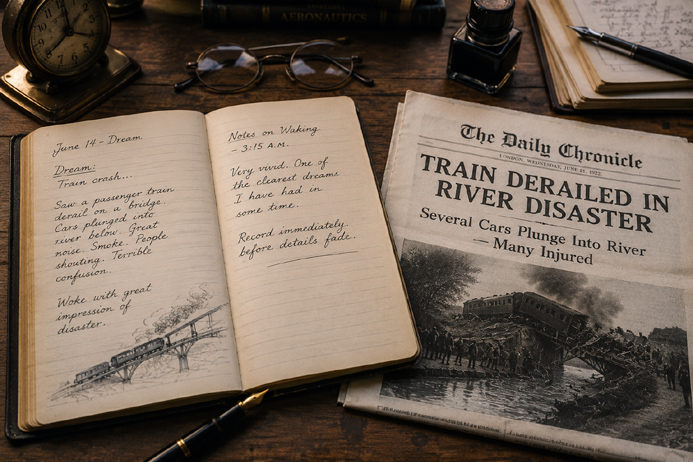
The heart of the J. W. Dunne Dream Experiments was simple: record the dream first, then compare it with future events to see whether the details matched.
The Book That Changed the Conversation
Dunne published An Experiment With Time in 1927, and its reception exceeded anything a book about an engineer’s dream records had any right to expect. It went through multiple editions within a few years of publication, was read and discussed across intellectual and literary circles far beyond the usual audience for works touching on psychic phenomena, and generated a level of serious engagement from serious people that distinguished it immediately from the spiritualist literature with which it might otherwise have been grouped.
The book succeeded in part because of how it was written. Dunne was not making mystical claims or appealing to faith. He was presenting records, describing methodology, acknowledging objections, and inviting readers to conduct the experiment themselves and evaluate the results. That approach gave readers who would have dismissed a conventional psychic claim the intellectual permission to take the evidence seriously, because the evidence was being presented in the language of investigation rather than belief.
He also made clear from the beginning that he had not wanted to find what he found. He was not a man looking for evidence of the paranormal. He was a man who found something he could not explain and felt professionally obligated to investigate it honestly rather than pretend it had not happened. That posture, familiar from the best scientific literature, gave the book a credibility that its subject matter alone could never have provided.
J. B. Priestley and the Three Plays
J. B. Priestley was one of the most successful British playwrights and novelists of the mid twentieth century, a writer with a vast popular audience and a serious critical reputation, and he read An Experiment With Time with the attention of someone who recognized immediately that Dunne had identified something worth dramatizing. The implications of serial time for questions of guilt, responsibility, fate, and the possibility of changing outcomes that have already been experienced were precisely the kind of philosophical material that Priestley found dramatically productive.
Time and the Conways, written in 1937, structured its two acts so that the audience sees a family’s present happiness and their future misery in an order that makes the relationship between the two acts an experience of Dunnian time rather than a simple depiction of it. I Have Been Here Before, also from 1937, deals explicitly with the recurrence of events and the possibility of escaping a predetermined future. An Inspector Calls, written in 1945 and now considered one of the finest British plays of the century, uses a mysterious inspector whose relationship to time is deliberately ambiguous as its central dramatic device.
Priestley acknowledged his debt to Dunne directly and wrote about the dream experiments in his own non-fiction work. The three plays represent the most sustained and artistically successful creative response to Dunne’s ideas and demonstrate more clearly than any critical discussion could that the J. W. Dunne dream experiments were taken seriously by people with no motive for credulity and every reason for skepticism.
Emanuel Swedenborg Influence on Modern Psychic Thought Revealed
H. G. Wells, Aldous Huxley, and C. S. Lewis
H. G. Wells had been writing about time as a dimension of experience since The Time Machine in 1895, and he engaged with Dunne’s serial time theory as a writer who had been thinking about related questions for decades. His response was characteristically skeptical but not dismissive, the response of a rationalist who found the theory interesting enough to argue with seriously rather than ignore.
Aldous Huxley encountered Dunne’s work during a period when he was increasingly interested in the nature of consciousness and the limits of ordinary waking experience. His engagement with the dream experiments fed into a broader intellectual project that would eventually produce The Doors of Perception and his later essays on mind and mysticism. Dunne was one of several serious investigators of unusual mental phenomena whose work Huxley found worth taking seriously rather than bracketing as pseudoscience.
C. S. Lewis referenced Dunne’s theory of time in his own thinking about the nature of divine experience and the relationship between eternity and temporal experience. For Lewis, whose intellectual interests spanned medieval literature, Christian theology, and the philosophy of mind, the serial time hypothesis raised genuine philosophical questions about the nature of consciousness that were worth engaging with regardless of whether the dream evidence that motivated it was ultimately convincing.
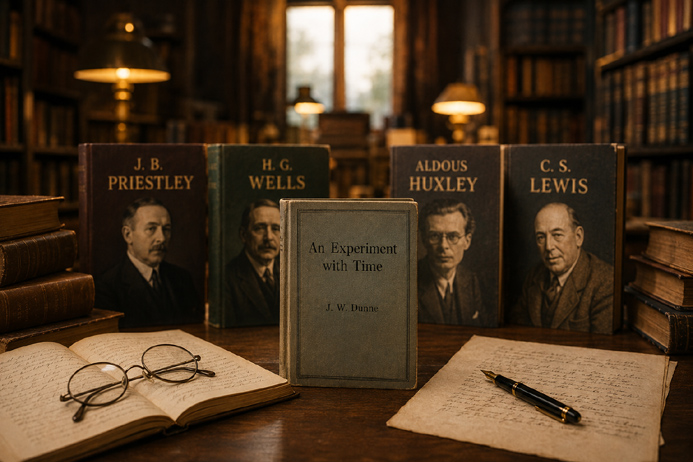
The J. W. Dunne Dream Experiments reached far beyond psychical research, influencing writers such as J. B. Priestley, H. G. Wells, Aldous Huxley, and C. S. Lewis.
What the Critics Said and What Dunne Said Back
The Scientific Objections
The primary scientific objection to the J. W. Dunne dream experiments was methodological rather than theoretical. Critics argued that the human tendency to remember correspondences between dreams and subsequent events while forgetting the far greater number of dreams that corresponded to nothing was sufficient to explain the pattern Dunne had documented without requiring any revision of the standard model of time. Selection bias, in other words, not precognition.
Memory distortion presented a related problem. Dreams recorded immediately on waking are more reliable than dreams recalled after the day has begun, but even immediate recording is subject to the influence of expectation and desire. A dreamer who is looking for correspondences may unconsciously record dreams in terms that make subsequent matching easier. The dream that seemed to predict a specific event may have been recorded in specific terms only after the event had occurred to make the match seem clearer than it actually was.
The broader problem of drawing causal conclusions from correlational data applied with particular force to an investigation that could not control for the base rate of coincidental matches between dream imagery and ordinary daily experience. Without knowing how often dream images match subsequent events by chance alone, it is impossible to determine whether Dunne’s matches exceeded what chance would predict.
Why the Objections Did Not Fully Close the Case
Dunne was aware of all of these objections and addressed them directly across the multiple editions of An Experiment With Time. His response to the selection bias argument was that the immediacy of his recording method, writing before full waking consciousness returned, minimized though did not eliminate the opportunity for motivated selection. His response to the memory distortion argument was similar. His response to the coincidence argument was that some of his cases were specific enough that the probability of a chance match was calculable and small.
None of these responses fully satisfied his critics, and Dunne did not claim they did. What he argued was that the objections, while valid as general cautions, did not account for the strongest cases in his records, the cases where the specificity of the correspondence between dream content and subsequent experience was high enough that invoking coincidence required accepting a level of improbability that felt more uncomfortable than the alternative.
The debate continued through the book’s successive editions without reaching the clean resolution that would have ended it. That absence of resolution is itself part of the historical record of the J. W. Dunne dream experiments and one of the reasons the case remains interesting rather than settled.
The Legacy That Outlasted the Debate
Dreams, Precognition, and Modern Research
The Maimonides Dream Laboratory in Brooklyn, operating through the 1960s and 1970s under researchers including Stanley Krippner and Montague Ullman, conducted controlled experiments in dream telepathy and precognition that represented the most rigorous attempt since Dunne to subject similar claims to systematic investigation. Their methodology used sealed target images, independent judges, and statistical analysis to evaluate whether sleeping subjects could dream about content they had no conventional means of knowing.
The results were contested in the same way Dunne’s results were contested, with supporters pointing to statistical patterns that exceeded chance expectation and critics pointing to methodological limitations that prevented definitive conclusions. The Maimonides work was eventually discontinued, partly for funding reasons and partly because the results, while intriguing, were not robust enough to compel acceptance from a mainstream scientific community that had not changed its fundamental assumptions about the nature of time and consciousness.
Where the investigation of precognitive dreaming stands today is in the same unresolved territory it has occupied since Dunne first published his records. The phenomenon has not been demonstrated to the satisfaction of mainstream science. It has also not been definitively ruled out. The question Dunne raised in 1927 remains open in the specific sense that no investigation has produced evidence strong enough to close it in either direction.
Why J. W. Dunne Dream Experiments Still Matter
John William Dunne died in 1949, having spent the final decades of his life refining and defending a theory that the scientific establishment never accepted and never fully refuted. He had approached the question as an engineer, with the assumption that careful records and honest methodology would eventually produce a result that honest investigators could agree on. That assumption turned out to be more optimistic than the subject matter warranted.
What the J. W. Dunne dream experiments left behind is something more durable than a verdict. They left a methodology, a body of records, a theoretical framework, and a demonstration that the question of whether the dreaming mind operates within the same temporal constraints as waking consciousness is a question serious people can investigate seriously without abandoning their intellectual integrity.
The writers who engaged with Dunne’s work, Priestley, Wells, Huxley, Lewis, were not credulous people. They were among the sharpest minds of their era, and they found the dream experiments worth taking seriously. That judgment has not expired. A man with no reason to believe in precognitive dreaming, every professional incentive to dismiss it, and the methodological discipline to investigate it carefully spent years on a question that has still not been answered. Pick up a notebook. Keep it beside the bed. Write down what you find before the day has a chance to change it. Dunne would have considered that the most honest response to everything he left behind.

Known as The Man Who Notices, Mike Lamp is a theatrical hypnotist and psychic performer with more than twenty years of live stage experience. His work emphasizes observation, psychological influence, and measured presentation rather than spectacle or provocation. Performances are tailored for adult audiences, private events, and professional settings where control, clarity, and atmosphere matter.




Leave a Reply
You must be logged in to post a comment.