28
Jun
Arthur Ellen Hypnotist: The Fascinating Man Who Worked With Sports Legends and Movie Stars
Arthur Ellen Hypnotist Lived in Two Worlds at Once and Was Taken Seriously in Both
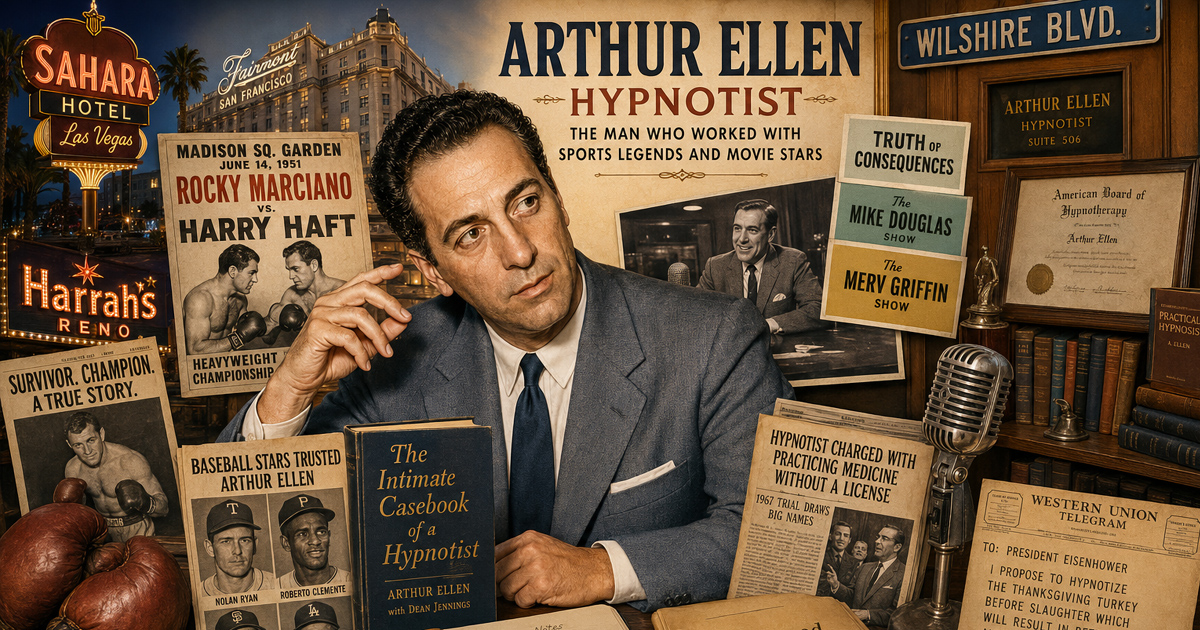
Arthur Ellen hypnotist built an extraordinary career helping Hall of Fame athletes, Hollywood stars, and television personalities while performing on some of America’s most famous stages.
There is a story from 1949 that tells you almost everything you need to know about Arthur Ellen. A professional boxer named Harry Haft was minutes away from climbing into the ring to fight Rocky Marciano when three men entered his dressing room uninvited. They were not there to wish him luck. They represented the Mafia, and they told Haft to lose the fight on purpose. By the time they left, Haft was not dealing with the ordinary fear that visits every fighter before a bout. He was dealing with something considerably more complicated.
Arthur Ellen was already in that dressing room. He had been brought in to help Haft manage his nerves before the fight. What happened next, what hypnosis could address and what it could not, sits at the center of one of the strangest stories in the history of the sport. It also tells you what kind of hypnotist Arthur Ellen was and why the people who sought his help tended to be people whose careers depended on what happened inside their own heads.
For forty six years, Arthur Ellen hypnotist worked in two worlds simultaneously and was taken seriously in both. That combination was rarer than it sounds, and the story of how he managed it has been largely forgotten.
A Career That Did Not Fit Any Single Category
Most hypnotists of the mid twentieth century fell into one of two camps. They were either stage performers working nightclub circuits and television variety shows, or they were clinical practitioners working quietly with patients in office settings. Arthur Ellen was both, simultaneously and without apparent contradiction, for nearly five decades.
He performed his nightclub act at the Sahara Hotel in Las Vegas, at Harrah’s, at the Fairmont Hotel, at Grossinger’s Catskill Resort, and at venues across the United States and internationally. He also worked out of a professional office on Wilshire Boulevard in Los Angeles, where he saw athletes, actors, and ordinary people with phobias that conventional medicine had not been able to address. The same man who could put a nightclub audience through its paces on a Friday night was available Monday morning to work with a Hall of Fame baseball player who could not shake his pregame anxiety.
The mid twentieth century entertainment world had no clean label for what Arthur Ellen did. He was not a therapist in any licensed sense. He was not purely an entertainer. He occupied a middle ground that made him genuinely useful to people whose needs fell between the two categories, and he stayed in that middle ground for forty six years.
How He Learned to Hypnotize
Arthur Ellen was born around 1912, and the specific details of his early life are sparsely documented. What is known comes primarily from his own accounts and from the case studies he later published. His interest in hypnosis began in adolescence, sparked by a personal encounter that he described as igniting his curiosity about what the mind could actually do under the right conditions.
His first attempt to hypnotize a friend failed. Rather than discouraging him, the failure sent him deeper into whatever literature on the subject he could find, studying technique through self directed reading before he had any formal instruction or professional model to follow. By his high school years he was experimenting practically, beginning with willing peers. His first successful subject was Ted Adams, a fellow member of the track team where Ellen himself competed as the city broad jump champion.
From there he expanded his practice to family members, working through parents, siblings, and extended relatives with the methodical persistence of someone who understood that skill requires repetition before it becomes reliable. By the time he entered professional life, Arthur Ellen had been practicing hypnosis informally for years. The nightclub stages and the Wilshire Boulevard office came later. The foundation was built in high school gymnasiums and family living rooms.
Martin St James Hypnotist: The Fascinating Life of the Man Australia Could Not Stop
The Night a Hypnotist Walked Into a Boxing Dressing Room
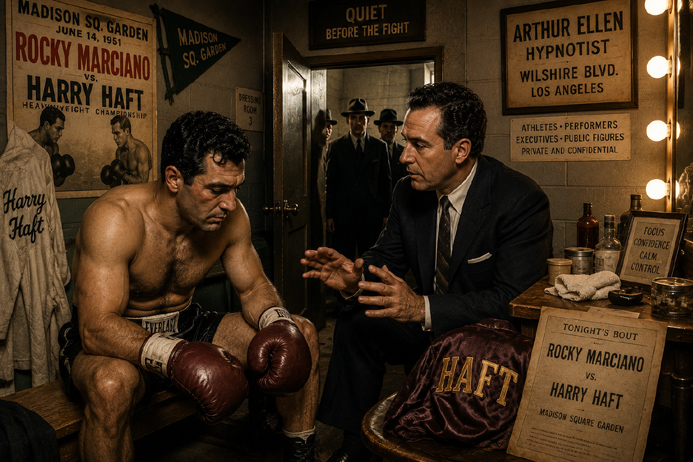
One of the most dramatic moments in the career of Arthur Ellen hypnotist came before Harry Haft’s historic fight with Rocky Marciano, where hypnosis was used to help calm pre-fight anxiety.
Harry Haft and the Fight Nobody Fully Understood
Harry Haft’s story before he ever met Arthur Ellen was already extraordinary. A Jewish boxer from Poland, Haft had survived Auschwitz and eventually made his way to the United States, where he built a professional boxing career that was credible enough to earn him a bout with Rocky Marciano, one of the most feared heavyweight fighters of the era.
Arthur Ellen was brought in before that fight to help Haft manage the psychological pressure that comes with stepping into the ring against a fighter of Marciano’s caliber. That was a straightforward enough assignment. Elite athletes dealing with performance anxiety before high stakes competition was precisely the kind of work Ellen did regularly and well. What made the Haft situation different was what happened in the dressing room before the fight began.
What the Mafia Had to Do With It
Three men entered Harry Haft’s dressing room shortly before the bout and told him to lose the fight on purpose. They were not making a suggestion. They were delivering an instruction from people who had significant financial interests in the outcome and no patience for an uncooperative boxer.
What this meant for Arthur Ellen’s work that night was that the fear he was being asked to address had shifted entirely. Haft was no longer dealing with ordinary competitive anxiety. He was dealing with a threat that existed outside the ring and would follow him after the final bell regardless of what happened during the fight. Hypnosis could help a man manage fear of losing. It was less well equipped to address the specific terror of men who had just told him his cooperation was not optional.
What Hypnosis Could and Could Not Do That Night
Ellen worked with Haft and did what he could. According to accounts from Alan Haft, Harry’s son, Ellen helped his father manage the immediate fear that was overwhelming him in the minutes before the bout. That was not nothing. A fighter who cannot function in the dressing room cannot fight at all, and whatever Ellen did that night was enough to get Haft into the ring in a functional state.
Haft lost the fight to Marciano. He spent the rest of his life insisting that he had not thrown it deliberately. Whether that was true, and what role the dressing room visit played in what happened that night, are questions that the historical record does not answer cleanly. What is clear is that Arthur Ellen was present for one of the stranger moments in mid century boxing history, doing his job in circumstances that went considerably beyond what any hypnotist could have been expected to manage.
The Baseball Players Who Trusted Him With Their Careers
Nolan Ryan, Roberto Clemente, Orlando Cepeda, and Maury Wills
The Los Angeles Times reported at the time of Arthur Ellen’s death that he had freed noted ballplayers including Nolan Ryan, Orlando Cepeda, Roberto Clemente, and Maury Wills of their pregame jitters. That sentence, read against the careers of the men named, is not a minor claim. These were not marginal players. They were among the finest baseball players of their generation, and at least three of them are enshrined in the Hall of Fame.
What Ellen actually did in those sessions was consistent with his broader approach to performance anxiety. He was not interested in excavating the psychological roots of a player’s tension or exploring childhood experience for contributing factors. His conversational induction required no formal scripts, no props, and no elaborate ritual. It required a practitioner with enough presence and enough skill to guide a subject into a receptive state through direct engagement alone.
That was a harder thing to learn than it looked and a rarer thing to do well than most people understood. He wanted to produce results quickly, using conversational induction techniques that relied on his engaging manner and direct presence rather than formal scripts or elaborate props. Athletes needed fast solutions to mental interference. Ellen provided them.
The fact that players of this caliber sought him out and returned suggests the sessions produced something they found valuable. Professional athletes at the highest level of their sport do not repeat experiences that do not work. The list of names associated with Arthur Ellen’s practice is itself a form of testimony that no advertising could have manufactured.
Dr. Michael Dean: Stability in Hypnosis History
The Dodgers and the Job He Never Got
Despite the results his individual clients were reporting, Arthur Ellen was unsuccessful in his attempt to become the official hypnotist to the Los Angeles Dodgers. He lobbied for the position, arguing that on the spot hypnotic intervention during games could provide the kind of immediate mental adjustment that no other available technique could match. The Dodgers were not persuaded.
The rejection was not unusual for the era. The 1960s were early days for any formal recognition of psychological support in professional sports, and hypnosis carried enough cultural baggage from its entertainment history that front office decision makers were reluctant to make it an official part of their organization’s operations. Individual players seeking individual help was one thing. Institutionalizing a hypnotist on the team staff was something the baseball establishment was not ready for.
Jackie Jensen and the Fear Hypnosis Could Not Fix
Not every case ended well, and Arthur Ellen was honest about that. Jackie Jensen, an outfielder who had been one of the most promising players in the American League, came to Ellen with a fear of flying that was effectively ending his ability to maintain a major league career during the era of expanding air travel in professional sports.
Ellen worked with Jensen and could not help him. His conclusion about why was more interesting than a simple acknowledgment of failure. He came to believe that Jensen’s fear of flying was not really about flying. It was, in Ellen’s assessment, a mask for Jensen’s desire to stay home and address a failing marriage rather than spend his life in the air traveling between cities while his personal life deteriorated. Hypnosis could address a fear. It could not address a life decision that the fear was being used to avoid making.
The Jensen case illustrated something important about how Arthur Ellen understood his own work. He was not an evangelist for hypnosis as a solution to every problem. He was a practitioner who had spent enough time in the field to recognize when a presenting symptom was concealing something that no induction technique was going to reach.
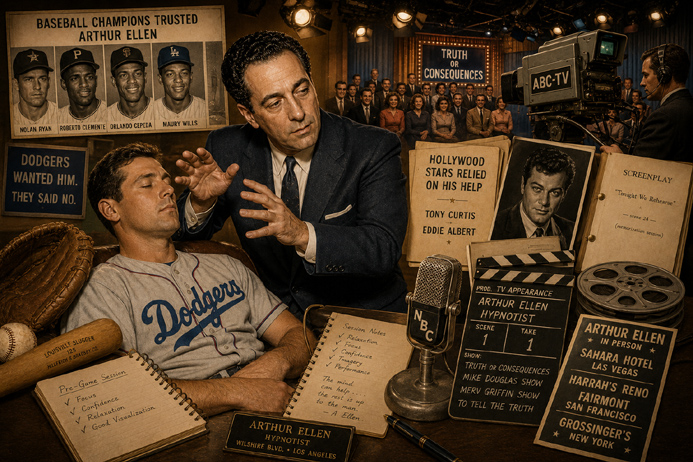
Arthur Ellen hypnotist earned the trust of professional baseball players, Hollywood actors, and national television producers, making him one of the best-known hypnotists of the mid-twentieth century.
Hollywood Stars Trusted Arthur Ellen Too
Tony Curtis, Eddie Albert, and the Problem of Memorizing Scripts
The same qualities that made Arthur Ellen useful to professional athletes made him useful to professional actors. Hollywood in the mid twentieth century ran on production schedules that left performers limited time to internalize large amounts of dialogue under conditions of significant pressure. The ability to absorb and retain script material quickly was a genuine professional asset, and any technique that reliably improved it was worth investigating.
Tony Curtis and Eddie Albert were among the Hollywood figures who sought Ellen’s help. His hypnotic sessions with them focused on enhancing their capacity to memorize scripts more effectively and on managing the relaxation that allowed performance anxiety to ease rather than compound. Both were established actors with serious careers when they worked with Ellen, which meant they were not desperate men trying anything available. They were professionals making a considered choice about a tool they believed could help them work better.
The Nightclub Stages Where He Performed for Paying Audiences
The venues where Arthur Ellen performed his stage act were not small rooms. The Sahara Hotel and Harrah’s were among the most prestigious entertainment destinations in the country during the 1950s and 1960s. The Fairmont Hotel in San Francisco, Grossinger’s Catskill Resort, Bimbo’s 365 Club, and the Elmwood Casino represented the kind of nightclub circuit that separated working performers from headliners.
Ellen headlined at these venues repeatedly, which meant he was not simply tolerated in those rooms. He was drawing audiences willing to pay to watch a hypnotist work, in an era when entertainment competition was fierce and club owners had no patience for acts that did not deliver. The nightclub career and the therapeutic practice reinforced each other in ways that benefited both. Audiences who watched him perform became aware of what hypnosis could do in other contexts. Clients who came to his office had often first encountered him through his public performances.
The Television Appearances That Made Him a Recognizable Name
Television extended Arthur Ellen’s reach beyond any nightclub circuit could manage. On October 7, 1955, a nineteen year old college student named Pat Morris was hypnotized by Ellen on an episode of Truth or Consequences. One hundred thousand dollars sat on a table in front of her. If she could rise and pick it up while under hypnotic suggestion, the money was hers. She could not get up. She received a new car and one thousand dollars as a consolation prize. The segment demonstrated Ellen’s command of the medium and gave him a national audience that newspaper coverage alone could never have produced.
He also appeared on The Mike Douglas Show in December 1964 alongside Bill Cosby and Della Reese, on The Merv Griffin Show performing hypnosis segments with Zsa Zsa Gabor among the guests, and on To Tell the Truth as the authentic hypnotist among imposters, where panelists correctly identified him as the genuine article. Each appearance added another layer to a public reputation that was building across multiple platforms simultaneously throughout the 1950s and 1960s.
The Trial and the Telegram
Charged With Practicing Medicine Without a License
In 1967, Arthur Ellen faced legal scrutiny that threatened to end everything he had built over twenty five years. He was charged with practicing medicine without a license, a charge that in the context of mid century American law was not a minor administrative inconvenience. A conviction could have shut down his practice entirely and ended his ability to work with clients in the therapeutic capacity that formed a significant part of his professional identity.
What happened in that courtroom was unusual. His show business clients showed up to testify on his behalf. The people who had come to him for help with script memorization, performance anxiety, and the particular pressures of professional life in Hollywood were willing to attach their names publicly to the argument that what Arthur Ellen did was legitimate and valuable. The case studies that would later appear in his 1968 book were cited as part of the testimony. The legal outcome reflected a growing if still contested recognition that hypnosis occupied territory that existing medical licensing frameworks had not been designed to regulate.
Ronald Pellar: A Cautionary Figure in Stage Hypnosis History
The Telegram to President Eisenhower
Not everything Arthur Ellen did was serious in its immediate intent. In November 1956, he sent a telegram to President Dwight D. Eisenhower urging him to hypnotize the presidential Thanksgiving turkey before it was killed. His reasoning was specific and delivered with a straight face. A hypnotized turkey, Ellen argued, would taste better due to the absence of adrenaline in the bloodstream at the moment of slaughter, and would pluck more easily because the muscles holding the feathers would be relaxed.
The Port Angeles Evening News reported the proposal. Other outlets picked it up. The White House did not adopt the suggestion, but the story traveled in the way that only genuinely absurd ideas delivered with complete sincerity tend to travel. It was exactly the kind of publicity that kept Arthur Ellen’s name in public circulation between nightclub engagements and demonstrated the particular quality that ran through his entire career. He understood that hypnosis was most interesting to most people when it appeared in unexpected places doing unexpected things.
The Book That Laid It All Out
The Intimate Casebook of a Hypnotist
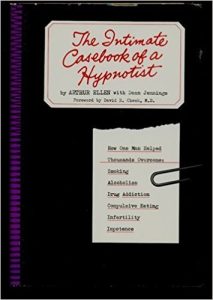
Book cover art of The Intimate Casebook of a Hypnotist
In 1968, Arthur Ellen published The Intimate Casebook of a Hypnotist, co-authored with Dean Jennings and carrying a foreword by psychiatrist David B. Cheek. The book drew on more than twenty five years of professional case studies to present hypnosis as what Ellen called a neglected but proven science, describing its applications across athletic performance, entertainment, phobia treatment, and habit modification in language accessible to a general reader.
The cases covered in the book ranged from the famous to the ordinary. Sal Maglie and Maury Wills appeared alongside anonymous patients who had come to Ellen with dental anxiety, claustrophobia, stuttering, and other conditions that conventional approaches had addressed incompletely or not at all. The variety of the case studies reflected the variety of Ellen’s actual practice, which had never confined itself to any single category of client or application.
The book was marketed with a title that acknowledged its entertainment value without pretending to be something it was not. The content inside adopted a tone that was straightforward and non-sensational, assuring readers of hypnosis’s safety when applied ethically while declining to oversell what it could reliably deliver.
What the Book Said About Limits
What distinguished The Intimate Casebook of a Hypnotist from the promotional literature that surrounded hypnosis in the mid twentieth century was its candor about failure. Ellen addressed the technique’s inconsistent results with smoking cessation directly, acknowledging that the outcomes in that area were less reliable than practitioners often claimed. He noted that hypnosis was ineffective on individuals with psychotic conditions. He was specific about the kinds of problems that responded well and the kinds that did not.
This honesty was not incidental to the book’s value. It was central to it. A practitioner willing to document his failures alongside his successes in print was making a claim about his own credibility that no amount of success stories could manufacture on their own. Arthur Ellen understood that the long term legitimacy of hypnosis as a serious tool depended on practitioners being accurate about what it could and could not do, and he was willing to be that practitioner in public.
The Man History Almost Forgot
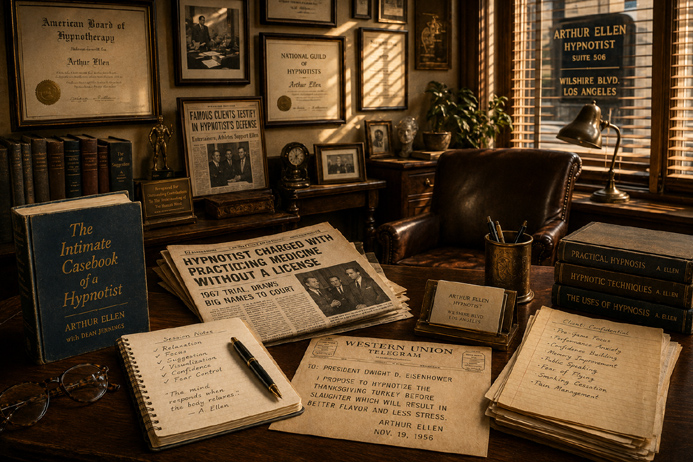
The legacy of Arthur Ellen hypnotist lives on through his writings, case studies, and decades spent helping famous clients while advancing public understanding of hypnosis.
Forty Six Years Between Two Worlds
Arthur Ellen died of throat cancer in Northridge, California, in January 1987. He was seventy five years old and survived by three daughters. The Los Angeles Times ran an obituary that noted his work with athletes and actors, placed it in the context of a forty six year career, and moved on. There was no major retrospective, no documentary, no revival of interest in the body of work he had accumulated across five decades of practice in two of the most demanding professional environments in the country.
He had performed in Las Vegas when Las Vegas was the center of American entertainment. He had worked with Hall of Fame athletes at the peak of their careers. He had been in a boxing dressing room the night Harry Haft fought Rocky Marciano with the Mafia waiting in the wings. He had sent a telegram to a president about a turkey and watched the story run in newspapers across the country. He had been tried for practicing medicine without a license and had his Hollywood clients testify on his behalf. And then he died and the world moved on without pausing particularly long to take note of what it was leaving behind.
Why Arthur Ellen Hypnotist Still Matters
The career of Arthur Ellen matters for the same reason that any honest record of what hypnosis actually accomplished in professional hands during the mid twentieth century matters. He was not a fraud and he was not a mystic. He was a skilled practitioner who spent forty six years applying a genuine technique to real problems in the lives of real people, some of them among the most accomplished athletes and performers of their generation.
He documented his work honestly, acknowledged his failures publicly, performed in the best rooms available to an entertainer of his era, and left behind a body of case studies that still represent one of the more complete records of practical hypnosis in the mid century American context. That he is remembered today primarily by specialists in hypnosis history rather than by the broader public says more about how we allocate cultural memory than it does about the significance of what he built.
The man who walked into Harry Haft’s dressing room before a Rocky Marciano fight deserves to be remembered. So does the man who sent a telegram to Eisenhower about a turkey. So does the man who helped Roberto Clemente take the field without the pregame anxiety that had been following him into the clubhouse. Arthur Ellen hypnotist was all three of those men, and he spent forty six years proving that the two worlds he inhabited were not as far apart as most people assumed.

Known as The Man Who Notices, Mike Lamp is a theatrical hypnotist and psychic performer with more than twenty years of live stage experience. His work emphasizes observation, psychological influence, and measured presentation rather than spectacle or provocation. Performances are tailored for adult audiences, private events, and professional settings where control, clarity, and atmosphere matter.



Leave a Reply
You must be logged in to post a comment.