11
Jun
Corporate Holiday Party Entertainment: 7 Things That Actually Matter
Corporate Holiday Party Entertainment: 7 Things That Matter
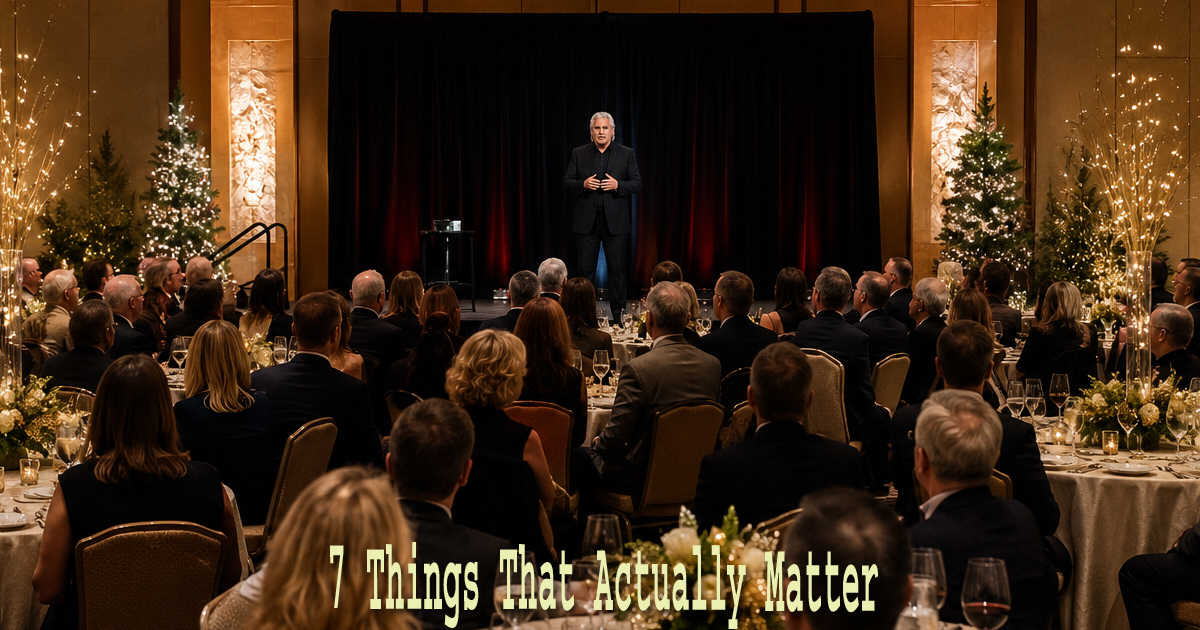
One evening. One chance to deliver.
Not every corporate holiday party is a Christmas party. I have performed at Halloween events where half the audience arrived in costume and the other half did not get the memo. I have worked New Year’s dinners where the room was formal enough to require a tuxedo and summer celebrations that the organization called a holiday party because they liked the word. The specific holiday changes the decorations and sometimes the dress code. It does not change what the audience needs from the entertainment.
What people need from a well-planned corporate celebration is consistent regardless of the occasion. They want to feel like the evening was worth showing up for. They want to leave with something they did not have when they arrived, a conversation they are still having, a moment they did not expect, a memory that belongs to everyone who was in that room. After more than two decades performing at corporate events across the country, I can tell you that entertainment is the variable most responsible for whether any of that actually happens.
1. First Impressions Set The Tone Before You Realize It
The opening minutes of a performance tell the audience everything they need to know about the rest of the evening. Guests at a corporate party arrive mid-conversation. They are catching up with colleagues, settling into their seats, making their way through the room. Their attention is not automatically available. It has to be earned, and the opening is where that happens or it does not.
I once performed at a December year-end dinner where the program before me ran long and the audience had been sitting for nearly two hours before I was introduced. The room was restless and distracted and the first two minutes were the most important two minutes of the entire evening. Everything that followed depended on what happened in that opening. A performer who understands how to read a room and respond to what it actually needs in that moment is worth considerably more than one who simply delivers the same opening regardless of what the audience is giving them.
The tradition of employer-sponsored holiday celebrations in the United States expanded significantly after World War II, when personnel management literature of the late 1940s and early 1950s began framing the company party as a tool for building employee loyalty and reducing postwar workforce turnover.
2. Corporate Holiday Party Entertainment Must Work For Every Table
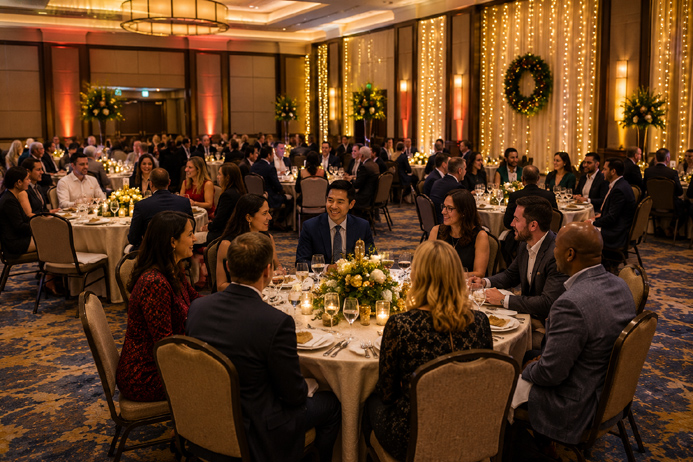
Every table needs to feel it.
A corporate holiday party contains more audience variety than almost any other event on the calendar. The room holds people from different departments, different generations, different relationships to the organization, and different expectations for the evening. The person who has been with the company for twenty years is sitting two tables from the person who started in September. The executive team is in the same room as the warehouse staff. Everyone is watching the same program.
Entertainment that plays well for one corner of that room and loses another corner creates a problem the rest of the evening cannot easily fix. This is one of the most specific challenges in corporate entertainment and it is worth raising directly in the booking conversation. Ask the performer how they handle mixed audiences. The answer will tell you something important.
The first formal industry survey tracking corporate entertainment spending at holiday events was conducted by Meeting Professionals International in the early 1990s, revealing that entertainment represented a larger share of holiday event budgets than any other single program element including decorations and audiovisual production.
3. Where You Place The Entertainment Changes Everything
I have had performances go exceptionally well and performances that worked far harder than they should have, and the difference was often not the program. It was the placement. Entertainment that follows a long awards presentation to a fatigued audience faces a different challenge than the same program placed at the peak of the evening’s energy. The material does not change. The room does.
After dinner and before the evening loses momentum is the window that tends to produce the best results for most corporate holiday events. The specific timing depends on the structure of your program, but the principle is consistent. Where the entertainment sits in the schedule is a planning decision that deserves as much attention as any other element of the evening, and it is one that is far easier to get right before the schedule is printed than after.

Placement matters as much as performance.
4. The Difference Between Watching And Being In The Room
There is a Halloween party I think about occasionally when this subject comes up. The audience was loosened up, in costume, fully present in a way that corporate audiences sometimes take longer to arrive at. When the room connected with what was happening on stage it connected completely, and the energy that produced was something no amount of production value could have manufactured. The audience was not watching the entertainment. They were inside it.
That distinction matters enormously for a corporate holiday event. A program that pulls the audience in, that makes them feel like participants rather than observers, creates shared memories that a polished but passive performance simply cannot. The conversations that happen during dessert, the moments people describe to their families on the drive home, the things that come up at the office the following week, those almost always trace back to a moment where the room became part of the experience rather than an audience for it.
5. The Wrong Entertainment Becomes The Story
This is the part of the planning conversation that does not always get said plainly, but it should. When entertainment misses the room at a corporate holiday party it does not simply fade from memory. It becomes the reference point for that year’s event. Guests remember it specifically. They describe it to people who were not there. It follows the planner and the organization in a way that is disproportionate to the investment that went wrong.
I am not saying this to create anxiety around the decision. I am saying it because the same dynamic works in reverse. When the entertainment is right for the room, that becomes the story too. I have had planners tell me years later that guests still mention a particular evening. That kind of return on a single planning decision is unusual in the events business, and it is almost always traceable to the entertainment.
Workplace anti-discrimination guidance issued by the United States Equal Employment Opportunity Commission beginning in the 1990s directly influenced how corporate holiday parties were planned and branded, leading many organizations to shift from Christmas-specific themes toward inclusive seasonal celebrations, a change that also affected how entertainment was selected and briefed for those events.
6. Preparation Before The Event Is Part Of The Performance
A professional entertainer’s job begins well before they walk into the venue. It begins in the conversations leading up to the event, in the questions they ask about the audience, in the clarity of their technical requirements, in the advance coordination with the venue that ensures nothing is being solved for the first time on the day of the party.
I think about a Christmas dinner I performed at several years ago where the venue contact and I had spoken twice before the event date, walked through the room layout, confirmed the schedule, and addressed a staging question that would have been a genuine problem if it had surfaced during load-in. The event ran smoothly in part because the work happened early. A performer who asks good questions before the event and communicates clearly with everyone involved is already demonstrating the standard they will bring to the performance itself. Those two things are not separate.
7. The End Of The Evening Is What Guests Actually Take Home
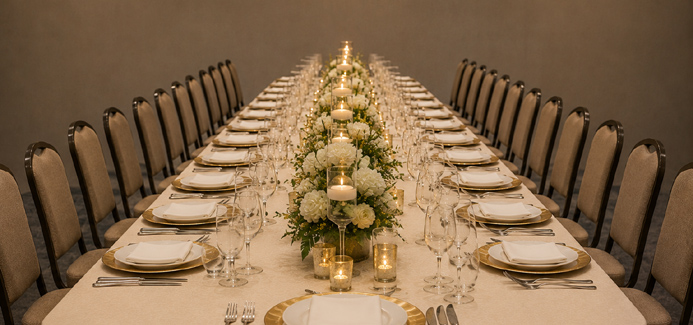
The end is what they carry home.
However the evening unfolds, the last impression is the lasting one. Guests carry the end of the evening into the parking lot, into the car, and into the office the following week. An entertainment program that builds toward a genuine conclusion, something that leaves the room energized or quietly affected rather than simply stopping when the allotted time runs out, gives the entire evening a shape that guests feel even if they cannot describe it.
Ending a corporate holiday party on a high note is not a matter of saving the best material for last, though that is part of it. It is a matter of understanding that the close of the entertainment program is the close of the emotional arc of the evening, and that arc deserves to be planned as deliberately as anything else on the schedule. The room that leaves on a high note is the room that remembers the night well, and the planner who created that room is the one who gets asked to do it again next year.
Final Thoughts
Whether the party is a Halloween celebration, a Thanksgiving dinner, a carefully worded year-end gathering, or a Christmas party with no ambiguity about the occasion, the entertainment is the element with the most direct influence over whether the evening becomes something worth remembering. The venue creates the setting. The catering takes care of the comfort. The entertainment creates the moment that people carry home.
That moment does not happen by accident. It is the result of a planner who thought carefully about the audience, asked the right questions before signing anything, placed the entertainment where the room was ready for it, and chose a performer who understood that their job was to serve that specific group of people on that specific evening. Done well, corporate holiday party entertainment is the reason guests look forward to next year’s invitation before they have finished this year’s dessert.

Known as The Man Who Notices, Mike Lamp is a theatrical hypnotist and psychic performer with more than twenty years of live stage experience. His work emphasizes observation, psychological influence, and measured presentation rather than spectacle or provocation. Performances are tailored for adult audiences, private events, and professional settings where control, clarity, and atmosphere matter.