3
Apr
Scorpio Symbolism Meaning: Bold Water Sign Insights
Scorpio Symbolism Meaning: Bold Water Sign Insights

Ancient scorpion, still watching
The Scorpion as Celestial Symbol
Scorpio symbolism draws from one of the most layered symbolic vocabularies in the entire zodiac. Scorpio is the eighth sign, positioned in the second half of the wheel where the concerns of the self give way to shared resources, power, and the confrontation with what cannot be avoided. It is a fixed sign, meaning it holds its position with unusual tenacity.
That quality of fixity runs through nearly every interpretation associated with the sign: the refusal to move on until something is genuinely resolved, the capacity to endure long after other signs have redirected their attention. Understanding Scorpio symbolism means looking past surface impressions and into a system built on transformation, intensity, and concealed power.
Read about Zodiac Meaning Explained: Clear Guide to Symbolism in our Exclusive Article
The Scorpion as Primary Symbol
Scorpio symbolism begins, for most students of astrology, with the scorpion itself. The creature is ancient in its use as a celestial symbol, appearing in Babylonian astronomical records where it was associated with the month of darkness following the autumn equinox, and persisting across cultures without losing its essential character. What the scorpion communicates is a particular relationship to danger, one that is not aggressive in the conventional sense but is instead defensive and precisely calibrated.
It does not pursue. It waits. The scorpion in Scorpio symbolism is not simply a creature of danger but a figure of precision and patience. It carries venom it rarely uses, and it survives in environments that would exhaust other creatures. Astrologically, this translates to a sign associated with reserves, with held resources both psychological and material, and with the understanding that timing matters more than speed.
The constellation Scorpius is one of the oldest recorded constellations, with cuneiform references placing it in Babylonian star catalogues dating to approximately 1200 BCE.
Water Sign and Emotional Depth
Scorpio symbolism belongs to the water element, which in astrological tradition governs feeling, instinct, and inner life. The three water signs, Cancer, Scorpio, and Pisces, each engage with the emotional realm in distinct ways. Cancer tends toward protection and containment. Pisces moves toward dissolution and merging. Scorpio is characterized by depth and pressure, the kind of emotional experience that does not disperse but concentrates.
Water under pressure transforms its environment. In the symbolic structure of the zodiac, Scorpio represents emotional experience that is held rather than expressed freely, growing more powerful the longer it is sustained. This is why the sign is so consistently associated with intensity. It is not that Scorpio feels more than other signs, but that what it feels is rarely discharged casually.
Planetary Rulership: Mars and Pluto
Two rulers, one fixed sign
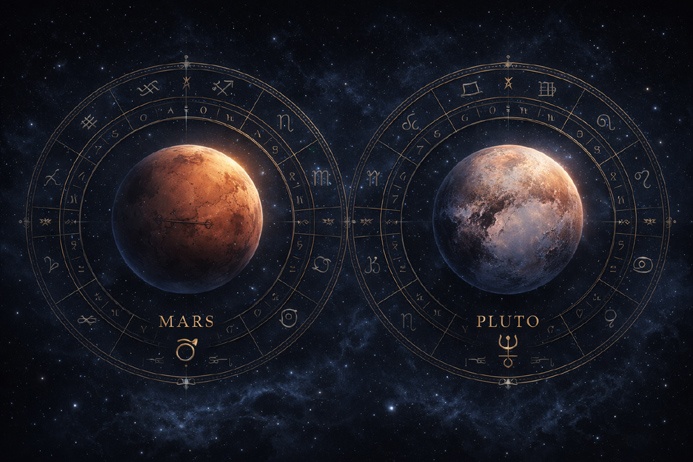
The planets that shape Scorpio symbolism are Mars and Pluto, and together they define its dual nature. Mars was the original ruler, assigned in classical astrology before the outer planets were discovered, and its influence explains the sign’s association with will, conflict, and directed force. Mars brings the scorpion’s sting, the capacity for decisive and sometimes sharp action when provoked.
When Pluto was discovered in 1930 and gradually integrated into astrological practice, it was assigned co-rulership of Scorpio based on thematic resonance, though traditional astrologers have continued to recognize Mars as the sole and sufficient ruler, and the debate between classical and modern practice on this point has never fully resolved itself. Pluto governs transformation at the deepest level, the kind that requires something to end before something else can begin.
Pluto’s addition to Scorpio symbolism brought a generational and evolutionary dimension that Mars alone could not fully contain. Together these two planetary influences give the sign an unusual range, from the immediate and combative to the slow and inexorable.
In ancient Egypt, the scorpion goddess Serket was a protective deity associated with the dead and with healing from venomous stings, a figure entirely separate from the Greek astrological tradition that later shaped Western zodiac interpretation.
The Eagle and the Phoenix
Two forms, one sign’s range
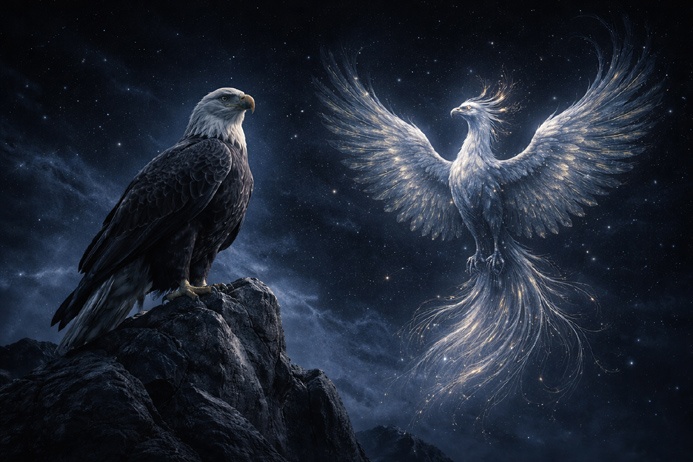
The eagle and the phoenix are the two elevated forms that appear in Scorpio symbolism alongside the scorpion. In traditional astrological symbolism, signs are sometimes associated with more than one animal or figure, and Scorpio carries three. The scorpion represents the baseline expression of the sign’s energy. The eagle represents the evolved form, a creature of broad vision and strategic patience, capable of seeing from a distance what others cannot detect at close range.
The phoenix represents the sign at its most transformative, the image of something that does not merely survive destruction but uses it as the mechanism of renewal. These three figures in Scorpio symbolism, the scorpion, the eagle, and the phoenix, represent three levels of the sign’s expression. Most interpretations treat them as a progression, a three-stage model most clearly developed by Renaissance astrologers drawing on classical sources. In practice, a single individual may move between all three depending on circumstances and development.
The Eighth House Connection
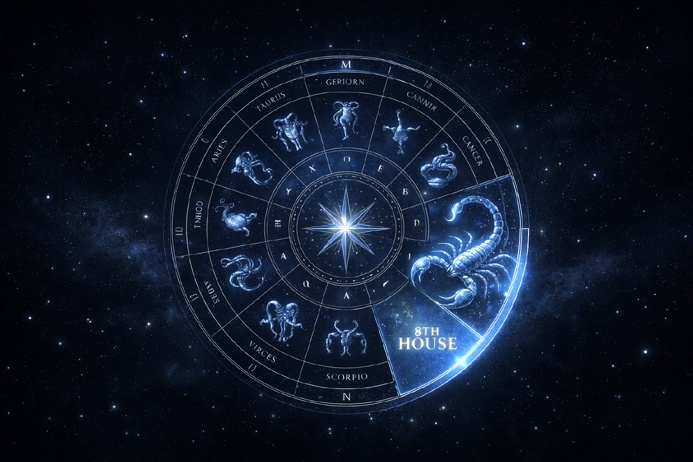
Scorpio symbolism finds its structural home in the eighth house, the most psychologically complex position in the natal wheel. The eighth house governs shared resources, inheritance, debt, and the merging of assets between two people, as well as the psychological dimensions of intimacy and the confrontation with mortality. It is the house associated with what is owed and what is received, with what must be surrendered in the process of deep connection.
In the natural zodiac, a framework used for thematic correspondence rather than natal interpretation, each sign aligns with its corresponding house, and Scorpio’s placement in the eighth position reinforces every quality the sign is known for. The concerns of the eighth house are not comfortable ones. They involve negotiation with forces larger than the individual, the recognition that full control is rarely available. Scorpio, as a sign, is built to work within exactly that kind of territory.
Scorpio in the Zodiac Wheel
The eighth house holds its ground
When placed in the context of the full zodiac, Scorpio symbolism occupies a pivotal position in the second half of the wheel. It follows Libra, the sign of balance and relationship, and precedes Sagittarius, the sign of expansion and inquiry. Scorpio sits between those two energies, after the ideal of harmony has been established and before the search for meaning begins. What it occupies is the space of consequence, where the terms of relationship are tested and the cost of connection becomes real.
The opposition across the wheel falls to Taurus, the fixed earth sign that governs material stability and sensory experience. That opposition is one of the most discussed in astrological interpretation, pitting the visible and tangible against the hidden and transformative, the held resource against the shared one. No other sign carries quite the same convergence of depth, mythic weight, and structural tension that defines Scorpio symbolism across its long astrological history.
The glyph used to represent Scorpio in modern Western astrology, the stylized letter m with an arrow, did not become standardized until the early printed almanac tradition of the fifteenth and sixteenth centuries.
Editor’s Reflection
What stays with most people, after spending time with this material, is how internally consistent the whole structure is. The scorpion, the eagle, the eighth house, the dual planetary rulership: none of it feels arbitrary once the pieces are read together. Scorpio symbolism holds together not because astrologers forced a theme onto it, but because the symbolic tradition kept returning to the same qualities from different angles and finding the same answer. That kind of coherence is worth noticing.
For those who have spent time with this sign, either in their own chart or in watching it operate in someone close to them, some questions tend to linger. Where does the line fall, in practice, between the scorpion’s patience and simple avoidance? Does Scorpio symbolism read differently to people who carry it prominently in their charts than it does to those observing it from the outside? And of the three symbolic figures, the scorpion, the eagle, and the phoenix, which one feels most honest to the actual lived experience of the sign?

Known as The Man Who Notices, Mike Lamp is a theatrical hypnotist and psychic performer with more than twenty years of live stage experience. His work emphasizes observation, psychological influence, and measured presentation rather than spectacle or provocation. Performances are tailored for adult audiences, private events, and professional settings where control, clarity, and atmosphere matter.



Leave a Reply
You must be logged in to post a comment.