7
Mar
Temperance Tarot Card Meaning: Clear Guide to Powerful Symbolism
Temperance Tarot Card Meaning: Powerful Symbolism Guide

Temperance Tarot Card Meaning illustrated through the balance of flowing water and spiritual harmony within the Major Arcana
The Major Arcana holds twenty-two cards, numbered zero through twenty-one, before its sequence reaches the World, and somewhere near the midpoint of that journey stands a figure pouring water between two cups. That figure is Temperance, the fourteenth card in the sequence, numbered XIV, which places it as the card immediately following Death in the Rider-Waite and most traditional decks. The Temperance Tarot Card draws on one of the oldest moral and philosophical concepts in Western tradition, the idea that balance is not passivity but active, careful management of opposing forces.
Read Major Arcana Secrets: Shocking Dark Origins Revealed Exclusive Article
What the Image Carries
Most traditional depictions of Temperance show a winged figure, frequently read as androgynous or as the archangel Michael, standing with one foot in water and one foot on land. Two cups are held at an angle, and liquid passes between them without spilling. A solar symbol appears on the figure’s chest in the Rider-Waite tradition, representing the presence of divine light brought into the material plane. A path winds toward mountains in the background, with a crown of light hovering at the path’s end. Each element in this composition speaks to the card’s central concern, which is mediation between extremes.
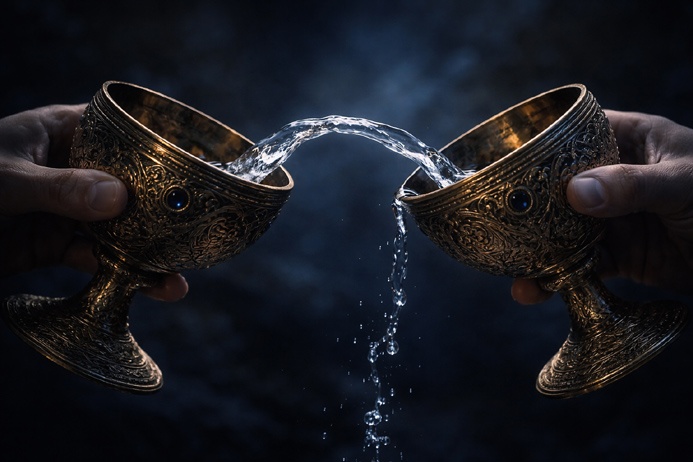
The Temperance Tarot Card Meaning finds its most direct visual expression in the gesture of two vessels held in careful relation, neither one allowed to overflow.
The Temperance Tarot Card Meaning is embedded in those visual contrasts. Water and earth, movement and stillness, the near and the distant. The figure does not choose one side. It occupies both simultaneously, and the liquid passing between the cups represents the continuous, careful work of keeping things in flow. The path toward the mountains is not hidden or inaccessible. It is simply far off, suggesting that balance is not a destination reached quickly.
The wings identify the figure specifically as the archangel Michael in most interpretive traditions, the great mediator who governs the element of fire and the movement between worlds. Something larger than personal effort is at work, and naming that figure grounds the card in a specific symbolic lineage rather than vague angelic imagery. In older symbolic traditions, angelic figures served as intermediaries, and Temperance carries that sense of in-between space. It is a card of thresholds rather than fixed positions.
The word temperance entered English usage primarily through Latin temperantia, a term Cicero used to describe the rational governance of appetite and desire, making it one of the four cardinal virtues in classical Roman moral philosophy before it ever appeared in a card game or divinatory system.
Temperance in the Major Arcana Sequence
The Major Arcana symbolism of this card depends partly on what surrounds it. Death, card XIII, marks the end of one phase. The Devil, card XV, represents attachment and entrapment. Temperance sits between these two, and its placement is meaningful. It is the space where transformation is digested, where something new is being formed without yet hardening into fixed pattern or compulsion.
The spiritual journey in tarot runs through the entire Major Arcana, and Temperance marks a particular kind of passage. The Fool, at the sequence’s beginning, moves forward without calculation. By the time the journey reaches Temperance, experience has accumulated. The card does not celebrate recklessness or blind enthusiasm. It favors steady attention and the patient mixing of what has been learned.
The tarot card archetypes found in the Major Arcana tend to present large, sometimes overwhelming forces. The Tower brings collapse. The Wheel of Fortune turns without asking permission. Temperance is quieter than most of its neighbors. Its power comes not from drama but from consistency, not from sudden revelation but from ongoing practice, and this quality connects it symbolically to the element of Fire in the Rider-Waite tradition, a detail that surprises many students who expect a water-dominant card given the imagery of flowing liquid.
Temperance Upright Meaning
The Temperance upright meaning points toward moderation in the most active sense of that word. This is not about doing less or suppressing impulse. It describes a person or situation that is integrating competing elements successfully. Something that was out of proportion is being brought into alignment. Something that seemed irreconcilable is being blended.

The Temperance Tarot Card Meaning in its upright position describes exactly this kind of stance, present on two surfaces at once without surrendering either.
In a practical context, the Temperance upright meaning often signals that patience is the operative quality. A project or relationship that has required careful navigation is finding its rhythm. The extremes have not disappeared, but they are being managed with skill. The card frequently appears when someone has moved past a period of instability and is now working within a more sustainable range, and in traditional numerological readings the number fourteen reduces to five, connecting Temperance back to the Hierophant and the theme of integrating outer structure with inner understanding.
The Temperance Tarot Card Meaning in an upright position also carries a suggestion of healing, not as a sudden cure but as a gradual restoration. Whatever was depleted or disrupted is being replenished through steady attention. Time is functioning as an ally rather than a pressure. The card can indicate a period of recuperation, creative incubation, or the quiet work of bringing something long neglected back into balance.
The earliest surviving tarot decks produced in northern Italy during the fifteenth century, including the Visconti-Sforza series, depicted Temperance as a woman pouring liquid between two pitchers rather than cups, a compositional choice that emphasized domestic virtue and civic moderation over angelic or spiritual intermediary roles.
Temperance Reversed Meaning
When the card appears reversed, the Temperance reversed meaning points toward imbalance that has gone unaddressed, or toward an attempt to force an outcome before conditions are ready. The liquid between the cups is spilling. The figure has lost its footing on one of the two surfaces it once occupied simultaneously.
The Temperance reversed meaning does not necessarily signal catastrophe. It more often indicates a pattern of excess or avoidance that has been building gradually. Something that should have been moderated was not. A situation that required patience was pushed too hard. In some readings, reversal points to an inner conflict between competing desires that has not yet been acknowledged, let alone resolved.
The Temperance Tarot Card Meaning in its reversed position can also reflect a period when healing has stalled. The recuperative process that the upright card favors has been disrupted, perhaps by outside pressure, perhaps by impatience, perhaps by the return of an old habit that draws things back out of alignment. The card reversed does not condemn. It describes a condition, and conditions can shift.
The Card’s Relationship to Time and Process
One of the more distinctive qualities within the Temperance Tarot Card Meaning is its relationship to time. Most cards in the Major Arcana are associated with events or states. Temperance is associated with a process. It is less concerned with what is happening and more concerned with how something is being handled over a sustained period.
This card in tarot tradition often emphasize flow rather than arrival. The two cups and the liquid between them suggest that the card’s meaning is not static. Balance, in this framework, is not a fixed position but something that must be maintained through continuous small adjustments. The spiritual journey in tarot is not a single dramatic arc. It contains long stretches of quiet work, and Temperance names one of those stretches directly.
The tarot card archetypes tend to function as mirrors. A reader or student looking at Temperance is invited to consider where in their own situation flow has been disrupted, where competing demands have gone unmediated, and where patience might produce what urgency cannot. The Major Arcana symbolism here is not moralistic. It does not say that excess is wrong. It says that excess carries consequences, and that moderation is a skill rather than a virtue imposed from outside.
When Arthur Edward Waite and Pamela Colman Smith redesigned the card for the 1909 Rider-Waite deck, they deliberately added the triangular symbol within a square on the figure’s chest robe, a geometric emblem drawn from Hermetic tradition representing the elements contained within physical matter, a detail absent from earlier standard tarot designs.
Symbolism Across Deck Traditions
Different deck traditions handle the Temperance imagery with small but meaningful variations. Some place the figure fully in or above water, and the Thoth deck tradition, following Crowley, renamed the card Art rather than Temperance, emphasizing the alchemical dimension of the imagery over its moral or moderating associations. Some depict the cups as clearly different in color or material, emphasizing the two sources being combined. Some remove the wings entirely, grounding the figure in a more human register. These variations affect the feel of the card without altering its core concern.
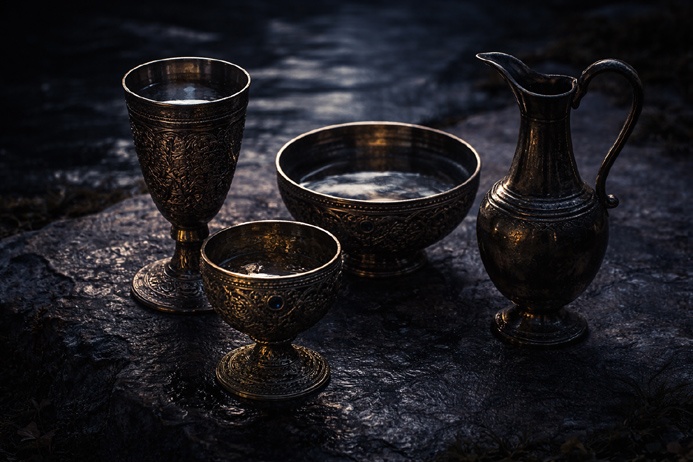
The Temperance Tarot Card Meaning persists across vessel shapes and deck traditions because the meaning lives in the relationship between containers, not in any single form.
The Temperance Tarot Card Meaning remains consistent across most of these versions because the underlying structure is stable. Two things are being combined. The process requires skill. The outcome is not guaranteed by the mere intention to balance but by the sustained practice of doing so. That consistency across visual variation says something about how deeply the concept is embedded in the card’s identity. It is not an image that depends on decorative details. The meaning lives in the gesture, in the angle of the cups, in the figure’s position between two surfaces.
Understanding the Temperance Tarot Card Meaning is, in the end, an exercise in paying attention to proportion. The card does not celebrate any particular value in isolation. It asks what happens when different values are held in relation to one another, and what kind of attention is required to keep that relation functional over time.
Editor’s Reflection
What the Temperance Tarot Card Meaning ultimately offers is a way of thinking about difficulty that does not require resolution to feel meaningful. The card does not promise that opposing forces will eventually agree or that patience always produces the outcome sought. It simply observes that the work of holding things in proportion, day after day, without forcing a conclusion, is its own kind of practice. That is a quiet idea, and quieter ideas tend to last.
For anyone sitting with the Temperance Tarot Card Meaning in a reading or as a longer study, a few things are worth turning over slowly. What does balance actually look like in a situation where one element keeps demanding more than its share? Is there a difference between genuine moderation and the kind of holding back that is really just postponement? And when the process stalls, as it sometimes does, what tends to restore the flow?

Known as The Man Who Notices, Mike Lamp is a theatrical hypnotist and psychic performer with more than twenty years of live stage experience. His work emphasizes observation, psychological influence, and measured presentation rather than spectacle or provocation. Performances are tailored for adult audiences, private events, and professional settings where control, clarity, and atmosphere matter.


Leave a Reply
You must be logged in to post a comment.