28
Feb
The Emperor Tarot Card Meaning: Clear Guide to Powerful Symbolism
The Emperor Tarot Card Meaning: Strong Essential Guide

The Emperor Tarot Card Meaning illustrated through regal symbolism, structure, and authority within the Major Arcana.
The Major Arcana and the Emperor’s Place Within It
The Major Arcana consists of twenty-two cards, each representing a distinct stage or force within the symbolic journey of the tarot. The Emperor Tarot Card Meaning occupies the fourth position in this sequence and sits between The Empress and The Hierophant. That placement is not incidental. The Empress, numbered three, carries associations with abundance, nurturing, and creative receptivity. The Emperor follows as a natural counterpart, embodying structure, boundary, and directed will. Together they form one of the clearest paired relationships in the deck. Understanding The Emperor Tarot Card Meaning requires attention to this context, because no card in the Major Arcana exists in isolation. Each one gains definition partly through proximity to those before and after it.
The number four itself carries symbolic weight in tarot. Four suggests solidity, the four directions, the four classical elements, the stable corners of a foundation. A table with four legs holds its ground. The Emperor Tarot Card Meaning draws heavily on this sense of stable form. Where other cards suggest movement, transition, or flux, the Emperor represents what has been established and what holds its shape under pressure.
Read Major Arcana Secrets: Shocking Dark Origins Revealed Exclusive Article
Visual Symbolism and Card Imagery
Most traditional depictions of The Emperor show a figure seated on a stone throne, often ornate, frequently carved with ram heads or similar imagery. The figure is typically robed in red and armored beneath, suggesting that beneath civic authority lies readiness for conflict or defense. These visual details carry symbolic weight that rewards patient attention.
The throne itself is stone rather than wood. Wood suggests growth, living material, something that was once a tree and retains organic character. Stone does not grow. It is taken from the earth already complete, already hard, and shaped only by force applied from outside. The Emperor’s throne carries that quality into the reading: what sits here was not cultivated but constructed, and it intends to remain. The ram imagery, where it appears, connects to qualities of initiative and forward force. The armored layers beneath ceremonial robes suggest that the Emperor’s authority is not merely decorative. It has been tested and is prepared to be tested again.

The Emperor Tarot Card Meaning draws on imagery of barren, unyielding terrain as a symbol of order maintained through discipline rather than ease.
The background in many versions shows barren mountains or rocky terrain, spare and unadorned. This is not an environment of softness or ease. The Emperor Tarot Card Meaning includes this landscape as part of its message: order is maintained through discipline, and the ground it stands on is unyielding.
The tarot deck as a complete system, including the Major Arcana sequence, took its most recognizable standardized form in the late eighteenth century, when French occultists began assigning systematic symbolic meaning to cards that had previously been used primarily for gaming in northern Italy.
The Emperor Upright Meaning
In an upright position, The Emperor represents authority that is applied with intention and responsibility. The Emperor upright meaning centers on leadership that does not need to announce itself through volume. It is the kind of authority that sets clear terms, follows through on commitments, and expects the same from others. This is structure in its constructive form, rules that exist because they protect rather than merely restrict.
The Emperor Tarot Card Meaning in the upright position also speaks to self-governance. Before one can lead others with any real effectiveness, a degree of internal order is generally required. The Emperor asks whether the systems a person has built around themselves, the habits, the financial arrangements, the unspoken rules of their relationships, actually hold what they were meant to hold. Where they are, the card affirms that foundation. Where they are not, it identifies what needs tending.
In practical readings, the upright Emperor often appears when questions involve authority figures, organizational structures, career hierarchies, legal or contractual matters, or the need to apply more consistent discipline to a goal or project. The Emperor Tarot Card Meaning in these contexts is rarely about inspiration or spontaneity. It is about what gets built through sustained, methodical effort and what holds when tested.
The Emperor Reversed Meaning
When The Emperor appears reversed, the symbolism shifts from order to its distortions. The Emperor reversed meaning can point to authority applied without wisdom, structure become rigidity, or control pursued as an end in itself rather than as a means of protection and stability. In some readings, the reversal indicates someone who holds power but uses it in ways that diminish rather than support those around them.
The card in the reversed position can also indicate an internal pattern rather than an external one. A person may be applying excessive self-discipline in ways that have become counterproductive, or they may be avoiding necessary structure out of resistance to anything that feels constraining. Neither extreme serves the practical purposes that the Emperor in upright form is meant to represent.
It is worth noting that The Emperor reversed meaning does not necessarily point to malice. Sometimes it reflects exhaustion, a leader who has held responsibility too long without adequate support. Sometimes it reflects inexperience, someone who has taken on authority before developing the steadiness to carry it well. The Emperor Tarot Card Meaning reversed asks where the imbalance lies and what might restore a more functional relationship with structure and responsibility.
Tarot Card Archetypes and the Emperor’s Role
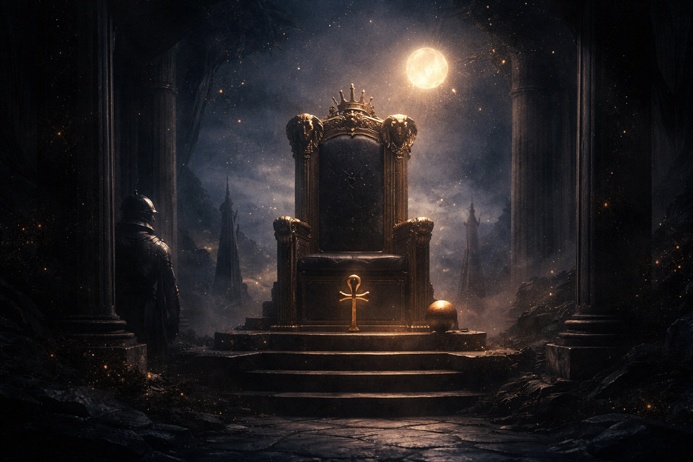
The Emperor Tarot Card Meaning expressed through a solitary golden throne illuminated by the moon, symbolizing authority and structure.
Within the broader framework of tarot card archetypes, The Emperor represents the archetype of the father principle in its governing rather than nurturing expression. This is authority that organizes, protects, and defines the limits within which others can act freely. The Emperor Tarot Card Meaning participates in the same archetypal territory as kings, lawgivers, generals, and patriarchs across centuries of symbolic tradition.
This does not mean the card is gendered in a limiting sense. The Emperor represents a quality or mode of engagement that any person can embody or encounter regardless of gender. The archetype is about the capacity to impose order on chaos, to define terms and hold them, to protect through structure rather than through warmth alone. Major Arcana symbolism uses these ancient archetypes not to prescribe social roles but to map human experiences that recur across cultures and contexts.
Placed alongside cards like The High Priestess, who represents interior knowledge and careful withholding, or The Chariot, which channels will into directed motion, The Emperor occupies a specific function. He is the card of established order, not of seeking or of questing. That stability is his contribution to the overall symbolic journey in tarot.
The Emperor’s number, four, held particular significance in medieval European cosmology, where the four elements, four humors, and four cardinal directions were understood as the basic organizing structure of physical reality, a framework that informed early symbolic readings of the card.
Spiritual Journey in Tarot and the Emperor
The spiritual journey in tarot mapped by the Major Arcana moves from The Fool’s open, unformed potential through a series of encounters with principles, figures, and forces that shape consciousness and experience. The Emperor Tarot Card Meaning at position four represents an early and significant encounter with the principle of definition. Before the seeker can advance into more complex territory, represented by cards like The Hierophant or The Lovers or The Tower, they must grapple with what it means to build something lasting.
This stage of the spiritual journey in tarot is not glamorous. Structure is rarely as compelling as mystery or transformation. But The Emperor Tarot Card Meaning addresses something fundamental: the idea that form and freedom are not simply opposites. A river without banks is only flooding. The Emperor knows this, and the card asks whether the seeker knows it too. The Emperor represents the banks.
In readings where spiritual development is the focus, The Emperor Tarot Card Meaning often appears to indicate that the next step is not more seeking but more consolidating. Something needs to be organized, clarified, committed to. The symbolic journey does not move forward only through expansion. It also deepens through definition.
Arthur Edward Waite and Pamela Colman Smith redesigned The Emperor for the 1909 Rider-Waite deck, introducing the ram-headed throne that became the most widely referenced version of the card’s imagery in English-language tarot practice throughout the twentieth century.
Editor’s Reflection
What the Emperor ultimately offers is not a single, fixed answer but a set of conditions worth examining. The Emperor Tarot Card Meaning returns, across different readings and different moments in a person’s life, to the same underlying territory: what has been built, whether it serves, and whether the authority one holds or encounters is being used with any real care. That is a quieter kind of inquiry than some cards invite, but it is rarely a trivial one.
For those who have sat with this card in a reading, certain questions tend to linger. Where does structure feel like protection in your own life, and where has it started to feel more like a wall? The Emperor Tarot Card Meaning raises different things for different people, and those differences are probably worth exploring. When authority has shown up in your experience, whether your own or someone else’s, what has made it feel legitimate rather than merely imposed?

Known as The Man Who Notices, Mike Lamp is a theatrical hypnotist and psychic performer with more than twenty years of live stage experience. His work emphasizes observation, psychological influence, and measured presentation rather than spectacle or provocation. Performances are tailored for adult audiences, private events, and professional settings where control, clarity, and atmosphere matter.



Leave a Reply
You must be logged in to post a comment.