27
Feb
The High Priestess Tarot Card Meaning: Clear Guide to Powerful Symbolism
The High Priestess Tarot Card Meaning: Essential Major Arcana Truth

The High Priestess Tarot Card Meaning illustrated through moonlight, sacred pillars, and hidden knowledge within the Major Arcana.
The High Priestess Tarot Card Meaning draws from one of the most quietly commanding figures in the Major Arcana. She sits between two pillars, one dark and one light, with a veil behind her and a crescent moon at her feet. She holds a scroll but does not open it. That is not caution. Some knowledge belongs to the mystery itself and does not pass to the reader simply because the reader has asked. Where other cards in the deck announce themselves with action or symbol-heavy imagery, the High Priestess communicates through stillness. Understanding her requires a different kind of attention, one that is less concerned with what is visible and more alert to what is being withheld.
Read Major Arcana Secrets: Shocking Dark Origins Revealed Exclusive Article
Origins and Place in the Major Arcana
The Major Arcana moves through a sequence of archetypal figures, each representing a stage or principle in a larger symbolic narrative. The High Priestess holds position two, following the Magician and preceding the Empress. That placement is not arbitrary. After the Magician demonstrates active will and outward expression, the High Priestess offers the opposite quality: inward knowing, the authority of silence, and the kind of understanding that does not need to announce itself.
Historically, the card has appeared in various forms across different tarot traditions, sometimes called the Papesse or the Female Pope, a figure that carried considerable symbolic weight in medieval and Renaissance iconography. She represented hidden wisdom and a kind of authority not derived from public office or visible power. The Rider-Waite deck, illustrated by Pamela Colman Smith and published in 1909, gave her the imagery most tarot readers recognize today. The pillars, the veil, the pomegranates, the scroll marked with the letters TORA, these are all Rider-Waite conventions that have since shaped how the card is interpreted across most modern decks.
The two pillars she sits between are labeled B and J in the Rider-Waite version, referencing Boaz and Jachin, the twin pillars of Solomon’s Temple. Their black and white coloring reinforces the card’s consistent theme: duality held in balance. The High Priestess Tarot Card Meaning is partly about that balance, the idea that wisdom does not require choosing one side over the other but rather maintaining composure between opposites.
Pamela Colman Smith, who illustrated the Rider-Waite deck including the High Priestess, was paid a one-time flat fee for her work and received no ongoing royalties. Her visual interpretation of the card became the dominant reference for nearly every English-language tarot deck published in the 20th century.
What the Symbolism Communicates
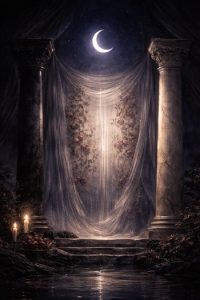
The High Priestess Tarot Card Meaning is carried through recurring symbols.
Every element of the High Priestess carries interpretive weight. The scroll she holds contains hidden knowledge, and her decision not to open it suggests that some things are revealed only when the questioner is ready. The veil behind her, decorated with pomegranates, marks a boundary between the seen and the unseen. Pomegranates in Western symbolic tradition often reference fertility, cycles, and the relationship between surface life and what lies beneath it. The crescent moon at her feet points to rhythmic change, to the kind of knowledge that comes in phases rather than all at once.
Her robe flows downward in a manner that suggests water, which in tarot symbolism is frequently associated with the unconscious mind, emotional depth, and intuitive knowledge. She wears a crown that references the lunar cycle: a full moon flanked by crescent shapes. That crown identifies her not as a ruler of earthly affairs but as someone whose domain is interior and cyclical rather than fixed and material.
The High Priestess Tarot Card Meaning is, in large part, a meditation on the value of things not yet spoken. She represents the knowledge that has not been acted on, the answer that has not yet been formed into words. For that reason, she tends to appear in readings where the situation calls for patience, observation, or a willingness to wait before moving.
The term Papesse, used for the High Priestess in early Italian tarot decks, was considered controversial enough that some 15th and 16th century card sets replaced the figure entirely with a neutral or secular substitute to avoid conflict with Church authority.
The High Priestess Upright Meaning
When drawn upright, the High Priestess signals a period of quiet attention. The High Priestess upright meaning centers on intuition, inner knowing, and the value of not forcing a resolution before one is ready to emerge. In practical terms, this card often appears when a person is being asked to trust what they sense rather than what they can immediately verify. It is a card associated with restraint in the best sense: not hesitation born of fear, but deliberate stillness that holds its ground.
The High Priestess Tarot Card Meaning in its upright orientation also points to information that has not yet surfaced. There may be facts not yet known, dynamics not yet visible, or layers of a situation that have not made themselves clear. The card does not suggest deception exactly, but it does suggest incompleteness. Acting on partial information may not serve the situation well.
She is sometimes associated with study, with accumulated knowledge, with the kind of learning that happens over time rather than in a single revelation. In that context, the High Priestess upright meaning can affirm that careful, ongoing attention to a subject will eventually produce understanding, even if that understanding is slow to arrive.
The High Priestess Tarot Card Meaning in upright position also frequently surfaces in readings connected to personal cycles, to transitions that mirror the waxing and waning of the moon rather than following a straight line. Whatever is being asked about may be in a phase of gathering rather than expressing.
The High Priestess Reversed Meaning
The High Priestess reversed meaning involves many of the same themes, but in configurations that have become blocked or distorted. Where the upright card suggests productive stillness, the reversed position can point to withdrawal that has become avoidance, or to intuitive signals that are being ignored. The knowledge the card represents is still present, but something is interfering with access to it.
The High Priestess Tarot Card Meaning in reversal sometimes indicates that external noise is drowning out quieter internal signals. The individual may be too focused on the surface of a situation to notice what is operating underneath it. Alternatively, the reversed card can point to secrecy used not as appropriate discretion but as a means of control, information withheld not because the time is not right but because someone in the situation is choosing not to share it.
There is also a version of the High Priestess reversed meaning that pertains to self-deception, to a situation where someone believes they are being patient and perceptive when they are actually avoiding something uncomfortable. The card in this position can function as a gentle but direct signal that what feels like wisdom may actually be reluctance.
The High Priestess Tarot Card Meaning when reversed does not typically indicate crisis. It points more often to a real severance, a loss of the thread that connects surface experience to whatever runs beneath it. Recognizing that drift is usually the first step toward correcting it.
The letters B and J on the pillars in the Rider-Waite deck were assigned by Arthur Edward Waite, who was a member of the Hermetic Order of the Golden Dawn. The reference to Boaz and Jachin was drawn from Freemasonic and Kabbalistic tradition, not from earlier tarot conventions.
Reading the High Priestess in Context
Reading The High Priestess Tarot Card Meaning in context asks for a slower, more interior kind of attention than most cards in the Major Arcana require.
Like all tarot card archetypes, the High Priestess gains specificity from the cards around her. Paired with a card from the Cups suit, her emphasis on inner knowing tends to take on a more emotional or relational quality. Placed near cards like the Moon or the Hermit, her themes of depth and withdrawal become even more pronounced. Near more active Major Arcana figures like the Chariot or the Tower, she can serve as a counterweight, suggesting that whatever is moving quickly in a situation would benefit from a slower, more considered response.
The spiritual journey in tarot is not a straight ascent from ignorance to enlightenment. It moves through different qualities of awareness, and the High Priestess represents one of the more demanding of those qualities. Demanding not because it is difficult to understand intellectually, but because it requires a kind of trust that does not come easily, trust in the value of what is not yet known, what is not yet said, what has not yet become clear.
Tarot card archetypes work by correspondence: readers encounter a symbol, recognize something in it, and use that recognition to think more clearly about a question or situation. The High Priestess offers a particular kind of correspondence, one that most people have experienced but may not have named. That moment of knowing something before being able to explain it, of sensing that a situation is more complex than it appears, of needing to wait before acting even when waiting is uncomfortable: These are the experiences she reflects. The High Priestess Tarot Card Meaning is, at its core, a serious and composed acknowledgment that some forms of understanding cannot be rushed.
Editor’s Reflection
What stays with most people who spend time with this card is how much it resists easy interpretation. The High Priestess Tarot Card Meaning is not something that resolves into a tidy takeaway. It asks for a different kind of engagement, one that is slower and less certain than most of us are comfortable with. That quality is what makes her one of the more enduring figures in the Major Arcana, not because she answers questions, but because she changes how questions get asked.
For those who have encountered this card in a reading, it might be worth considering what the experience of genuine patience actually feels like, as distinct from simply waiting. The High Priestess Tarot Card Meaning raises questions that are worth sitting with: whether there are moments when not knowing is itself a form of clarity, what it means to trust something that cannot yet be explained, and whether the things left unsaid in a situation sometimes carry more information than the things that have been spoken.

Known as The Man Who Notices, Mike Lamp is a theatrical hypnotist and psychic performer with more than twenty years of live stage experience. His work emphasizes observation, psychological influence, and measured presentation rather than spectacle or provocation. Performances are tailored for adult audiences, private events, and professional settings where control, clarity, and atmosphere matter.


Leave a Reply
You must be logged in to post a comment.