14
Feb
Stage Psychics: Amazing Mental Acts in Early Theater
Stage Psychics: Vaudeville’s Powerful Mental Acts

Stage psychics created compelling theatrical experiences that blurred the line between entertainment and genuine psychic phenomena
The curtain rises on a dimly lit stage. A man in formal evening wear stands before an audience, eyes closed, fingers pressed to his temples. A woman in the third row has written something on a slip of paper. Without looking, without asking a single direct question, he describes what she has written. The audience erupts.
This was the world of mental performers, performers who occupied a peculiar space in entertainment from the mid-nineteenth century through the early twentieth century. They were not quite magicians, not quite spiritual mediums, but something that borrowed from both traditions while creating its own theatrical vocabulary.
Read Peter Hurkos: Legendary Psychic Detective Biography Exclusive Article
The Vaudeville Circuit and Mental Acts
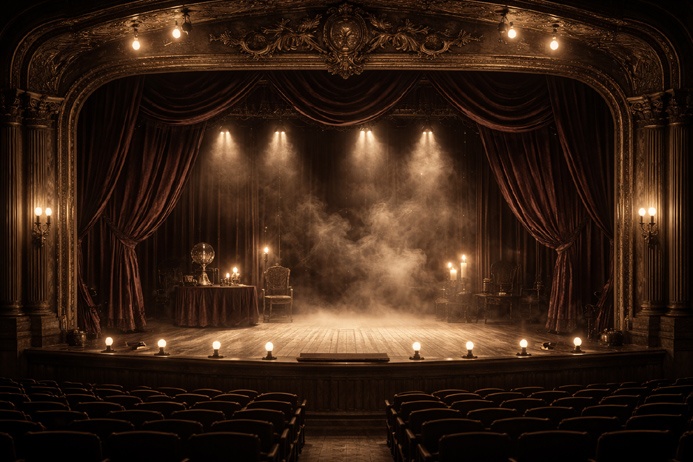
The vaudeville circuit provided stage psychics with venues designed for intimate audience interaction and dramatic presentation
Stage psychics found their most natural home in vaudeville, that sprawling network of variety theaters that dominated American entertainment from the 1880s through the 1930s. Vaudeville thrived on novelty, on acts that could hold an audience’s attention for fifteen or twenty minutes before the next performer took the stage. Mental acts, as they were often billed, fit perfectly into this ecosystem.
These performers presented what they called demonstrations of thought transference, clairvoyance, and second sight. The phrasing mattered. They were demonstrations, not tricks. The language created distance from standard magic acts, suggesting something more profound was taking place. Whether the performers themselves believed in genuine psychic ability varied considerably. Some were outright skeptics who saw their work as pure entertainment. Others occupied a more ambiguous middle ground, leaving the question of genuine ability carefully unanswered.
The typical stage psychic act followed established patterns. A performer might ask audience members to concentrate on objects, numbers, or personal details, then reveal this information through apparent mind reading. Some acts featured two performers working in tandem, with one blindfolded or positioned across the theater while the other gathered information from the audience. The blindfolded performer would then describe objects held up by audience members, read selected passages from books, or identify items removed from pockets and purses.
Washington Irving Bishop, a prominent thought reader of the 1880s, collapsed and died during a performance in 1889, leading to controversy when an autopsy was performed before his family could prevent it, as Bishop had warned he suffered from cataleptic fits that mimicked death.
Techniques and Theatrical Methods
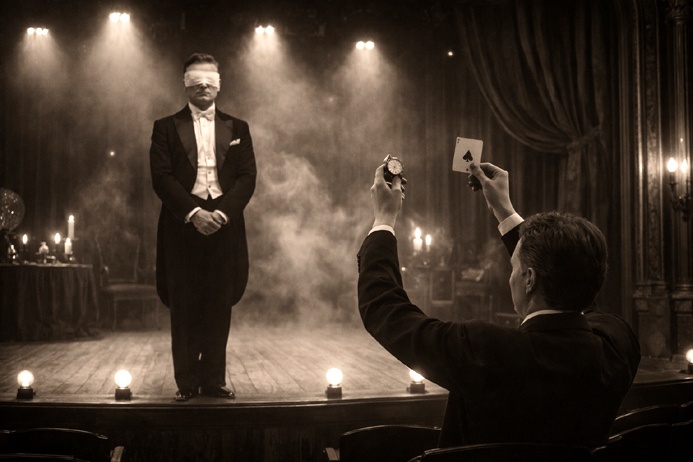
Stage psychics often worked in pairs, with one performer blindfolded while the other gathered information from audience members
Stage psychics employed a sophisticated array of methods. Some were borrowed directly from stage magic. Others came from the world of spirit mediumship. Still others were unique to the mental performance tradition.
Cold reading formed the foundation of many acts. This technique involved making general statements that seemed specific, observing audience reactions, and adjusting accordingly. A skilled cold reader could create the impression of supernatural knowledge through careful attention to clothing, body language, speech patterns, and the audience member’s responses to preliminary statements.
Hot reading represented a more calculated approach. Information about audience members was gathered before the performance through various means. In smaller towns, a performer’s advance agent might spend time in local establishments, gathering gossip and personal details. Theater staff could be enlisted to observe and report. Even the act of purchasing tickets could provide useful data if the box office staff were cooperative.
The two-person telepathy acts relied on elaborate verbal and physical codes. These systems allowed one performer to communicate detailed information to another through seemingly innocent patter, the precise wording of questions, coughs, pauses, or subtle physical movements. The codes could be remarkably complex, developed over years of performance and capable of transmitting specific details with considerable accuracy.
Some mental performers incorporated actual sensory capabilities that appeared supernatural but were simply highly trained or unexpected. A few performers developed unusually acute hearing through practice and could detect sounds most people would miss Others had trained their peripheral vision to observe things while appearing to look elsewhere or even while genuinely blindfolded, depending on how the blindfold was applied.
The Piddington mental act, popular in the 1940s and 1950s, demonstrated thought transference over radio broadcasts, adapting stage psychic techniques to the new medium and reaching millions of listeners who debated whether the demonstrations were genuine.
The Distinction from Spirit Mediums
Stage psychics occupied different cultural territory than spiritual mediums, though the boundary between them was not always clear. Mediums operated primarily in the context of spiritualism, communicating with the deceased and providing comfort or closure to the bereaved. Their work was explicitly religious or spiritual in nature.
Stage psychics performed in commercial entertainment venues. They were paid performers with scheduled showtimes, not spiritual counselors conducting private sittings. This distinction mattered legally and culturally. Entertainment enjoyed more protection from fraud accusations than did spiritualist practice, which was periodically targeted by skeptics and authorities.
That said, some performers crossed between both worlds. A person might perform mental acts in vaudeville theaters while also conducting private sittings with clients seeking spiritual guidance. The techniques often overlapped, even as the context and claimed purpose differed.
Notable Performers and Their Influence
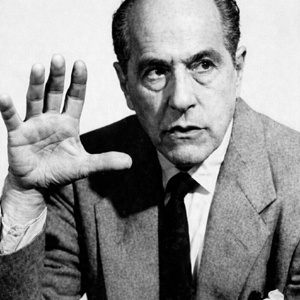
Joseph Dunninger one of the most well known Stage psychics
Joseph Dunninger became one of the most successful stage psychics of the early twentieth century. His performances emphasized telepathy and psychic phenomena, and he worked extensively in vaudeville before transitioning to radio and eventually television. Dunninger publicly challenged anyone to prove he used confederates or codes, offering substantial rewards, but he never claimed supernatural powers instead positioning his work as genuine mind reading achieved through natural, if extraordinary, mental ability.
The married team of Julius and Agnes Zancig performed as The Zancigs, presenting elaborate demonstrations of thought transference. Their act featured Julius in the audience handling objects while Agnes, blindfolded on stage, described them in precise detail. They performed internationally and were examined by serious psychical researchers, some of whom believed the couple possessed genuine telepathic abilities. The Zancigs never publicly revealed their methods during their active performing years.
Anna Eva Fay occupied an interesting position in this landscape. She presented mental phenomena and spirit cabinet effects, sometimes framing them as spiritualist demonstrations and other times as theatrical performance. Significantly, magicians who examined her work, including John Nevil Maskelyne, could not definitively explain her methods, which added to her credibility in both spiritualist and theatrical circles. Her career spanned from the 1870s into the early twentieth century, and she adapted her presentation based on audience and venue. Fay’s willingness to shift between spiritualist and entertainment contexts illustrated the fluid boundaries of the era.
Read 19th Century American Spiritualism: The Hidden Movement Exclusive Article
The Golden Age and Gradual Decline
The period from roughly 1880 to 1930 represented the peak years for stage psychics in vaudeville and variety theater, though earlier decades saw significant second-sight acts in different performance contexts. Vaudeville provided consistent work and good pay for successful acts. Public interest in psychic phenomena remained high, fueled by the spiritualist movement and widespread curiosity about the boundaries of human capability.
Several factors contributed to the gradual decline of these acts. Vaudeville itself collapsed during the 1930s, unable to compete with motion pictures and radio. The performance venues that had sustained stage psychics simply disappeared. Some performers transitioned to radio, where mental acts could be adapted to the new medium, but the visual elements that made stage demonstrations compelling were lost.
Public attitudes also shifted. The exposure of fraudulent mediums and psychics became more common and more widely publicized. Skeptical investigators, some of them former magicians, demonstrated the techniques used by mental performers. While this had always occurred to some extent, the scale and reach of these exposures increased. The sense of mystery that surrounded stage psychics diminished as methods became better understood.
The term “muscle reading” described a technique where performers detected unconscious muscular movements in subjects who knew the location of hidden objects, allowing the performer to be “led” to the correct location through subtle physical cues.
Legacy in Modern Performance
Stage psychics left their mark on contemporary entertainment, though the terminology has changed. Modern mentalists perform what are essentially updated versions of the classic mental acts. They present demonstrations of mind reading, prediction, and psychological influence, typically framing their work as a combination of psychology, suggestion, and observation rather than supernatural ability.
The techniques developed by early stage psychics remain in use. Cold reading is taught and practiced. The basic structures of two-person telepathy acts continue to appear, refined with contemporary technology when desired. The fundamental tension between performance and belief, between explaining methods and preserving mystery, persists in modern mentalism.
The historical importance of stage psychics extends beyond their entertainment value. They represented a moment when theatrical performance engaged directly with profound questions about consciousness, perception, and human capability. They created space for audiences to wonder, to question, and to experience carefully constructed ambiguity about what was possible.
Understanding the Appeal
Why did audiences find stage psychics compelling? The obvious answer points to spectacle and mystery, but something deeper was at work. These performances offered a temporary suspension of ordinary rules. They suggested that consciousness might operate in ways not yet fully understood, that information might transfer through means beyond the conventional senses.
This was not necessarily about belief in the supernatural. Many audience members probably understood they were watching skilled performance. The appeal lay partly in the craft itself, in witnessing something executed with such precision that the methods remained invisible. There was pleasure in not quite knowing how it was done, even while suspecting a technical explanation existed.
Stage psychics also offered something that standard magic acts could not. Magic was openly theatrical, clearly presented as illusion. Mental demonstrations occupied more ambiguous ground. They touched on experiences most people had encountered in daily life moments of unexpected intuition, of thinking about someone just before they appeared, of knowing what someone would say before they said it. Mental performers took these common experiences and amplified them into theatrical form.
The performances created a temporary community of shared experience. An entire theater audience witnessed the same demonstration, reacted together, and left with the same questions. This collective aspect of the experience mattered in an era before mass media made shared cultural experiences commonplace.
The era of classic stage psychics has passed, replaced by different forms and different cultural contexts. But the fundamental elements they explored the nature of perception, the transmission of information, the boundary between performance and reality remain endlessly fascinating. They remind us that entertainment can be more than simple diversion, that it can engage with deeper questions while still providing the spectacle and surprise that makes theater memorable.
Read Houdini Debunking Psychics: The Ruthless Truth Exclusive Article
Editor’s Reflection
The performers who worked as stage psychics understood something fundamental about the relationship between audience and entertainer. They knew that the most compelling performances exist in the space between explanation and mystery, where technical skill becomes indistinguishable from something more. Whether they believed in their own abilities or saw themselves purely as theatrical craftspeople, they created experiences that allowed audiences to question the boundaries of perception and consciousness. That tradition of carefully constructed ambiguity shaped not just entertainment, but how people thought about the mind itself.
What draws us to performances that refuse to fully explain themselves? When stage psychics stood before audiences a century ago, were people hoping to witness genuine phenomena, or were they more interested in the pleasure of not quite knowing? And perhaps more importantly, does our current era with its emphasis on exposure and explanation lose something that those earlier audiences understood about the value of sustained wonder? These questions don’t have simple answers, but they’re worth considering when we look back at what these performers accomplished and why their work still resonates.

Known as The Man Who Notices, Mike Lamp is a theatrical hypnotist and psychic performer with more than twenty years of live stage experience. His work emphasizes observation, psychological influence, and measured presentation rather than spectacle or provocation. Performances are tailored for adult audiences, private events, and professional settings where control, clarity, and atmosphere matter.




Leave a Reply
You must be logged in to post a comment.