26
Jan
Powerful Truth: Suggestion in the Human Mind Explained
How Suggestion in the Human Mind Takes Root
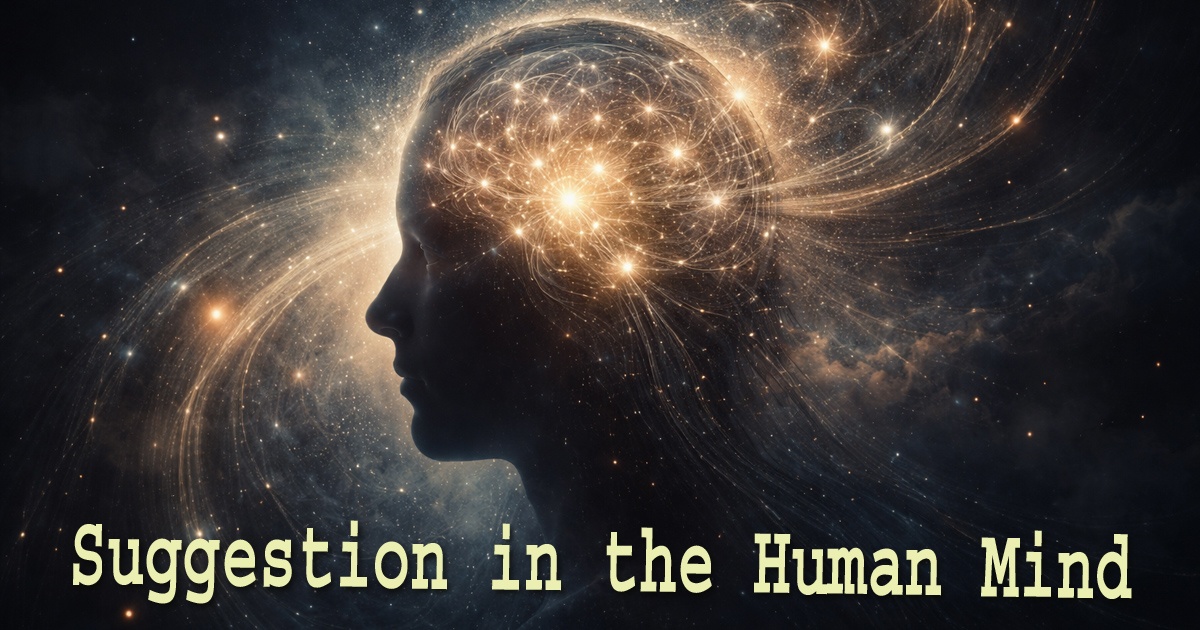
A visual metaphor for suggestion in the human mind, showing how subtle ideas form, connect, and quietly influence thought.
The process by which an idea enters consciousness and settles into belief has occupied researchers, clinicians, and philosophers for more than a century. Suggestion in the human mind operates through mechanisms both subtle and powerful, shaping not only what we think but how we interpret reality itself. This examination considers how thoughts offered by external sources or generated internally can take hold, influence perception, and ultimately guide behavior.
Read History of Hypnosis Explained: The Surprising Truth
The Basic Nature of Suggestion
Suggestion in the human mind begins with presentation. An idea, image, or statement is introduced into awareness through conversation, observation, reading, or internal thought. What distinguishes suggestion from mere information is its tendency to bypass critical evaluation and settle directly into the belief structure. The process doesn’t require force or repetition, though both can strengthen its effects.
Psychologists in the late nineteenth and early twentieth centuries observed that suggestion in the human mind followed patterns. Pierre Janet and others noted that certain mental states relaxation, distraction, emotional arousal, or fatigue created conditions where suggestions encountered less resistance. The conscious mind, preoccupied or temporarily quieted, allowed ideas to pass through with minimal scrutiny.
This phenomenon appears in everyday life far more often than most people realize. A friend mentions feeling a draft, and suddenly you notice the room feels cold. A news report describes a symptom, and within hours you detect it in yourself. These are not examples of gullibility but demonstrations of how psychological suggestion operates within normal cognitive function.
The Nancy School of hypnosis, led by Hippolyte Bernheim in the 1880s, argued that hypnotic phenomena resulted entirely from suggestion rather than from any special magnetic or physiological state, a position that eventually became the dominant scientific view.
How Suggestion Works Within Mental Architecture
The human mind processes thousands of inputs daily, filtering most while allowing certain elements through to conscious awareness. Suggestion in the human mind succeeds when it aligns with existing beliefs, arrives during moments of reduced critical assessment, or carries emotional weight that overrides analytical thinking.
Cognitive researchers have identified several factors that determine whether a suggestion takes root. Expectation plays a significant role. When people anticipate a particular outcome, suggestions that support that expectation integrate more easily into their belief system. Authority also matters. Ideas presented by trusted sources, experts, or figures in positions of power encounter less internal resistance than those from unfamiliar or discredited sources.
Repetition strengthens suggestion but isn’t required for initial acceptance. A single powerful suggestion delivered at the right moment can establish itself permanently. The effectiveness depends less on frequency and more on the mental state of the recipient and the skill with which the suggestion is framed.
Mental suggestion processes involve both conscious and unconscious processing. The conscious mind may accept or reject an idea based on logic and evidence. But suggestions that reach deeper levels of awareness often bypass this checkpoint entirely, settling into the unconscious where they influence thought and behavior without triggering critical examination.
The Role of Belief Formation
Suggestion and belief formation share an intimate relationship. Beliefs rarely emerge fully formed from pure reasoning. Instead, they develop through accumulated experience, social influence, and critically accepted suggestions. A child told repeatedly that she has a good memory may develop confidence in that ability, which then affects how she approaches learning. An adult convinced through subtle social cues that certain foods are unhealthy may experience genuine digestive discomfort when consuming them, even if the foods themselves pose no biological threat.
This demonstrates how suggestion in the human mind doesn’t merely add information to existing knowledge but actively shapes the framework through which new information is interpreted. Once a belief forms through accepted suggestion, it creates a filter. Subsequent experiences are evaluated based on whether they confirm or challenge that established belief, with confirming evidence typically receiving more weight.
Researchers studying suggestion and belief formation have documented this in clinical settings. Patients given inert substances while being told they will experience specific effects often report those exact effects. The suggestion establishes an expectation, the expectation primes perception, and perception confirms the belief. The cycle reinforces itself, making the suggestion increasingly resistant to contradiction.
During World War I, military physicians observed that soldiers exposed to identical combat conditions showed vastly different psychological responses, leading researchers to investigate how individual susceptibility to traumatic suggestion varied based on pre-existing mental frameworks.
Mental Pathways of Influence
The influence of suggestion extends beyond simple belief acceptance into the realm of perception itself. Studies conducted throughout the twentieth century showed that suggestion could alter sensory experience, pain perception, memory recall, and even physiological responses. Hypnosis research provided particularly clear evidence, as subjects under hypnotic suggestion demonstrated measurable changes in blood flow, skin temperature, and immune response all initiated by nothing more than carefully worded ideas.
The influence of suggestion operates through several mechanisms. Direct suggestion states an idea explicitly: “You will feel relaxed.” Indirect suggestion embeds the idea within a larger context or frames it as a possibility: “Some people find that focusing on their breathing helps them feel more relaxed.” Both approaches can produce similar results, though indirect suggestion often encounters less conscious resistance.
Social influence represents another pathway. People unconsciously mirror the behaviors, attitudes, and beliefs of those around them. Group dynamics amplify this effect. Ideas that might seem questionable to an individual considered alone become more plausible when endorsed by multiple trusted figures within a social context.
Suggestion and Conscious Resistance
Not all mental suggestion processes succeed. The conscious mind maintains protective functions that evaluate incoming information for consistency, plausibility, and potential threat. Strong suggestions that conflict sharply with core beliefs or observable reality typically trigger rejection or at minimum careful scrutiny.
However, resistance itself can be circumvented through skillful design of how suggestion works. Therapeutic hypnosis, for example, often begins with suggestions that are undeniably true and easily accepted: “You are sitting in this chair. You can hear my voice.” These accepted suggestions build a pattern of agreement, making subsequent suggestions more likely to pass through conscious filters.
Psychological suggestion becomes more effective when it works with existing inclinations rather than against them. A person already interested in improving sleep quality will accept sleep-related suggestions more readily than someone who feels their sleep is adequate. The suggestion amplifies existing desire rather than creating desire from nothing.
Historical Context and Modern Understanding
Early researchers into suggestion in the human mind worked primarily with hypnosis and crowd psychology. Gustave Le Bon described how individuals within crowds became susceptible to suggestions they would reject in isolation. Émile Coué developed a system of therapeutic autosuggestion based on the principle that repeated positive statements could reshape unconscious beliefs.
These pioneers understood something fundamental: suggestion in the human mind doesn’t require exotic circumstances to function. It operates continuously, shaping experience in ways both trivial and profound. Modern cognitive science has added detail to these observations without fundamentally altering the basic understanding.
Contemporary research examines suggestion through frameworks like priming, anchoring, and confirmation bias. The terminology has evolved, but the underlying phenomenon remains consistent. Ideas introduced under the right conditions settle into the belief structure and subsequently influence perception, interpretation, and behavior.
The placebo effect, documented systematically in clinical trials beginning in the 1950s, demonstrated that suggestion could produce measurable physiological changes including pain reduction, altered heart rate, and modified immune responses even when patients knew they were receiving inert substances.
Practical Implications
Understanding suggestion and belief formation carries practical significance. Therapeutic applications use suggestion deliberately to help clients overcome phobias, manage pain, change unwanted habits, and build confidence. The same mechanisms that allow harmful suggestions to take root can be redirected toward beneficial outcomes.
Mental suggestion processes also operate in less formal contexts. Advertising relies heavily on suggestion, presenting products alongside images and concepts that bypass analytical thinking and create positive associations. Political messaging uses suggestion to shape public opinion, often framing issues in ways that predetermine acceptable conclusions.
Awareness of these processes doesn’t necessarily prevent suggestion from working. Even people who understand suggestion mechanisms remain susceptible to them. But awareness does provide a degree of choice about which suggestions to entertain and which to examine more carefully before acceptance.
The Question of Autonomy
One persistent concern about suggestion in the human mind involves personal autonomy. If beliefs and perceptions can be shaped through external suggestion, to what extent do individuals control their own thinking? This question has ethical dimensions, particularly regarding therapeutic suggestion, advertising, and political influence.
The evidence suggests that while suggestion is powerful, it operates within limits. People cannot be compelled through suggestion alone to act against fundamental values or survival instincts. Hypnotic subjects, despite popular mythology, retain the capacity to reject suggestions that violate their moral principles or endanger themselves.
Nevertheless, the boundary between influence and autonomy remains imprecise. Suggestion in the human mind works most effectively when the recipient doesn’t recognize the process occurring. Transparent suggestion often triggers resistance, while covert suggestion slips past defenses more easily. This creates ongoing tension between legitimate persuasion and manipulation.
Editor’s Reflection
What becomes clear through examining these mechanisms is that suggestion in the human mind represents neither a flaw in human reasoning nor evidence of unusual susceptibility. It’s simply how consciousness operates taking in information, filtering some elements, allowing others to settle, and constructing from all of this a coherent sense of reality. The process continues whether we acknowledge it or not, shaping experience in ways both profound and mundane.
This raises questions worth sitting with. How much of what we consider personal conviction emerged from our own thinking, and how much took root through external suggestion we’ve since forgotten? When we encounter ideas that challenge comfortable beliefs, are we evaluating them fairly or simply protecting suggestions that arrived earlier? And if we can’t entirely escape the influence of suggestion, what responsibility do we bear both for the suggestions we accept and for those we offer to others?

Known as The Man Who Notices, Mike Lamp is a theatrical hypnotist and psychic performer with more than twenty years of live stage experience. His work emphasizes observation, psychological influence, and measured presentation rather than spectacle or provocation. Performances are tailored for adult audiences, private events, and professional settings where control, clarity, and atmosphere matter.



Leave a Reply
You must be logged in to post a comment.