2
Jan
History of Hypnosis Explained: The Surprising Truth
History of Hypnosis Uncovered: Facts vs Fiction

Visual representation of mental focus associated with hypnosis
Hypnosis has existed in one form or another for as long as people have sought relief from pain, fear, and uncertainty. What we now recognize as focused attention and heightened suggestion once appeared under many names, often tied to religion, ritual, or healing traditions. Long before it had a formal label, people understood that the mind could influence the body in powerful ways.
The History of Hypnosis is not a straight line of progress, but a series of rediscoveries. Ideas were embraced, dismissed, and later revived under new explanations. Practices that seemed mystical in one century were later studied scientifically in another, often producing the same results through different language and frameworks.
Understanding the History of Hypnosis helps separate fact from folklore. It shows how cultural beliefs shaped what people thought hypnosis was capable of doing, and why misunderstandings persist today. By looking at where hypnosis came from, it becomes easier to understand what it truly is, and what it is not.
Some medical schools briefly taught hypnosis as a required subject in the late nineteenth century.
Ancient and Early Roots
Long before hypnosis had a name, altered states of attention were part of everyday life in early civilizations. People entered trance-like conditions through chanting, rhythmic movement, drumming, fasting, and guided storytelling. These experiences were not viewed as unusual. They were accepted tools for healing, guidance, and spiritual connection.
In many ancient cultures, healing was inseparable from belief. Illness was often seen as a disturbance of balance rather than a physical defect alone. By focusing the mind through ritual and expectation, healers aimed to restore that balance. The power of suggestion worked quietly, reinforced by authority, ceremony, and shared belief.
Sleep temples and sacred healing spaces appeared across the ancient world. Individuals seeking relief would rest in controlled environments designed to calm the senses and narrow attention. Dreams, visions, and symbolic experiences were interpreted as messages that could lead to recovery. While explanations varied, the mental process was consistent.
These early practices form the foundation of the History of Hypnosis. They show that focused attention and responsiveness to suggestion were recognized long before science tried to explain them. What later generations would debate as theory was, for ancient people, simply a practical way to influence the mind and body together.
Mesmer and Animal Magnetism
By the late eighteenth century, hypnosis re-entered public awareness through the work of Franz Anton Mesmer, an Austrian physician who believed a natural force flowed through all living things. He called this force animal magnetism and claimed that illness resulted when its flow was blocked. Mesmer used magnets, hand movements, and intense eye contact to restore balance, often producing dramatic physical and emotional reactions in his patients.
Mesmer’s sessions were theatrical and highly structured. Patients gathered around a tub filled with metal rods, music played softly, and Mesmer moved among them directing their attention and expectation. Many participants reported relief from pain or emotional distress, while others experienced convulsions or deep trance-like states. These results drew large crowds and fierce criticism in equal measure.
Scientific authorities of the time investigated Mesmer’s claims and rejected the idea of animal magnetism as a physical force. However, they could not ignore the observable effects on patients. What Mesmer misidentified as magnetism was later understood as suggestion, focused attention, and social influence acting on the mind.
This period marked a turning point in the History of Hypnosis. Although Mesmer’s theory was discarded, his methods forced medicine and science to confront the reality that belief and expectation could produce real, measurable change. The debate shifted from whether the effects existed to how they worked.
Hypnosis Enters Medicine
During the nineteenth century, hypnosis began to move out of salons and public demonstrations and into hospitals and medical schools. Physicians started to separate the observable effects from Mesmer’s discarded theories and study the mental state itself. This shift marked the first serious attempt to treat hypnosis as a clinical tool rather than a spectacle.
Doctors such as James Braid observed that focused attention and fixation could reliably produce a trance-like condition. Braid rejected animal magnetism entirely and introduced the term hypnotism, linking the experience to natural psychological processes. Under hypnosis, patients showed reduced pain, altered sensation, and increased responsiveness to suggestion, all without mystical explanations.
One of the most significant medical uses of hypnosis during this period was pain control during surgery. Before chemical anesthesia became widely available, surgeons successfully performed operations using hypnotic suggestion alone. Patients remained conscious yet reported little or no pain, a result that challenged prevailing assumptions about both medicine and consciousness.
This era represents a crucial stage in the History of Hypnosis. Hypnosis was no longer defended as a mysterious force, but examined as a measurable mental condition with practical value. Even as anesthesia replaced it in surgery, hypnosis secured a lasting place in medical and psychological study.
In the early 1800s, hypnosis was used in dentistry before ether anesthesia became common.
Psychology and the Modern Mind
As psychology emerged as a formal discipline in the late nineteenth and early twentieth centuries, hypnosis found a new framework for explanation. Researchers and clinicians began to view hypnotic states as variations of normal attention rather than altered consciousness caused by external forces. This perspective allowed hypnosis to be studied alongside memory, perception, and behavior.
Early psychologists explored how suggestion could influence thought patterns, habits, and emotional responses. Hypnosis became a tool for examining the unconscious mind, especially in the treatment of phobias, trauma, and compulsive behavior. While theories differed, most agreed that the subject’s willingness and focus were central to the process.
The rise of psychoanalysis and later behavioral psychology shifted how hypnosis was used and understood. Some schools embraced it as a shortcut to deeper mental material, while others dismissed it as unnecessary or unreliable. Despite these debates, clinical results continued to support its usefulness when applied carefully.
Within the History of Hypnosis, this period represents maturation rather than reinvention. Hypnosis was no longer fighting for legitimacy as a phenomenon. Instead, it was being refined, limited, and integrated into broader psychological practice, where it remains today.
Stage Hypnosis and Public Perception
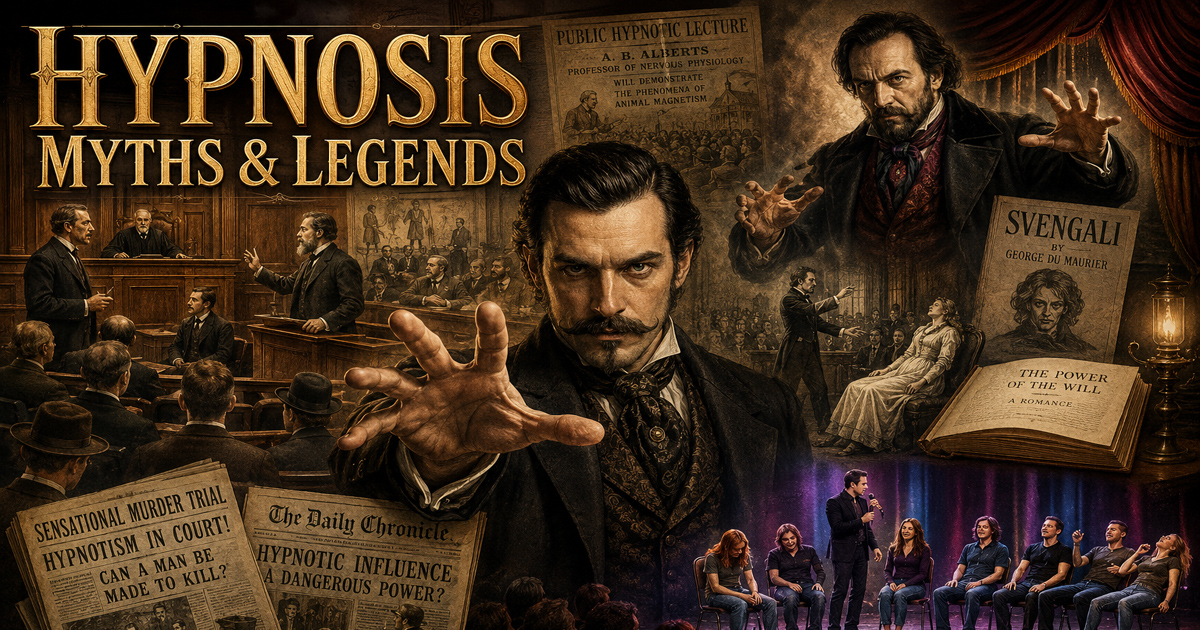
As hypnosis entered popular culture, it took on a second life as public entertainment. Stage hypnosis emphasized humor, surprise, and exaggerated behavior, often blurring the line between psychology and performance. Audiences were shown volunteers responding dramatically to suggestion, which shaped how hypnosis was understood outside clinical settings.
This entertainment format created lasting misconceptions. Many people came to believe hypnosis involved mind control or loss of free will, when in reality participants were willing and responsive collaborators. The show depended as much on personality, pacing, and audience management as on hypnotic technique itself.
Well-known performers such as Jim Rose and Bob Gale helped define the modern stage hypnosis format, blending psychology with sharp showmanship. Others followed similar paths, each adapting the act to suit changing audiences while keeping the core principles intact. In more recent years, performers like Mike Lamp have focused on explaining the process alongside the performance, pushing back against older myths.
Within the History of Hypnosis, stage work played a complicated role. It kept hypnosis visible and culturally relevant, but often at the cost of accuracy. While entertainment shaped public perception, it also ensured that hypnosis never disappeared from public awareness, allowing serious discussion to resurface again and again.
Hypnosis Today
Today, hypnosis is used across a wide range of professional settings, from medical offices to therapy rooms and performance venues. It is applied to pain management, stress reduction, habit change, and performance improvement, often alongside conventional treatment rather than in place of it. Modern practitioners emphasize informed consent, cooperation, and clear goals.
Clinical hypnosis is now supported by decades of research showing measurable effects on perception, behavior, and physical response. Hospitals and licensed therapists use it to help patients manage chronic pain, anxiety, and recovery. The language has become more careful, focusing on evidence and outcomes rather than dramatic claims.
Public understanding has also improved, though misconceptions remain. Educational efforts, ethical standards, and professional organizations have helped separate legitimate practice from exaggerated portrayals. People are more likely to encounter hypnosis today through therapy or structured programs than through spectacle alone.
In the History of Hypnosis, the present era reflects balance. Hypnosis is no longer treated as a cure-all or a mystery, but as a practical method grounded in psychology and experience. Its survival into modern practice suggests that, when stripped of excess claims, it continues to meet real human needs.
Hypnosis research contributed to early studies of placebo effects long before the term existed.
Conclusion
The History of Hypnosis shows a pattern of persistence rather than trend. Across centuries, methods and explanations changed, but the underlying principle remained the same: focused attention can influence human experience in meaningful ways. Each era reinterpreted hypnosis through its own beliefs, leaving behind both progress and confusion.
Looking at the History of Hypnosis as a whole makes clear why misunderstandings still exist. Hypnosis has been shaped by religion, medicine, entertainment, and psychology, often at the same time. Understanding that layered past allows modern practice to move forward with clarity, restraint, and respect for what hypnosis can realistically offer.
📘 Theory & History of Hypnosis (Kindle Edition)

Theory & History of Hypnosis
Master the roots of therapeutic hypnosis, from ancient ritual practice to modern clinical application, in this essential theoretical guide by Artem Kudelia, PhD.
Hypnosis has fascinated and perplexed thinkers for centuries. In Theory & History of Hypnosis, the reader is guided through the full intellectual evolution of trance work, from early shamanic traditions to the structured psychological frameworks used in professional hypnotherapy today.
🌿 Imagine confidently guiding clients into therapeutic trance states, supported by knowledge grounded in history and refined through modern psychology.
This book traces the History of Hypnosis through its major turning points, including the contributions of Mesmer, Charcot, Freud, and Erickson. It examines hypnotic phenomena, personality traits related to hypnotizability, ethical considerations, and clinical relevance across trauma recovery, pain management, and psychotherapy.
In this book, you’ll learn how to:
- Explore hypnosis’s evolution from mystical rituals to clinical applications.
- Understand personality profiles that influence the History of Hypnosis.
- Analyze real-world case studies across therapeutic settings.
- Build a solid theoretical foundation before advancing to hands-on hypnotherapy training.
What makes this book stand out:
- ✔ Deep historical analysis of hypnosis and its key figures.
- ✔ Strong clinical relevance for modern hypnotherapy practice.
- ✔ Authoritative perspective from an experienced psychologist and hypnotherapist.
💡 Ideal for newcomers and experienced practitioners alike, this book provides clarity, structure, and intellectual depth essential for serious study.
Further Reading & Resources
📖 Read: History of Hypnosis – Franz Anton Mesmer
🔍 Explore: History of Hypnosis – Wikipedia

Known as The Man Who Notices, Mike Lamp is a theatrical hypnotist and psychic performer with more than twenty years of live stage experience. His work emphasizes observation, psychological influence, and measured presentation rather than spectacle or provocation. Performances are tailored for adult audiences, private events, and professional settings where control, clarity, and atmosphere matter.



Leave a Reply
You must be logged in to post a comment.