22
Sep
Hypnotic Amnesia and the Puzzling Power to Forget
Hypnotic Amnesia: The Strange Truth About Forgetting Under Hypnosis
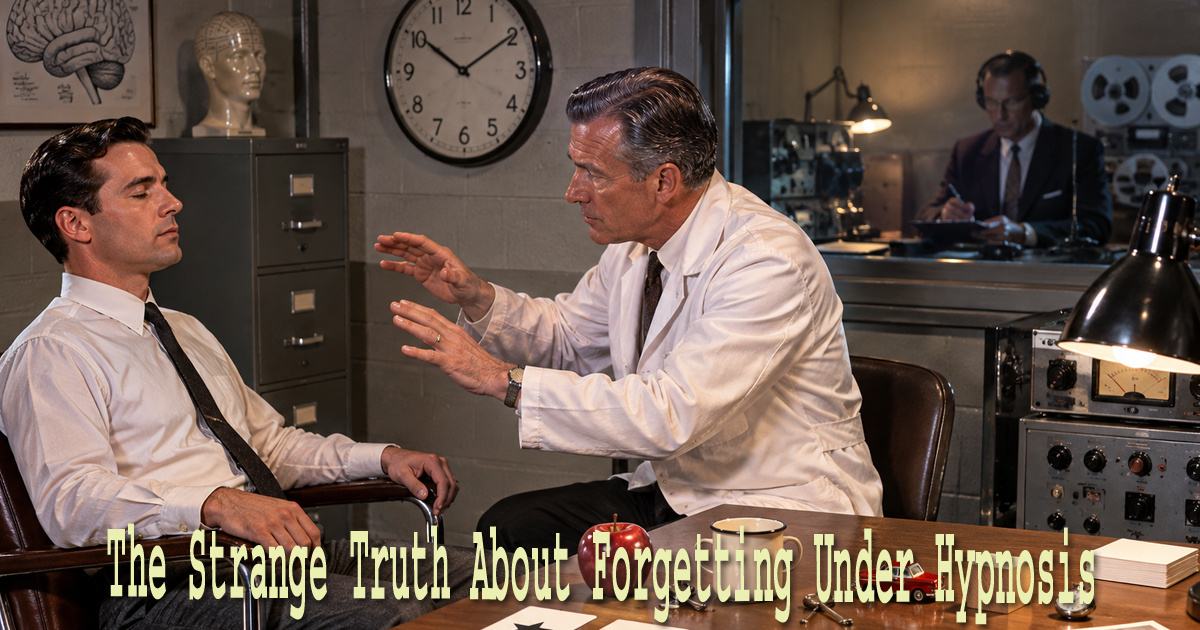
Hypnotic amnesia research examines how suggestion can temporarily change a person’s ability to recall information.
Hypnotic amnesia is one of the most puzzling effects ever studied in the science of suggestion. A person can be shown information, told to forget it, and then genuinely fail to recall it moments later. Anyone who has spent real time on a stage or in a hypnosis chair has watched this happen firsthand. What makes the effect so compelling is not that people forget. It is that the forgetting can often be lifted with a single cue, as if a door had simply been closed and then reopened.
What Is Hypnotic Amnesia?
A hypnotist who has worked with hundreds of subjects learns to recognize a very specific look. The subject searches for something they clearly know, and it simply will not surface. That search, not a blank stare, is the real signature of the effect.
In formal terms, this describes a temporary inability to recall specific information after a suggestion given during hypnosis. The person is often told they will forget certain words, events, or experiences once the session ends. In practice the block is usually precise. A subject may lose access to one list of words while remembering everything else from the session with complete clarity.
This has been documented since the earliest formal studies of hypnosis, and any experienced practitioner will confirm it holds up session after session. It is not a matter of inattention. It is a targeted disruption of retrieval, not of learning.
Hypnotic Time Distortion: The Strange Power of Altered Time
Hypnotic Amnesia Is Not Ordinary Forgetting
Laypeople often assume forgetting under hypnosis looks the same as misplacing your keys. It does not. Ordinary forgetting happens because information was never encoded strongly in the first place. A person loses track of where they set their keys because they were not paying attention when they set them down.
A practitioner watches for something entirely different. The subject was clearly attentive during the learning moment, often visibly engaged, yet the material becomes inaccessible the instant the suggestion takes hold. Researchers call this a functional amnesia. It resembles the memory disruptions seen in dissociative conditions, but without any underlying injury to the brain. Nothing has been damaged. Access has simply been closed off for a period of time.
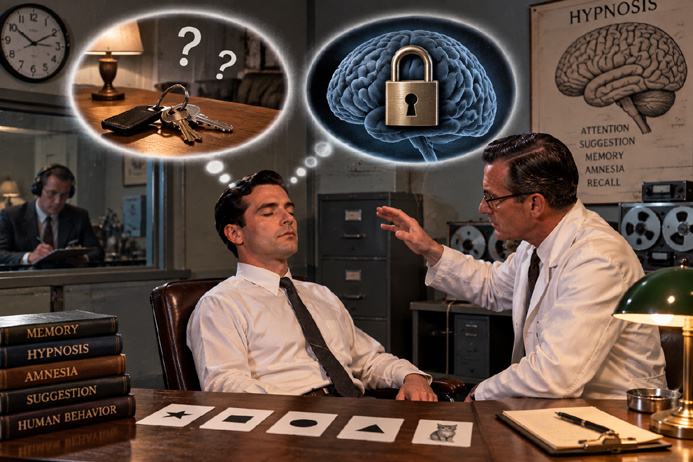
Hypnotic amnesia differs from ordinary forgetting because the memory may still be stored while access to it is temporarily blocked by suggestion.
How an Amnesia Suggestion Works
Producing this response is not as simple as reciting a line and expecting compliance. An experienced hypnotist builds toward it. Rapport comes first, since a subject who does not trust the hypnotist rarely lets go enough to respond fully.
Pacing matters just as much. Suggestions delivered too quickly, before the subject has settled into a receptive state, tend to produce weak or partial results. A skilled practitioner slows down, uses calm and confident wording, and reads the subject’s physical responses before introducing the forgetting instruction at all.
Wording itself carries weight. A vague or hesitant suggestion invites a vague or hesitant response. A clear, calmly delivered instruction, given once the subject is genuinely ready, tends to produce the cleanest results. None of this is guesswork. It is a skill built through repetition, much like tuning an instrument by ear rather than by formula.
Subject readiness is the final piece. Some people arrive already primed for a strong response, often due to natural suggestibility or prior hypnotic experience. Others need more time and a gentler approach before the same instruction will take hold.
Why Some People Respond More Strongly Than Others
Anyone who has worked with large groups notices the pattern almost immediately. In a room of thirty volunteers, a handful will drop into a deep, highly responsive state within minutes. Others will follow instructions cooperatively but show only a partial effect, if any at all.
This lines up closely with what researchers have measured for decades using standardized hypnotizability scales. People who score higher on these scales are far more likely to experience convincing memory suppression under suggestion. Those same highly responsive individuals also tend to show the cleanest recovery once the block is lifted.
A practitioner learns to spot likely candidates early, often before the induction even begins. Breathing changes, eye behavior, and how readily a subject follows small preliminary suggestions all offer clues. This is observation built from repetition, and it consistently matches what the research has found in controlled settings.
Is the Memory Actually Gone?
This is the question every serious practitioner gets asked constantly, usually right after a demonstration. The honest answer, backed by both experience and research, is no. The material has not been erased.
Anyone who has reversed the effect has seen this directly. The moment recall returns, subjects frequently report the memory arriving whole, not rebuilt piece by piece. That immediacy is telling. If the information had truly been destroyed, there would be nothing for it to snap back into.
Laboratory studies support this same conclusion through more formal means. Subjects often relearn previously blocked material faster than brand new material, even while insisting they have no memory of it. Word association tasks show the same pattern, with forgotten information quietly influencing behavior beneath conscious awareness. The material appears to remain stored. Access to it is simply restricted for a period of time.
Powerful Truth: Suggestion in the Human Mind Explained
What Happens When the Amnesia Is Reversed?
The reversal moment is often the most striking part of the entire process to witness. A single prearranged cue, agreed upon before the suggestion was ever given, restores full recall almost instantly in responsive subjects.
Watching this happen never quite loses its impact, even after doing it many times. A subject who moments earlier insisted they remembered nothing will suddenly recount the blocked material in full detail, often with visible surprise at how completely it had been hidden from them.
This reliable reversal is one of the clearest signs that the effect touches retrieval rather than storage. If the underlying memory were gone, no cue could bring it back. The fact that recall returns so consistently tells us the information was present the entire time, simply waiting behind a closed door.
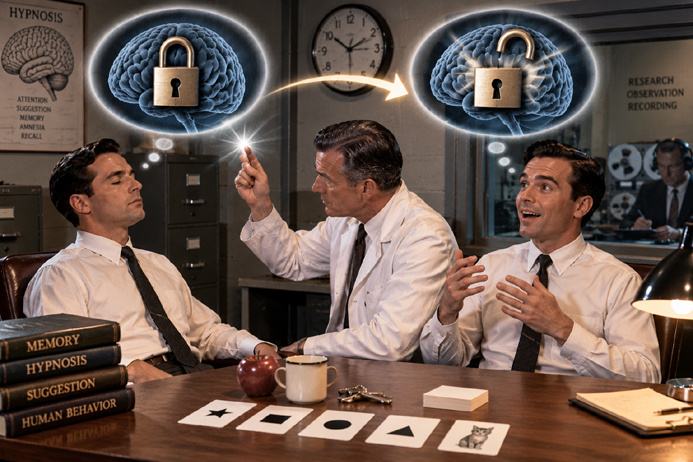
Hypnotic amnesia can reverse rapidly when the agreed-upon cue is given, showing that the memory was still stored even while conscious recall was temporarily blocked.
What Brain Research Has Found
Brain imaging and EEG studies have added real depth to this topic in recent decades. Researchers have used event related potentials, a method that measures the brain’s electrical response to stimuli, to study attention and recognition during suggested forgetting.
Several studies found that highly hypnotizable subjects who reported this effect showed measurable changes in brain activity linked to attention and recognition. These changes were not present in less responsive subjects or in those simply instructed to simulate hypnosis. This suggests the effect involves real shifts in how the brain processes and accesses information, not simply a change in what subjects choose to report.
The Debate Over Why Hypnotic Amnesia Happens
Not all researchers agree on the exact mechanism at work here. One major theory frames it as a form of dissociation, where normal connections between mental processes are temporarily interrupted. Another perspective emphasizes social and cognitive factors, including expectation and the subject’s understanding of their role.
Both camps agree the phenomenon itself is genuine and measurable. The disagreement centers on whether it results primarily from an altered state of consciousness or from ordinary cognitive processes shaped by strong expectation. This debate has driven much of the experimental work in the field for decades, and it remains unresolved.
Hypnosis Cannot Turn Memory Into a Perfect Recording
It is important to separate this phenomenon from claims that hypnosis can perfectly restore forgotten memories. Legal and psychological researchers have repeatedly found that memory recovered under hypnosis can include confabulation, meaning details invented to fill gaps in recall.
Subjects often become highly confident in these invented details, even when they are inaccurate. Professional organizations and courts have raised serious concerns about using hypnosis to recover memories in legal or investigative settings. This demonstrates that hypnosis can influence access to real memories. It does not demonstrate that hypnosis can produce a flawless record of the past.
Hypnotic Amnesia on the Stage
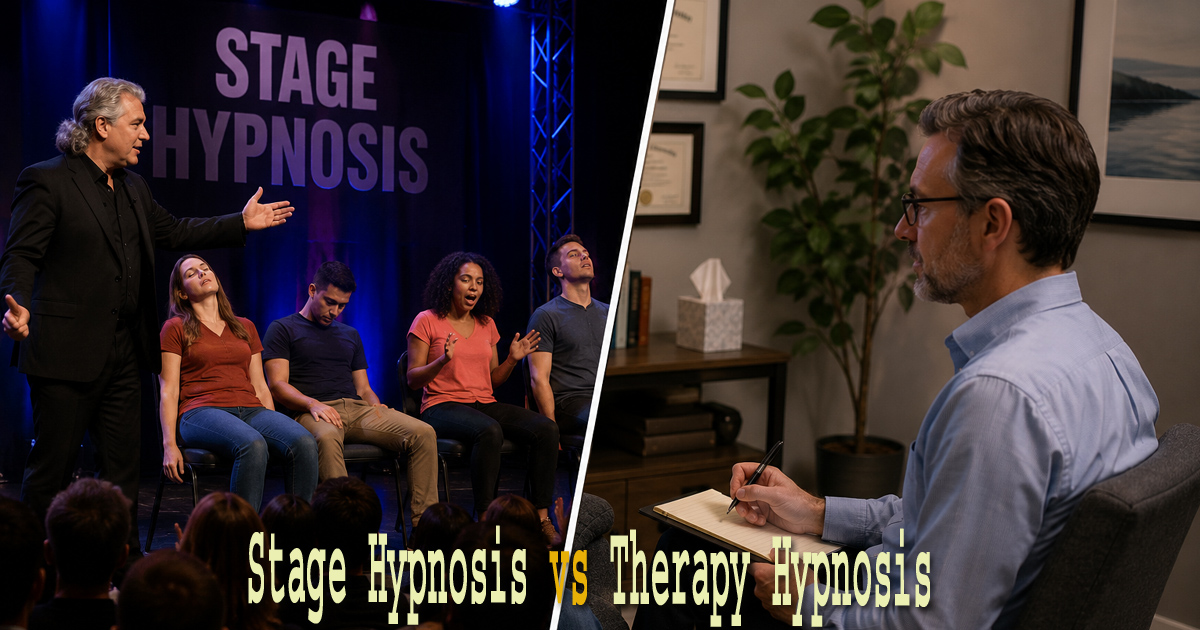
Stage performers have used forgetting suggestions for well over a century, long before formal research existed. A volunteer who confidently forgets a simple instruction, then recalls it the moment a cue is given, creates a striking moment for an audience.
The demonstration works because it highlights something audiences rarely think about. Memory does not always work the way we assume it does. Watching someone lose and then regain access to a clear memory challenges the audience’s intuitions about how reliable their own minds really are.
Is Stage Hypnosis Real? The Surprising Truth Behind the Show
What Hypnotic Amnesia Tells Us About Memory
Decades in front of live audiences and decades of laboratory research point toward the same conclusion. Memory is not a simple recording that plays back on command whenever we ask it to. Access to stored information can shift dramatically under the right conditions.
What began as a stage curiosity has become a serious subject of scientific study, and the two perspectives inform each other well. The core mystery remains just as compelling as it was two centuries ago. A memory can be present, intact, and completely out of reach, until the right cue brings it back into full view.

Known as The Man Who Notices, Mike Lamp is a theatrical hypnotist and psychic performer with more than twenty years of live stage experience. His work emphasizes observation, psychological influence, and measured presentation rather than spectacle or provocation. Performances are tailored for adult audiences, private events, and professional settings where control, clarity, and atmosphere matter.


Leave a Reply
You must be logged in to post a comment.