15
Sep
Hypnotic Time Distortion: The Strange Power of Altered Time
Hypnotic Time Distortion: When Five Minutes Doesn’t Feel Like Five Minutes
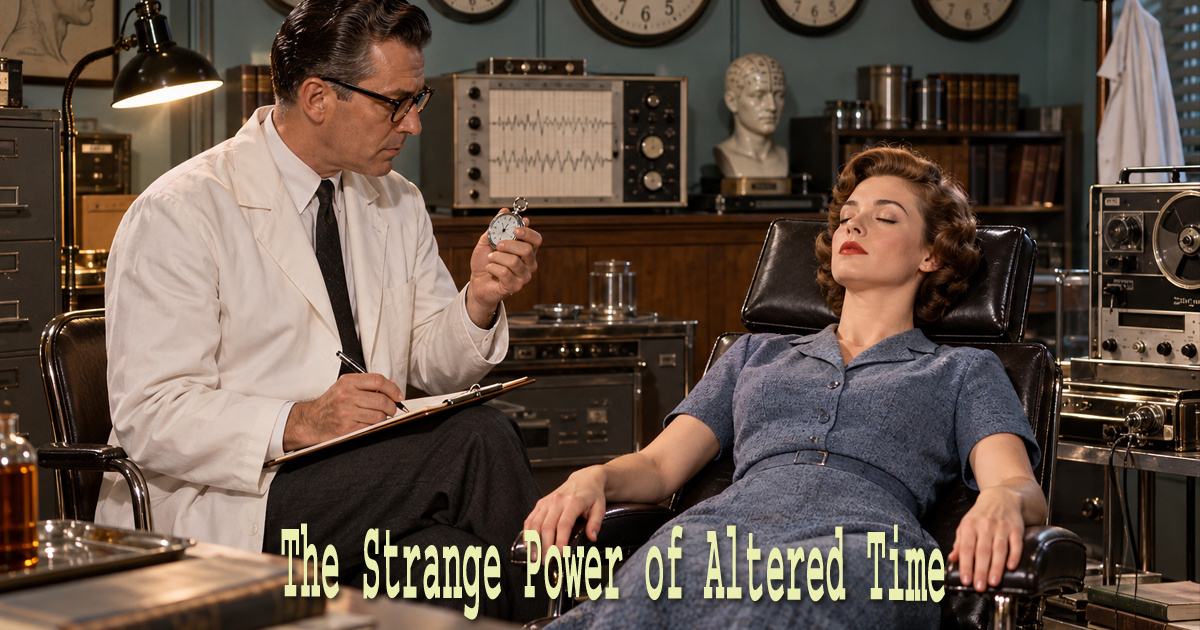
Early hypnotic time distortion research explored whether hypnosis and suggestion could alter a person’s perception of how quickly or slowly time passed.
Consider two hours in a waiting room and two hours absorbed in a film that holds you completely. The clock moves at exactly the same pace through both experiences. Your sense of those hours does not.
This gap between objective time and subjective time is something every person experiences. Most of us accept it as an ordinary feature of consciousness and think little more about it. Researchers, however, have spent decades examining whether that gap can be deliberately widened, and whether hypnosis might be a particularly reliable way of doing it.
Hypnotic time distortion refers to the deliberate alteration of a person’s subjective experience or estimate of elapsed time during hypnosis. The word deliberate is important here. This is not the accidental foreshortening that comes from being absorbed in something pleasant. It is a hypnotist giving explicit suggestions, and a subject reporting, or in some cases appearing to demonstrate, that their experience of time has shifted significantly from clock reality.
One clarification before going further: nobody in this field is claiming that hypnosis literally changes time. The clock does not slow down. The minutes do not stretch. What changes, or what researchers are examining when they examine hypnotic time distortion, is the person’s relationship to those passing minutes. Their experience of them. Their estimate of how many have gone by. That distinction matters, and it matters a great deal once you start looking at how researchers have tried to study and explain the phenomenon.
What Is Hypnotic Time Distortion?
The phenomenon operates in two basic directions. Time contraction occurs when a relatively long period of objective time seems much shorter to the subject. A forty-five minute hypnosis session might be estimated as fifteen minutes when it ends. Time expansion occurs when a short objective interval seems considerably longer. A subject given a suggestion that the next thirty seconds will feel like a much longer period may report experiencing something that felt like several minutes of elaborated mental activity.
These two directions are not equally easy to produce or equally well supported by experimental evidence, which is one of the more interesting findings in the research literature and worth examining in some detail later.
Modern researchers distinguish between prospective time estimation, in which a person judges duration while time is passing, and retrospective time estimation, in which a person judges how much time passed after the interval is complete. These two tasks appear to involve different cognitive processes and respond differently to hypnotic suggestion. That distinction has become increasingly important in understanding what the research actually shows, as opposed to what earlier accounts suggested it showed.
Subjective time, even without hypnosis, is affected by attention, expectation, emotional content, and the degree to which a person is engaged with or detached from their immediate surroundings. A person waiting anxiously for news experiences time very differently from a person absorbed in creative work, even when the objective duration is identical. Hypnotic time distortion is not, then, something utterly alien to ordinary experience. It is an intensification and a deliberate shaping of a capacity the mind already possesses.
Psychological Frameworks of Hypnosis Explained Clearly
Cooper and Erickson’s Early Time-Distortion Experiments
The foundational work in this area belongs to two researchers whose names are inseparable from the serious study of hypnosis in the mid-twentieth century. Linn F. Cooper was a psychiatrist whose primary research interest was the systematic investigation of hypnotic phenomena under controlled conditions. Milton H. Erickson was a psychiatrist and hypnosis researcher who became one of the most influential figures in the history of clinical hypnosis, founding the American Society for Clinical Hypnosis and developing approaches to hypnotic technique that continue to shape practice today.
Cooper and Erickson published their first paper on hypnotic time distortion in October 1950 in The Bulletin of Georgetown University Medical Center. Their work expanded over the following years. Their full experimental and clinical investigation was published as a book in 1954, with a second edition following in 1959. That book, Time Distortion in Hypnosis: An Experimental and Clinical Investigation, reports on research conducted between 1948 and 1954 and remains one of the most cited starting points in the literature on this subject.
The core experimental approach was straightforward in concept, though demanding in execution. Subjects were hypnotized and given suggestions designed to alter their subjective experience of a brief objective interval. The question Cooper and Erickson were most interested in was not simply whether subjects would report that time seemed to pass differently. They wanted to know whether subjects appeared capable of experiencing or performing mental activity that was consistent with the altered subjective interval they had been given.
The subjects Cooper and Erickson worked with were selected for their demonstrated capacity to enter deep hypnotic states. Under suggestion that a brief interval would feel much longer, subjects reported elaborated sequences of mental experience that would, under ordinary circumstances, have required considerably more objective time to occur. Under suggestion that a longer interval would feel much shorter, subjects reported reduced or compressed subjective experience. The book covers both time expansion and time contraction, with a section added in the second edition specifically addressing subjective time condensation as distinct from time expansion.
Erickson’s contribution to the second half of the book focused on clinical phenomena and therapeutic applications. He was particularly interested in whether time distortion could be used to alter the subjective duration of pain, discomfort, or other difficult experiences. The possibility that a patient might experience a prolonged uncomfortable procedure as subjectively much shorter represented an obvious clinical interest, and Erickson discussed approaches to this application with the specificity that characterized his clinical writing generally.
It is important to present Cooper and Erickson’s work for what it was: historically significant, carefully conducted for its era, and genuinely stimulating to subsequent research. What it was not is a settled proof of the claims that their most enthusiastic readers sometimes drew from it. The questions their work raised proved considerably harder to answer than the initial experimental reports might have suggested.
Seconds That Seemed Like Minutes
The accounts from Cooper and Erickson’s subjects are striking. Selected deep trance subjects, given suggestions that very brief objective intervals would seem much longer, reported remarkably elaborate subjective experiences during those intervals. A subject given thirty seconds of objective time might describe what appeared, from their subjective perspective, to have been an extended sequence of vivid mental activity.
These reports were exactly the kind of result that could capture the imagination of researchers and clinicians. If subjects could genuinely experience richly elaborated mental activity in compressed objective time, the implications for learning, creative problem-solving, and clinical applications would be significant.
The obvious and important question was whether those reports demonstrated a genuine change in the subject’s subjective experience of time, or whether they reflected something else entirely. A subject in a hypnotic context, given explicit suggestions about time and then asked to report their experience, is in a situation where the expectations of the experiment are quite clear. Were subjects reporting genuine subjective time expansion, or were they responding to what they understood the experiment expected of them?
T.X. Barber and D.S. Calverley directly examined this question in a 1964 paper published in the Archives of General Psychiatry. The title was Toward a Theory of Hypnotic Behavior: An Experimental Study of Hypnotic Time Distortion. Barber and Calverley were among the most persistent critics in hypnosis research. Their position was straightforward. They believed that claimed hypnotic effects were better explained by cognitive and social factors than by anything unique to hypnosis itself.
Their investigation looked specifically at the Cooper and Erickson claims. They found that the effects were more difficult to demonstrate under conditions designed to minimize demand characteristics. Demand characteristics refers to the tendency of experimental subjects to behave in ways they understand the experimenter to expect. When those expectations were reduced, the effects became harder to reproduce. This was not a refutation of everything Cooper and Erickson had reported. It was a significant complication. It established the central tension in this research area that subsequent decades of work would not fully resolve.
Is Time Contraction Easier Than Time Expansion?
One of the more reliable findings in the decades of research following Cooper and Erickson is that the two directions of time distortion do not appear equally easy to produce. Time contraction, specifically the underestimation of how long a hypnosis session lasted, has proven considerably more robust and replicable than the elaborate time expansion effects described in the early experimental reports.
Kenneth S. Bowers published research in 1979 in the Journal of Abnormal Psychology examining the relationship between hypnotic ability and the underestimation of hypnosis duration. Bowers and his colleague H.A. Brenneman found that subjects who were administered the Harvard Group Scale of Hypnotic Susceptibility underestimated the duration of the hypnotic interval by approximately 41 percent. The same subjects underestimated a non-hypnotic interval of the same length by only 14 percent. That is a substantial difference, replicated across several separate samples with a combined total of 435 subjects.
The finding that hypnotized subjects routinely underestimate how long they have been hypnotized is one of the more consistent results in this literature. It aligns with the informal observations of hypnotists and subjects that time seems to pass quickly during hypnosis, and it connects naturally to the attentional explanation of time perception: people who are absorbed in something, who have reduced attentional resources available for tracking the passage of time, tend to underestimate how long that absorption lasted.
A later controlled experiment that compared hypnosis with progressive relaxation and a control condition found results relevant to an important question: was the time distortion found in hypnosis simply an effect of relaxation rather than anything specific to hypnosis? The experiment found that only the hypnosis group showed significant distortion. The researchers reported that hypnosis accounted for approximately 35 percent of the variance in absolute time-estimation distortion. This is a meaningful finding because it addressed the most obvious alternative explanation. Relaxation alone did not produce the same degree of effect.
Does Hypnosis Really Change the Internal Clock?
The skeptical side of this research deserves substantial space, not as a dismissal of the phenomenon but as an honest account of how much remains unsettled.
Peter Naish, a researcher at The Open University in Milton Keynes whose work on hypnotic time perception has been among the most sustained and careful in the field, proposed a model in which the hypnotic state specifically slows down an internal clock, a putative central timing mechanism composed of a pacemaker emitting pulses that are accumulated in a counter. If the pacemaker runs more slowly under hypnosis, the counter accumulates fewer pulses for any given objective interval, and the person experiences and estimates that interval as shorter than it was.
In 2016, a research team led by Jean-Rémy Martin, working with colleagues including Jérôme Sackur, Hernan Anlló, Naish himself, and Zoltan Dienes, published a study in Frontiers in Psychology that examined the question of whether hypnotic time distortions reflect a genuine change in subjective perception or a response to demand characteristics. The paper, published on August 30, 2016, was titled Perceiving Time Differences When You Should Not: Applying the El Greco Fallacy to Hypnotic Time Distortions.
The El Greco fallacy refers to a logical argument about perception and behavior. El Greco, the Spanish Renaissance artist, painted figures that are conspicuously elongated. It has been proposed that he might have suffered from astigmatism that caused him to perceive the world as vertically stretched. If he saw the world stretched, the argument goes, he would paint what he saw, and the elongated figures would result. The problem with this argument is that if El Greco’s visual system stretched the world, it would also stretch his canvas and his paintings as he looked at them, and he would correct for the elongation as he worked. The alleged perceptual distortion could not produce the behavioral outcome attributed to it.
Martin and colleagues applied this logic to hypnotic time distortion. If hypnosis genuinely changes the rate of an internal clock, that change should affect both the experience of time passing and the judgment of intervals on a calibrated scale used to estimate duration. Their findings challenged the simple internal-clock interpretation. The results were more consistent with suggestion and demand characteristics playing an important role in reported time distortion than with a straightforward slowing of an internal clock. Their conclusion was appropriately cautious: current available evidence does not allow a definitive determination of whether hypnotic time distortions are intrinsic perceptual effects based on the hypnotic state itself or rather the result of expectations and demand characteristics.
That is not a dismissal of the phenomenon. It is an honest statement of where the science stands.
Hypnosis May Not Be the Only Ingredient
Peter Naish’s own experimental work produced a finding that significantly complicates the simple equation of hypnosis with time distortion. In a series of experiments aimed at identifying which components of the hypnotic situation are actually necessary for time distortion effects to occur, Naish found that subjects who closed their eyes and engaged in vivid imagination, without any formal hypnotic induction and without any explicit reference to hypnosis, could produce hypnotic-like time effects.
This result, published in the journal Contemporary Hypnosis in 2003 under the title The Production of Hypnotic Time-Distortion: Determining the Necessary Conditions, is significant in several ways. It suggests that the formal apparatus of hypnosis, the induction procedure, the hypnotist’s authority, the explicit framing of the experience as hypnosis, may not be strictly necessary for the time distortion effects to appear. What may matter more is a combination of factors that hypnosis tends to reliably produce: eyes closed, attention turned inward, vivid imaginative engagement, detachment from the immediate external environment.
Naish’s interpretation of this finding connected to his internal clock model. He suggested that the internal clock runs more slowly when a person becomes detached from external reality and generates their own internal experiences. Under this view, hypnosis is an efficient and reliable way of producing the conditions under which time distortion occurs, but it is not uniquely capable of producing those conditions. Vivid imagination in a non-hypnotic context can achieve something similar.
This moves the discussion in a productive direction. Rather than asking what hypnosis does to time, researchers can ask what role attention, absorption, imagination, and detachment from external reality play in subjective time perception, with hypnosis as one reliable method of studying those factors in a controlled setting.
Hypnotic Response Explained: Powerful Psychological Theories
Why Our Sense of Time Is So Easy to Fool
The research on hypnotic time distortion sits within a much broader context of findings about how human beings experience duration, and that broader context makes the hypnotic effects less surprising rather than more.
Waiting for news you dread makes minutes drag. Absorbing creative work makes hours disappear. A frightening experience can seem to unfold in slow motion. A pleasant afternoon can seem to have lasted thirty minutes when three hours have passed. None of these require hypnosis. None of them involve any change in the objective passage of time. They involve only the mind’s relationship to that passage.
Research into subjective time perception has established that attention is one of the primary determinants of time estimation. People who have fewer attentional resources available for tracking time, because those resources are absorbed elsewhere, tend to estimate that less time has passed than actually did. People who are highly attentive to the passage of time, as people tend to be when waiting anxiously, tend to overestimate duration. Emotional content, expectation, and the density of experienced events also affect duration estimates.
Hypnosis provides researchers with a reasonably controlled way of studying an ability the brain already possesses. The absorption, the inward focus, the reduced engagement with external time-keeping cues that characterize hypnotic experience are all factors that ordinary time perception research has identified as relevant to subjective duration. Hypnosis intensifies and shapes these factors in ways that make them available for systematic study. That is part of its value as a research tool, quite apart from any clinical applications.
How Hypnotic Time Distortion Has Been Used
The research and clinical literature describes a range of contexts in which hypnotic time distortion has been explored as a potentially useful phenomenon, and Erickson’s clinical writing is the most detailed source for many of these applications.
Pain management represented the most consistent clinical interest. If a patient undergoing a prolonged uncomfortable procedure could experience that procedure as subjectively much shorter, the clinical benefit would be meaningful even if the mechanism remained unclear. Erickson discussed time distortion as one of several hypnotic approaches relevant to pain management, and subsequent clinical researchers have continued to explore this application. The evidence for hypnosis in pain management more broadly is considerably stronger than the evidence specifically attributing effects to time distortion, but the two are difficult to fully separate in clinical practice.
The subjective shortening of difficult experiences was a related application. A patient facing a challenging medical procedure, or a person working through a difficult therapeutic process, might benefit from a subjective experience of that difficulty as compressed in duration, even when the objective time remained unchanged.
Imagined practice and mental rehearsal represent another area of reported application. If a subject could be given a brief objective interval while experiencing a subjectively longer one, the possibility arose that that subjective time could be used for elaborated mental rehearsal of skills or activities. This was the application that generated some of the most optimistic early claims, and also some of the most significant skeptical scrutiny. Whether genuine improvements in performance resulted from such procedures, beyond what could be explained by the suggestion itself and the subject’s expectations, proved difficult to establish cleanly.
The use of hypnotic time distortion in studying memory and cognitive processes represents a more purely research-oriented application. If subjects can be reliably brought to underestimate or overestimate elapsed time under hypnosis, the phenomenon becomes a tool for examining how time perception and memory interact, and how the parameters of attention and absorption that characterize hypnosis affect cognitive functioning more broadly.
One important clarification: historical clinical reports of these applications are not instructions for self-treatment and should not be read as guarantees of specific outcomes. The research in this area is interesting and ongoing. It is not a prescription.
What Hypnotic Time Distortion Does Not Mean
The popular presentation of hypnotic time distortion sometimes drifts well beyond what the research actually supports, and that drift does not serve anyone well.
Hypnotic time distortion does not mean that a person literally experienced several physical hours during three objective minutes. The subjective experience of expanded time is not equivalent to the actual passage of expanded time.
It does not mean that the brain somehow stopped or slowed external time. Objective time continued at its normal rate throughout any hypnotic experience ever reported or studied.
It does not mean that a person can accomplish unlimited learning or skill development in compressed objective time by using hypnotic time expansion. The most optimistic early claims in this direction were not supported by subsequent controlled research.
It does not mean that every hypnotized person experiences dramatic time distortion. The research consistently shows wide individual variation. Some subjects show pronounced effects. Others show minimal ones. Hypnotic responsiveness, the degree to which a given person responds to hypnotic suggestions, is itself a variable that affects the degree of time distortion reported.
And it does not mean that every reported effect proves that a biological internal clock changed its rate of operation. As the Martin and colleagues 2016 study illustrates, distinguishing genuine perceptual change from expectation-driven reporting is methodologically difficult, and the available evidence does not fully settle the question.
What Researchers Still Don’t Know
After more than seventy years of research, the honest summary of where the field stands contains as many open questions as settled findings.
There is consistent evidence that hypnosis and hypnotic suggestions affect people’s judgments and estimates of elapsed time, particularly in the direction of underestimation. The Bowers and Brenneman finding of 41 percent underestimation in hypnosis compared to 14 percent in a non-hypnotic condition of the same length is a genuinely meaningful result, replicated across hundreds of subjects.
There is evidence that something specific to hypnosis, rather than simply relaxation or general suggestion, contributes to this underestimation, based on comparisons with progressive relaxation and control conditions.
There is also evidence from Naish’s work that vivid imagination with eyes closed can produce similar effects without formal hypnotic induction, which complicates any theory that locates the effect uniquely in hypnosis itself.
There is ongoing disagreement about whether the effects reflect genuine perceptual changes in subjective time, changes in the rate of operation of an internal timing mechanism, or responses to suggestion and demand characteristics that produce altered reports without necessarily producing altered experience.
These disagreements make the subject more interesting, not less. Hypnotic time distortion is a window into a larger question that researchers are only beginning to examine with the tools now available: how does the human mind construct its experience of time, and what factors can alter that construction? The answers to those questions will matter for understanding consciousness, attention, memory, and experience in ways that extend well beyond the hypnosis laboratory.
How Hypnosis Works: Scientific Explanations and Theories
The Clock Doesn’t Change. Our Experience Can.
The clock kept moving at exactly the same pace through every experiment described in this article. Through Cooper and Erickson’s sessions in the late 1940s and early 1950s. Through Barber and Calverley’s skeptical examination in 1964. Through Bowers and Brenneman’s large-sample studies in 1979. Through Naish’s imagination experiments in 2003. Through Martin and colleagues’ El Greco fallacy analysis in 2016.
What changed, in each of those investigations, was the person’s relationship to those ticking seconds. The experience of them. The estimate of how many had passed. The sense of how much had happened within them.
From Cooper and Erickson’s early work through seven decades of refinement and critique, hypnotic time distortion has proven to be neither the simple and dramatic phenomenon that its early advocates described nor the mere artifact of suggestion that its most thorough skeptics proposed. It is something more interesting than either: a genuine and measurable effect on subjective time experience, whose precise mechanisms remain under investigation, whose boundaries are still being mapped, and whose study opens onto questions about consciousness and time perception that no one has yet fully answered.
That makes it considerably more interesting than the old cliché that someone in hypnosis simply lost track of time. Losing track of time is something people do every day. What the research on hypnotic time distortion suggests is that the relationship between mind and time may be more flexible, more responsive to suggestion and attention and absorption, and more open to deliberate influence than ordinary experience tends to reveal.
The clock does not change. But the person listening to it can.

Known as The Man Who Notices, Mike Lamp is a theatrical hypnotist and psychic performer with more than twenty years of live stage experience. His work emphasizes observation, psychological influence, and measured presentation rather than spectacle or provocation. Performances are tailored for adult audiences, private events, and professional settings where control, clarity, and atmosphere matter.




Leave a Reply
You must be logged in to post a comment.