23
Jun
Hypnotized vs Daydreaming: The Surprising Truth About These Two Mental States
Hypnotized vs Daydreaming: Why So Many People Confuse the Two

Many people compare hypnotized vs daydreaming because both experiences can involve deep focus and reduced awareness of the surrounding environment.
If you have ever zoned out during a long drive and arrived at your destination with almost no memory of the journey, you have probably wondered whether that felt a little like hypnosis. You would not be wrong to wonder. The two states share enough surface qualities that the comparison comes up constantly, and it is one of the most genuinely interesting questions in the study of human consciousness.
Both hypnosis and daydreaming involve a shift away from ordinary focused awareness. Both can feel absorbing, effortless, and a little otherworldly when they are happening. Both involve the imagination in ways that feel more vivid and real than ordinary thinking. And in both states the outside world tends to fade into the background while something internal takes center stage. So the confusion is understandable and completely natural. But the differences between them are significant, and understanding those differences opens up a much richer picture of what the human mind is actually capable of. Hypnotized vs daydreaming turns out to be a more layered question than it first appears.
What Daydreaming Actually Is
Daydreaming is something every human being does, whether they intend to or not. It is the mind’s default tendency to wander away from the task at hand and into a loosely connected stream of thoughts, images, memories, and imagined scenarios. It happens in waiting rooms, during lectures, on long walks, and in the middle of conversations that have stopped holding our attention. It is spontaneous, largely uncontrolled, and deeply familiar to every person who has ever found themselves staring out a window with no clear memory of deciding to do so.
The Spontaneous Nature of Daydreaming
What defines a daydream most clearly is that it arrives uninvited. You do not sit down and decide to daydream in the way you might decide to read or exercise. You simply notice, at some point, that your mind has drifted somewhere else entirely. Researchers studying the default mode network, the brain system most active when we are not focused on a specific external task, have found that daydreaming is essentially the brain’s resting state.
When the demands of the outside world ease up, the mind naturally begins to wander. It is not a malfunction or a failure of attention. It is what brains do when left to their own devices, and it serves important functions including creativity, memory consolidation, and emotional processing.
Can Skeptics Be Hypnotized? A Powerful Guide to Overcoming Doubt
What Happens During a Typical Daydream
During a daydream the mind moves freely and associatively. One thought leads to another with no particular logic or direction. You might begin thinking about a conversation you had yesterday, drift into imagining a future scenario, loop back to a half-remembered song, and surface ten minutes later with no clear sense of how you got from one place to another. There is no guide, no structure, and no goal. The experience is passive and self-generated at the same time, which is part of what makes it feel so different from deliberate thinking. And it is also part of what makes the hypnotized vs daydreaming comparison so interesting, because on the surface the two can feel remarkably alike.
What Hypnosis Actually Is
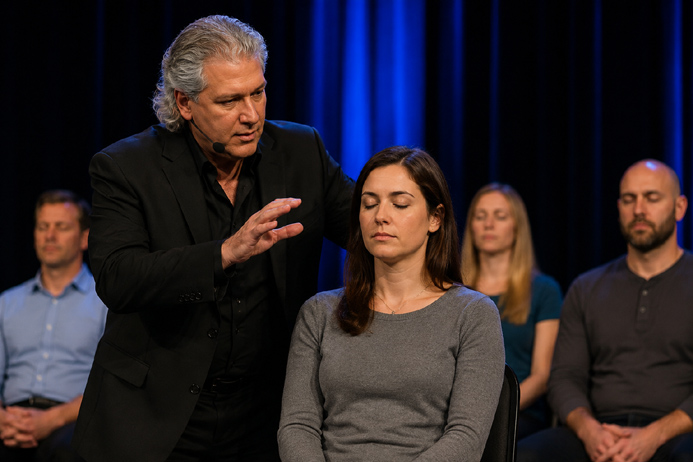
Unlike daydreaming, hypnosis is typically entered through a deliberate process that directs attention toward a specific experience or suggestion.
Hypnosis is a deliberately induced state of focused attention and heightened suggestibility. Unlike daydreaming, it does not arrive on its own. It is guided into existence through a process called an induction, and it has a clear purpose from the moment it begins. Whether it is being used for therapeutic change, pain management, performance enhancement, or stage entertainment, hypnosis is always intentional and always directed toward something specific.
How Hypnosis Is Deliberately Induced
A hypnotic induction typically involves guiding a person’s attention inward through a combination of relaxation, focused imagery, and carefully worded suggestions. The hypnotist, or in self-hypnosis the individual themselves, uses language and rhythm to narrow attention, quiet the analytical mind, and open a channel of heightened responsiveness to suggestion. The process is gradual and collaborative. Nothing is forced. But unlike a daydream, which simply happens when attention relaxes, hypnosis is constructed deliberately and with clear intention from beginning to end.
What Happens During a Typical Hypnotic Experience
Once in a hypnotic state a person typically feels deeply relaxed, unusually focused, and remarkably open to suggestion. The inner critic that normally evaluates and second-guesses everything becomes quieter. Imagination becomes more vivid and feels more real. Time may seem to compress or expand. Suggestions from the hypnotist land with an ease and resonance that ordinary waking instructions rarely achieve. The person remains aware of their surroundings but is less distracted by them. It is a state of absorbed, purposeful inner focus rather than the loose and wandering drift of a daydream, and that distinction matters enormously when you consider what each state can actually accomplish.
Where Hypnosis and Daydreaming Overlap
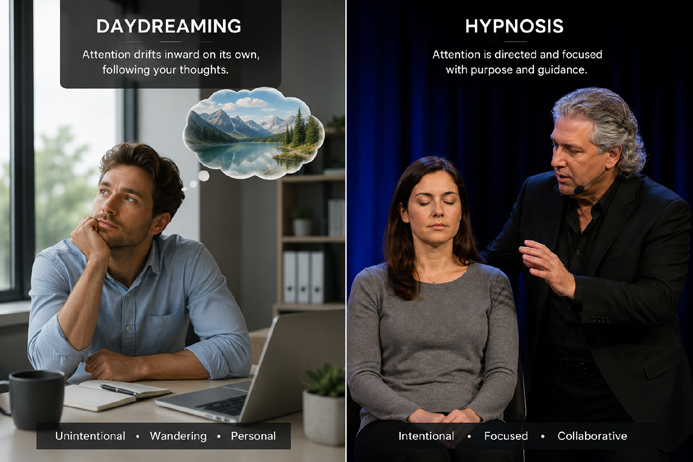
The hypnotized vs daydreaming comparison reveals important similarities in attention and imagination, while also highlighting key differences in purpose and direction.
Despite their differences, hypnosis and daydreaming do share real common ground. Understanding where they meet helps explain why so many people assume they must be essentially the same thing.
The Role of Imagination in Both States
Both states rely heavily on the imagination and both can produce experiences that feel more vivid than ordinary thinking. In a daydream you might imagine a conversation so clearly that you can almost hear the other person’s voice or feel the emotions the scenario brings up. In hypnosis that same imaginative capacity is channeled and amplified, often producing experiences that feel strikingly real and present. The raw material is the same in both cases. What differs is how that material is being used, with what degree of focus, and toward what end.
How Focus Changes in Both States
Both hypnosis and daydreaming involve a narrowing of attention away from the immediate external environment. In both states the outside world recedes somewhat and the inner world becomes more prominent. This shared quality of inward absorption is why the two states can feel so similar from the inside, especially to someone who has not experienced deliberate hypnosis and is trying to imagine what it must be like. The felt sense of being somewhere else while still technically present is common to both, even though the mechanisms and outcomes are quite different.
Stuck in a Hypnotic State? The Reassuring Truth About Hypnosis Safety
The Key Differences That Set Them Apart
This is where the comparison becomes most interesting and most useful. The similarities between hypnosis and daydreaming are real but they are largely surface-level. The differences go much deeper and have significant implications for what each state can actually do.
Direction and Intent
A daydream has no destination. It wanders wherever the associative mind leads, following whims and half-formed connections with no particular purpose. Hypnosis is always directed toward something. Even in its most relaxed and exploratory forms, hypnosis involves a guiding intention. There is a reason the session is happening and a direction the experience is moving in. That intentionality is one of the most fundamental things that separates the two states, and it is the quality that makes hypnosis useful in ways that daydreaming simply is not.
Depth of Focus and Suggestibility
While both states involve some degree of inward absorption, hypnosis produces a depth of focused attention that daydreaming rarely approaches. In a daydream attention drifts loosely and can be interrupted by almost anything. In hypnosis attention is concentrated and stable, held in place by the structure of the induction and the ongoing guidance of the hypnotist. Along with that depth of focus comes heightened suggestibility, a genuine increase in the mind’s openness and responsiveness to directed suggestion. This quality operates at a far lower level in ordinary daydreaming and is one of the defining features of the hypnotic state.
Awareness and Control
In a daydream awareness is diffuse and control is minimal. You are not steering the experience. You are just along for the ride. In hypnosis awareness is actually quite clear and present, focused inward rather than scattered. And while the hypnotist guides the experience, the person being hypnotized retains the ability to reject suggestions that conflict with their values or comfort. There is more structure, more awareness, and more purposeful engagement in hypnosis than a casual comparison with daydreaming would suggest. The hypnotized vs daydreaming distinction is nowhere clearer than in how much intentional awareness is actually present in each state.
The Role of a Guide or Hypnotist
Daydreaming requires no one else. It is entirely self-generated, even if it is also largely uncontrolled. Hypnosis in its most effective forms involves a guide whose language, pacing, and skill shape the experience in specific and intentional ways. The hypnotist is not just a bystander. They are an active architect of the state, using tested techniques to deepen focus, increase responsiveness, and direct the imagination toward outcomes that serve a clear purpose. That relational and guided quality has no equivalent in daydreaming.
Why the Difference Matters in Real Life

Understanding hypnotized vs daydreaming can help people better appreciate when hypnosis may offer benefits that ordinary daydreaming cannot provide.
Understanding the distinction between these two states is not just an academic exercise. It has real practical implications for anyone curious about hypnosis or considering it for a specific purpose.
Is Stage Hypnosis Real? The Surprising Truth Behind the Show
What Hypnosis Can Do That Daydreaming Cannot
Because hypnosis involves directed suggestion delivered into a state of heightened receptivity, it can produce changes in behavior, perception, habit, and physical experience that daydreaming simply cannot reliably achieve. People use hypnosis to manage chronic pain, overcome phobias, change entrenched habits, improve performance under pressure, and process difficult emotions. A daydream about being more confident does not reliably make you more confident. A well-crafted hypnotic session targeting that same goal can produce measurable and lasting results. The difference in outcome reflects the difference in the states themselves.
When Daydreaming Is Actually Enough
That said, daydreaming has its own genuine value and should not be dismissed simply because it lacks the structure and intentionality of hypnosis. Research has consistently shown that mind-wandering supports creativity, problem-solving, emotional processing, and the consolidation of memory. Some of the most useful thinking a person does happens not when they are focused and directed but when they have stepped back and let the mind roam freely. Daydreaming is not a lesser state. It is simply a different one, suited to different purposes and deserving of its own respect.
Final Thoughts on Hypnosis and Daydreaming
Hypnotized vs daydreaming is one of those comparisons that seems simple on the surface and reveals real depth the moment you look closely. Both states are natural expressions of the human mind’s remarkable flexibility. Both involve imagination, inward focus, and a loosening of ordinary analytical awareness. But they are not the same thing, and treating them as interchangeable misses what makes each of them genuinely interesting and genuinely useful.
Daydreaming is the mind at rest, wandering freely through its own landscape with no particular destination. Hypnosis is the mind at purposeful work, focused and receptive, moving toward a specific outcome with the guidance of a skilled hand.
Both are worth understanding. And understanding the difference between them is the first step toward appreciating just how much range the human mind actually has.

Known as The Man Who Notices, Mike Lamp is a theatrical hypnotist and psychic performer with more than twenty years of live stage experience. His work emphasizes observation, psychological influence, and measured presentation rather than spectacle or provocation. Performances are tailored for adult audiences, private events, and professional settings where control, clarity, and atmosphere matter.


Leave a Reply
You must be logged in to post a comment.