2
Mar
The Chariot Tarot Card Meaning: Clear Guide to Powerful Symbolism
The Chariot Tarot Card Meaning: Bold Guide to True Mastery
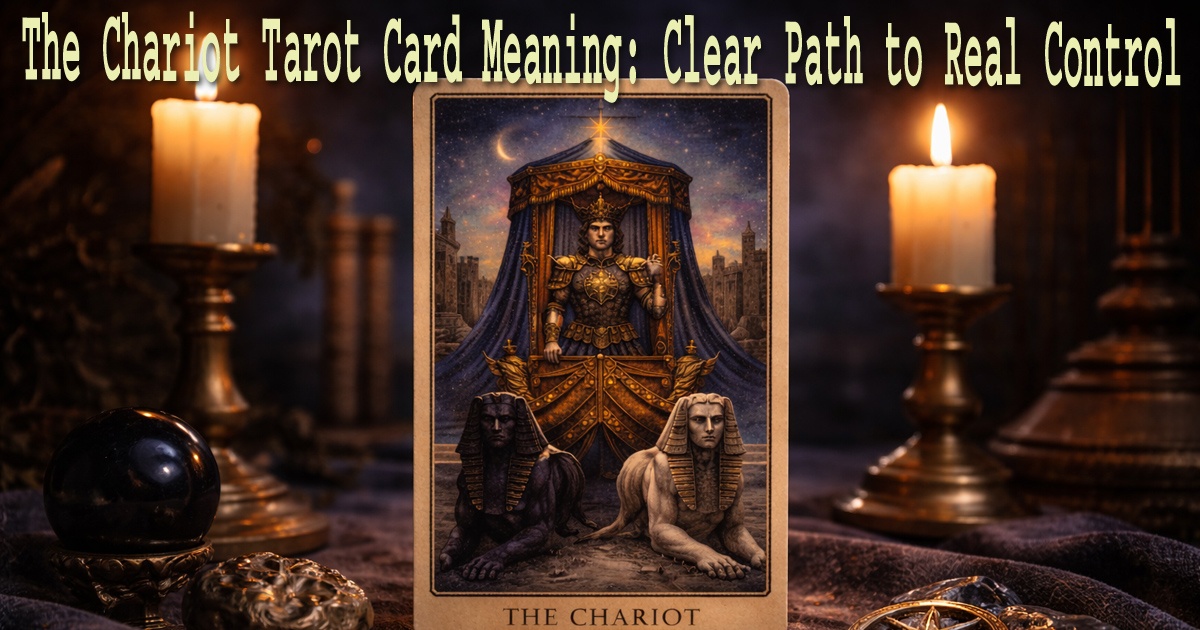
The Chariot Tarot Card Meaning expressed through disciplined motion, balance, and controlled power
What the Card Represents
The Chariot Tarot Card Meaning begins with the image itself. A figure sits upright in a stone chariot, armored and composed, holding a wand in one hand while the reins, where they exist at all, are symbolic rather than functional. Two sphinxes rest before the vehicle, one black and one white. In earlier tarot traditions these were horses, sometimes of different colors. The Rider-Waite shift to sphinxes introduced a deliberate reference to mystery, guardianship, and the riddle of opposing natures that must be answered rather than simply overcome.
The night sky spreads overhead, sometimes dotted with stars, and a canopy of celestial symbols arches above the charioteer. The walled city lies behind, representing the structured world of human society and its institutions. Open territory lies ahead, uncharted and demanding. Everything in the composition communicates controlled movement, not speed, not recklessness, but deliberate forward progress drawn from internal command. This is the seventh card of the Major Arcana, and its placement matters. It follows The Lovers, a card of choice and alignment, and precedes Strength, which deals with patience and inner mastery. The Chariot sits at the point where decision has been made and forward motion has begun, but the outcome is not yet secured.
The sphinxes are worth examining closely. They do not pull in unison. They face different directions, suggesting that the forces behind this journey are not naturally cooperative. The charioteer keeps them moving forward not through physical control but through will, concentration, and the authority of focused intention. The Chariot Tarot Card Meaning depends heavily on this detail, because the card is not about easy progress. It is about progress achieved when the internal landscape is divided but discipline holds.
Read Major Arcana Secrets: Shocking Dark Origins Revealed Exclusive Article
Symbolism Within the Major Arcana
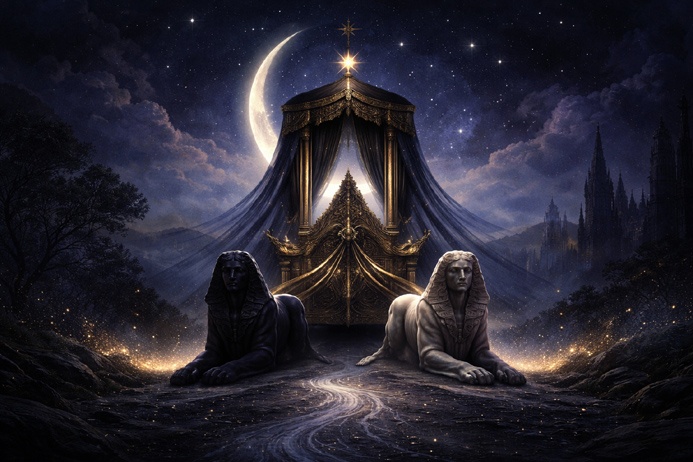
The Chariot Tarot Card Meaning expressed through balance, discipline, and forward command
The Major Arcana traces a symbolic journey, and The Chariot Tarot Card Meaning fits precisely within that arc. Cards one through six deal with the basic conditions of human life, identity, duality, creative impulse, structure, love, and choice. The Chariot arrives when those foundations have been laid and the individual must now move through the world with purpose. The armor the charioteer wears is covered in symbolic marks, crescents on the shoulders representing the phases of the moon, a tunic decorated with alchemical squares suggesting the grounding of will in matter.
The crown is eight-pointed, a number associated in symbolic systems with regeneration and cyclical completion, suggesting that the authority the charioteer carries is not static but renewed through continued effort.
The absence of reins is one of the most discussed symbolic details of this card. In some versions of the Rider-Waite deck, what appear to be reins are present but are made of laurel and a wand, suggesting ceremonial authority rather than physical restraint. The point stands either way: control is not mechanical. It comes from somewhere else entirely, from the alignment of the charioteer’s intention with the direction of travel.
The Chariot Tarot Card Meaning, when read within the full arc of the Major Arcana, points to a stage of development where external aids have become secondary to inner command. This is not recklessness disguised as confidence. The card communicates the opposite, that real movement through difficulty requires a quality of concentration that external tools cannot provide.
The Chariot appears as card VII in the Rider-Waite deck published in 1909, but in some earlier Italian tarot traditions the card was numbered VIII, placing it after Justice rather than before it. The numbering was never universally standardized across all schools of tarot practice.
The Chariot Upright Meaning
The Chariot Tarot Card Meaning in its upright position reflects disciplined movement and sustained drive through difficulty
The Chariot upright meaning centers on willpower, determination, and forward momentum. When this card appears in a reading in its standard orientation, it generally suggests that the querent is in a position to push through obstacles, complete a difficult phase, or assert enough direction to keep competing forces from pulling a situation apart. The Chariot Tarot Card Meaning in the upright position is not triumphant in an easy sense. It acknowledges that the path involves tension and that success depends on the ability to hold that tension productively.
In practical terms, this card has appeared historically in readings related to ambition, travel, competition, and any situation where sustained effort over difficulty is required. It also carries a caution embedded in its imagery. The charioteer who loses focus, who allows one sphinx to overpower the other, will drift or stall. The Chariot upright includes the implicit expectation that the drive being applied is disciplined and directed, not simply reactive force. Victory in the Chariot’s terms is measured, earned, and conscious.
The Chariot Reversed Meaning
The Chariot reversed meaning shifts the emphasis considerably. Where the upright card speaks to focused forward drive, the reversed position introduces questions about that drive. Is the energy scattered, excessive, or pointed in the wrong direction? The Chariot in reversal often appears when movement has become compulsive rather than purposeful, when someone is pushing hard but without adequate control over where that energy is going.
Reversal can also suggest inertia. The same concentration required to keep the chariot moving can, when absent or blocked, leave the entire vehicle immobile. The Chariot Tarot Card Meaning reversed does not typically indicate failure so much as a disruption in the alignment between intention and action. The sphinxes are still there, but they may be working against each other more visibly than the situation can tolerate. Readings with this card reversed often point toward a need to pause, reassess the direction, and reconnect with whatever internal clarity was initially driving the effort.
The sphinxes now associated with The Chariot in the Rider-Waite tradition replaced horses that appeared in earlier French and Italian decks. Arthur Edward Waite and illustrator Pamela Colman Smith introduced the sphinxes deliberately, drawing on Egyptian symbolism to emphasize mystery and duality over raw physical force.
Tarot Card Archetypes and The Chariot
Tarot card archetypes function as compressed symbolic systems, and The Chariot belongs to a category within the Major Arcana sometimes described as the cards of outer achievement, cards that deal with how the individual moves through the material and social world. The Chariot Tarot Card Meaning fits that framework while adding a dimension that lifts it beyond pure worldly ambition. The celestial canopy above the charioteer, the stars, the cosmic symbols, all suggest that the journey being undertaken has significance beyond the immediate goal.
The archetype of the charioteer appears in many cultural traditions as a figure who must manage opposing forces through skill and concentration rather than brute strength. In symbolic terms, the two sphinxes represent any pair of genuine opposites that a person must hold in productive tension: action and restraint, confidence and doubt, the immediate desire and the longer-term aim. The Chariot Tarot Card Meaning draws its depth from this quality of managed opposition, suggesting that the most meaningful progress is rarely the result of a single uncontested impulse but of competing drives brought into sufficient alignment to move.
Spiritual Journey in Tarot

The Chariot Tarot Card Meaning extends into the spiritual journey in tarot through the practice of sustained inner command
The spiritual journey in tarot is not confined to the cards most obviously associated with inner life. The Chariot Tarot Card Meaning carries a spiritual dimension precisely because it deals with the development of will as a conscious faculty rather than a reactive force. The charioteer has moved through the early stages of the Major Arcana’s symbolic education and arrived at a moment where intentional action is the primary vehicle for growth.
This does not mean the spiritual dimension of the card is abstract. It shows up in ordinary situations where a person must decide whether to continue under difficulty, whether the effort being made reflects genuine purpose or accumulated momentum that has outlasted its original direction. The Chariot Tarot Card Meaning, understood through the lens of the spiritual journey in tarot, suggests that self-mastery is not a fixed state but a continuing practice, one that each new obstacle tests in a different way. The card shows a moment of that practice in action, neither the beginning of the work nor its completion, but the active middle ground where character is actually formed.
The figure on The Chariot in the Rider-Waite deck wears a crown of eight points, a detail connected to the number eight’s traditional association with regeneration and cyclical return. This same symbolism appears in other esoteric traditions of the same period, reflecting the broader influence of late nineteenth century occult scholarship on the deck’s design.
Editor’s Reflection
What the seventh position means in any symbolic system is never entirely settled, and The Chariot Tarot Card Meaning is no different in that regard. The card resists simple summary. It presents a figure in motion but not at rest, in command but not unchallenged, moving forward through a tension that has not been resolved so much as held. That quality of sustained, conscious effort under pressure is what the card keeps returning to, regardless of how a particular reader or tradition chooses to interpret the finer details of its imagery.
The Chariot Tarot Card Meaning tends to prompt genuine reflection in people who sit with it long enough. What does it mean to move forward when the forces at work are genuinely pulling in different directions? Is the kind of control the card depicts something that can be learned, or does it emerge only under specific pressure? And when the reversal appears, when the chariot stalls or drifts, what does that moment actually ask of the person holding the question?

Known as The Man Who Notices, Mike Lamp is a theatrical hypnotist and psychic performer with more than twenty years of live stage experience. His work emphasizes observation, psychological influence, and measured presentation rather than spectacle or provocation. Performances are tailored for adult audiences, private events, and professional settings where control, clarity, and atmosphere matter.



Really glad this one went deeper than the usual “willpower card” summary. The part about the sphinxes not naturally pulling together hit differently than I expected.
I think for me it’s always been the pause and reassess side, but reading this made me realize I sometimes dress up avoidance as strategy. The reversal section was uncomfortably accurate on that front. The line about competing drives being brought into alignment rather than eliminated is something I’m going to sit with for a while.
That distinction between avoidance and strategy is one the card keeps pushing on, and you named it better than most people do. 🌟
The reversal has a way of being the more honest read for a lot of people precisely because it doesn’t flatter. It just points at what’s actually happening. Really glad the alignment piece landed the way it did, that one took some unpacking to get right. Thanks for reading it closely enough to find it.