27
Jan
Theosophical Society Influence: Profound Metaphysical Legacy
Theosophical Society Influence on Modern Metaphysics and Spirituality

The Theosophical Society influence reshaped how Western culture encountered Eastern philosophy and esoteric traditions, creating lasting networks of metaphysical exchange.
The Theosophical Society, founded in New York City in 1875, reshaped the way Western audiences encountered Eastern religious ideas and esoteric philosophy. Its founders Helena Petrovna Blavatsky, Henry Steel Olcott, and William Quan Judge created an organization that would leave a lasting mark on metaphysical thought, occult study, and spiritual movements well into the twenty-first century. Understanding Theosophical Society influence requires examining not only what the group taught, but how it positioned those teachings within a culture hungry for alternatives to orthodox religion and materialist science.
The Theosophical Society Founding and Early Years
The Theosophical Society founding took place during a period of intense cultural transition in America and Europe. Spiritualism had already popularized the idea that unseen forces and entities could be contacted or studied. Scientific advances were challenging traditional religious narratives, yet many people remained unsatisfied with purely materialist explanations of existence. Into this environment came Blavatsky, a Russian émigré with a talent for synthesizing disparate religious and philosophical systems into a coherent framework.
The early meetings of the Society drew intellectuals, reformers, and seekers who were interested in comparative religion, ancient wisdom traditions, and what they termed “occult science.” Theosophy, as the movement came to be known, proposed that all religions shared a common esoteric core. This core, according to Theosophical teachings, could be accessed through study, meditation, and moral development. The Society did not ask members to abandon their existing faith traditions. Instead, it encouraged exploration of universal spiritual principles that transcended sectarian boundaries.
The Theosophical Society’s headquarters relocated from New York to Adyar, India in 1882, establishing a permanent base that strengthened its connections to Eastern philosophical sources.
Helena Blavatsky Theosophy and Core Concepts
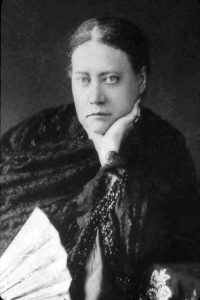
Blavatsky, c. 1877
Helena Blavatsky Theosophy centered on several key texts, most notably Isis Unveiled (1877) and The Secret Doctrine (1888). These works presented a complex cosmology that drew from Hinduism, Buddhism, Hermeticism, Gnosticism, and Neoplatonism. Blavatsky described a universe governed by spiritual laws, populated by hierarchies of evolved beings, and unfolding according to cyclical patterns of manifestation and dissolution.
Central to her system was the concept of the “Mahatmas” or “Masters” advanced spiritual teachers said to guide humanity’s evolution from remote locations in Tibet and elsewhere. Blavatsky claimed to be in contact with these figures, receiving teachings and guidance that she transmitted to her students. Whether one accepted these claims literally or viewed them as symbolic frameworks, the ideas themselves proved influential. They offered a vision of spiritual progress that was both individual and cosmic, linking personal development to the evolution of consciousness itself.
Theosophical teachings also emphasized reincarnation and karma, concepts that were relatively unfamiliar to mainstream Western audiences at the time. By presenting these ideas as universal truths rather than exclusively Eastern doctrines, the Society helped naturalize them within Western metaphysical discourse. This cross-pollination of ideas became one of the most significant aspects of Theosophical Society influence.
Theosophical Society Influence on Western Occultism
Theosophical Society influence on Western occultism was immediate and far-reaching. Esoteric orders that emerged in the late nineteenth and early twentieth centuries including the Hermetic Order of the Golden Dawn and various Rosicrucian groups drew heavily on Theosophical concepts. The language of spiritual evolution, the emphasis on hidden masters, and the integration of Eastern and Western symbolism became standard features of occult literature.
Theosophy also legitimized the study of comparative religion and mythology as spiritual practices rather than purely academic exercises. By treating ancient texts as repositories of living wisdom, the Society encouraged a generation of students to look beyond surface interpretations. This approach influenced how later occultists and metaphysical thinkers engaged with everything from Egyptian mysteries to Celtic folklore.
The Society’s organizational structure, with its blend of democratic principles and hierarchical degrees of knowledge, became a model for other esoteric groups. Lodges and branches spread across Europe, India, Australia, and the Americas, creating networks of correspondence and exchange that persisted even as the organization itself experienced internal conflicts and schisms.
Annie Besant, who became the Society’s president in 1907, was simultaneously a prominent British socialist, women’s rights advocate, and Indian independence supporter, demonstrating Theosophy’s intersection with progressive political movements.
From Theosophy to New Age Spirituality
The Theosophical Society influence extended into what would eventually be called New Age spirituality, though the connection is sometimes indirect. Many foundational ideas associated with New Age thought including the existence of ascended masters, the concept of planetary consciousness, and the belief in imminent spiritual transformation have clear precedents in Theosophical literature.
Alice Bailey, a former Theosophist who broke away from the Society in 1920, developed teachings that became central to New Age philosophy. Her concept of the “Great Invocation” and her emphasis on world service and group meditation borrowed heavily from Theosophy while adapting its language for a new generation. Rudolf Steiner, who served as secretary of the German Section of the Theosophical Society from 1902 until breaking away to found Anthroposophy in 1912, similarly took Theosophical frameworks and expanded them into comprehensive systems encompassing education, agriculture, and the arts.
By the mid-twentieth century, modern metaphysical movements were incorporating Theosophical concepts without always acknowledging their origins. The human potential movement of the 1960s and 1970s, with its focus on consciousness expansion and spiritual evolution, echoed themes that Blavatsky had articulated decades earlier. Channeled teachings claiming to originate from advanced beings often mirrored the structure and content of communications Blavatsky attributed to the Mahatmas.
Metaphysical Thought and Contemporary Practice
Today, the Theosophical Society influence can be traced in numerous areas of metaphysical thought. The popularity of chakra systems in Western wellness culture, for instance, owes much to Theosophical interpretations of yogic anatomy. While these concepts originated in Indian traditions, it was largely through Theosophical texts that they entered Western consciousness in their current forms.
The notion that spiritual truth transcends religious boundaries now a commonplace assumption in many progressive spiritual circles was actively promoted by the Theosophical Society when such ideas were still controversial. The Society’s motto, “There is no religion higher than truth,” expressed a universalism that anticipated contemporary interfaith dialogue and comparative spirituality.
Contemporary teachers who speak of “ancient wisdom,” “hidden knowledge,” or “perennial philosophy” are often working within conceptual territories mapped by Theosophy. Even critics of the Society acknowledge its role in creating vocabularies and frameworks that subsequent movements have adopted, adapted, or reacted against.
Critical Perspectives and Historical Assessment
Assessing the Theosophical Society influence requires acknowledging both its contributions and its controversies. Blavatsky faced accusations of fraud during her lifetime, particularly regarding phenomena she claimed to produce as evidence of psychic powers. Some of her historical and scientific assertions have been thoroughly discredited by scholars. The Society’s later leaders were involved in scandals that damaged its credibility and led to organizational fractures.
Yet these controversies have not diminished the Society’s historical importance. Its impact on how Western culture engages with Eastern philosophy, its role in legitimizing esoteric study, and its contribution to modern metaphysical movements remain significant regardless of debates about the veracity of specific claims.
The Theosophical Society influence operates on multiple levels. It provided specific concepts and practices that were adopted by later movements. It modeled a way of engaging with religious pluralism that was ahead of its time. And it created networks of exchange that connected seekers, scholars, and practitioners across geographical and cultural boundaries.
The term “Theosophy” derives from the Greek “theosophia,” meaning “divine wisdom,” and was used by Neoplatonist philosophers in the third century before being revived by Blavatsky’s organization.
Lasting Legacy in Esoteric Philosophy
The Society’s library and publishing efforts preserved and disseminated texts that might otherwise have remained obscure. Its journals and lecture series introduced Western audiences to Sanskrit terminology, Buddhist psychology, and Hermetic symbolism in accessible formats. This educational function, separate from questions of belief or practice, represents a concrete contribution to the availability of esoteric philosophy in modern languages.
Current metaphysical practitioners may not identify as Theosophists or even be familiar with the organization’s history. Yet the conceptual architecture they inhabit the assumption that spiritual development involves stages of unfoldment, the belief that ancient cultures possessed advanced knowledge, the integration of meditation and study as complementary practices reflects patterns established by Theosophical literature and organization.
The Theosophical Society influence thus operates both as a matter of historical record and as a continuing presence in how contemporary seekers approach questions of meaning, consciousness, and spiritual possibility. Whether one views Theosophy as profound wisdom or as historical curiosity, its role in shaping modern metaphysical discourse remains undeniable.
Editor’s Reflection
The Theosophical Society influence persists not because the organization dominated spiritual culture, but because it arrived at a moment when Western seekers were ready to look beyond the boundaries of their own traditions. It offered a framework imperfect, controversial, sometimes contradictory that made room for questions orthodox institutions were unwilling to entertain. Whether its specific claims hold up under scrutiny matters less, in historical terms, than the conversations it made possible and the networks it built across continents and disciplines.
What draws people to esoteric teachings in one era often differs from what attracts them in another. Do contemporary seekers find the same appeal in ideas about hidden masters and spiritual evolution that captivated readers in the 1880s, or has the language simply adapted while the underlying hunger remains constant? And when a movement’s specific doctrines fade but its influence endures, what does that suggest about how spiritual ideas actually spread and take root? These aren’t questions with definitive answers, but they’re worth sitting with if you’re interested in how metaphysical thought moves through culture.

Known as The Man Who Notices, Mike Lamp is a theatrical hypnotist and psychic performer with more than twenty years of live stage experience. His work emphasizes observation, psychological influence, and measured presentation rather than spectacle or provocation. Performances are tailored for adult audiences, private events, and professional settings where control, clarity, and atmosphere matter.



Leave a Reply
You must be logged in to post a comment.