23
Sep
Zener Cards Review: A Fascinating Tool for ESP Experiments
Zener Cards Review: Facts and History
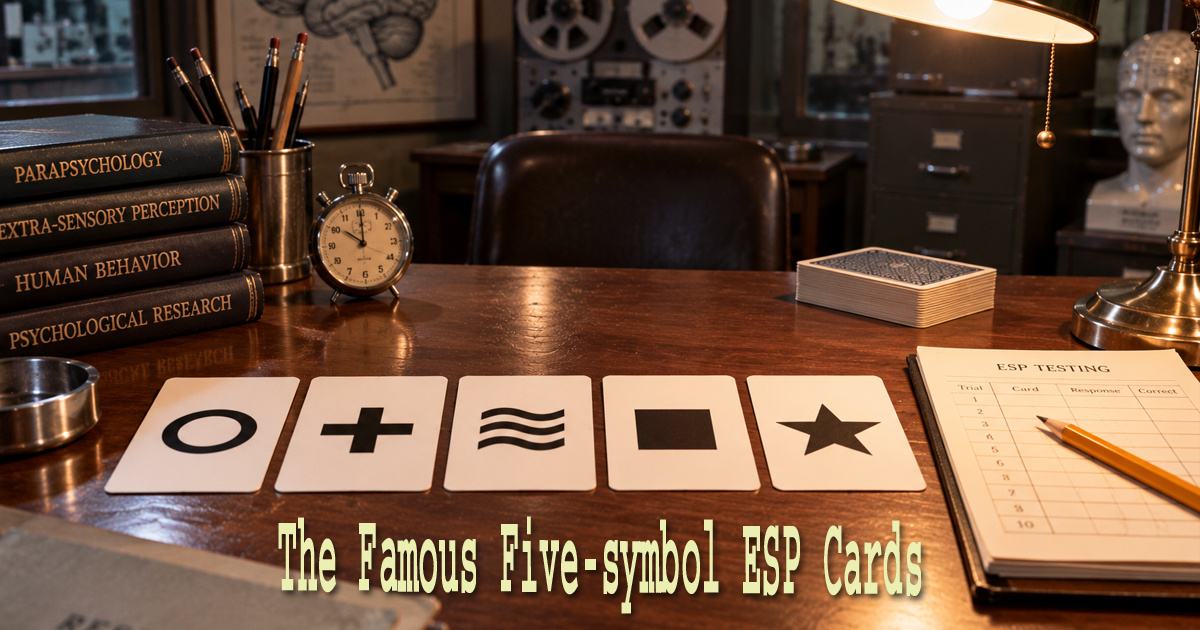
A traditional Zener card set uses five simple symbols originally associated with experimental ESP testing.
This Zener cards review examines one of the most consequential tools in the history of parapsychology. A deck of twenty five cards, printed with five plain symbols, became the centerpiece of a research program at Duke University. That program ran for decades and produced results still argued over today. The cards later crossed into popular culture, appearing in film and television.
The cards remain a working prop for mentalists and a collectible for anyone interested in psychic history. Before buying a deck, it helps to understand where these cards came from. It also helps to understand the specific experiments that made them famous. Knowing the criticism those experiments drew matters too, along with what separates a genuine testing deck from a performance prop sold under the same name.
What Are Zener Cards?
Zener cards are a set of twenty five cards printed with five simple symbols. The symbols are a hollow circle, a plus shaped cross, a square, a five pointed star, and a set of three vertical wavy lines. Each symbol appears exactly five times within a standard deck. This keeps the odds mathematically even across every possible draw.
The design was functional rather than decorative. Karl Zener selected symbols meant to carry little emotional weight. He also wanted shapes distinct enough that confusion between symbols could not explain a wrong answer. This made the deck usable for testing extrasensory perception under laboratory conditions. Any deviation from a random guessing pattern could be measured against a known statistical baseline.
In a typical test, a subject tries to guess which symbol sits on a hidden card before it is revealed. With five possible symbols in equal number, pure chance predicts a twenty percent hit rate. That works out to five correct guesses out of every twenty five attempts. This twenty percent baseline became the number every serious researcher measured actual results against.
Automatic Writing Traditions: Powerful Psychic Methods
Where Zener Cards Came From
The deck takes its name from Karl Zener, a perceptual psychologist born in Indianapolis, Indiana in 1903. He earned a Ph.B from the University of Chicago in 1923. He followed that with an MA and PhD in psychology from Harvard, completed in 1924 and 1926. After a year studying in Berlin, Zener joined the Duke University faculty in 1928. He spent the rest of his career there, eventually chairing the psychology department from 1961 until his death in 1964.
Zener built the card deck at the request of his colleague, Joseph Banks Rhine, commonly known as J. B. Rhine. Rhine had arrived at Duke in 1927. He held a PhD in botany from the University of Chicago and had served as a marine during the First World War. Rhine and his wife, Louisa Rhine, began formal laboratory work at Duke around 1929. They deliberately chose the term parapsychology over psychical research, distancing the work from seance culture.
Rhine’s earliest tests used ordinary playing cards, and later, cards with numbers sealed inside envelopes. Both approaches ran into the same problem. Subjects tended to favor certain cards or numbers over others. This skewed results before any meaningful testing could occur. Rhine needed a deck stripped of that kind of bias, so he asked Zener, a specialist in perception, to design one.
Zener produced a five symbol set intended to carry roughly equal visual and emotional weight. Rhine began using the finished deck around 1930. By 1934 he had published Extrasensory Perception, the book that introduced his Duke findings to a wider audience outside academic psychology.
The Duke Parapsychology Laboratory that Rhine directed ran for decades and tested thousands of subjects using this format. The lab eventually became the independent Rhine Research Center after Rhine’s retirement. It continues various forms of psi research today, long after Rhine’s death in 1980.
What Comes in a Standard Zener Card Deck?
A traditional Zener deck contains twenty five cards. Each of the five symbols, the circle, cross, square, star, and wavy lines, appears exactly five times. This keeps the probability of any single symbol at exactly one in five on any given draw.
This exact structure was chosen deliberately. Rhine and Zener wanted a deck where blind guessing produced a predictable, calculable baseline. With twenty five cards split evenly across five symbols, chance alone predicts about five correct guesses per full run. That number gave researchers a fixed point to measure real results against. Any subject scoring well above five hits per run drew closer attention.
Some sellers today offer larger fifty card decks that simply double the standard set. This does not change the underlying probability, since the ratio of symbols to total cards stays identical. Buyers should know which version they are purchasing. Instructions written for a twenty five card run will not automatically apply to a fifty card deck without adjustment.
Standard Cards Versus Marked ESP Decks
Not every deck sold under the Zener or ESP name is built for testing. Standard research decks are plain and identical on the back of every card. There is no way to identify the symbol without turning the card face up. Magician and mentalist decks are a different product entirely, built for a different purpose.
These performance decks often include subtle back markings that let a performer identify each symbol without an audience noticing. The markings are designed to stay invisible from normal viewing distance. They defeat the entire purpose of an honest guessing test, since the outcome can be controlled rather than observed.
Even Rhine’s original laboratory ran into a version of this problem by accident rather than by design. Some early printings of the deck used cardstock thin enough that the symbol bled through. It remained faintly visible on the back of the card under strong light. Once discovered, this printing flaw was corrected in later runs. It still illustrates how easily an unmarked testing deck can become unintentionally compromised through nothing more than a manufacturing error.
Card Size and Print Quality
Readability matters more than most first time buyers expect. Symbols printed too small, too thin, or too faint become difficult to distinguish quickly. This is especially true across a table during a private session, or from a distance during a group demonstration.
Cardstock quality affects durability just as much as symbol clarity does. A thin, flimsy deck wears out fast under repeated shuffling and handling. Corners soften, edges fray, and printed ink can wear thin after only a few dozen uses. This becomes a real problem for anyone using the deck regularly rather than occasionally.
A sturdy deck with bold, clearly printed symbols on quality cardstock holds up far longer under repeated use. This matters most for anyone planning to run the deck through many sessions. Informal testing at home and consistent use inside a themed presentation both demand a deck built to last.
Using Zener Cards for Simple ESP Experiments

This Zener Cards Review looks at the famous Pearce-Pratt experiments, where Hubert Pearce attempted to identify cards handled by Joseph Gaither Pratt from roughly 100 yards away on Duke University’s campus.
The original purpose of these cards was direct. A subject attempts to guess which symbol appears on each hidden card before it is revealed. Results are recorded across a full run of twenty five cards, then compared against the twenty percent chance baseline.
Rhine’s laboratory refined this basic format considerably as the research progressed. One of the most famous versions, known as the Pearce-Pratt series, tested a divinity student named Hubert Pearce. The test spanned roughly one hundred yards across Duke’s campus. Researcher Joseph Gaither Pratt handled the shuffled deck alone in the physics building. He placed one card face down on a book each minute without looking at it. Pearce sat in the library and recorded a guess for each card at the same pace.
Across 37 sittings between August 1933 and March 1934, Pearce and Pratt logged 558 correct guesses out of 1,850 trials. Chance alone predicts roughly 370 hits across that many trials, which made the actual result a substantial deviation. Rhine treated this series as some of the strongest evidence his laboratory had produced.
The Pearce-Pratt results did not go unchallenged. In 1960, researcher C. E. M. Hansel argued that Pearce could have slipped out of the library undetected. He proposed that Pearce observed Pratt through a corridor window near the physics building, then returned before the session ended. Psychiatrist Ian Stevenson later inspected the actual building and found Hansel’s published floor plan inaccurate. The window in question sat six feet off the floor in a busy, frequently occupied corridor. This made the proposed peeking scenario far less plausible than Hansel’s diagram suggested, though mainstream psychology still does not treat the Pearce-Pratt series as proof of ESP, since Pearce remained unsupervised during parts of the test regardless of the window’s height.
Rhine’s broader body of work produced other patterns researchers had to account for statistically. The decline effect described scores that started strong in a session and gradually fell toward chance as testing continued. Rhine attributed this to fatigue or boredom, though skeptics have offered a simpler explanation. Statistical regression toward the mean predicts that unusually high early scores will drift back toward chance over time, with no paranormal cause required.
The sheep-goat effect described a consistent pattern too. Subjects who believed in psychic ability, nicknamed sheep, tended to score above chance. Skeptical subjects, nicknamed goats, scored at or even below chance. Researchers also documented an experimenter effect, where certain researchers consistently obtained stronger results with the same subjects than other researchers did. Rhine linked this to differences in rapport between experimenter and subject.
Several individual subjects produced scores that became famous within the field. Duke sophomore A. J. Linzmayer correctly guessed 404 cards out of 1,500 trials in tests conducted between 1931 and 1933. Chance alone predicts roughly 300 hits across that many attempts. Hubert Pearce averaged 9.6 hits per 25 card run across his first thousand trials, nearly double the chance expectation of five. Other subjects tested during this period, including George Zirkle and Sara Ownbey, produced similarly elevated scores. These results drew both scientific interest and public skepticism in equal measure.
That skepticism has never fully faded. Chemist Irving Langmuir described Rhine’s body of research as an example of what he called pathological science. In Langmuir’s view, this meant investigators had sincerely fooled themselves rather than committed deliberate fraud. Decades later, magician and skeptic James Randi ran a televised test in which a self described psychic attempted 250 Zener card guesses. The subject correctly identified 50, exactly matching the twenty percent rate predicted by chance alone. In 2016, skeptical investigator Massimo Polidoro tested an Italian mother and daughter who claimed a psychic transmission success rate above 90 percent using Zener cards. Their results did not hold up under controlled conditions.
Results this contested do not settle the underlying question of whether extrasensory perception is real. Serious researchers on both sides have continued arguing over Rhine’s data for close to a century. What the format reliably offers is a simple, repeatable framework. Anyone curious about informal testing at home can run the same basic setup. Tally results across a full deck and compare your own hit rate against the twenty percent baseline that chance predicts.
Zener Cards for Mentalism and Entertainment
Beyond their scientific origins, these five symbols became instantly recognizable props in psychic themed entertainment. Audiences associate the star, circle, and wavy lines with ESP testing almost immediately. Often no explanation is needed before a routine even begins.
Part of this recognition comes from decades of media exposure. The opening scene of the original Ghostbusters film features a Zener card test. The imagery has appeared in countless television shows, novels, and stage acts in the years since. Performers built entire routines around a prop that audiences already understood on sight. That is a rare advantage in live entertainment.
A mentalist working with this deck inherits decades of built in cultural association for free. The cards do not need to be explained or justified to an audience before use. Everyone already carries a rough idea of what the deck represents. This makes it an efficient prop for building a themed routine without spending stage time on setup.
Pendulum Dowsing Techniques: Master Question Framing
Why Unmarked Cards Matter for Genuine Experiments
Anyone interested in running honest, informal ESP experiments should avoid marked performance decks entirely. A marked deck defeats the purpose of testing outright. The outcome can be influenced by the person holding the cards rather than observed and recorded.
This distinction is not purely theoretical. Rhine’s own team learned through experience that even innocent card handling opened the door to unintentional cheating. A subject allowed to shuffle or hold the deck gained more opportunity to glimpse a symbol than the protocol intended. Later Rhine experiments, including the Pearce-Pratt series, deliberately separated the person handling the cards from the person guessing them. This was done specifically to close that gap.
Unmarked, standard decks preserve the integrity of the original testing format that made these cards significant in the first place. This matters most for hobbyists, students, or collectors who want an authentic experience. Nobody wants a performance tool quietly disguised as a research deck under the same familiar name.
Who Would Enjoy a Zener Card Deck?
Readers interested in paranormal history will appreciate owning a physical piece of that legacy. These cards connect directly to a research program that ran for half a century and shaped an entire academic field. They represent one of the most famous, and most debated, chapters in the history of parapsychology research.
Casual experimenters enjoy running simple guessing tests with friends or family. They compare their own results against the twenty percent hit rate that chance predicts. It is fun to see how their numbers stack up against Rhine’s most famous subjects. Collectors often want a deck simply for its historical significance, particularly reproductions styled after the original Duke laboratory decks from the 1930s.
Anyone interested in mentalism will also find real value in understanding how the format works from both sides. This includes the honest unmarked testing version and the marked performance version sold under similar branding.
Zener Cards
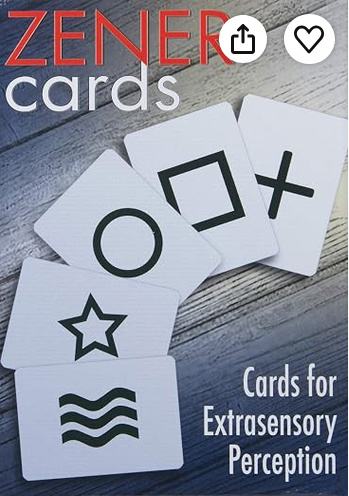
Zener Cards deck featured in our Zener cards review
Product Description:
If our Zener cards review made you curious about trying the classic ESP experiment yourself, this deck gives you the familiar five-symbol system associated with parapsychology research. Zener cards use simple geometric symbols designed for controlled guessing experiments, making them an easy way to recreate the basic tests that became famous through early twentieth-century ESP research.
Key Features:
• Based on cards used in experiments involving extrasensory perception (ESP)
• Features the classic, simple Zener-style symbols used for guessing tests
• Easy to use for individual practice or experiments with a partner
• Useful companion for anyone interested in the history of parapsychology and ESP testing
• Companion booklet is presented in English, Spanish, French, Italian, and German
Why This Works:
Our Zener cards review explores the history behind these deceptively simple cards and the experiments that made them famous. Having an actual deck lets you go beyond reading about the research and recreate a basic ESP test yourself. Shuffle the cards, keep the symbols hidden from the person guessing, record every response, and compare the results with the one-in-five hit rate expected by chance.
Buy on Amazon
What to Check Before Buying Zener Cards
A few details separate a good purchase from a disappointing one. Check whether the deck contains the traditional twenty five cards Rhine and Zener used. Some modern sellers offer a doubled fifty card version instead, and instructions differ slightly between the two.
Confirm whether the deck is marked or unmarked before buying. This single detail changes its intended use entirely and cannot be reversed after purchase. A deck built for stage performance is not a substitute for one built for testing, regardless of how similar the two look in photographs.
Card size should suit how the deck will actually be used. Private testing across a small table calls for one size, while group demonstrations viewed from a distance call for another. Clear printed instructions and a sturdy storage box also add real value. This matters most for anyone planning to keep the deck long term as a collectible rather than a disposable novelty.
Zener Cards Review: Final Thoughts
Zener cards remain an inexpensive and significant piece of parapsychology history. They connect directly to decades of research conducted at Duke University under Rhine and Zener. This includes the Pearce-Pratt series and the statistical debates over the decline effect and sheep-goat effect. It also includes decades of pointed criticism from figures like Hansel and Langmuir.
The story behind these cards is far from simple, and that complexity is part of what makes the deck worth owning. It includes scientific ambition and methodological improvement over time. It includes specific named subjects who produced extraordinary scores, and specific named critics who worked just as hard to explain those scores away. Modern parapsychology has largely moved past card guessing toward methods like the ganzfeld technique. The Zener deck remains the format that started the entire conversation.
Whether used for casual experiments, collecting, or mentalism, a well made deck offers real value beyond its low price. This Zener cards review points toward one clear conclusion. Few objects this affordable carry this much documented scientific history, statistical argument, and cultural staying power behind them.

Known as The Man Who Notices, Mike Lamp is a theatrical hypnotist and psychic performer with more than twenty years of live stage experience. His work emphasizes observation, psychological influence, and measured presentation rather than spectacle or provocation. Performances are tailored for adult audiences, private events, and professional settings where control, clarity, and atmosphere matter.




Leave a Reply
You must be logged in to post a comment.