15
Sep
Tibetan Singing Bowls: The Surprising Truth Behind the Sound
Tibetan Singing Bowls and the Question Behind the Tone
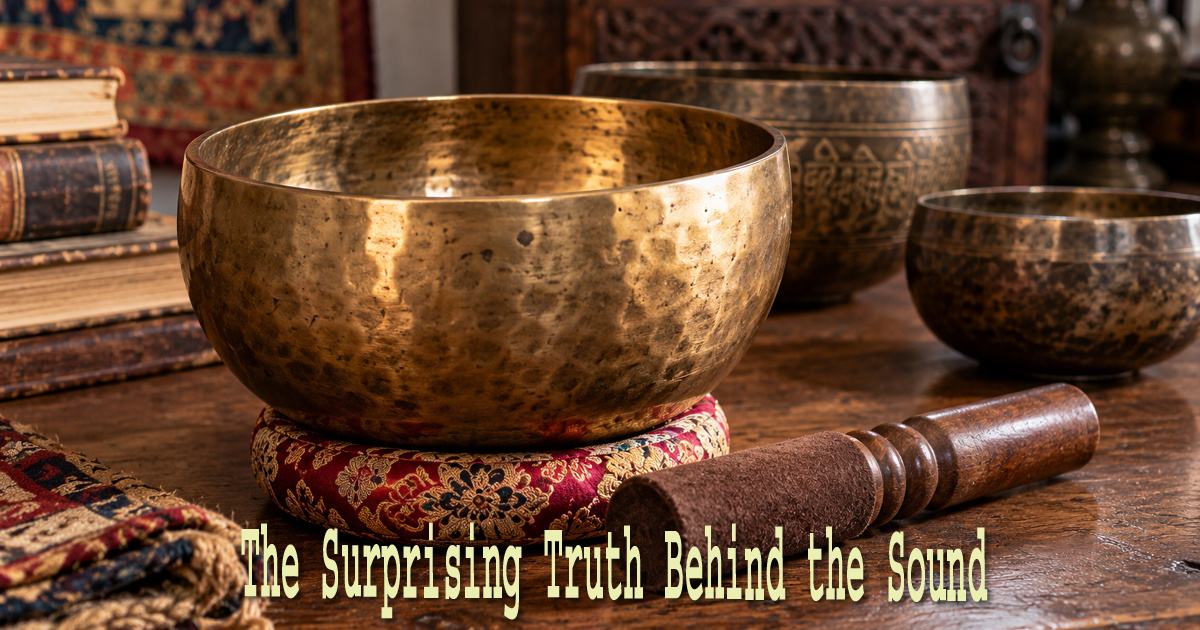
Tibetan singing bowls have become closely associated with meditation and sound practices, but their history, construction, and modern use are more complicated than the familiar story suggests.
Pick up a small metal bowl and tap its rim. The tone that follows is clean and rich. It expands outward. It lingers. It seems to carry something more than a simple bell strike should.
That experience is real. The sound is not an illusion. Neither is the sense of calm that many people report when they hear it.
Tibetan singing bowls appear today in meditation studios, yoga classes, sound baths, Reiki sessions, and online marketplaces shipping them to every corner of the world. They are associated with ancient wisdom, spiritual healing, and the mountains of Tibet.
Some of that association holds up under examination. Some of it does not.
This article looks at what singing bowls actually are, where the name came from, how they work acoustically, what metaphysical traditions say about them, and what clinical research has actually found. The answer to each question is more interesting than the marketing suggests.
What Are Tibetan Singing Bowls?
A singing bowl is a metal vessel played with a mallet or striker. It can be struck like a bell or played by moving the striker slowly around the outer rim. Both methods produce sound through vibration.
Bowls vary in diameter, thickness, shape, and metal composition. Those differences determine the bowl’s pitch, overtones, and resonance. A larger bowl generally produces a lower tone. A thicker bowl holds its vibration differently than a thin one.
Most traditional-style bowls are made from a bronze alloy. The alloy typically includes copper and tin. Some bowls also contain zinc, iron, silver, gold, or nickel in smaller amounts. The precise composition of older handmade bowls is often unknown.
Now for the terminology problem. The name Tibetan singing bowl is a Western marketing label. It is the name consumers recognize. It is also, according to scholarly research, historically misleading in important ways. The objects sold under that name have a more complicated origin than the label implies.
Dream Journals and the Hidden Power of Memory
Where Did Singing Bowls Come From?
This is where the popular story and the documented history begin to separate.
Metal bowls and related instruments have histories across Nepal, India, and other Himalayan and Asian regions. They appear in religious and contemplative contexts across these cultures. Their use as instruments of spiritual practice is genuine and historically rooted.
Tibet is a different matter.
In 2020, Candy Gunther Brown, a professor of religious studies at Indiana University Bloomington, published a scholarly paper titled Tibetan Singing Bowls in the journal American Religion. Her research examined the actual history of the objects now sold under that name.
Her conclusion was clear. Few if any of the bowls sold as Tibetan singing bowls are ancient or Tibetan. Brown’s research found that the concept of the Tibetan singing bowl was largely created beginning in the 1970s. Asian sellers and American buyers together developed the category. They attached spiritual and scientific meanings to these objects. Those meanings made the bowls into valuable commodities.
Brown’s paper describes the bowls as exemplifying key features of American religion: creativity, commodification, and conflict. The image of an ancient Tibetan Buddhist healing instrument was constructed. It was not discovered.
This does not mean singing bowls are worthless or that using them is dishonest. It means that the story told about them on most product listings is not the actual history. Knowing that makes the real story more interesting, not less.
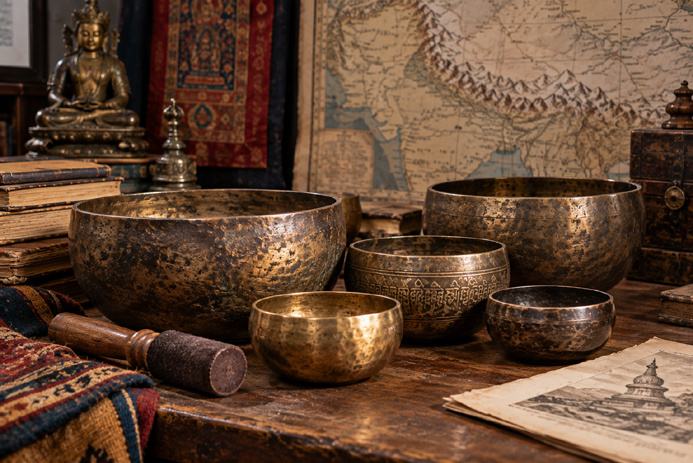
The history of Tibetan singing bowls is less certain than many modern accounts suggest, with questions remaining about their origins, traditional uses, and connection to Himalayan Buddhist practices.
How Does a Singing Bowl Actually Make Sound?
When you strike a singing bowl, the metal flexes. That flexing creates vibrations. Those vibrations move the air around the bowl. Moving air creates sound waves. Sound waves reach your ears.
That is the basic physics. The interesting part is what happens with the frequencies.
Every singing bowl vibrates at what acousticians call a fundamental frequency. Think of this as the bowl’s primary note. But the bowl does not stop there. It also produces overtones, which are higher frequencies vibrating alongside the fundamental.
Those overtones are what give a singing bowl its characteristic richness. What sounds like a single sustained tone is actually a layered chord of frequencies happening simultaneously. That complexity is part of why the sound seems to occupy space in an unusual way.
When the striker is rubbed around the rim, something slightly different occurs. The friction between striker and metal creates a stick-slip process. The striker alternately grips the surface and releases it in rapid succession. This action continuously excites the bowl’s vibration. It is similar to running a wet finger around the rim of a crystal glass.
The rubbing method excites primarily the bowl’s fundamental mode. It locks the bowl into sustained vibration. This is the singing technique. The tone continues as long as the striker keeps moving.
Different bowls produce different combinations of frequencies. Size, thickness, shape, and metal composition all matter. Handmade bowls are not precision-tuned instruments. Their overtone ratios are close to integer relationships but not exact. That near-integer quality is part of why they sound harmonious rather than discordant.
Why Does the Sound Seem to Last So Long?
The answer is resonance.
When energy is transferred into the bowl through striking or rubbing, the bowl’s metal structure continues vibrating on its own. It does not stop immediately. The energy dissipates gradually. The sound fades as that energy releases.
The metal composition and construction of the bowl determine how long that process takes. Some bowls sustain their tone for several seconds. Others hold it considerably longer.
The combination of sustained resonance and layered overtones produces what people describe as a floating or expansive quality. The sound does not feel like a simple impact. It feels like something that blooms and then slowly withdraws.
One practical note from the acoustics: striking a bowl too hard does not improve the sound. It can actually produce a harsher, less controlled tone. Gentle contact allows the bowl’s natural frequencies to emerge cleanly.
How Singing Bowls Are Used in Meditation
The most common use of a singing bowl in modern practice is straightforward. The sound marks the beginning or end of a meditation session. It gives the mind something simple to attend to. It creates a calm acoustic environment.
A sustained tone is a natural anchor for attention. When attention drifts, the sound calls it back. That is a useful property for anyone practicing focused meditation.
Singing bowls are also used to accompany breathing exercises. The length of a bowl’s resonance can serve as a natural timer for an inhale or exhale. Some practitioners use the bowl to mark transitions between postures in yoga or between phases of a guided relaxation.
None of these uses require accepting metaphysical claims. A bowl that helps someone sit quietly and return their attention to the present moment is doing something genuinely useful. Whether that value is understood in acoustic, meditative, or spiritual terms depends entirely on the person using it
Singing Bowls and Metaphysical Practice
The metaphysical traditions surrounding singing bowls are rich and specific. They deserve honest treatment rather than dismissal or uncritical endorsement.
In chakra work, practitioners associate particular tones with individual energy centers of the body. Different bowls are said to correspond to different chakras. The tone of the bowl is understood to resonate with and support the associated energy center.
In sound baths, participants lie down while practitioners play multiple bowls around them. The intention is immersion in a field of sound that promotes deep relaxation and energetic clearing.
In Reiki sessions, bowls are sometimes used alongside hands-on energy work. The sound is understood to support the movement of energy through the body’s field.
Singing bowls also appear in ritual, intention-setting, and spiritual cleansing practices. The sound is used to clear a space, open a ceremony, or signal a shift in attention and intention.
These are beliefs and practices. They are meaningful to the people who hold them. The chakra associations and energy-clearing concepts are part of metaphysical tradition. They are not scientifically established mechanisms. A particular frequency does not medically affect a particular organ in ways that have been confirmed by controlled clinical research.
Both things can be true at once. A practice can be meaningful and well-established in tradition without making claims that science has verified. Treating practitioners with honesty means acknowledging that distinction rather than pretending it does not exist.
Can Singing Bowls Really Affect the Body?
The honest answer is: possibly, in some ways, for some people, under some conditions. That is more interesting than either extreme.
Actual clinical research has been conducted on singing bowl interventions. This is not a field of pure anecdote.
In 2025, a systematic review published in Integrative Medicine Research examined nineteen clinical studies conducted across eight countries between 2008 and 2024. Researchers looked at outcomes including anxiety, depressive symptoms, sleep quality, pain, and physiological measures such as heart rate variability and brainwave activity. Half of the included studies were randomized controlled trials.
Most studies in this review reported significant reductions in anxiety and depressive symptoms. They also reported improvements in well-being and quality of life. Some studies found increases in heart rate variability and decreases in heart rate. Some found increased delta and theta brainwave activity.
A separate 2025 systematic review, published in Healthcare and covering fourteen quantitative studies, reported potentially beneficial patterns for stress, anxiety, and well-being. It also noted differences in study design and emphasized the need for stronger controlled research.
These findings are promising. They are not proof that singing bowls heal disease. They suggest that something is happening during singing bowl interventions that affects measurable psychological and physiological outcomes. What exactly is causing those effects, and how reliable those effects are across different populations and conditions, requires considerably more research to establish.
Amulets and Talismans: Ancient Protection Symbols
What the Research Does Not Prove
The same research that offers promising findings also sets important limits. Those limits matter.
The 2025 review covering nineteen studies found heterogeneity in study design that prevented meta-analysis. That means the studies were different enough from each other that their results could not be statistically combined. That limits what can be concluded from them collectively.
An earlier 2020 systematic review found only four peer-reviewed human studies available at that time. The field has expanded since then. But it is still young, and the methodological quality across studies varies.
Current evidence does not establish that singing bowls cure disease. It does not prove that specific frequencies realign organs. It does not show that bowls medically balance chakras in any clinically verifiable sense. It does not support replacing psychological or medical treatment with singing bowl sessions. It does not guarantee specific health outcomes for any individual.
The research supports singing bowls as a low-risk complementary practice that may support relaxation and psychological well-being. That is a meaningful finding. It is also a careful one. Both deserve to be communicated honestly.
How to Play a Tibetan Singing Bowl
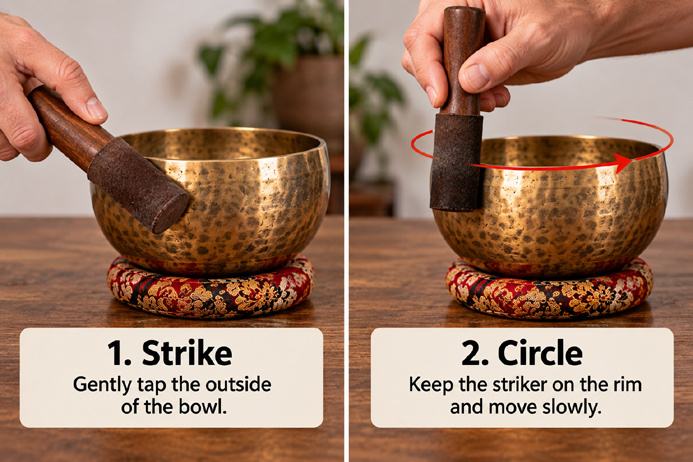
Tibetan singing bowls can be played by gently striking the outside of the bowl or moving the striker slowly around the rim to create a sustained tone.
Playing a singing bowl well takes more practice than it looks. Most beginners discover this quickly.
For the strike method, place the bowl on a cushion or flat surface. Hold the striker near its base. Strike the outer side of the bowl gently with the padded end. Allow the bowl to resonate fully before touching it again.
For the rim method, hold the striker against the outside rim at a slight angle. Move it slowly and steadily around the circumference. Maintain consistent pressure throughout. Even speed matters more than force.
Beginners most often press too hard. They also move too quickly. Both habits interrupt the bowl’s vibration rather than sustaining it. The goal is to feed energy into the bowl’s natural resonance, not to force it.
If the bowl rattles or produces a harsh sound, reduce pressure and slow down. If the tone cuts out, you may be moving the striker too quickly or lifting it slightly off the rim. Small adjustments usually solve the problem quickly.
Choosing Your First Singing Bowl
The most important thing about a first singing bowl is whether you can actually play it.
A smaller bowl with a thinner rim is generally easier for a beginner to get singing. It requires less pressure and responds more readily to the rim technique. A very large or very thick bowl can frustrate a new player before they ever hear the tone they are working toward.
Size matters for sound as well as playability. A smaller bowl produces a higher tone. A larger bowl produces a lower, fuller one. Neither is better. The question is what tone appeals to you and what you intend to use it for.
The striker and cushion matter more than many beginners realize. A good striker makes the rim technique significantly easier. A cushion that holds the bowl securely prevents unwanted vibration from the surface beneath it.
Elaborate engraving does not improve sound. It is decoration. A plain bowl with good construction will sing more reliably than a heavily engraved bowl made from thin, poorly finished metal. When evaluating a bowl, trust your ears over the appearance.
Complete beginner sets that include a bowl, striker, and cushion together are a practical starting point. They remove the guesswork of matching components separately and generally represent good value for someone exploring the practice for the first time.
Tibetan Singing Bowl Set
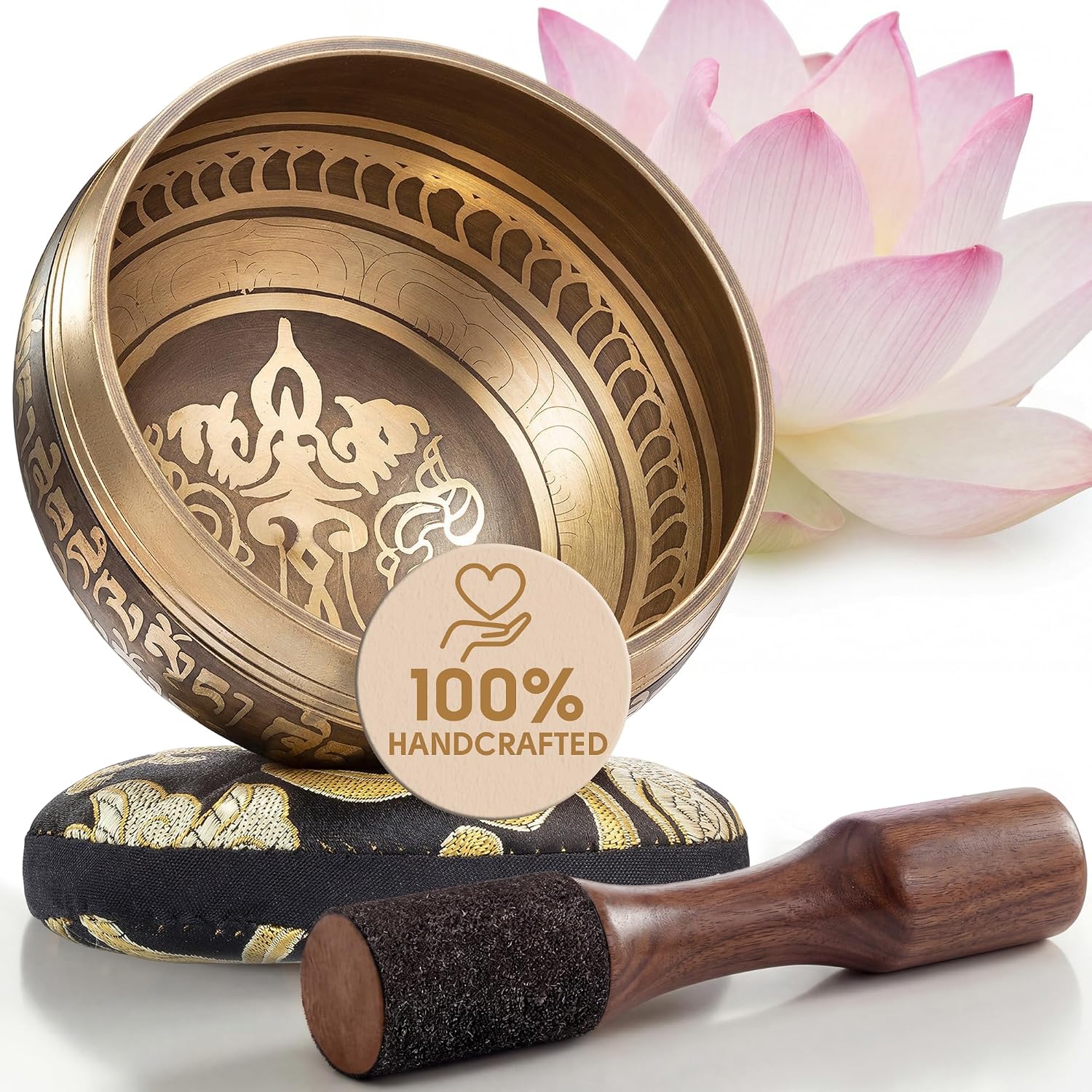
Tibetan Singing Bowl Set for meditation, relaxation, and sound practice
Product Description:
If you’re curious about singing bowls after reading our research article, this beginner-friendly Tibetan Singing Bowl Set is an excellent place to start. Designed for easy use, the set produces clear, resonant tones that are suitable for meditation, mindfulness exercises, relaxation routines, or simply enjoying the unique sound of a traditional singing bowl.
Key Features:
• Beginner-friendly design that’s easy to learn and play
• Produces clear, resonant tones for meditation and relaxation sessions
• Complete set includes singing bowl, cushion, and wooden striker
• Bonus eBook collection, user guide, and sound bath audio resources included
• Makes a thoughtful gift for meditation practitioners, yoga enthusiasts, and anyone interested in sound-based relaxation
Why This Works:
If our article sparked your interest in singing bowls, this complete set lets you experience one firsthand. The included accessories and learning materials make it easy to begin exploring different playing techniques while enjoying the calming tones that have made Tibetan-style singing bowls popular for meditation, yoga, mindfulness, and quiet personal reflection.
Buy on Amazon
Are Tibetan Singing Bowls Worth Trying?
That depends on what you are expecting from them.
If you are expecting a guaranteed cure for anxiety, depression, or physical illness, the evidence does not support that expectation. No responsible reading of the current research justifies that claim.
If you are expecting a real acoustic instrument that produces complex and genuinely beautiful sustained tones, you will not be disappointed. That is exactly what a singing bowl is.
If you are expecting a meditation aid that gives your attention something simple and pleasant to return to, singing bowls do that reliably. The research on their use in meditation and relaxation contexts is consistently positive, even if the mechanisms remain incompletely understood.
If you are open to metaphysical practice and find meaning in chakra work, sound baths, or energy clearing, singing bowls have a well-established place in those traditions. The practices are real even when their mechanisms differ from what science has confirmed.
Someone does not need to accept every claim surrounding these objects to find genuine value in them. The sound is real. The relaxation response is real. The instrument’s history is more complicated than most marketing suggests. All of that is true at the same time.
More Than Just a Bowl
A singing bowl sits at an interesting intersection. It is a musical instrument, a meditation tool, a spiritual object, and a subject of clinical research simultaneously.
Its sound is real and explainable through physics. The relaxation people experience when using one is real too. The larger healing claims require caution and honest acknowledgment of what the evidence does and does not support.
Its name is a modern Western marketing category. The traditions associated with it across Nepal, India, and Himalayan cultures are genuine. The specific image of an ancient Tibetan Buddhist healing instrument, unchanged for centuries, is largely a construction of the 1970s commodification that Candy Gunther Brown documented in her research.
None of that diminishes the experience of sitting quietly with a singing bowl, striking it once, and listening to what follows.
The sound does what it does regardless of what you call it. The question of what that means is yours to answer.

Known as The Man Who Notices, Mike Lamp is a theatrical hypnotist and psychic performer with more than twenty years of live stage experience. His work emphasizes observation, psychological influence, and measured presentation rather than spectacle or provocation. Performances are tailored for adult audiences, private events, and professional settings where control, clarity, and atmosphere matter.



Leave a Reply
You must be logged in to post a comment.